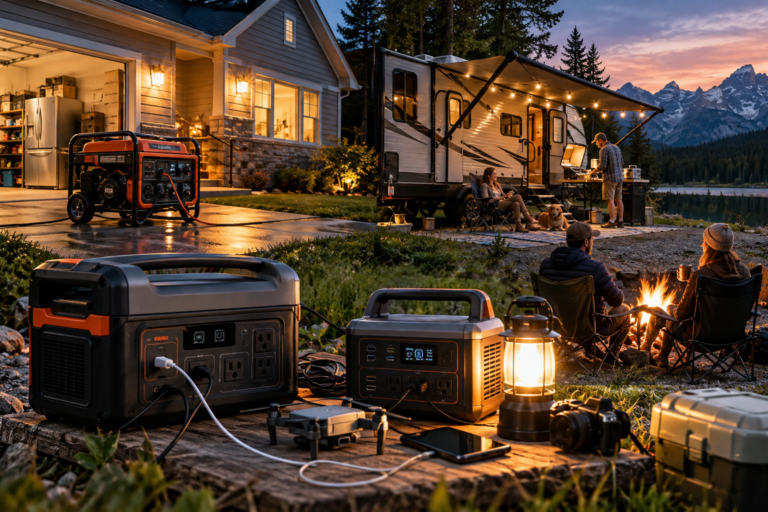
Portable power stations promise something combustion generators cannot easily provide: stored electricity without an engine running beside the user. That distinction becomes particularly meaningful around campsites, RVs, apartments, bedrooms during outages and any setting where exhaust, fuel storage and engine noise complicate backup power.
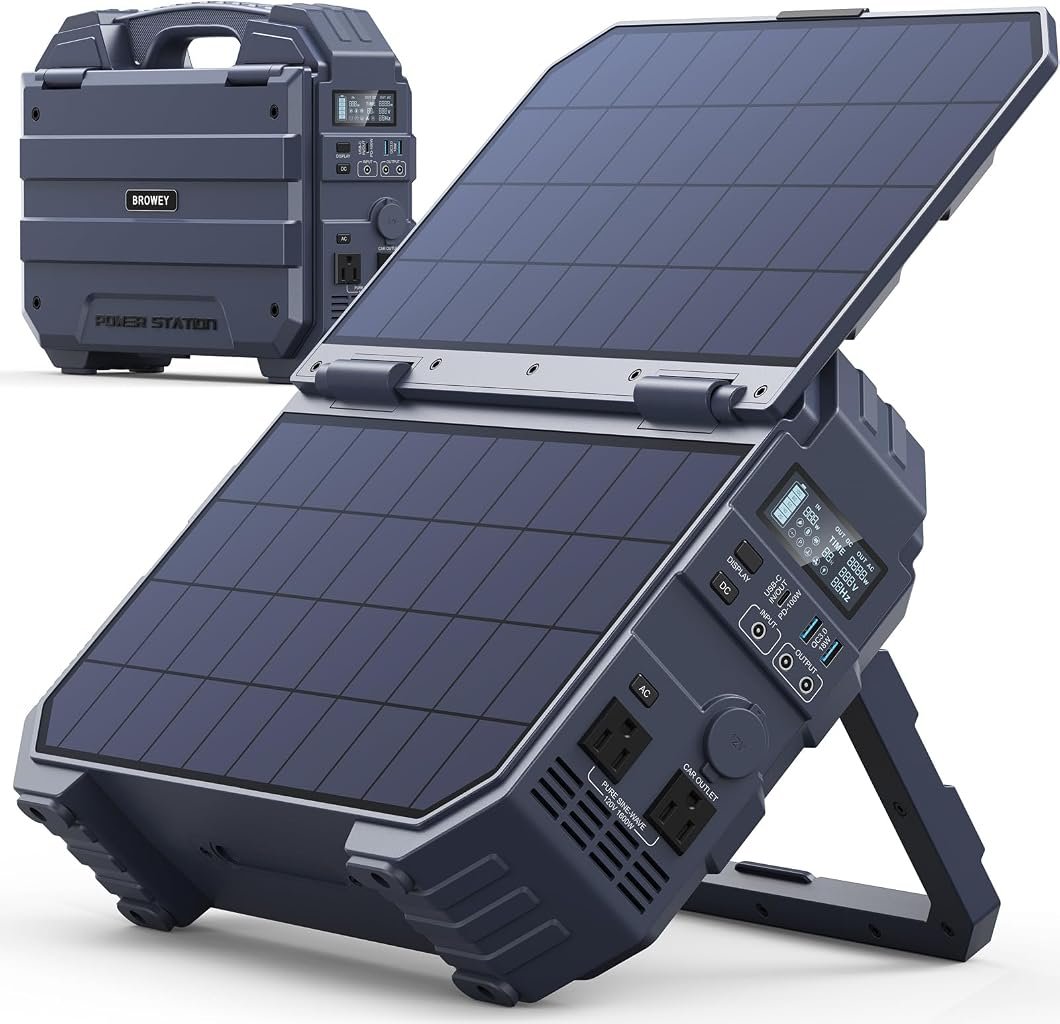
The BROWEY 1600W Portable Power Station with Built-in Solar Panel adds another idea to that proposition. Its integrated solar feature attempts to make renewable charging part of the physical product rather than another separate item that must be packed, carried and connected.
Our overall score is 8.95/10. Customer Sentiment reaches 9.16, Buyer Confidence stands at 8.75, and Value receives 8.64. Those figures create a notably favorable editorial profile. They also reveal where the product’s appeal is strongest: customer sentiment leads the scoring, while value, although still favorable, is the lowest of the four measures.
That difference is informative. A portable power station can be appealing to own while still requiring careful arithmetic before purchase. The buyer needs to distinguish watts from watt-hours, understand what solar charging can realistically accomplish, and decide whether stored battery power fits the expected duration of an outage or trip.
The BROWEY should therefore be judged less like a conventional generator and more like an energy system with three separate jobs: accepting energy, storing it and delivering it to connected equipment.
Our Assessment: 8.95/10
An 8.95/10 overall score puts the BROWEY in strong editorial territory.
Customer Sentiment at 9.16 is the highest component. Buyer Confidence at 8.75 follows, with Value at 8.64. The scoring pattern suggests a product proposition that resonates particularly well at the ownership level while carrying a somewhat more measured value assessment.
That makes sense for portable battery systems generally. Purchase price tells only part of their economic story.
Unlike a gasoline generator, a power station stores a finite amount of electrical energy before it must be recharged. Unlike a bare battery, it typically combines energy storage, power conversion, charging electronics and multiple output functions in one package. Solar capability adds another layer by creating a possible off-grid charging route.
The resulting product can replace a collection of separate components for some users.
Yet a 1600W designation alone cannot answer how long the station will operate a refrigerator, television, laptop, CPAP device or other load. That requires battery energy capacity, expressed in watt-hours, plus realistic allowance for conversion losses and operating overhead.
This distinction is central to the review.
1600W Does Not Mean 1600Wh
Watts measure power. Watt-hours measure energy.
The difference sounds academic until a blackout occurs.
A 1,600W output rating describes the scale of load a power station can support under its specified operating conditions. Battery capacity answers how long a given load can theoretically be supported. Those are separate measurements.
A simplified runtime relationship is:
Runtime ≈ usable battery energy in watt-hours ÷ average load in watts
If a hypothetical battery offered 1,000 usable watt-hours, a steady 100W load would have a theoretical energy budget of about 10 hours. A steady 500W load would reduce that theoretical figure to about two hours. Real operation is lower because power conversion and the station itself consume energy.
That example is deliberately hypothetical. Runtime for the BROWEY should be calculated from its verified battery-capacity specification and the measured or manufacturer-rated consumption of the intended equipment.
This is one area where a conventional portable generator buying guide and a power-station review diverge sharply.
With combustion equipment, the owner thinks in gallons or pounds of fuel, engine load and runtime per tank. With a battery station, the useful framework becomes watt-hours, load and recharge rate.
The difference changes how backup power is planned.
The Built-In Solar Panel Is the Defining Feature
The integrated solar panel is the BROWEY’s most distinctive stated feature.
Portable solar systems ordinarily involve at least two major pieces: the power station and a separate solar panel. The panel must be unpacked, positioned, connected and stored. Integrating solar collection into the power station can simplify that arrangement.
Convenience, however, should not be confused with energy abundance.
Solar panels are constrained by surface area, available sunlight, panel orientation, temperature, shading and charging-system limits. A compact integrated panel cannot be judged simply by the fact that it is solar. Its output specification determines how much energy it can theoretically harvest under appropriate conditions.
Solar energy also arrives unevenly. A panel positioned poorly during cloudy weather will behave differently from the same panel receiving strong direct sunlight. Partial shade can materially affect production.
For this reason, the built-in panel is best understood as an energy-input feature rather than a promise of indefinite operation.
The buyer should establish three figures before relying heavily on solar charging:
- the station’s verified battery capacity in watt-hours;
- the rated solar input or integrated-panel output under specified conditions; and
- the daily electrical consumption of the intended equipment.
Those numbers reveal whether solar is likely to replenish most daily consumption, merely extend runtime or function primarily as a supplementary charging method.
Why Customer Sentiment Leads at 9.16
Our Customer Sentiment score of 9.16 is the strongest measure attached to the BROWEY.
That creates an interesting editorial profile because sentiment exceeds both Buyer Confidence and Value. The difference suggests that the ownership proposition carries particularly strong appeal even when the purchase is evaluated more cautiously on economics and decision certainty.
Portable battery systems have several characteristics that can support this kind of response.
They do not require gasoline to produce electricity from stored charge. They do not need an engine running while delivering battery power. They can be used in circumstances where combustion exhaust would make generator operation inappropriate.
The U.S. Environmental Protection Agency explains that battery power stations and solar generators do not produce carbon monoxide while operating, unlike fuel-powered portable generators.
That difference can fundamentally alter the experience of backup power.
A conventional generator must operate outdoors and well away from occupied structures. A battery station can deliver stored electrical power without producing an exhaust stream at the point of use.
That does not eliminate electrical or battery safety requirements. It does, however, remove the combustion engine from the immediate user environment.
For apartment residents, campers, photographers, remote workers and households primarily interested in keeping modest electronics and selected appliances operating, that can be a substantial practical advantage.
Buyer Confidence Scores 8.75
Buyer Confidence is rated at 8.75, slightly below the overall 8.95 score.
That remains a favorable assessment, but the gap is meaningful.
Portable power stations require more careful sizing than their simple exterior appearance suggests. The box may contain battery storage, an inverter, charge controller and output electronics, yet every one of those systems has limits.
A buyer should verify continuous AC output, surge capability, battery capacity, supported charging inputs, outlet configuration and any relevant environmental operating limits before assigning critical loads to the station.
The 1600W designation gives one useful reference point, but it is not a complete electrical profile.
Consider a refrigerator. Its average energy consumption across an entire day differs from its instantaneous compressor demand. A power station must be able to accommodate the relevant power requirement while also storing enough energy to operate the appliance through the desired period.
The same distinction applies to pumps, heating equipment and appliances with compressors or motors.
Buyer confidence is therefore strongest when the purchaser starts with equipment requirements and works backward toward the power station rather than purchasing first and discovering the limits later.
Value at 8.64
Our Value rating of 8.64 sits below the other three editorial measures, though it remains favorable.
That difference reflects the economics of battery storage.
A gasoline generator can often deliver substantial instantaneous power for a relatively modest equipment cost, but ownership requires fuel, oil, engine maintenance and safe outdoor operation. A portable power station shifts much of the expense toward the battery and power electronics while reducing many recurring mechanical requirements.
Neither approach is automatically cheaper.
The useful calculation is cost relative to the job.
If the intended task is running phones, computers, networking equipment, lighting and selected modest appliances during short outages, a battery station can provide a particularly convenient operating model.
If the requirement is operating several kilowatts of household equipment continuously for days, the amount of battery storage and charging infrastructure required can rise rapidly.
Solar changes the equation only when enough solar energy can actually be harvested.
The BROWEY’s 8.64 Value score therefore reflects a favorable proposition without treating battery power as universally superior to combustion generation. Value depends on how often the system is used, what it powers and how it is recharged.
Home Backup Requires an Energy Budget
Backup-power discussions often begin with the wrong question: “Will it power a house?”
A house is not a single electrical load.
A refrigerator, internet router, television, furnace blower, microwave, well pump, electric range and central air conditioner impose radically different requirements. Whether a portable station can support an outage therefore depends on which loads are selected and for how long.
Battery backup rewards prioritization.
Communications equipment and LED lighting generally consume far less energy than resistance heating or electric cooking. Refrigeration cycles rather than operating continuously at maximum compressor demand. Laptops and phones can represent relatively modest energy requirements.
A household should therefore create an outage energy budget.
First, list essential equipment. Second, identify its power requirement. Third, estimate daily operating time or daily energy use. Fourth, compare that demand against verified usable battery storage and realistic recharge opportunities.
This approach can reveal surprising efficiencies.
Keeping internet service, several lights, phones and computers available may require only a fraction of the energy involved in electric space heating. During a prolonged outage, choosing which loads not to power can be as consequential as choosing the power station itself.
Solar Charging Changes the Runtime Question
A battery station without renewable charging is essentially a finite reservoir.
Solar creates replenishment.
That changes the question from “How long will the battery last?” to “How does daily energy consumption compare with daily energy harvested?”
Suppose a hypothetical system consumes 600Wh each day and receives 400Wh of usable solar energy. Its battery is still losing 200Wh per day. Solar extends autonomy but does not make the system energy-neutral.
If consumption falls below daily harvested energy, the operating picture changes considerably.
This is why built-in solar should be evaluated mathematically rather than symbolically.
A solar-equipped power station therefore needs a margin for real conditions. Cloud cover, tree shade and imperfect panel orientation do not disappear because a manufacturer’s laboratory rating is favorable.
For travelers, the integrated panel can provide another charging pathway without carrying a completely separate panel assembly. For emergency preparedness, it can add resilience when grid charging is unavailable.
Its practical contribution still depends on verified output and sunlight.
Camping Is a Natural Use Case
Camping makes many of the BROWEY’s conceptual strengths easier to appreciate.
Combustion generators bring fuel, engine noise, exhaust and maintenance into an environment where electrical requirements may consist primarily of refrigeration, lights, phones, cameras, laptops and other relatively modest loads.
A power station reverses that arrangement. Energy is stored beforehand, then delivered without running a combustion engine.
That can make overnight operation much less disruptive.
Solar also fits naturally into multi-day outdoor use because the station can potentially regain energy during daylight while equipment is being used intermittently.
Yet camping is another area where buyers can overestimate what a wattage label means.
A 1600W designation does not mean every 1600W appliance is automatically a sensible camping load. A high-wattage appliance operating for an extended period can drain a battery quickly even when its instantaneous demand falls within the station’s output limit.
Energy-hungry cooking and heating equipment deserve particular scrutiny.
The best camping load is often not the appliance the station can technically operate, but the appliance whose energy demand makes sense relative to the available battery and charging opportunity.
RV Use Requires the Same Arithmetic
RVs create an appealing environment for portable power stations because they already operate around batteries, shore power and mixed AC/DC electrical systems.
The BROWEY could therefore attract buyers seeking supplementary portable electricity rather than replacing the RV’s entire electrical architecture.
Again, actual suitability depends on verified specifications.
An RV air conditioner can impose significant running and startup demand. Microwave ovens and electric water-heating elements can also consume substantial power. Smaller electronics, lights and charging loads are far less demanding.
A portable station can therefore have very different endurance depending on how the RV owner uses it.
Load sequencing can help. Avoiding simultaneous operation of several large appliances can reduce instantaneous demand, while using propane appliances where appropriate can preserve stored electrical energy.
The correct strategy is energy management rather than simply maximizing output.
Power Stations and Combustion Generators Solve Different Problems
Portable power stations are frequently described as alternatives to generators, but the comparison is imperfect.
A combustion generator creates electricity as long as its engine has suitable fuel and remains within operating limits. Refueling can restore hours of operation quickly.
A battery station must recharge after its stored energy is depleted. Grid charging can be straightforward when utility service is available. Solar charging can provide independence but is constrained by panel capability and environmental conditions.
The battery station’s advantage is immediate, quiet electrical availability without combustion at the point of discharge.
The generator’s advantage is energy replenishment through fuel.
This creates a useful hybrid strategy for some households. A battery station can support low-demand overnight loads while a combustion generator operates for limited periods during the day to handle larger loads or recharge batteries.
Such an arrangement can reduce generator operating hours while preserving the long-duration energy advantage of stored fuel.
The BROWEY should therefore not be judged by whether it can categorically “replace a generator.” The better question is which portion of a buyer’s power requirements it can handle more conveniently.
Safety Still Requires Attention
A battery station avoids carbon-monoxide production during battery discharge, but it remains electrical equipment containing substantial stored energy.
Users should follow the manufacturer’s instructions for charging, ventilation, operating temperature, moisture exposure and storage.
Solar equipment introduces cables and connectors that should be kept in good condition and connected only according to the specified configuration.
Loads must also remain within output limits.
Extension cords, power strips and adapters should be appropriately rated for the equipment connected to them. High-power appliances deserve particular care because current and heat increase as electrical demand rises.
Battery stations should not be treated casually merely because they lack an engine.
The absence of gasoline and exhaust simplifies several hazards. It does not repeal electrical safety.
Who Is the BROWEY Best Suited To?
The scoring profile points toward a fairly specific buyer.
With an overall score of 8.95, Customer Sentiment of 9.16, Buyer Confidence of 8.75 and Value of 8.64, the BROWEY makes the strongest editorial case for users who value quiet stored electricity, portability and an integrated solar option more than the rapid refueling capability of a combustion generator.
That can include campers, RV users, remote workers, photographers, households preparing for shorter outages and people seeking a secondary layer of emergency power for selected devices.
It becomes less straightforward when the buyer expects to operate high-energy household loads for long periods without reliable recharging.
In that scenario, battery capacity and solar replenishment become decisive.
The integrated solar panel is appealing precisely because it adds another charging pathway, but no solar feature should be treated as an unlimited energy source. The buyer needs the panel’s verified output and a realistic estimate of available sunlight before relying on it for sustained autonomy.
The Strengths and Trade-Offs
The BROWEY’s central strengths are easy to identify without embellishment.
Its 1600W positioning places it above very small charging stations in output ambition, while the built-in solar panel adds an unusual degree of integration. The absence of combustion during battery discharge makes it fundamentally different from a gasoline generator in indoor and close-proximity use.
The editorial scores reinforce the appeal. Customer Sentiment at 9.16 is particularly notable, while Buyer Confidence and Value remain comfortably favorable.
The trade-offs are equally important.
Stored energy is finite. Solar replenishment depends on conditions. High-wattage loads can consume battery reserves rapidly. And the 1600W designation cannot substitute for knowing battery capacity, surge capability, charging limits and outlet configuration.
That balance is what keeps this review informational rather than promotional.
Final Considerations
The BROWEY 1600W Portable Power Station with Built-in Solar Panel earns our 8.95/10 overall score. Customer Sentiment leads at 9.16, followed by Buyer Confidence at 8.75 and Value at 8.64.
The scoring tells a coherent story. The product proposition is highly appealing, buyer confidence remains favorable, and value is strong without pretending that battery storage is the cheapest answer to every backup-power problem.
Its defining feature is the integrated solar panel. That design can reduce the friction involved in carrying separate charging equipment and create another energy source away from the grid. Its real usefulness, however, should be measured against verified solar output, battery capacity, local sunlight and daily energy consumption.
The 1600W designation addresses power capability rather than endurance. Buyers should keep those measurements separate. Watts determine whether the station can support a load at a given moment; watt-hours help determine how long stored energy can sustain that load.
For camping and mobile electronics, the underlying concept is particularly compelling. For RV use, careful load management becomes more important as appliances grow larger. For home backup, the BROWEY makes the strongest case when essential loads are selected deliberately rather than when the buyer expects a portable battery to behave like an unlimited household electrical supply.
That distinction ultimately defines the product.
The BROWEY is not compelling because solar energy makes electricity limitless or because 1600W answers every sizing question. Its appeal lies in combining stored portable electricity with an integrated renewable charging pathway, then allowing the user to build an energy plan around those capabilities.
Buyers who perform that arithmetic before an outage or trip are in the best position to benefit from what a portable power station does well: delivering electricity where an operating combustion engine would be inconvenient, noisy or unsafe.