Standing desks have acquired enough secondary features to make a simple furniture decision unexpectedly complicated. Drawers, shelves, privacy panels, charging ports, cable channels, monitor supports, and decorative fronts can transform an adjustable surface into something closer to a complete office system.
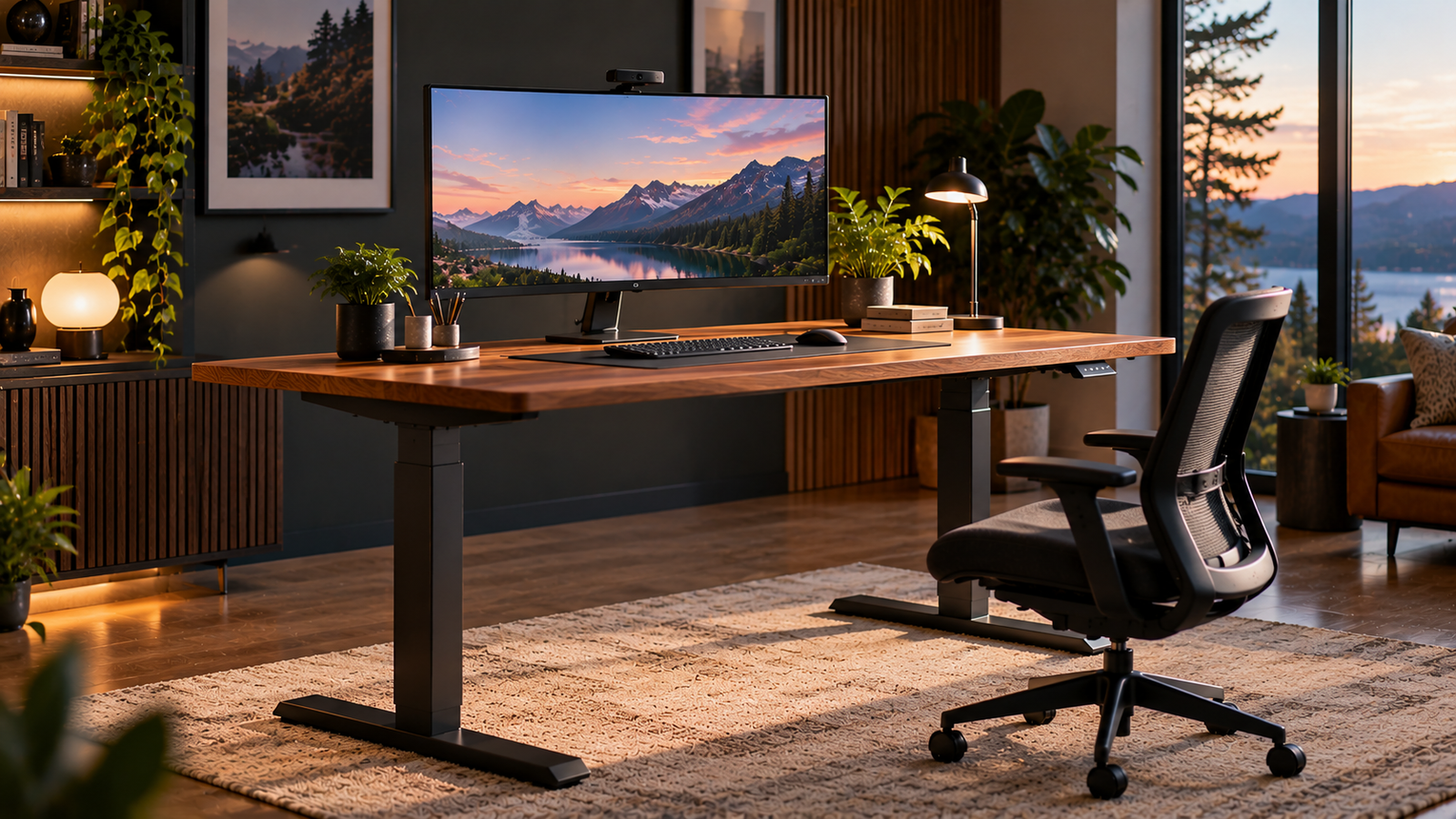
Not every addition improves the workstation.
Storage can reduce desktop clutter while consuming knee space or adding weight. Privacy panels can make an exposed office feel more contained while complicating cable access. Drawers can keep stationery close at hand but become an ergonomic liability when installed directly above the user’s thighs.
The useful question is therefore not whether storage or privacy panels are desirable. It is what problem each feature solves, what physical compromise it introduces, and whether that compromise matches the way the desk will actually be used.
For buyers consulting a standing desk buying guide, this distinction matters more than feature count. A desk with fewer additions can produce a better workstation when every component has a clear purpose.
Storage and Privacy Solve Different Problems
Storage and privacy panels are sometimes treated as competing upgrades, but their functions are fundamentally different.
Storage manages objects. Drawers can hold documents, cables, stationery, notebooks, and small electronics. Shelves can separate reference materials from the primary work surface.
Privacy panels manage visibility and spatial definition. A panel can obscure the area beneath a desk, partially screen cables and equipment, and create a more enclosed appearance in an exposed room.
The decision begins with identifying the actual source of friction.
If paperwork repeatedly accumulates beside the keyboard, storage may have measurable daily utility. If the desk faces a doorway, reception area, or shared office, a privacy panel may solve the more persistent problem.
Adding both without a clear reason can create a heavier, less flexible workstation.
The Ergonomic Cost of Storage
Desk storage is useful only when it does not interfere with the person using the desk.
The Occupational Safety and Health Administration’s guidance for computer workstations emphasizes adequate clearance beneath the work surface so users can position their legs comfortably and change posture.
This requirement creates an immediate problem for some integrated drawers.
A drawer installed beneath the central portion of a desktop reduces vertical clearance. For a taller user, or someone who prefers a relatively low keyboard position, even a modest storage compartment can bring the thighs uncomfortably close to the underside of the desk.
Standing does not eliminate the problem. Adjustable desks are meant to support both seated and standing positions, so storage should function in both.
The better storage arrangement often places drawers or shelving outside the primary knee area.
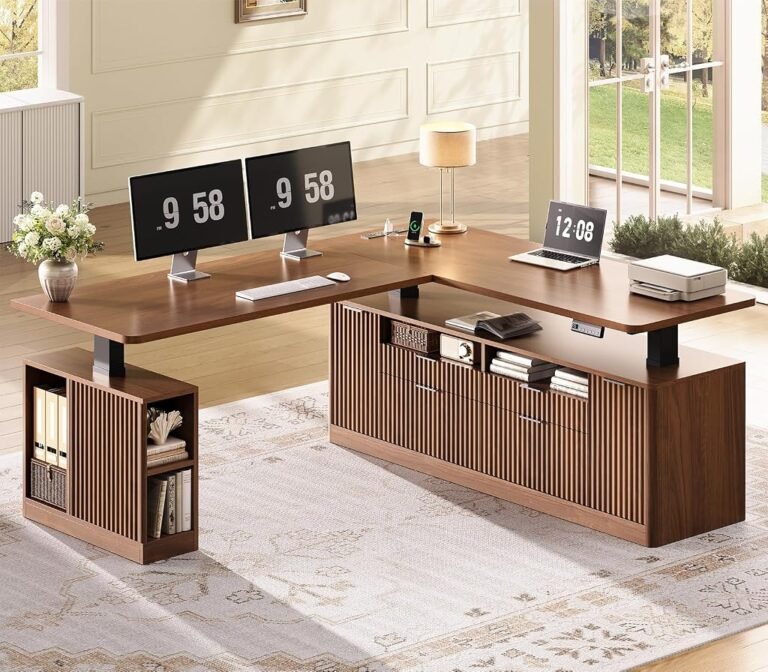
This is one reason L-shaped executive desks can make sense for storage-heavy work. The secondary surface creates opportunities to separate equipment and documents without placing every organizational feature directly beneath the primary typing position.
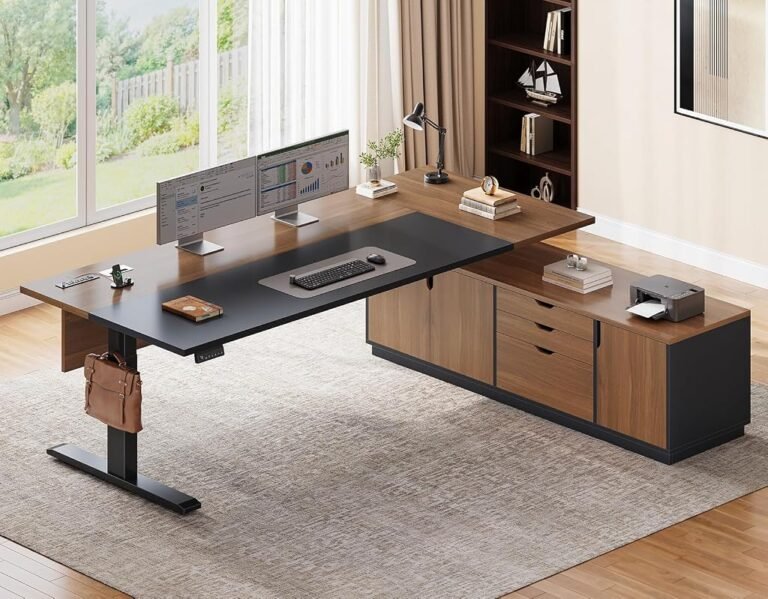
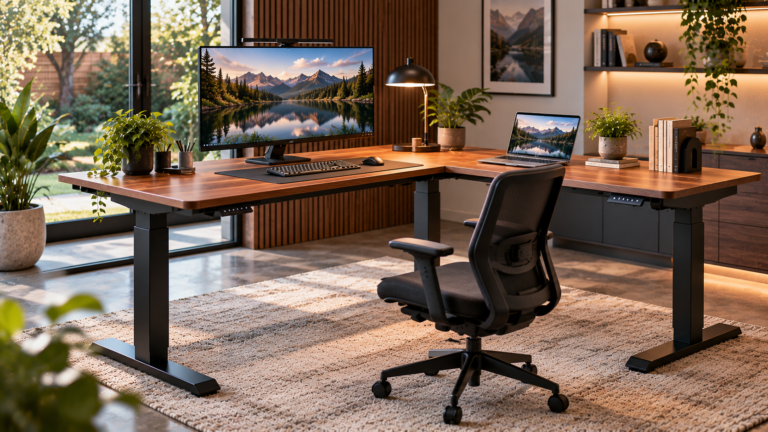
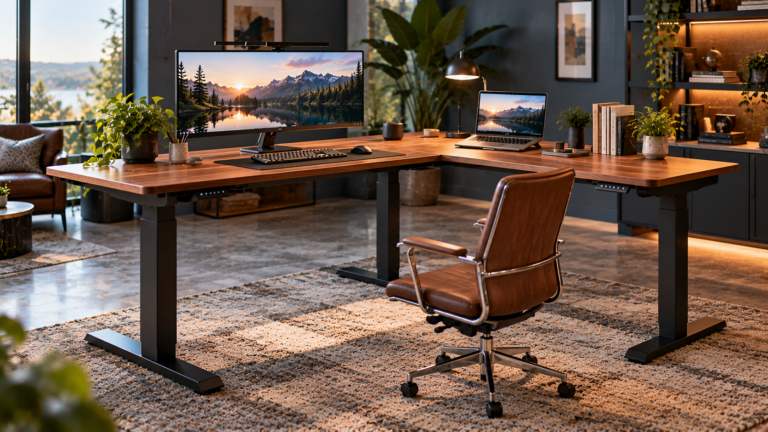
The MOUMON Electric Standing Desk illustrates this approach through its L-shaped design with drawers and shelves. Its 63-by-63-inch footprint creates two working directions, while its stated height range runs from 28.9 to 45.3 inches.
Those dimensions also reveal the trade-off: more furniture demands more room.
Drawers Work Best When They Reduce Reaching
Storage earns its footprint when frequently used objects become easier to access.
A drawer containing pens, a notebook, charging cables, and small office tools can eliminate repeated trips across the room. A drawer full of rarely accessed paperwork offers far less daily benefit.
The ergonomic question is reach.
Frequently used objects should generally remain close enough that they can be accessed without substantial leaning, twisting, or shoulder extension. Storage positioned too far from the normal working area can create movement without providing useful physical activity; reaching awkwardly for a stapler is not an exercise program.
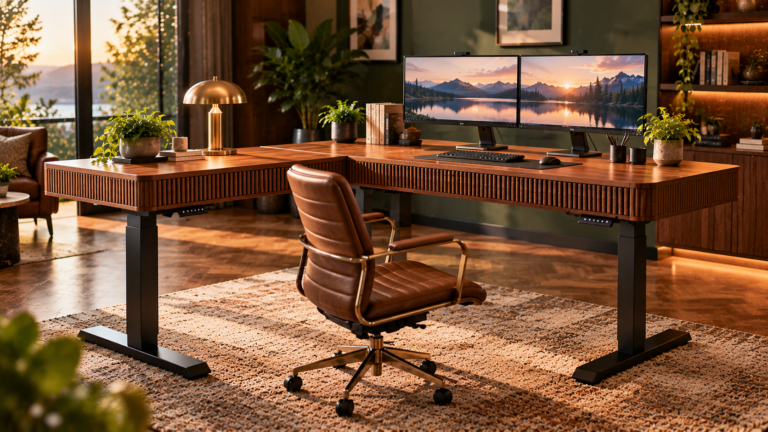
The SEDETA Fluted L Shaped Executive Electric Standing Desk with 4 Drawers represents the storage-heavy end of this category. Four drawers can support a document-intensive office, particularly where separate filing furniture would otherwise be necessary.
Its editorial profile is solid rather than dominant. We rate it 8.00/10 overall, with Customer Sentiment at 7.84, Buyer Confidence at 8.57, and Value at 7.91.
The relatively high Buyer Confidence score is encouraging, but the desk makes most sense when the four-drawer configuration addresses a real organizational requirement. Buyers who store almost everything digitally may be allocating substantial furniture volume to compartments they rarely use.
Shelves Create a Different Kind of Storage
Shelves and drawers should not be treated as interchangeable.
A drawer conceals objects. A shelf keeps them visible and generally easier to access.
Open shelving can work well for books, reference materials, docking equipment, or decorative objects. It can also become a magnet for clutter.
The MOUMON configuration combines drawers and shelves, which makes it relevant for offices containing several categories of physical material. Our overall score is 8.17/10, supported by Customer Sentiment of 8.06, Buyer Confidence of 8.64, and Value of 8.03.
Its Buyer Confidence rating is the strongest component of its editorial profile.
Still, the L-shaped arrangement should be chosen because two working surfaces and integrated storage support the user’s workflow, not because a larger desk appears inherently more capable.
A workstation that requires the user to repeatedly swivel, reach, and search through multiple storage zones can be less efficient than a smaller desk paired with one well-positioned cabinet.
Privacy Panels Address Exposure Rather Than Clutter
Privacy panels solve a subtler problem.
Many home offices are not dedicated rooms. A workstation may sit in a bedroom, living area, open-plan office, or multipurpose space. In these environments, the exposed underside of a standing desk can reveal wiring, computer equipment, power strips, and the user’s lower body.
A privacy panel can create visual separation.
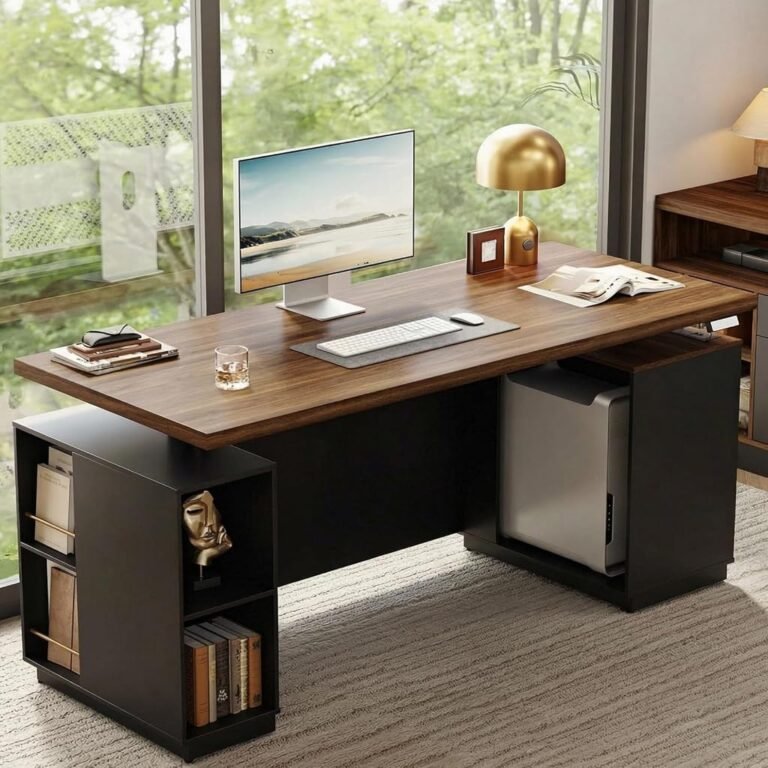
The ModernMate 71-inch Executive Standing Desk with Privacy Panel takes this approach directly. Rather than making storage its defining feature, the desk uses a privacy panel as part of an executive-oriented configuration.
We rate the ModernMate at 8.29/10 overall. Customer Sentiment is 8.28, Buyer Confidence reaches 8.50, and Value stands at 8.15.
Among the storage- and privacy-oriented examples considered here, that gives ModernMate the highest overall editorial score.
Its appeal is particularly clear for a desk positioned where presentation matters: facing an entrance, appearing behind someone during meetings, or separating a working area from a larger room.
Privacy, however, should not come at the expense of movement.
Privacy Panels Can Complicate Cable Management
The rear or front area beneath a standing desk is prime territory for electrical infrastructure.
Power strips, charging adapters, display cables, USB connections, and computer power leads all have to coexist with the desk’s frame and adjustment mechanism.
A privacy panel can hide much of this equipment from view. It can also make the equipment harder to reach.
This matters more on an adjustable desk than on fixed furniture because wiring must accommodate movement.
When the desktop rises, cables connecting the desk to wall outlets need sufficient slack. Wires attached to equipment on the moving surface must remain clear of lifting components. A cable arrangement that looks neat at seated height can become strained at standing height.
Before choosing a privacy-panel desk, buyers should examine:
- How cables can travel between the desktop and floor.
- Whether power strips remain accessible.
- Whether the panel obstructs cable trays or clamps.
- Whether monitor-arm hardware has sufficient mounting clearance.
- Whether wiring can be inspected without removing substantial furniture components.
- Whether the panel leaves comfortable leg and foot clearance.
A privacy panel that conceals cable disorder without allowing the wiring to be organized properly is cosmetic rather than functional.
Storage Adds Weight to a Moving System
Electric standing desks have to move more than the desktop.
Anything attached to the moving structure contributes to the load: monitors, computers, speakers, drawers, documents, charging hardware, and accessories.
Storage therefore introduces a consideration that conventional fixed desks largely avoid.
The issue is not simply whether a drawer physically fits. The complete equipment arrangement must remain within the manufacturer’s stated load limits.
Documents can be surprisingly heavy in quantity. Books are heavier still.
A storage-rich standing desk should therefore be evaluated as a loaded system rather than as an empty piece of furniture.
Buyers should calculate the approximate weight of major equipment and leave reasonable capacity for items added later.
Manufacturer specifications for the exact configuration should govern this assessment.
Integrated Charging Can Be Useful Without Becoming the Main Event
Storage-oriented desks sometimes add charging connections as another convenience feature.
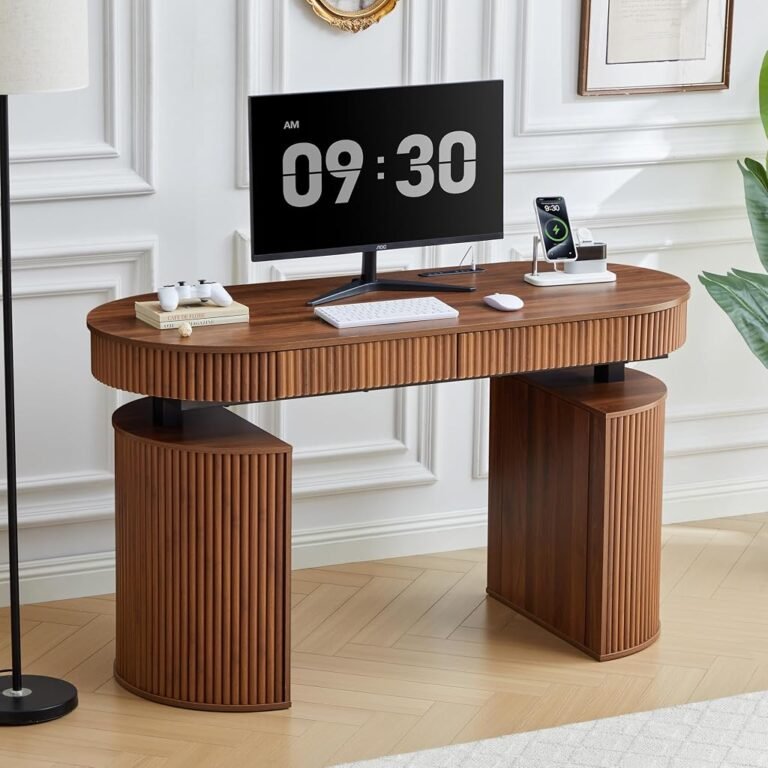
The ORRD Electric Standing Desk combines storage with USB and Type-C charging ports and a mid-century-inspired fluted design.
Its editorial performance is more restrained than the other examples examined here. ORRD receives 7.82/10 overall, with Customer Sentiment at 7.62, Buyer Confidence at 8.42, and Value at 7.79.
The charging connections can reduce the need to route certain device cables to separate adapters, but integrated charging should remain a secondary purchasing factor.
Charging standards change faster than desks.
A workstation may remain in use long after a particular charging interface or power specification becomes less useful. Structural design, ergonomic compatibility, storage placement, and working dimensions therefore deserve greater weight than built-in electronics.
The ORRD makes the most sense when its combination of storage, charging, and furniture styling matches the intended office. Buyers seeking a purely functional adjustable workstation may place those additions lower on their priority list.
When Privacy Matters More Than Storage
A privacy panel is generally the more rational feature when the desk’s location creates visual exposure.
Examples include:
- A desk facing visitors or clients.
- A workstation visible from a doorway.
- A home office sharing space with a bedroom or living room.
- An open office where the underside of the desk is highly visible.
- A workspace where concealed cables contribute meaningfully to a cleaner visual presentation.
In these environments, the ModernMate’s privacy-oriented design has a coherent purpose.
Its 8.29/10 overall rating also places it ahead of the SEDETA Fluted, MOUMON, and ORRD models considered here.
That does not make a privacy panel inherently better than drawers. It indicates that ModernMate presents the strongest overall editorial profile among these particular feature-oriented desks.
When Storage Matters More Than Privacy
Storage deserves priority when physical materials are part of daily work.
Someone regularly using notebooks, documents, stationery, reference books, or specialized equipment can benefit from keeping those objects close to the workstation.
The SEDETA Fluted model’s four drawers address this requirement directly.
MOUMON provides another approach by combining drawers and shelves within an L-shaped workstation.
The deciding factor should be frequency of access.
If an object is used several times each day, integrated storage can reduce unnecessary searching and movement around the office. If the drawers mostly contain archived paperwork, separate storage may preserve more desk flexibility.
There is also a spatial issue.
Integrated storage moves with or remains physically connected to the workstation design, depending on the configuration. A separate filing cabinet can often be repositioned independently.
Buyers who expect to rearrange their offices frequently should consider whether permanent integrated storage will become restrictive.
The Case for Choosing Neither
There is an overlooked third option: a standing desk without substantial integrated storage or a large privacy panel.
This can be the more flexible arrangement.
A simple adjustable desk can be paired with a mobile pedestal, freestanding cabinet, wall shelving, or independent cable-management system. These components can be replaced or repositioned without changing the desk itself.
The approach also protects leg clearance.
For users working primarily with digital documents, integrated drawers may solve a problem that barely exists.
Likewise, a privacy panel has limited practical value when the desk sits against a wall and its underside is rarely visible.
Features should earn their physical footprint.
That principle is more useful than counting how many additions a manufacturer can attach to a workstation.
A Practical Decision Framework
Storage and privacy features can be evaluated with a short sequence of questions.
First, identify what currently causes friction. Is the problem clutter, lack of document access, exposed wiring, insufficient visual separation, or simply inadequate desktop area?
Second, measure the room. L-shaped storage desks require substantially different floor planning from conventional rectangular workstations.
Third, map the seated position. Any drawer or panel near the user’s legs should be examined for clearance.
Fourth, plan the cables. Every powered device should have a safe route through the workstation.
Fifth, consider future changes. A desk that accommodates today’s laptop should not become unusable when a second monitor or docking station is added.
Finally, distinguish working features from decorative ones. Fluted panels, furniture styling, and concealed storage can make an office visually coherent, but ergonomic compatibility should remain the first filter.
Final Considerations
Standing desk storage and privacy panels solve different office problems, and neither deserves automatic priority.
Storage has the greater functional value when physical documents, accessories, and equipment need to remain within easy reach. The SEDETA Fluted L Shaped Executive Electric Standing Desk with 4 Drawers represents a storage-focused approach, while the MOUMON Electric Standing Desk combines drawers and shelving with an L-shaped work surface.
Privacy panels make greater sense when the workstation is visually exposed. The ModernMate 71-inch Executive Standing Desk with Privacy Panel addresses that requirement directly and earns the highest overall score among these examples at 8.29/10.
The ORRD Electric Standing Desk takes a different path, combining storage with USB and Type-C charging and furniture-oriented styling. Its 7.82/10 overall score makes it a more specialized choice for buyers who specifically value that combination.
The broader purchasing lesson is straightforward: features should solve observable problems.
Drawers that restrict legroom are not useful storage. A privacy panel that blocks cable access is not useful concealment. Shelves that collect unused objects are not useful organization.
The strongest workstation is often the one in which every feature has a job.
For buyers comparing storage and privacy options, the correct priority can usually be established by examining three things before anything else: what needs to be stored, what needs to be concealed, and how much unobstructed space the person working at the desk actually needs.