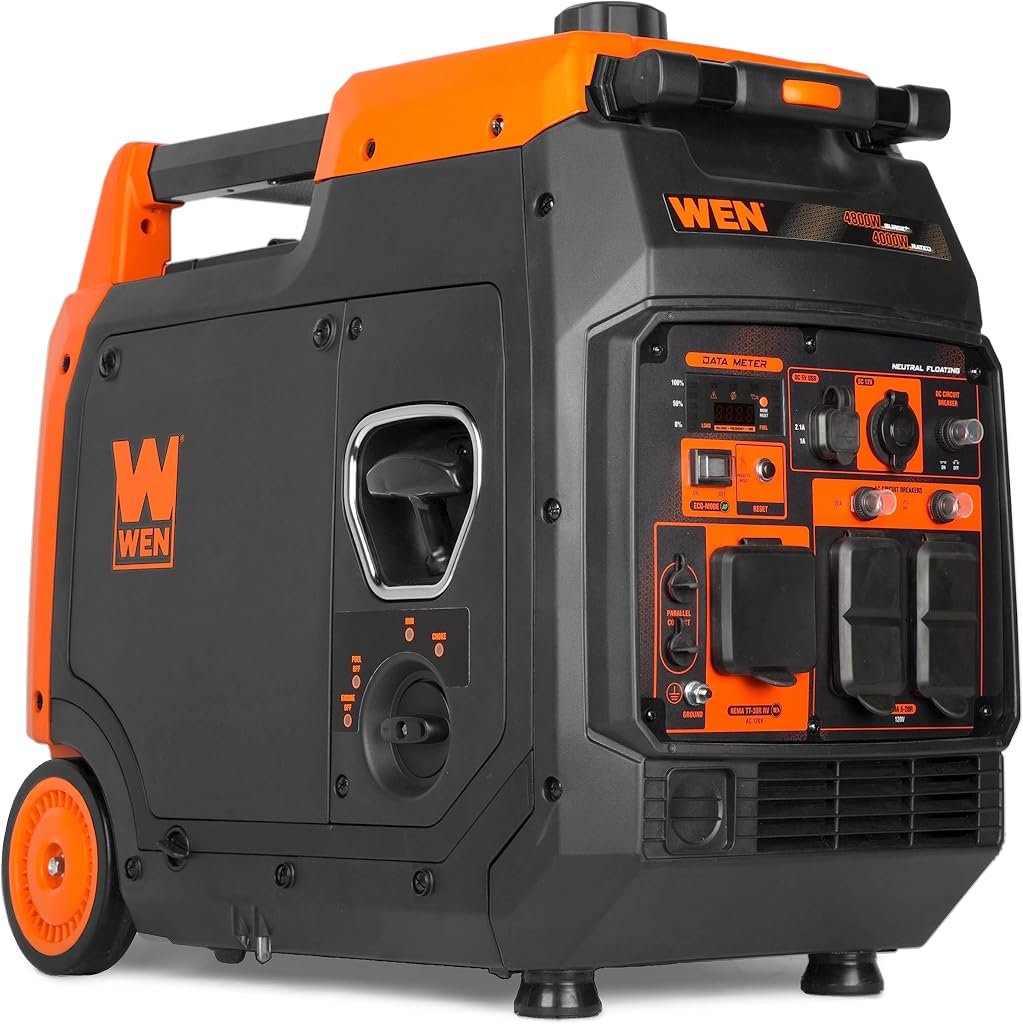
Portable-generator marketing has a habit of putting its largest number in the largest type. The WEN 56477i arrives under the banner of 4,800 watts, but that figure describes surge capacity rather than the electrical output available hour after hour. The more consequential number is 4,000 watts: the generator’s rated output and the figure around which a realistic power plan should be built.
The distinction immediately establishes the character of the 56477i. This is not a large whole-house generator compressed into a portable enclosure. It is a gasoline-powered inverter generator aimed at RV use, camping, selected emergency loads, and other applications where electrical quality, manageable sound, mobility, and useful connectivity matter alongside raw wattage.
According to WEN’s official specifications for the 56477i, its 224cc engine produces 4,800 surge watts and 4,000 rated watts. The generator uses a 1.9-gallon gasoline tank, runs for up to seven hours at half load, is rated at 62 decibels at quarter load, includes an RV-oriented TT-30R receptacle, and incorporates fuel-shutoff technology.
Our score is 8.48/10. Customer Sentiment stands at 8.28, Buyer Confidence at 9.44, and Value at 8.15. Those numbers describe a machine whose strongest characteristic is clarity: its specifications establish a fairly precise picture of what it can and cannot do. The lower Value score reflects a more competitive question, particularly around a $634.99 reference price.
The 4,800-Watt Label Requires Translation
The 56477i’s 224cc engine produces 4,800 surge watts and 4,000 rated watts.
Those two figures should never be treated as interchangeable.
Surge watts accommodate short periods of elevated demand. Motor-driven equipment can require significantly more electricity while starting than once normal operation begins. Refrigerators, air conditioners, pumps, and certain tools illustrate why temporary headroom matters.
Rated output describes the sustainable electrical budget.
A load plan that requires 4,500 watts continuously is therefore unsuitable for the 56477i even though the generator carries a 4,800-watt headline. A better strategy begins with the 4,000-watt rated ceiling and leaves room for temporary startup events.
That approach is particularly relevant in an RV.
An air-conditioning compressor can start while a refrigerator, converter, lighting, chargers, or other appliances are already drawing electricity. The owner must account for simultaneous running loads and startup demand rather than simply adding appliances until the 4,800-watt number is reached.
This is a recurring lesson in any useful portable generator buying guide: surge capacity attracts attention, but rated output determines the sustainable workload.
Inverter Architecture Changes the Electrical Proposition
The 56477i is an inverter generator rather than a conventional open-frame generator.
WEN describes its output as clean power intended to avoid damage to sensitive electronics such as smartphones, tablets, and laptops.
That feature has become increasingly relevant as emergency and recreational power loads have shifted toward electronics.
A modern outage does not merely leave refrigerators and lamps without electricity. It can interrupt routers, computers, communication equipment, televisions, phone chargers, battery chargers, electronically controlled appliances, and medical or accessibility equipment where applicable.
Inverter architecture addresses that mixed-load environment differently from a conventional generator.
The practical advantage is not that every electronic device becomes automatically safe under every circumstance. Equipment requirements still need to be respected. Rather, the 56477i is explicitly engineered around applications where electronic loads are expected rather than incidental.
That gives it a coherent identity for RVs and selective residential backup.
A 1.9-Gallon Tank Creates a Specific Runtime Profile
WEN specifies a 1.9-gallon fuel tank and up to seven hours of runtime at half load.
Half load on a 4,000-rated-watt generator corresponds to approximately 2,000 watts.
That qualification matters.
A published seven-hour figure should not be interpreted as a universal runtime under every workload. A generator supplying heavier electrical demand will generally consume fuel differently from one operating at a modest fraction of capacity.
For planning purposes, the 1.9-gallon tank establishes the broader trade-off.
A smaller tank reduces the amount of gasoline carried onboard and contributes to a more manageable portable package. It also means extended outages can require more frequent refueling than a large conventional generator with a substantially larger tank.
That is neither inherently positive nor negative. It reflects the generator’s intended scale.
An RV owner spending an evening under moderate load may view the tank very differently from a homeowner trying to sustain refrigeration, communications, pumps, and other equipment throughout a multi-day outage.
Runtime needs context because use cases differ.
Fuel Shutoff Addresses What Happens After the Power Returns
One of the 56477i’s more useful features becomes relevant when the generator is being turned off rather than started.
WEN’s fuel-shutoff system stops the incoming fuel supply and allows the engine to consume gasoline remaining in the carburetor before shutting down. The manufacturer describes the feature as a way to extend generator life by reducing fuel left inside the carburetor.
The idea addresses an ordinary problem of small-engine ownership.
Emergency generators can spend long periods unused. Gasoline remaining in fuel-system components during storage can create maintenance issues over time. A machine purchased for outages may consequently suffer precisely because outages do not happen often enough to keep it in regular use.
Fuel shutoff does not eliminate storage procedures, oil changes, inspections, or other maintenance requirements.
It does, however, acknowledge the actual ownership pattern of portable generators: intense periods of usefulness separated by long intervals of inactivity.
That makes the feature more consequential than its lack of marketing drama might suggest.
The Outlet Panel Is Clearly Oriented Toward RV and Portable Use
WEN equips the 56477i with four three-prong 120V receptacles, one TT-30R RV receptacle, one 12V DC receptacle, and two 5V USB ports.
The TT-30R receptacle is particularly important.
It gives compatible 30-amp RV owners a connection intended for recreational-vehicle use rather than forcing them to begin with an ordinary household receptacle and an adapter.
The distinction is easy to overlook because “30A” can describe several different receptacle arrangements. A TT-30R is a 120V RV connection and should not be confused with 120/240V locking receptacles used on some larger backup generators.
The 56477i’s outlet panel therefore reveals its priorities.
This machine is not principally designed around supplying 240V household equipment. Its connection set is more naturally suited to an RV, campsite, portable appliances, charging equipment, and selected 120V emergency loads.
For the correct buyer, that specialization is useful.
For someone requiring 240V output, it establishes a boundary.
Sixty-Two Decibels Needs Its Quarter-Load Qualification
WEN rates the 224cc engine at 62 decibels at quarter load.
The operating condition deserves equal billing with the noise number.
Quarter load on a 4,000-rated-watt machine is approximately 1,000 watts. Acoustic behavior can change as electrical demand and engine workload increase, so 62 dB should not be treated as a promise covering every operating condition.
Still, the published figure helps explain the design priorities.
The 56477i is enclosed rather than built around the exposed engine architecture of a conventional open-frame generator. Combined with inverter technology, that form is better aligned with RV parks, campsites, residential backup, and other applications where prolonged engine noise can become a practical issue.
Sound should also be considered in relation to distance and surroundings.
A generator operating beside reflective walls can be perceived differently from one positioned in an open outdoor area. Yet placement cannot be chosen solely to reduce annoyance. Exhaust safety imposes a much more consequential constraint.
Our Score: 8.48/10
Our 8.48/10 score reflects a product with a coherent design and a clearly identifiable use case.
The 56477i combines 4,000 rated watts, inverter electrical output, RV connectivity, fuel shutoff, a 1.9-gallon tank, USB charging, onboard wheels, a telescoping pull handle, and a three-year warranty.
The feature set is not impressive merely because it is long.
Its strength lies in alignment.
The TT-30R receptacle matches RV use. Inverter architecture suits electronics and changing electrical loads. The enclosed format and published 62 dB quarter-load figure address applications where sound matters. Wheels and the telescoping handle address movement. Fuel shutoff responds to long storage intervals.
The machine’s limitations are similarly coherent.
Four thousand rated watts require load management. Gasoline is the sole fuel. The 1.9-gallon tank prioritizes portability over very large onboard fuel reserves. The connection arrangement does not transform the generator into a high-capacity 240V household power source.
An 8.48 rating captures a machine that knows its job.
Customer Sentiment: 8.28
Customer Sentiment is 8.28, slightly below our overall score.
That narrow difference suggests a generally aligned picture: the specification set is appealing, but actual ownership necessarily includes more work than a feature list conveys.
A portable gasoline generator needs fuel management, maintenance, storage, safe outdoor placement, extension equipment, load calculations, and periodic attention even when it is not being used.
Mobility also has limits.
Wheels and a telescoping handle make a generator easier to reposition, but they do not turn an engine-driven machine into luggage. Steps, rough terrain, vehicle loading, and storage arrangements still deserve consideration before purchase.
The 8.28 Customer Sentiment score recognizes those practical realities without erasing the advantages of the design.
The difference from our 8.48 overall assessment is modest enough to reinforce rather than undermine the editorial judgment.
Buyer Confidence: 9.44
Buyer Confidence is the strongest rating at 9.44.
That score is supported by specification transparency.
WEN identifies the engine displacement, surge output, rated output, fuel capacity, half-load runtime, quarter-load noise rating, receptacle arrangement, fuel-shutoff system, mobility hardware, and warranty coverage.
The result is a generator whose fit can be assessed with relatively little guesswork.
An RV owner can identify the TT-30R receptacle before purchase. A homeowner can compare 4,000 rated watts against an appliance schedule. A buyer concerned about fuel intervals can work from the 1.9-gallon tank and seven-hour half-load figure. Someone sensitive to generator noise has at least one manufacturer-defined acoustic measurement rather than a vague assertion of quiet operation.
High Buyer Confidence does not mean the 56477i suits every buyer.
It means the available specifications expose its boundaries clearly enough to make a reasoned decision.
That distinction explains why the 9.44 confidence rating sits well above our 8.48 overall score.
Value: 8.15
Our Value score is 8.15.
At a $634.99 reference price, the 56477i competes on more than watts per dollar.
Buyers are also paying for inverter architecture, an enclosed portable design, RV connectivity, fuel shutoff, multiple charging options, mobility hardware, and warranty coverage.
That combination has value, particularly for an RV owner or someone prioritizing inverter power and manageable portable use.
Still, approximately $635 creates meaningful competition.
Larger conventional generators can offer more raw output. Dual-fuel machines add propane capability. Other inverter models may add electric starting or alternative connection arrangements. Buyers who need 240V household backup have reason to consider a different generator class entirely.
The 8.15 score reflects that competitive environment.
The 56477i makes its strongest financial case when its specific features correspond directly to the intended application. A buyer paying for RV connectivity, inverter output, and a more portable enclosed format without needing those attributes will naturally see a weaker value proposition.
Gasoline-Only Operation Is a Real Trade-Off
The 56477i’s single-fuel design deserves attention because dual-fuel portable generators are now common enough to create a meaningful alternative.
Gasoline offers straightforward operation and broad availability under ordinary circumstances. It also requires storage planning.
During widespread emergencies, fuel availability can become unpredictable. Power failures can affect service stations, transportation disruptions can interfere with deliveries, and sudden regional demand can create shortages.
A propane-compatible generator gives its owner another fuel pathway.
The 56477i does not.
For an RV owner using the generator intermittently, that limitation may carry little weight. For emergency preparedness, it deserves more consideration because fuel resilience can matter as much as electrical output during a prolonged outage.
The trade-off should therefore be treated as a buyer-fit question rather than an abstract defect.
Carbon Monoxide Safety Overrides Convenience
Every gasoline generator produces carbon monoxide, and an enclosed inverter housing does nothing to change the combustion chemistry.
The Centers for Disease Control and Prevention’s generator safety guidance says generators should be operated outdoors at least 20 feet from doors, windows, and vents.
CDC separately states: “Never use a generator inside your home or garage, even if doors and windows are open.” It also recommends battery-powered or battery-backup CO detection inside the home.
That guidance deserves literal interpretation.
A garage with its door raised remains a garage. A porch, shed, basement, crawlspace, carport, or other partly enclosed structure can allow combustion gases to accumulate or migrate toward occupied areas.
The inconvenience of running an extension cord more than 20 feet is irrelevant beside the hazard. CDC specifically recommends using sufficiently long extension equipment to preserve safe generator distance during an outage.
Placement should therefore be planned before an emergency.
Household Backup Requires a Load Schedule
Four thousand rated watts can keep meaningful household equipment operating during a power failure, but it cannot reproduce normal unrestricted electricity use.
A refrigerator, freezer, internet equipment, selected lighting, chargers, television, and other moderate loads may fit comfortably within a managed schedule. Pumps and compressor-driven appliances complicate the picture because startup demand can exceed running consumption.
High-resistance heating loads can consume capacity particularly quickly.
Electric water heaters, portable electric heaters, electric cooking equipment, clothes dryers, and central HVAC systems can impose loads far beyond what a 4,000-running-watt generator should casually be expected to support.
The sensible approach is numerical.
The owner should record the running wattage of every appliance intended for simultaneous use and identify the startup requirement of motor-driven equipment. Continuous demand should remain below the 4,000-watt rating while preserving enough surge headroom for the largest realistic startup event.
This method turns generator sizing from guesswork into load management.
Household Wiring Requires Proper Connection Equipment
The 56477i’s portable 120V orientation makes individual appliance connections a natural use case. Supplying installed household wiring is a different electrical problem.
Improvised backfeeding is dangerous.
The U.S. Consumer Product Safety Commission has warned that male-to-male extension cords used for generator backfeeding can expose energized prongs and create electrocution and fire hazards.
Portable-generator electricity supplied to household circuits requires an appropriate connection arrangement that prevents dangerous interaction with utility power.
For many 56477i owners, heavy-duty outdoor-rated extension cords supplying selected appliances may be the simpler approach. Any more integrated household arrangement should match the generator’s electrical characteristics and applicable electrical requirements.
The presence of enough watts to energize household equipment does not make every connection method safe.
Portability Is One of the Better-Integrated Features
WEN includes onboard wheels and a telescoping pull handle with the 56477i.
Those are practical additions rather than decorative conveniences.
Portable generators are repeatedly moved between storage and operating locations. RV users may also reposition them at campsites or transport them between destinations.
A wheeled chassis reduces the amount of lifting required during ordinary movement.
Physical planning still matters.
A buyer should consider steps, gravel, inclines, storage thresholds, vehicle loading height, and the outdoor location where the generator will operate. A smooth driveway creates a very different mobility problem from a campsite with loose soil or uneven terrain.
The 56477i addresses movement sensibly, but no wheel kit can make every environment easy.
High-Altitude Operation Has a Defined Accessory Path
WEN offers a model-specific high-altitude kit for the 56477i covering operation from 3,000 to 9,800 feet.
That is a useful detail for buyers who camp or live at elevation.
Internal-combustion engines encounter different air density as elevation increases, and carburetion requirements can change accordingly. Rather than treating high-altitude use as an afterthought, WEN identifies a dedicated accessory for the model.
The existence of the kit does not mean owners should modify the generator casually. Installation and operation should follow manufacturer instructions.
It does, however, give mountain-region users a defined manufacturer-supported route rather than forcing them to improvise.
For a generator with a strong recreational identity, that is a sensible piece of the broader ownership picture.
Who Is the WEN 56477i For?
The 56477i has a fairly precise buyer profile:
- RV owners who need a TT-30R receptacle and can manage loads within 4,000 rated watts.
- Campers who value inverter architecture and an enclosed generator format.
- Households seeking selective 120V emergency backup rather than unrestricted whole-house power.
- Users expecting to operate laptops, communications equipment, chargers, and other electronics alongside conventional appliances.
- Buyers who value onboard wheels and a telescoping handle for routine movement.
- Owners who expect periods of storage and can benefit from fuel-shutoff functionality.
- High-altitude users who value access to a model-specific manufacturer kit.
Its boundaries should be equally visible.
The 4,800-watt number is surge capacity. Rated output is 4,000 watts. The machine runs on gasoline rather than offering dual-fuel flexibility. Its 1.9-gallon tank is relatively modest. The published seven-hour runtime applies at half load. The 62 dB figure applies at quarter load.
Those qualifications are not footnotes. They define how the generator should be planned and used.
Final Considerations
The WEN 56477i earns our 8.48/10 score by presenting a tightly aligned portable-power package rather than attempting to satisfy every generator application.
Its 224cc engine produces 4,800 surge watts and 4,000 rated watts. A 1.9-gallon tank provides a manufacturer-rated seven hours at half load. WEN specifies 62 decibels at quarter load. The outlet panel combines four 120V household receptacles with a TT-30R RV connection, 12V DC output, and two USB ports. Fuel shutoff, onboard wheels, a telescoping handle, and a three-year warranty reinforce the portable and recreational orientation.
Customer Sentiment at 8.28 sits close to our overall assessment, suggesting that the product’s practical compromises do not fundamentally disrupt its design logic. Buyer Confidence reaches 9.44 because WEN publishes enough concrete specifications for buyers to establish fit with unusual precision. Value at 8.15 remains positive while recognizing that a $634.99 reference price brings larger, dual-fuel, electric-start, and differently configured competitors into consideration.
The 56477i’s strongest case is not maximum output.
It is balance.
Four thousand rated watts can cover meaningful RV and emergency loads without moving into a much larger generator class. Inverter architecture aligns with electronics. The TT-30R receptacle addresses RV connectivity directly. The enclosed format and published acoustic figure acknowledge that generator noise matters when equipment operates near campsites or homes. Fuel shutoff responds to storage. Wheels and a telescoping handle respond to movement.
Its compromises are equally straightforward. Gasoline is the only fuel. The tank prioritizes compactness over enormous runtime. The machine is not a 240V household generator. Its 4,800-watt headline cannot be treated as continuous output. Carbon-monoxide risk demands outdoor placement regardless of weather or convenience.
For an RV owner, camper, or household seeking carefully managed 120V backup, those trade-offs form a coherent package. The buyer who begins with a realistic appliance schedule, plans from 4,000 rated watts, establishes safe fuel storage, and identifies an outdoor operating position before an emergency will understand the 56477i far better than someone shopping by peak wattage alone.
Portable power works best when its limits are known before the lights go out. The WEN 56477i makes those limits unusually visible-and that clarity is one of its strongest attributes.