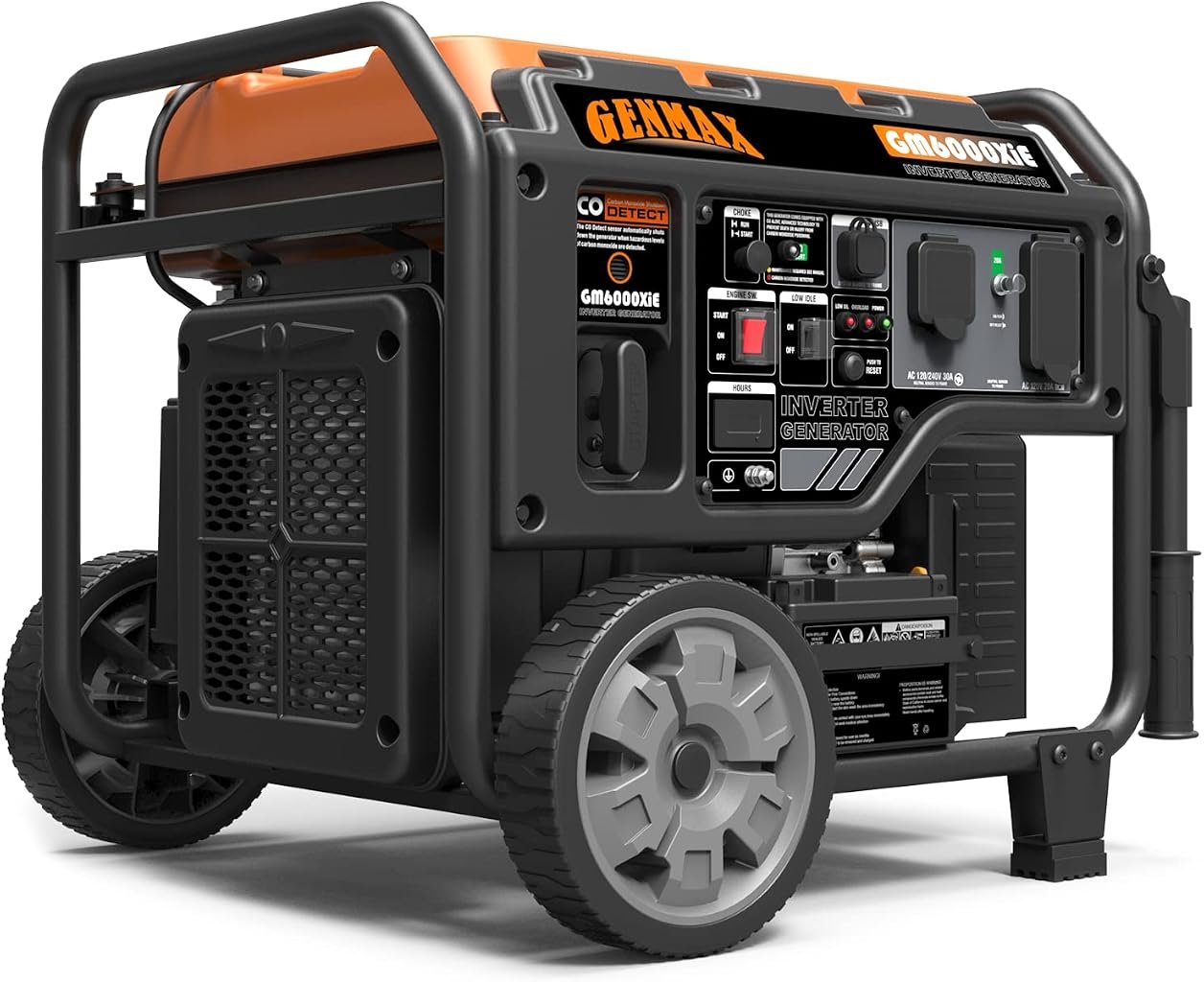
Portable generators tend to advertise themselves through one dominant number. In the case of the GENMAX GM6000XiE, that number is 6,000 watts. Yet the larger question is not how impressive that figure looks on a box. It is how much electricity the generator can sustain, what kind of electricity it produces, how long it can produce it, and how easily an owner can move, connect, fuel, and safely operate a 106.9-pound gasoline machine.
The GM6000XiE occupies an interesting position between two familiar generator categories. It uses an open-frame structure associated with conventional portable generators while incorporating inverter technology, variable engine speed, electric starting, carbon-monoxide shutdown, parallel capability, and electrical output with less than 3% total harmonic distortion. Its 120/240V capability and L14-30R locking receptacle further distinguish it from smaller recreational inverter models.
According to GENMAX’s GM6000XiE specifications, the generator produces 6,000 starting watts and 5,250 running watts from a 312cc four-stroke gasoline engine. It carries 3.8 gallons of fuel, is rated for 13 hours at quarter load, produces a listed 70 dBA noise level, and weighs 106.9 pounds.
Our score is 7.78/10. Customer Sentiment stands at 7.4, Buyer Confidence at 8.98, and Value at 7.67. The differences matter. The specifications create substantial confidence about what the machine can do, while the overall rating and value score reflect a more demanding ownership equation involving weight, gasoline dependence, noise, price, and the practical limits of 5,250 continuous watts.
6,000 Watts Is Only Half the Capacity Story
GENMAX rates the GM6000XiE at 6,000 starting watts and 5,250 running watts. It is a 120/240V, 60Hz machine with a rated current of 21.9 amps and a 312cc OHV engine.
The difference between starting and running output is fundamental.
Starting capacity exists for temporary demand spikes. Compressors, pumps, refrigerators, air conditioners, and other motor-driven equipment can draw substantially more electricity during startup than after reaching normal operating speed.
Running watts define the sustainable electrical budget.
That means a household should not construct a continuous 5,900-watt load plan simply because the generator has “6000W” in its name. The working ceiling is 5,250 watts, and sensible planning should preserve additional headroom rather than treating that figure as a target that must be continuously reached.
GENMAX itself recommends adding the running wattage of equipment expected to operate simultaneously when sizing a generator.
That principle belongs near the beginning of any portable generator buying guide. Peak numbers attract attention; sustained capacity determines what remains powered.
The Open-Frame Inverter Format Is the Defining Choice
The GM6000XiE is neither a basic conventional generator nor a compact enclosed inverter model.
Its open-frame construction leaves the machine physically closer to work-site and household-backup generators. The inverter system, meanwhile, changes its electrical character.
GENMAX specifies less than 3% total harmonic distortion. The company positions that output for sensitive electronic equipment.
Total harmonic distortion describes deviation in an AC waveform from an ideal sinusoidal shape. For buyers, the practical issue is simpler: modern backup loads increasingly include electronic equipment rather than only motors, incandescent lamps, and basic appliances.
A power outage can leave a household trying to operate routers, computers, phone chargers, televisions, battery chargers, refrigeration controls, and other electronics alongside traditional appliances.
The GM6000XiE’s inverter architecture therefore broadens its usefulness.
Yet the open frame creates a deliberate compromise. Fully enclosed inverter generators often emphasize acoustic isolation and recreational portability. The GENMAX instead combines inverter electronics with a larger, exposed chassis suited to higher-output portable work.
That hybrid design is the machine’s central engineering proposition.
The 312cc Engine Has a 5,250-Watt Job
The GM6000XiE uses a 312cc four-stroke OHV gasoline engine with variable speed. GENMAX specifies 10W-30 oil and an oil capacity of 0.84 quart, along with low-oil shutdown.
Variable engine speed is relevant because an inverter generator need not approach every electrical load in exactly the same mechanical manner as a traditional fixed-speed generator.
Demand changes throughout ordinary use.
A refrigerator compressor stops. A pump starts. A microwave operates for several minutes. A computer changes its power consumption. Lighting may be switched on or off. The generator encounters a shifting electrical workload rather than one static requirement.
The GM6000XiE is built around that pattern.
Its 5,250-watt running capacity also puts it beyond the smallest recreational inverter class. There is enough sustained output here for a meaningful collection of appliances or tools, provided startup requirements are calculated rather than guessed.
That proviso cannot be separated from the product.
A generator does not decide which equipment matters most during an outage. The owner does.
The 120/240V Output Broadens Its Backup Role
One of the more consequential GM6000XiE specifications is 120/240V output.
GENMAX equips the machine with a 120/240V 30A L14-30R locking receptacle and two 120V 20A GFCI-protected 5-20R household outlets. A dual USB adapter is also listed.
That configuration deserves more attention than a generic claim that the generator has “multiple outlets.”
The L14-30R is materially different from the TT-30R connection often found on RV-oriented generators. Both may involve 30-amp applications, but they have different configurations and purposes.
The GM6000XiE’s 120/240V locking receptacle makes it more naturally aligned with backup-power arrangements and other applications requiring that electrical configuration.
RV owners should therefore inspect their connection requirements carefully rather than assuming that every 30A receptacle is interchangeable.
Adapters can address some connection differences, but an adapter cannot alter generator capacity or magically transform one electrical system into another.
Exact receptacle identification is part of proper generator selection.
Thirteen Hours of Runtime Comes With a Load Qualification
GENMAX specifies a 3.8-gallon gasoline tank and up to 13 hours of operation at quarter load.
The words “quarter load” matter.
A runtime figure measured at relatively light electrical demand should not be treated as a guarantee of 13 hours under substantially heavier use. Fuel consumption rises as the engine is asked to produce more power.
Quarter load on 5,250 running watts corresponds to roughly 1,313 watts.
That operating point is plausible for light emergency duty: refrigeration cycling alongside communications equipment, modest lighting, and selected electronics could produce demand in that general range, depending on the specific appliances involved.
A heavier household or work-site load changes the fuel equation.
This illustrates why runtime comparisons need the same discipline as wattage comparisons. “13 hours” is incomplete without its operating condition.
For emergency planning, the more useful approach is to estimate expected average load and maintain a realistic gasoline supply rather than assuming the maximum published runtime will apply.
Gasoline-Only Operation Narrows Fuel Flexibility
The GM6000XiE is a gasoline generator. GENMAX lists a 3.8-gallon steel tank and no fuel gauge.
That arrangement is straightforward but creates one of the generator’s more obvious limitations against dual-fuel competitors.
Gasoline provides high energy density and widespread availability during ordinary conditions. During regional emergencies, however, availability can become less predictable. Service stations need electricity to pump fuel, and severe weather can disrupt deliveries or create unusually high demand.
Propane-capable generators give owners another storage and sourcing option.
The GM6000XiE does not.
That does not make gasoline operation inherently undesirable. It means fuel planning carries greater weight. An owner intending to rely on the machine for emergency backup needs suitable approved containers, safe storage practices, and a strategy for fuel rotation.
A generator without fuel is simply a 106.9-pound object with outlets.
Electric Start Is Appropriate, but Recoil Backup Matters
GENMAX equips the GM6000XiE with both electric and recoil starting. A battery is included, and the manufacturer also identifies a cold-start feature.
Electric start is particularly useful on a generator in this weight and engine class.
Push-button starting reduces physical effort and simplifies repeated startup. That matters when the generator is being operated during an outage, in poor weather, or by someone who finds repeated recoil pulls difficult.
The recoil system still has value.
Portable emergency equipment benefits from redundancy. Batteries can discharge, age, or suffer from long storage intervals. Retaining a mechanical starting option gives the generator another route to operation.
Neither starting method makes the machine automatic.
The GM6000XiE remains portable equipment that must be positioned, fueled, started, connected, monitored, and shut down deliberately. Buyers wanting automatic response to utility failure are considering a different category of backup-power equipment.
Our Score: 7.78/10
Our score of 7.78/10 reflects a generator whose core engineering package is useful but whose ownership compromises remain visible.
The positive case is substantial.
The GM6000XiE supplies 5,250 running watts, 120/240V output, inverter architecture, less than 3% THD, electric and recoil starting, a 30A locking outlet, GFCI household receptacles, CO shutdown, parallel capability, automatic voltage regulation, wheels, and a three-year warranty.
That is a coherent specification set for selective home backup and work-site electricity.
The constraints are equally tangible. It weighs 106.9 pounds. It burns gasoline only. Its listed noise level is 70 dBA. There is no fuel gauge according to GENMAX’s specification table. And 5,250 running watts, while useful, still demands deliberate household load management.
A 7.78 score captures that balance.
This is a capable machine, but capability does not erase operational friction.
Customer Sentiment: 7.4
Customer Sentiment is 7.4, the lowest of the four editorial measures.
That rating creates a useful counterweight to the specification sheet.
Generator ownership involves experiences that raw wattage cannot fully describe: moving more than 100 pounds, storing gasoline, maintaining an engine that may sit unused for months, arranging heavy-duty cables, managing sound, and deciding which appliances receive electricity when the grid fails.
The GM6000XiE addresses some of those problems effectively. Wheels help with mobility. Electric start reduces startup effort. A 3.8-gallon tank supports extended light-load operation. Inverter electronics improve its fit with mixed electrical loads.
None of those features removes the work inherent in owning a gasoline generator.
The 7.4 Customer Sentiment score therefore sits plausibly below our 7.78 overall assessment. The machine presents a stronger engineering proposition than its ownership experience is likely to feel effortless.
Buyer Confidence: 8.98
Buyer Confidence is considerably higher at 8.98.
The reason is specification clarity.
GENMAX publishes starting and running watts, voltage, frequency, engine displacement, fuel capacity, quarter-load runtime, weight, dimensions, outlet types, noise level, THD, starting methods, oil specifications, parallel capability, emissions information, and warranty length on its product page.
That information allows buyers to perform meaningful checks before purchase.
A homeowner can compare 5,250 running watts against an appliance schedule. A buyer requiring 240V capability can identify it directly. Someone concerned about sensitive electronics can examine the published less-than-3% THD figure. A user with limited storage space can measure against the listed 22.2-by-18.1-by-17.7-inch dimensions.
High Buyer Confidence does not imply universal fit.
It means the machine’s boundaries are visible enough for buyers to determine whether those boundaries match the job.
That distinction explains why 8.98 is substantially higher than our overall 7.78 score.
Value: 7.67
Our Value rating is 7.67.
At a reference price of $549.99, the GM6000XiE should be evaluated against more than watts per dollar.
Its inverter architecture, 120/240V output, electric start, CO sensor, parallel capability, GFCI receptacles, mobility equipment, and less-than-3% THD specification all contribute to the price proposition.
Still, the portable-generator market gives buyers several competing paths.
A conventional open-frame generator may provide more raw output for similar money. A dual-fuel model may sacrifice some gasoline performance while adding propane flexibility. A fully enclosed inverter generator may prioritize acoustic behavior and recreational use. Larger units may offer more household capacity at the expense of weight and fuel consumption.
The GM6000XiE sits between those alternatives.
Its value is strongest for buyers who specifically need the intersection of inverter electrical output, 120/240V capability, more than 5,000 running watts, and electric start.
If those characteristics are unnecessary, the 7.67 Value score explains why less expensive or differently configured generators deserve consideration.
Seventy Decibels Deserves Context
GENMAX lists the GM6000XiE at 70 dBA.
A noise figure without a measurement distance and load condition has limited comparative value, so it should not be converted into an overly precise prediction of what a particular campsite, driveway, or work site will sound like.
Still, 70 dBA reinforces the broader design story.
This is an open-frame 312cc generator producing more than 5,000 running watts. It should not be mentally grouped with small enclosed inverter generators built principally around quiet recreational operation.
Noise also interacts with placement.
Moving a generator farther from occupied areas can reduce perceived sound, but exhaust safety—not acoustic convenience—must dictate the minimum location requirements.
That leads to the most serious part of any gasoline-generator assessment.
CO Detect Does Not Make Unsafe Placement Safe
GENMAX equips the GM6000XiE with a carbon-monoxide shutdown sensor intended to turn the generator off when dangerous CO levels are detected.
That is useful secondary protection. It is not a substitute for correct placement.
The Centers for Disease Control and Prevention’s current generator guidance says generators should be operated outdoors at least 20 feet from doors, windows, and vents.
CDC also states: “Never use a generator inside your home or garage, even if doors and windows are open.” The agency recommends battery-powered or battery-backup CO detection inside the home.
The physics behind that warning are uncompromising. Carbon monoxide is colorless and odorless. A user cannot reliably detect dangerous accumulation through sight or smell.
A garage with an open door remains unsafe. So do basements, sheds, carports, crawlspaces, and other enclosed or partly enclosed locations.
The GM6000XiE’s CO sensor should therefore be understood as another protective layer behind proper outdoor placement, never permission to shorten the required safety distance.
Household Connection Requires Electrical Discipline
A generator with 120/240V capability and an L14-30R outlet naturally invites consideration for household backup.
That does not make improvised connections acceptable.
The U.S. Consumer Product Safety Commission’s warning on generator backfeeding explains that male-to-male extension cords can expose energized prongs and create electrocution and fire hazards. CPSC identifies their use to energize residential electrical systems from generators as dangerous backfeeding.
For installed household circuits, a suitable transfer arrangement is needed.
A CPSC technical memorandum states that “a suitable means such as a transfer switch is needed” to interface portable-generator output safely with installed household wiring.
That requirement fits the GM6000XiE’s use case particularly well.
Its 5,250 running watts can support selected household circuits, but those circuits need to be chosen according to load priority and connected through appropriate electrical equipment.
The generator has enough output to be useful. It does not have enough output to make electrical rules optional.
At 106.9 Pounds, “Portable” Means Wheeled
GENMAX lists the GM6000XiE at 106.9 pounds, with dimensions of 22.2 inches long, 18.1 inches wide, and 17.7 inches high. Eight-inch foam wheels are standard.
Those figures define portability more accurately than the category label.
This is movable equipment, not lightweight equipment.
A household owner needs to think about the path from storage to the operating location. Steps, loose gravel, steep grades, narrow doors, and uneven ground can turn a manageable wheeled machine into an awkward object.
Vehicle loading creates another question.
A 106.9-pound generator may require two-person handling or suitable loading equipment depending on the user and vehicle arrangement. Buyers expecting frequent transport should evaluate that physical reality alongside wattage and price.
The wheels solve part of the mobility problem. They do not repeal gravity.
Parallel Capability Provides an Expansion Option
GENMAX lists the GM6000XiE as parallel capable.
Parallel operation can appeal to buyers who prefer modular generating capacity rather than one much larger machine.
A single generator can address ordinary requirements. Additional compatible generating capacity can then be added where supported by the manufacturer’s approved parallel arrangement.
The trade-offs deserve equal attention.
Two generators mean two engines to store, fuel, maintain, transport, and position safely. Additional hardware is required, and compatibility needs to be verified rather than assumed.
For many households, careful load management with one 5,250-running-watt machine will be simpler.
For others, modular expansion may offer a useful path.
The presence of parallel capability therefore increases flexibility without automatically making expansion necessary.
Who Is the GM6000XiE For?
The GM6000XiE has a relatively clear buyer profile:
- Households seeking selective emergency backup with 120/240V capability.
- Users who need more than 5,000 watts of sustained portable output.
- Buyers who want inverter electrical architecture without requiring a fully enclosed recreational design.
- Work-site users who can benefit from GFCI-protected 120V receptacles and substantial running capacity.
- Owners who value electric start while retaining recoil backup.
- Buyers prepared to store gasoline safely and maintain a four-stroke engine.
- Users who can accommodate a 106.9-pound generator and its outdoor operating requirements.
Its limitations are just as concrete.
The machine is gasoline-only. The published 13-hour runtime applies at quarter load. The 6,000-watt figure represents starting capacity rather than continuous output. Its listed 70 dBA noise figure places acoustic expectations in a different category from small enclosed inverter models. Its weight makes wheels functionally significant rather than decorative.
There is also no published fuel gauge in GENMAX’s specification table.
These details do not invalidate the design. They establish where it fits.
Final Considerations
The GENMAX GM6000XiE earns our 7.78/10 score because it combines meaningful sustained output with an unusual and useful architecture: an open-frame gasoline generator built around inverter power.
Its numbers tell a coherent story when read carefully. Six thousand watts is starting capacity. The continuous electrical budget is 5,250 watts. A 312cc four-stroke engine supplies that output through a 120/240V system. The 3.8-gallon tank supports a manufacturer-rated 13 hours at quarter load. Electrical output is specified below 3% THD. The outlet panel includes an L14-30R locking connection and GFCI-protected household receptacles. Electric start, recoil backup, CO shutdown, low-oil protection, wheels, and parallel capability round out the operating package.
The score differences sharpen the assessment.
Customer Sentiment at 7.4 reflects a machine whose ownership demands remain tangible. Buyer Confidence at 8.98 is considerably stronger because GENMAX publishes enough engineering detail to make buyer fit unusually easy to evaluate. Value at 7.67 recognizes a credible $549.99 proposition while leaving room for dual-fuel, conventional, enclosed-inverter, and higher-output alternatives.
The GM6000XiE is therefore best understood not as a universal backup-power answer but as a specific tool for buyers who need its particular intersection of features.
It offers more than 5,000 running watts, 120/240V capability, inverter electrical output, electric start, and an open-frame layout in one machine. In exchange, the owner accepts gasoline-only operation, 106.9 pounds of mass, a listed 70 dBA noise level, routine engine maintenance, and the strict outdoor-placement rules inherent to combustion generators.
For selective household backup and demanding portable applications, those compromises can be rational. The decisive step is to plan from 5,250 running watts rather than the 6,000-watt headline, verify each intended load, arrange safe electrical connections, and establish fuel and CO-safety procedures before an outage occurs.
A generator is at its most useful when there are few surprises left on the day it is needed. The GM6000XiE supplies enough published detail to make that preparation possible, which is ultimately the strongest part of its case.