The Westinghouse iGen5000c presents a familiar generator-industry puzzle: the largest number in the product name is not the number that should govern everyday load planning. The machine produces 5,000 peak watts, but its sustained gasoline output is 3,900 running watts. That distinction is not fine print. It defines what the generator can realistically power hour after hour.
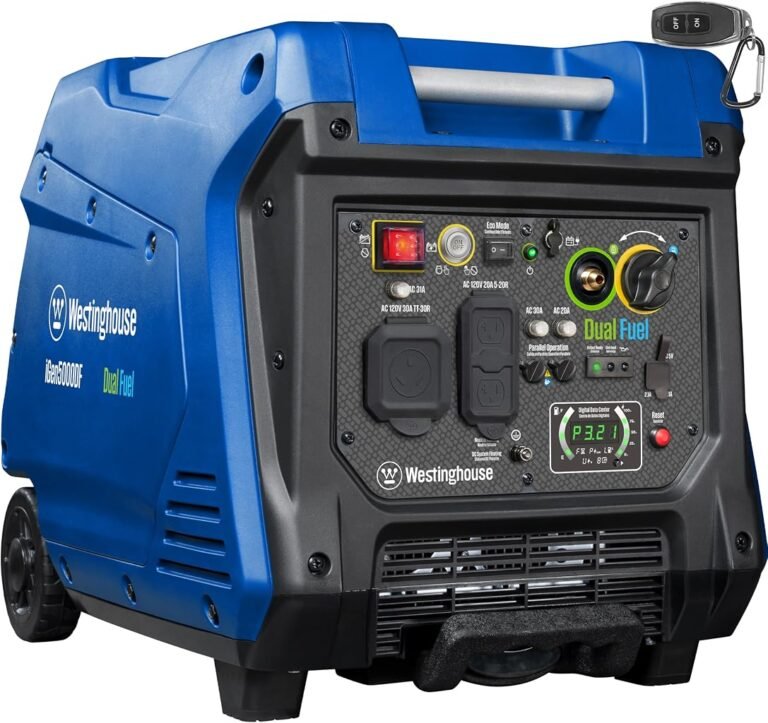
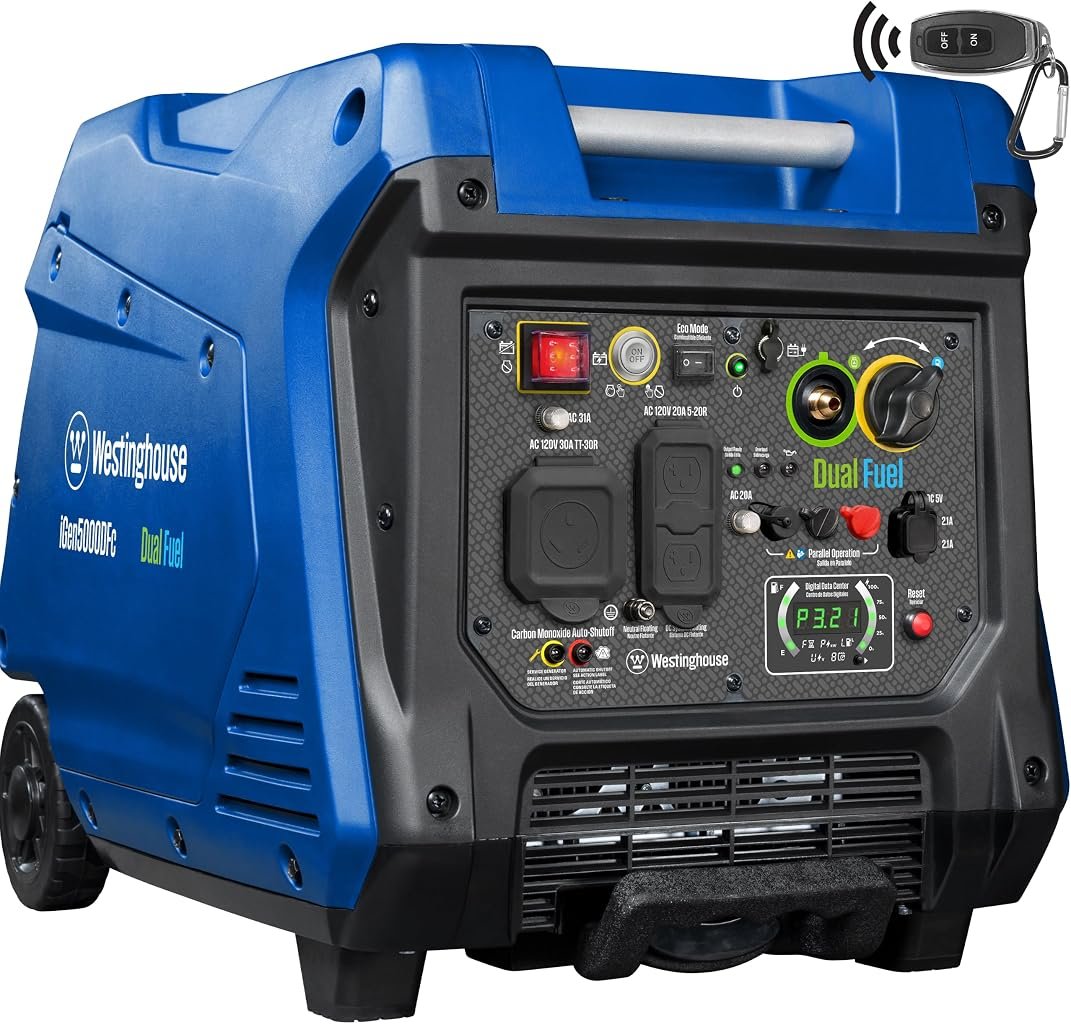
Westinghouse builds considerably more around that electrical core. The iGen5000c combines a 224cc engine, inverter architecture, a 3.4-gallon gasoline tank, remote and push-button starting, a TT-30R RV outlet, household receptacles, USB connections, an LED data center, an enclosed acoustic housing, automatic carbon-monoxide shutdown, wheels, and an extendable handle. The manufacturer also specifies total harmonic distortion below 3%.
Our score is 8.86/10, accompanied by Customer Sentiment of 8.72, Buyer Confidence of 9.8, and Value of 8.4. Those ratings reveal the central editorial judgment. Confidence is unusually high because the generator’s capabilities, operating limits, safety systems, and maintenance requirements are relatively well documented. Value is more restrained because buyers are paying for refinement and convenience as well as raw wattage.
This is not the cheapest possible route to several thousand watts of temporary electricity. Nor is that really the point. The iGen5000c is better understood as an attempt to make portable combustion power quieter, easier to move, easier to start, and better suited to modern electronic loads.
The 5,000-Watt Label Requires Context
Westinghouse specifies 5,000 peak watts and 3,900 running watts for the iGen5000c. Its official maintenance documentation independently identifies those same figures.
Peak output accommodates brief increases in electrical demand. Running output describes sustained capacity.
That distinction matters because many appliances containing motors or compressors require a temporary surge when starting. Refrigerators, pumps, air conditioners, and power tools can demand substantially more electricity for a short period than they consume once operating normally.
A buyer planning around 5,000 continuous watts would therefore begin with the wrong assumption.
The more defensible calculation starts at 3,900 watts and then leaves enough capacity for intermittent startup events. If a collection of appliances already consumes close to 3,900 watts continuously, a compressor switching on can push demand beyond the generator’s rated capability.
This is why any serious portable generator buying guide should separate running watts from starting watts before discussing features, price, or brand reputation.
The Westinghouse offers roughly 28% more peak capacity than its 3,900-watt continuous rating. That additional headroom is useful, but it is not another 1,100 watts available indefinitely.
The machine should consequently be viewed as a nearly four-kilowatt continuous generator with a five-kilowatt short-duration ceiling.
The 224cc Engine Carries the Workload
Westinghouse uses a 224cc engine in the iGen5000c. Its published maintenance guide specifies a 3.4-gallon, or 12.8-liter, gasoline tank and 0.6-liter engine-oil capacity. The recommended oil specification is 10W-30.
Those numbers are less glamorous than peak wattage, but they describe the mechanical reality underneath the electronics.
An inverter generator still relies on an internal-combustion engine. Fuel has to be stored, oil has to be monitored and changed, air must flow through the machine, heat must be managed, and exhaust must be routed safely away from people.
That engine architecture gives the Westinghouse an endurance advantage over finite-capacity battery systems. Once a battery power station is depleted, it needs an electrical source for recharging. A gasoline generator can be refueled repeatedly as long as fuel remains available and the machine receives appropriate maintenance.
The exchange is obvious: refueling extends operating time, but ownership includes an engine and everything an engine demands.
For emergency preparedness, that distinction matters. A generator that spends most of its life in storage still needs to be capable of starting when the utility fails. Neglected fuel, stale oil, an aging starting battery, or skipped maintenance can turn a theoretically capable machine into an expensive stationary object at precisely the wrong moment.
Inverter Architecture Changes the Electrical Character
The iGen5000c is not merely a conventional generator enclosed in plastic.
Westinghouse specifies total harmonic distortion of 3% or less and describes the generator as suitable for sensitive electronic equipment. Its inverter system also permits variable engine speed rather than requiring the engine to behave identically across widely different loads.
That has two practical consequences.
First, modern backup power increasingly involves electronics. Routers, computers, televisions, chargers, control boards, communications equipment, and numerous household appliances incorporate electronic circuitry. Stable AC output is therefore relevant far beyond laptops and smartphones.
Second, variable engine speed can reduce unnecessary fuel consumption when electrical demand is modest.
A generator supplying a refrigerator, router, several lights, and chargers does not face the same mechanical workload as one approaching its 3,900-watt continuous ceiling. Allowing engine operation to respond to demand improves the relationship between fuel consumption and useful output.
Westinghouse states that variable engine speeds can produce 30% to 50% higher fuel efficiency than a traditional generator. That is a manufacturer claim rather than a universal efficiency law, and actual consumption necessarily varies with load and operating conditions.
The broader engineering point remains sound: inverter generation allows a more flexible relationship between engine operation and electrical demand.
The 18-Hour Runtime Figure Has a Specific Condition
Westinghouse advertises up to 18 hours of runtime from the 3.4-gallon gasoline tank at 25% load.
The load condition matters as much as the runtime.
Twenty-five percent of 3,900 running watts is 975 watts. The headline figure therefore describes the generator supplying approximately one kilowatt, not operating near its full continuous capacity.
That distinction should change how buyers interpret endurance.
A 975-watt load can still support meaningful equipment. Refrigeration, lighting, communications hardware, televisions, chargers, and selected household electronics can produce a relatively modest average load when managed carefully.
Heavy resistance heating, electric cooking, large pumps, and air-conditioning equipment change the equation quickly.
Fuel consumption rises as the generator works harder. Eighteen hours should therefore be treated as a defined light-load benchmark, not a promise that one tank will last through almost a full day under any electrical demand.
Still, the figure has genuine practical value.
Long runtime at modest loads can reduce refueling frequency during an overnight outage. That means fewer shutdowns, fewer opportunities for fuel handling errors, and less time spent attending to the machine.
The 3.4-gallon tank also gives the iGen5000c substantially more onboard fuel than very compact inverter generators with smaller tanks.
The 30A RV Outlet Broadens Its Role
The iGen5000c includes a TT-30R RV-ready outlet, two 20A household outlets, and built-in USB connections.
The 30A receptacle is one of the machine’s defining features because it aligns the generator directly with recreational-vehicle use.
Yet outlet capacity and generator capacity should not be confused.
At 120 volts, 3,900 watts corresponds mathematically to 32.5 amps. Actual operation must remain within the generator’s rated output, individual receptacle ratings, circuit protection, and the connected equipment’s requirements.
RV air conditioning illustrates why the 5,000-watt peak rating matters.
Compressors can demand significantly more power while starting than during steady operation. The generator’s surge headroom can accommodate brief increases that might overwhelm a smaller machine, provided the rest of the electrical load leaves sufficient room.
That last condition is easily overlooked.
Running an air conditioner while simultaneously using a microwave, electric water heater, coffee maker, refrigerator, battery charger, and other RV equipment can push demand upward quickly. A 30A outlet makes the physical connection straightforward; it does not abolish load management.
For RV owners, however, the overall package is coherent: inverter output, an RV-ready receptacle, long light-load runtime, an enclosed housing, remote starting, and wheels.
The Wheel Kit Is Not Cosmetic at 105.8 Pounds
Westinghouse lists the iGen5000c at 105.8 pounds. The generator incorporates never-flat wheels and an extendable suitcase-style handle.
At that weight, mobility hardware is not an accessory in the ordinary sense. It is what makes the generator reasonably movable.
A 105.8-pound machine can be rolled across a garage floor, driveway, paved campsite, or similarly firm surface with much less effort than carrying it. Loading it into a vehicle, negotiating stairs, crossing deep gravel, or moving through mud is another matter.
This distinction matters because the word “portable” covers an enormous range of generator designs.
A 40-pound inverter generator can often be carried by one adult for a meaningful distance. A machine exceeding 100 pounds belongs to another category. It is mobile equipment, but its mobility depends heavily on wheels, handles, terrain, and the physical capabilities of the person moving it.
The iGen5000c’s wheel-and-handle arrangement therefore deserves more attention than its specification-sheet prominence might suggest.
The weight also reflects what is inside the enclosure: a 224cc engine, 3.4-gallon tank, inverter electronics, sound-control materials, starting hardware, cooling components, structural support, electrical connections, and the mobility system itself.
Engineering convenience tends to weigh something.
Remote Starting Changes Daily Interaction
The iGen5000c offers push-button electric start and wireless remote start. Westinghouse’s documentation for this generator family identifies remote-start operation as well as electric-start controls.
Neither feature increases electrical output.
Both can materially improve usability.
Recoil starting requires physical effort and proximity to the machine. Electric starting reduces that effort. Remote starting adds another degree of separation when the generator is already positioned safely outdoors and the operating setup permits remote use.
That can be useful for RV owners, users with limited upper-body strength, and households where more than one person may need to operate emergency equipment.
Convenience should not be mistaken for automation. The generator still needs fuel, oil, correct outdoor placement, electrical connections, inspection, and maintenance. Remote start cannot make an unsafe installation safe.
It does, however, address one of the less discussed barriers to emergency equipment: people are more likely to operate machinery correctly when its controls are understandable and physically manageable.
The LED Data Center Makes the Electrical Budget Visible
Westinghouse equips the iGen5000c with an LED data center displaying runtime, remaining fuel, load/output, voltage, and lifetime operating hours.
This feature has more substance than the familiar collection of indicator lights found on basic generators.
A portable generator operates within an electrical budget, but that budget can be difficult to perceive without instrumentation. Appliances switch on and off independently. Compressor loads appear suddenly. Users add devices incrementally.
A load display gives the operator a better sense of how much capacity is being consumed.
Runtime and fuel information support another type of planning: deciding when refueling will be required. Lifetime operating hours provide a reference for maintenance.
None of these displays guarantees perfect decision-making, but they reduce guesswork.
That matters most during prolonged outages, when generator management becomes repetitive. A machine may run for many hours while household priorities change. Refrigeration may be critical at one moment; cooking or water pumping may become the priority later.
Information allows the operator to manage those changes more deliberately.
Noise Is One of the iGen5000c’s Stronger Design Arguments
Westinghouse rates the generator as low as 52 dBA and attributes sound reduction to a double-insulated acoustic enclosure, asymmetrical cooling fans, and low-tone mufflers.
The phrase “as low as” deserves attention.
Generator noise changes with electrical demand, engine speed, distance, surrounding surfaces, and measurement conditions. A low-load sound figure cannot describe every operating situation.
Even so, the enclosure represents a meaningful difference from open-frame generator construction.
Noise affects where and when a generator can reasonably operate. In an RV campground, residential neighborhood, or overnight outage, sound can become a social and practical constraint long before the fuel tank is empty.
The iGen5000c is designed around that reality.
Its inverter architecture permits variable engine speed, while its physical enclosure addresses mechanical and exhaust sound. Neither feature makes a combustion engine silent, but together they create a different acoustic proposition from an exposed-frame machine.
Campground quiet-hour rules still apply regardless of manufacturer sound ratings, and neighbors may perceive generator noise differently depending on placement and local conditions.
Maintenance Cannot Be Delegated to the Electronics
The sophisticated inverter system does not eliminate routine engine maintenance.
Westinghouse’s published maintenance guide specifies checking engine oil before each use and identifies service intervals for oil, the air filter, spark plug, spark arrestor, fuel filter, and valve clearance.
That schedule is part of the ownership cost even though it does not appear in the wattage rating.
Portable generators present an unusual maintenance problem because many are purchased for infrequent emergencies. A worksite generator may accumulate hours regularly and receive maintenance as part of routine operations. A household backup generator can sit unused for months.
Long inactivity does not make maintenance irrelevant.
Fuel condition can deteriorate. Starting batteries can discharge or age. Oil still requires attention. Air passages can become obstructed. A generator stored indefinitely and never exercised may not deliver the confidence its owner assumes.
For emergency preparation, periodic inspection matters as much as theoretical capability.
The iGen5000c therefore rewards owners who treat it as machinery rather than a household appliance that can be forgotten until the lights go out.
Carbon Monoxide Is the Non-Negotiable Safety Issue
The iGen5000c includes automatic carbon-monoxide shutdown, along with automatic low-oil shutdown, voltage regulation, and overload protection.
The CO sensor is a meaningful safeguard. It is not a substitute for safe placement.
The U.S. Consumer Product Safety Commission’s current carbon-monoxide guidance states that more than 100 U.S. deaths each year are linked to portable generators. The agency also warns that one portable generator can produce the same amount of carbon monoxide as hundreds of cars.
CPSC instructs consumers to operate portable generators outdoors only, at least 20 feet from the home, with exhaust directed away from buildings. It specifically warns against using generators inside homes or garages even when doors and windows are open.
Those instructions should shape the generator setup before an outage occurs.
A garage with the door raised is not a safe generator room. Neither is a basement, shed, crawlspace, porch, or carport. Carbon monoxide is colorless and odorless, and CPSC warns that poisoning can occur rapidly enough for exposed people to lose consciousness before recognizing symptoms.
Automatic CO shutdown adds another defensive layer if dangerous concentrations develop around the generator. The primary defense remains keeping combustion exhaust away from people.
What the Editorial Scores Mean
Our 8.86/10 overall score reflects a generator with substantial capability and relatively few mysteries about its intended job.
The highest rating is Buyer Confidence at 9.8.
That figure reflects unusually useful specification disclosure. Westinghouse identifies peak and running output, engine displacement, fuel capacity, runtime conditions, total harmonic distortion, sound level, weight, outlet configuration, starting methods, protection systems, and maintenance requirements.
A buyer can therefore model the generator against real loads rather than relying primarily on a large number printed on the housing.
Customer Sentiment at 8.72 sits closer to our 8.86 overall assessment. The product combines several attributes that make sense together: nearly four kilowatts of continuous output, inverter electronics, an RV outlet, remote starting, a substantial gasoline tank, digital operating information, acoustic treatment, and a mobility system capable of handling its weight.
Value at 8.4 is the lowest editorial rating.
That difference is intentional.
The iGen5000c includes hardware that increases usability but also raises the level of investment relative to simpler open-frame machines. An enclosed acoustic housing, remote and electric starting, inverter electronics, digital monitoring, wheels, and a telescoping handle do not create additional running watts. They improve the experience of producing those watts.
For buyers who value those improvements, the cost has a clear rationale. For someone seeking the lowest possible purchase cost per running watt, a simpler generator may fit better.
Where This Westinghouse Fits Best
The iGen5000c is strongest where substantial 120V output and refined operation matter simultaneously.
Likely applications include:
- RV owners who need a TT-30R connection and enough surge capacity for demanding startup loads;
- households planning selective emergency backup rather than unrestricted whole-home operation;
- users powering electronics alongside conventional appliances;
- buyers who expect to move the generator primarily by rolling rather than carrying it;
- households where push-button or remote starting materially improves accessibility;
- users who value long light-load runtime from a 3.4-gallon tank;
- campsites and residential settings where acoustic control matters more than it would on a remote worksite.
The machine is less attractive for buyers who need 240V power or very high continuous output. Its electrical identity is centered on 120V applications and 3,900 running watts.
It is also less suitable for anyone who expects true carry-anywhere portability. At 105.8 pounds, the wheels solve much of the mobility problem only while the terrain cooperates.
Strengths and Limitations Are Closely Linked
The iGen5000c’s strengths are easy to identify because they form a coherent system.
The inverter architecture provides low-THD power and variable engine operation. The 3.4-gallon tank supports long light-load runtime. The acoustic enclosure addresses one of combustion generation’s persistent irritations. The TT-30R outlet supports RV use. Remote and electric starting improve accessibility. The LED display gives the operator useful information. Wheels and a telescoping handle make a heavy machine manageable on suitable surfaces.
Its limitations are equally concrete.
Five thousand watts is peak output, not sustained output. The continuous ceiling is 3,900 watts. Eighteen hours of runtime is tied to a 25% load rather than full output. The generator weighs more than 100 pounds. It burns gasoline, produces exhaust, requires maintenance, and must be operated outdoors at a safe distance from occupied buildings.
No electronic display or acoustic enclosure changes those fundamentals.
That is precisely why the product earns a high rating without becoming a universal recommendation. Its engineering choices solve several problems associated with portable generators, but they do not eliminate the underlying constraints of portable combustion power.
Final Considerations
The Westinghouse iGen5000c earns its 8.86/10 overall score by turning a 3,900-running-watt gasoline generator into a comparatively refined portable-power system.
Its 5,000-watt peak capacity provides useful surge headroom. The 224cc engine and 3.4-gallon tank support meaningful emergency and recreational operation. Inverter architecture keeps total harmonic distortion at or below 3%. The TT-30R outlet gives the generator an obvious RV application. Remote and push-button starting improve accessibility, while the LED data center makes electrical load, runtime, fuel status, voltage, and operating hours easier to track.
The wheel kit and telescoping handle deserve equal attention because they compensate for a substantial 105.8-pound operating reality. This generator is portable because it rolls effectively, not because it is light.
Its 9.8 Buyer Confidence rating is the strongest editorial score because the buyer can establish what the machine is and what it is not before purchase. Its 8.72 Customer Sentiment rating reflects a favorable overall balance of output, refinement, and convenience. Value at 8.4 is more measured because much of the generator’s appeal lies in features beyond basic wattage.
That score difference tells the story.
A buyer comparing generators solely by running watts may find cheaper ways to obtain roughly four kilowatts of gasoline-powered electricity. A buyer comparing the complete operating experience has more to consider: sound control, inverter output, remote starting, RV connectivity, digital monitoring, long light-load runtime, safety shutdowns, and a mobility system suited to a heavy machine.
The purchase decision should begin with arithmetic. Add the continuous wattage of the equipment that must operate together. Identify motors and compressors with higher startup requirements. Leave room below the 3,900-watt running ceiling. Decide whether a 120V-only power strategy covers the intended loads. Estimate runtime using realistic demand rather than assuming the 18-hour maximum applies universally.
Then consider the physical plan. Identify a safe outdoor operating position at least 20 feet from the home in accordance with CPSC guidance. Determine how the 105.8-pound generator will reach that location. Plan fuel storage and refueling. Establish a maintenance schedule before an emergency occurs.
Viewed through those practical requirements, the iGen5000c becomes easier to judge. It is not simply a “5,000-watt generator.” It is a 3,900-running-watt inverter generator engineered to make gasoline-powered backup and RV electricity less crude than traditional portable generation.
For buyers who need that combination, the appeal is not one oversized specification. It is the way the specifications work together.