Portable generators tend to advertise the number that looks most impressive and leave the number that governs everyday operation one line lower. The Westinghouse iGen5000DFc illustrates the problem neatly. Its name and headline specification emphasize 5,000 peak watts, but the more consequential figures are 3,900 running watts on gasoline and 3,500 running watts on propane.
Those distinctions do not diminish the machine. They clarify it.
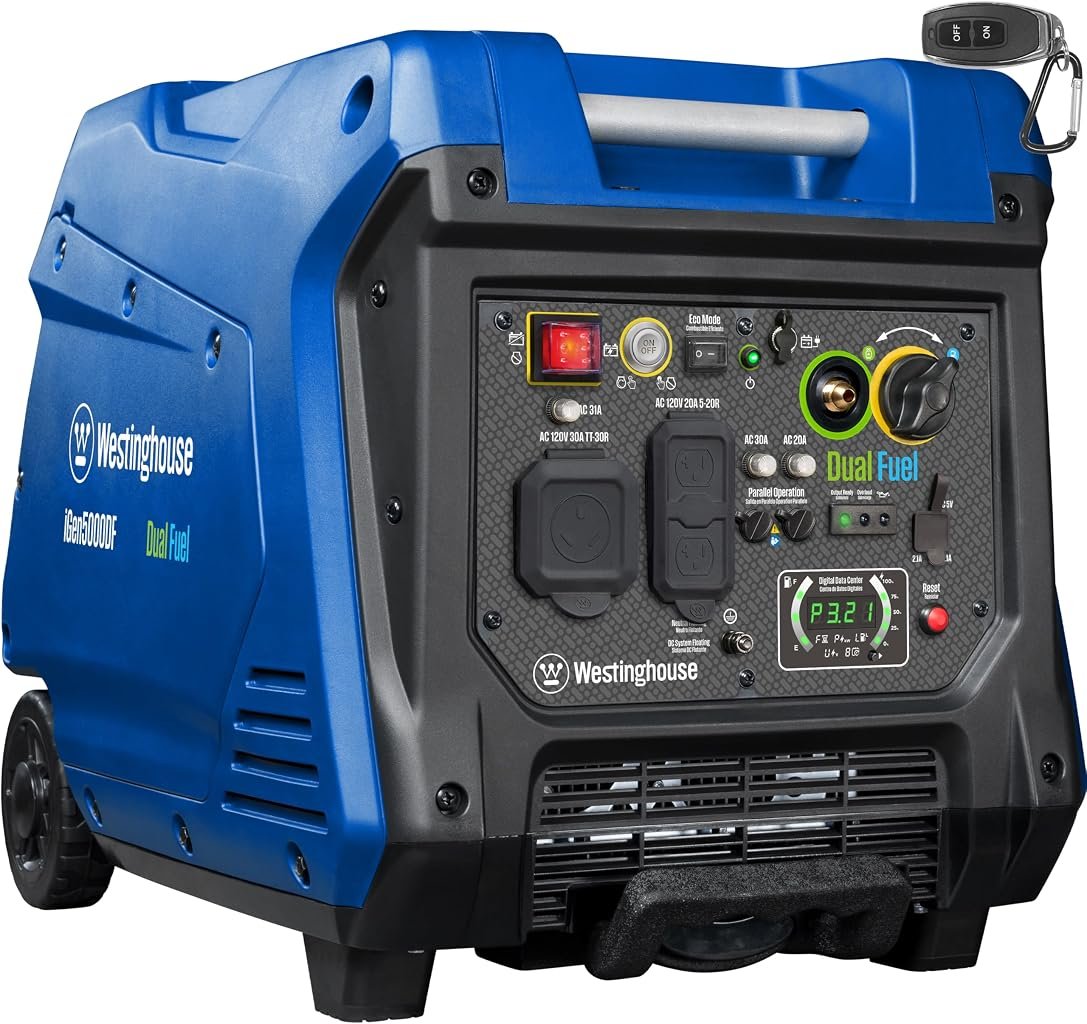
The Westinghouse iGen5000DFc is a dual-fuel inverter generator built around a 224cc engine, an RV-ready 30A outlet, electric and remote starting, an enclosed housing, wheels, a telescoping handle, digital operating information, and automatic carbon-monoxide shutdown. Westinghouse specifies less than 3% total harmonic distortion, positioning the generator for electronics as well as conventional appliances.
Our score is 9.01/10, accompanied by Customer Sentiment of 8.94, Buyer Confidence of 9.8, and Value of 8.52. Those ratings describe a machine with a particularly clear use case: buyers who want substantial 120V portable power without surrendering inverter refinement, fuel flexibility, RV connectivity, or convenient starting.
The price reference of $949 prevents the value judgment from becoming automatic. This is not a stripped-down open-frame generator competing primarily on watts per dollar. Its case rests on the entire operating package.
The 5,000-Watt Headline Needs Translation
The first task in evaluating the iGen5000DFc is separating gasoline output from propane output.
According to the official Westinghouse iGen5000DFc specifications, gasoline operation provides 5,000 peak watts and 3,900 running watts. Propane lowers those figures to 4,500 peak watts and 3,500 running watts. Westinghouse’s documentation lists the same output ratings.
That makes the generator’s actual operating identity considerably more precise than “5,000 watts.”
Peak wattage accommodates short increases in demand, particularly when equipment containing motors or compressors starts. Running wattage describes the sustained output available after those transient demands pass.
For load planning, 3,900 watts on gasoline is therefore the figure that deserves attention.
A refrigerator, lighting, communications equipment, television, furnace blower, chargers, selected kitchen equipment, or RV loads can potentially form a useful emergency-power package within that budget. The exact combination depends on each appliance’s operating and startup demand.
The propane ceiling of 3,500 running watts creates a modest but real reduction. Switching fuels is not electrically neutral.
This distinction belongs in any serious portable generator buying guide. Dual-fuel capability should never be interpreted as identical performance from two different fuels. Buyers should calculate their required load against the output available on the fuel they actually expect to use.
Dual Fuel Is More Than a Convenience Feature
The strongest practical argument for dual-fuel generation is not that propane is inherently superior to gasoline or vice versa. It is that fuel flexibility creates options.
Gasoline supports the iGen5000DFc’s maximum rated output. Propane sacrifices 400 running watts and 500 peak watts, but it changes the logistics of fuel storage and availability.
That can matter during emergencies.
A household that keeps propane available for other purposes may have a second energy source when gasoline supplies are inconvenient. An RV owner may already carry propane. Conversely, gasoline is widely available during ordinary conditions and extracts the generator’s full rated electrical output.
Fuel choice therefore becomes an operating decision rather than a permanent commitment.
That flexibility contributes significantly to the generator’s high 9.8 Buyer Confidence rating. A machine intended for outages gains resilience when its owner is not dependent on one fuel.
There is still no free lunch. Both fuels feed an internal-combustion engine. Both require appropriate storage and handling. Both produce exhaust. And neither eliminates the maintenance associated with an engine-driven generator.
Dual fuel reduces dependence on one fuel source. It does not turn the machine into a maintenance-free battery.
Inverter Output Is Central to the Product’s Identity
The iGen5000DFc is an inverter generator rather than a basic conventional portable generator.
Westinghouse specifies total harmonic distortion at no more than 3%, while its product documentation describes variable engine speeds and suitability for sensitive electronic equipment.
That distinction affects more than laptops.
Modern households contain electronics inside an expanding range of appliances: televisions, networking hardware, chargers, entertainment systems, controls, and numerous devices with electronic power supplies. Cleaner AC output broadens the range of equipment a generator can sensibly support.
Variable engine operation also addresses an old inefficiency of conventional generation. A household rarely consumes precisely the same electrical load hour after hour. Refrigerators cycle. Pumps stop. Lights are switched off. Chargers taper their demand.
An inverter generator can adapt engine behavior to changing electrical requirements rather than treating a few hundred watts and several thousand watts as identical operating conditions.
Westinghouse attributes substantial fuel-efficiency improvement to this variable-speed architecture compared with traditional generator designs.
The editorial significance is simpler: buyers paying more for an inverter machine should actually benefit from inverter characteristics. The iGen5000DFc offers enough sustained output that those advantages are available in a machine capable of doing considerably more than charging small electronics.
Runtime Is Impressive, but the Test Condition Matters
Westinghouse advertises up to 18 hours of runtime on the 3.4-gallon gasoline tank, with the headline specification tied to 25% load.
At 3,900 running watts, a quarter load corresponds to approximately 975 watts.
That context changes how the 18-hour figure should be read.
Eighteen hours does not describe the generator producing 3,900 watts continuously. It describes light-load operation. As electrical demand rises, fuel consumption rises and runtime falls.
Still, a long low-load runtime is genuinely useful.
Outage loads are often intermittent. A refrigerator compressor cycles. Lights consume comparatively little. Internet hardware, televisions, and chargers can remain modest loads. A furnace blower may operate periodically rather than continuously.
For those patterns, tank capacity and inverter-controlled engine behavior can translate into longer intervals between refueling.
That has consequences beyond convenience. Refueling a generator requires shutting it down and allowing it to cool. Longer runtime can mean fewer interruptions and fewer refueling events during an extended outage.
The number should therefore neither be dismissed as marketing nor mistaken for universal performance. It is a load-specific measurement that becomes useful when the buyer understands the load.
The 30A RV Outlet Is a Serious Asset
The generator includes a TT-30R RV-ready outlet, along with two 120V 20A household outlets and built-in USB connectivity. Westinghouse’s owner’s documentation identifies the 120V 30A RV receptacle alongside the conventional duplex receptacles.
The TT-30R connection gives the machine an obvious RV application.
That does not mean an RV owner can ignore the generator’s 3,900-watt gasoline ceiling. A 30A receptacle describes the connection architecture, not permission to exceed generator output.
At 120 volts, 3,900 watts corresponds to 32.5 amps mathematically, although actual operation must follow the generator’s outlet, breaker, and overall ratings. The generator’s output therefore aligns logically with the needs of many 30A RV configurations.
Air-conditioning deserves particular attention because compressor startup can create a much higher temporary demand than steady operation. The 5,000-watt gasoline peak rating provides startup headroom, but appliance-specific requirements still need to be checked.
For RV owners, this combination—30A connection, inverter output, enclosed housing, dual fuel, remote starting, and substantial runtime—is one of the iGen5000DFc’s strongest arguments.
Portability Comes With a 105.8-Pound Reality Check
Westinghouse lists the non-EFI iGen5000DFc at 105.8 pounds and equips it with never-flat wheels and a telescoping suitcase-style handle.
That weight changes the meaning of portable.
A hundred-pound generator is movable, particularly on wheels. It is not something most users will casually carry across a campground or repeatedly lift into a vehicle without planning.
The wheels and extendable handle therefore matter more than they might on a 40-pound generator. They convert a heavy machine into equipment that can reasonably be rolled across driveways, garage floors, paved campsites, and other suitable surfaces.
Stairs, mud, loose gravel, and vehicle loading tell a different story.
This is a recurring compromise in portable power equipment. Higher sustained output requires an engine, alternator, fuel capacity, sound insulation, structural components, electronics, and cooling hardware. Every improvement adds mass somewhere.
The iGen5000DFc is consequently better viewed as a wheeled generator than a carryable generator.
For home backup or RV use, that distinction may matter little. For users who expect frequent manual loading and unloading, it matters a great deal.
Remote and Electric Starting Improve Everyday Usability
Starting systems are easy to dismiss until a generator must be started at night, in poor weather, or by someone who struggles with a recoil cord.
The iGen5000DFc includes push-button electric start and wireless remote start, while retaining the broader practical advantages expected from an engine-driven portable generator.
Remote start is not essential to electricity generation. It is a usability feature.
Yet usability has a way of becoming important during emergencies. Equipment that is difficult to operate invites shortcuts, delays, or frustration. A push-button start reduces physical effort, while a remote key fob can simplify operation in appropriate outdoor setups.
The generator also incorporates an LED data center displaying operating information including runtime, remaining fuel, load/output, voltage, and lifetime operating hours.
That information can help users make better decisions during extended operation. Load information is particularly useful because a generator’s electrical budget is invisible without instrumentation. A user who can see demand approaching the machine’s capacity is better equipped to decide which appliance should wait.
Lifetime hours also provide a straightforward reference for maintenance scheduling.
These conveniences are not substitutes for mechanical quality. They make a mechanically useful generator easier to live with.
Noise Needs the Same Context as Runtime
Westinghouse rates the iGen5000DFc as low as 52 dBA and attributes its sound management to features including a double-insulated acoustic enclosure, asymmetrical cooling fans, and low-tone mufflers.
“As low as” is the operative language.
Generator noise varies with electrical load, engine speed, measurement distance, surrounding surfaces, and acoustic conditions. A light-load measurement cannot predict the experience of standing near the machine while it supplies several kilowatts.
Still, an enclosed inverter generator has inherent acoustic advantages over many open-frame designs.
For RV use, campsites, residential neighborhoods, and nighttime outage operation, noise is not a cosmetic issue. It affects neighbors, communication, sleep, and where a machine can practically be positioned.
The iGen5000DFc’s sound-control architecture is therefore meaningful even if a single decibel figure cannot describe every operating condition.
Campground rules also remain independent of generator capability. A quiet generator can still be prohibited during designated quiet hours.
Maintenance Is the Price of Engine-Driven Independence
A portable generator may spend months unused and then suddenly be expected to start during a storm. That operating pattern makes maintenance unusually consequential.
Westinghouse’s maintenance guide specifies checking engine-oil level before each use. It calls for an oil change after the first 25 hours or first month, then another interval at 50 hours or six months. The guide also specifies periodic attention to the air filter, spark plug, spark arrestor, fuel filter, and valve clearance.
That schedule exposes an important difference between combustion generators and large battery power stations.
A gasoline/propane generator can be refueled repeatedly and keep producing electricity as long as fuel, maintenance, and operating conditions permit. In exchange, the owner inherits an engine.
Oil ages. Filters collect contamination. Spark plugs wear. Fuel systems need care. Starting batteries require attention. Gasoline storage creates additional considerations.
Someone seeking emergency power with minimal mechanical maintenance may prefer battery storage despite its capacity and charging constraints. Someone preparing for a prolonged outage may prefer the rapid energy replenishment that liquid or gaseous fuel provides.
The iGen5000DFc belongs firmly on the engine-driven side of that trade-off.
Carbon-Monoxide Shutdown Is a Backup Safeguard, Not a Placement Strategy
The iGen5000DFc includes automatic carbon-monoxide shutdown in addition to low-oil shutdown, voltage regulation, and overload protection.
The CO feature is significant because generator exhaust can kill.
The current U.S. Consumer Product Safety Commission carbon-monoxide guidance states that more than 100 U.S. deaths each year are linked to portable generators and warns that one portable generator can produce as much carbon monoxide as hundreds of cars. CPSC instructs users to operate generators outdoors only, at least 20 feet from homes, with exhaust directed away.
More recent CPSC reporting provides historical scale. The agency estimated that approximately 750 people died from carbon-monoxide poisoning associated with generators from 2012 through 2022.
Those figures put automatic CO shutdown in proper perspective.
A sensor is a secondary protection system. It is not permission to place a generator in a garage, basement, shed, porch, or other unsafe location.
CPSC explicitly warns against operating portable generators inside homes, garages, basements, crawlspaces, sheds, or similar enclosed areas even when doors or windows are open. The agency also advises directing exhaust away from buildings.
The iGen5000DFc’s CO shutdown adds a meaningful defensive layer. Safe placement remains the primary defense.
What the Scores Reveal
Our 9.01/10 score reflects a generator whose capabilities align unusually well with the needs of its intended audience.
The standout figure is Buyer Confidence at 9.8. Westinghouse publishes specific output ratings for both fuels, tank capacity, engine displacement, total harmonic distortion, maintenance requirements, outlets, runtime conditions, starting systems, and protection features. Buyers can compare those numbers against their actual electrical requirements rather than purchasing from a peak-wattage label alone.
Customer Sentiment is 8.94, only slightly below the overall score. The generator’s combination of dual-fuel operation, inverter output, remote starting, RV connectivity, and long light-load gasoline runtime forms a coherent package.
Value at 8.52 is noticeably lower than Buyer Confidence.
That gap deserves attention.
At a reference price of $949, the iGen5000DFc costs more than some simpler generators capable of producing similar headline wattage. Its value depends on whether the owner benefits from inverter output, dual-fuel operation, remote start, an enclosed design, digital monitoring, and the RV-ready 30A connection.
A buyer who needs nothing more than inexpensive emergency wattage may not extract full value from those features.
A buyer who specifically needs those features has a much stronger case.
Where the iGen5000DFc Fits Best
The generator is particularly well suited to users who need substantial but selective portable power.
Likely applications include:
- 30A RV power where inverter output and manageable noise matter;
- household emergency backup for selected appliances and circuits;
- camping or mobile applications where propane availability is useful;
- electronics-heavy loads that benefit from low-THD inverter output;
- owners who prefer push-button or remote starting;
- outage planning where long light-load runtime reduces refueling frequency;
- users who value a second fuel option rather than relying exclusively on gasoline.
It is less well matched to buyers seeking whole-home automatic backup. At 3,900 running watts on gasoline and 3,500 on propane, electrical priorities still have to be managed.
Large central air conditioners, electric water heaters, electric ranges, clothes dryers, large pumps, and other high-demand equipment can consume much of the available capacity individually or exceed it.
The generator is also a questionable fit for anyone whose definition of portability requires frequent lifting. A 105.8-pound machine is transportable, not light.
The Strengths and Drawbacks in Practical Terms
The strongest attribute is balance.
The iGen5000DFc provides enough sustained output to handle meaningful loads without abandoning the quieter, cleaner-output characteristics associated with inverter generators. Dual fuel increases operational flexibility. The TT-30R outlet makes RV use straightforward. Remote and push-button starting reduce friction. Digital load information makes the power budget more visible. CO shutdown adds a secondary safety layer.
The drawbacks are similarly concrete.
The 5,000-watt figure applies only to peak gasoline output. Continuous gasoline output is 3,900 watts, while propane lowers it to 3,500 watts. The machine weighs more than 100 pounds. The 18-hour runtime claim represents operation at 25% load rather than near full output. Combustion brings exhaust, noise, fuel storage, oil changes, and scheduled maintenance.
And despite the CO sensor, the generator must still be operated outdoors at a safe distance from occupied structures.
None of those drawbacks invalidates the product. They define the conditions under which it makes sense.
Final Considerations
The Westinghouse iGen5000DFc earns its 9.01/10 overall score by combining 3,900 running watts on gasoline with the refinement and flexibility that distinguish a well-equipped inverter generator.
Its 9.8 Buyer Confidence rating is particularly justified by specification clarity. Gasoline and propane outputs are separately documented. Runtime has an identifiable load condition. Total harmonic distortion is specified. Maintenance intervals are published. The outlet architecture, engine displacement, starting systems, and safety protections are identifiable rather than vague.
Customer Sentiment at 8.94 reflects the strength of that overall package. Value at 8.52 is more restrained because buyers are paying for features beyond raw output. At $949, the machine makes the most financial sense when dual fuel, inverter power, the 30A RV outlet, remote starting, digital monitoring, and enclosed construction will actually be used.
The machine’s most important number is not 5,000. For gasoline operation, it is 3,900 running watts. On propane, it is 3,500 running watts. Those figures should form the foundation of every load calculation.
From there, the decision becomes practical. Calculate the continuous demand of the equipment that must run. Identify motor and compressor startup requirements. Decide whether propane’s lower output is sufficient. Consider how often the 105.8-pound generator must be moved. Estimate runtime at realistic loads rather than assuming the maximum published duration. Plan maintenance before an outage occurs. Establish a safe outdoor operating location at least 20 feet from the home in accordance with CPSC guidance.
Viewed that way, the iGen5000DFc is neither a miniature whole-house generator nor merely an oversized camping accessory. It is a relatively high-output 120V inverter generator built for buyers who value flexibility almost as much as wattage.
That distinction explains why its ratings are high without requiring inflated claims. The Westinghouse does not escape the limitations of portable combustion generation. It manages many of them intelligently: two fuels instead of one, inverter output instead of basic generation, several starting methods instead of a recoil cord alone, useful instrumentation instead of guesswork, and automatic CO shutdown as an additional protection.
For an RV owner or household building a selective backup-power plan around roughly four kilowatts of sustained gasoline output, those choices form a credible and unusually well-defined package.