Countertop appliances have a peculiar economics problem: the purchase price is paid once, but the space they consume is paid for every day.
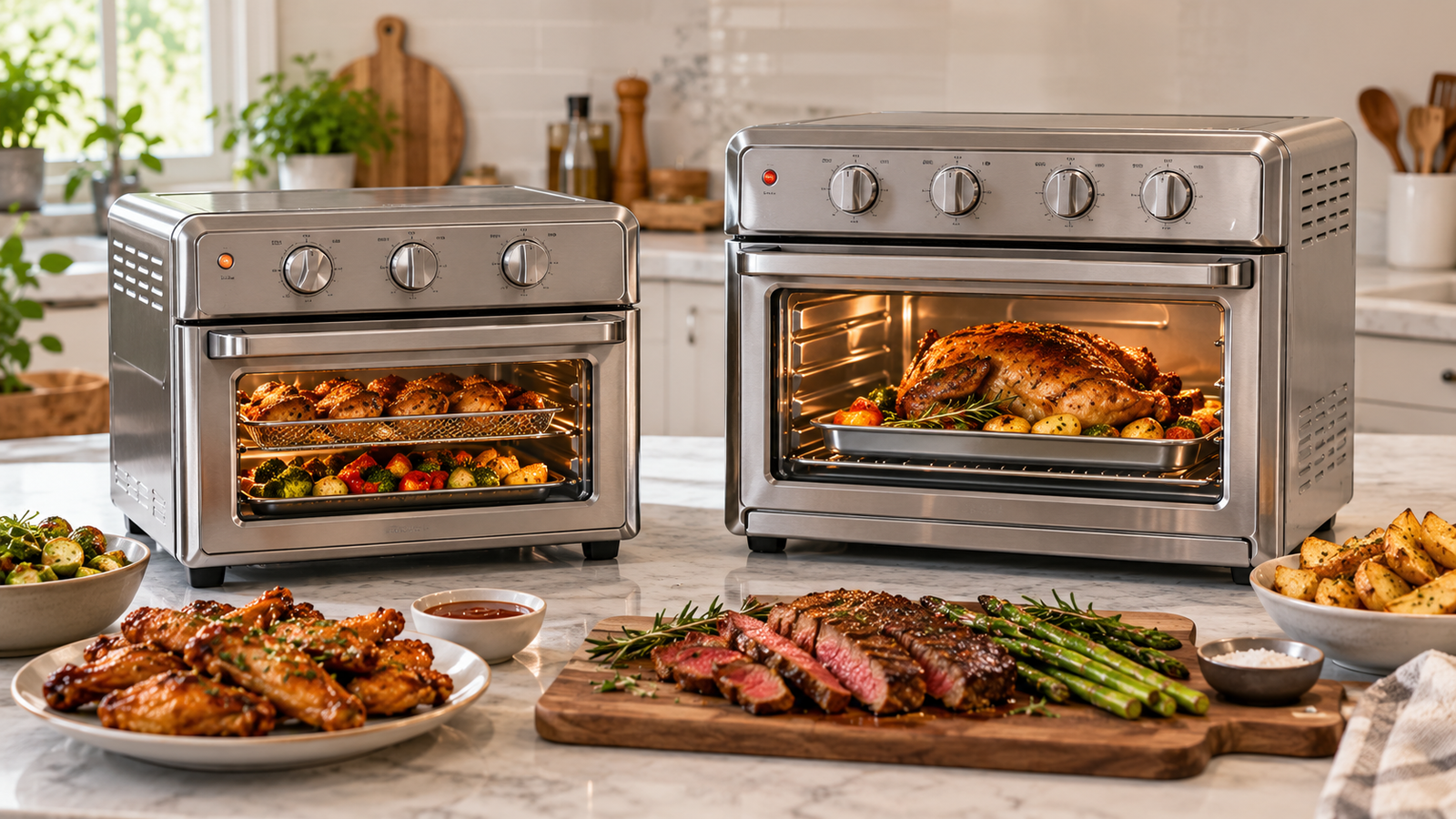
That distinction sits at the center of the Cuisinart TOA-26 vs TOA-70NAS comparison. Both are stainless-steel air fryer toaster ovens built around the same broad proposition-combining air frying with conventional countertop-oven duties-but they pursue that proposition at different scales. The TOA-26 emphasizes compactness and a narrower collection of cooking modes. The TOA-70NAS expands capacity, controls and cooking options, including a dedicated grill function.
The price difference is equally concrete. At the prices assessed here, the TOA-26 costs $149.95 while the TOA-70NAS costs $219.95. That is a $70 gap, or roughly 46.7% more for the larger model.
The question, therefore, is not simply whether the TOA-70NAS does more. It demonstrably does. The more useful question is whether those additions solve problems a particular kitchen actually has.
Our assessment gives the TOA-26 an 8.1/10 overall score and the TOA-70NAS an 8.55/10. That relatively modest 0.45-point separation is revealing. The TOA-70NAS has broader capability, but the TOA-26 makes a persuasive counterargument through size, lower cost and a simpler footprint.
Cuisinart TOA-26 vs TOA-70NAS at a Glance
| Category | Cuisinart TOA-26 | Cuisinart TOA-70NAS |
|---|---|---|
| Product type | Air fryer toaster oven | Air fryer toaster oven with grill |
| Price assessed | $149.95 | $219.95 |
| Our Score | 8.1/10 | 8.55/10 |
| Customer Sentiment | 7.62/10 | 8.28/10 |
| Buyer Confidence | 9.8/10 | 9.8/10 |
| Value | 7.79/10 | 8.15/10 |
| Cooking functions | 6 | 8 |
| Air-fry capacity | Up to 2.5 lb. | Up to 3 lb. |
| Maximum temperature | 450°F | 450°F |
| Dimensions | 11.5 x 12.5 x 11.5 in. | 12.25 x 15.75 x 13.75 in. |
| Weight | 15 lb. | 23 lb. |
| Interior capacity | Not stated as cubic feet by Cuisinart | 0.6 cu. ft. |
| Timer | Toast-shade selector timer | 60-minute timer/auto shutoff plus toast-shade selector |
| Grill/griddle plate | No | Yes |
| Interior light | Not listed | Yes |
| Warranty | 3-year limited | 3-year limited |
Cuisinart’s current specifications confirm the TOA-26’s six functions, 2.5-pound air-fry capacity, 450°F temperature setting and compact dimensions. The company’s specifications for the TOA-70NAS confirm eight cooking functions, a 3-pound air-fry capacity, 0.6-cubic-foot interior, 1,800-watt rating, 60-minute timer and grill/griddle plate.
The TOA-26 Makes Counter Space Part of the Specification
The defining characteristic of the Cuisinart TOA-26 is not an exotic cooking feature. It is physical restraint.
Cuisinart lists the machine at 11.5 inches long, 12.5 inches wide and 11.5 inches high, with a weight of 15 pounds. The TOA-70NAS measures 12.25 by 15.75 by 13.75 inches and weighs 23 pounds.
Using the published length and width figures, the TOA-26 has a nominal rectangular countertop footprint of about 143.8 square inches, versus approximately 192.9 square inches for the TOA-70NAS. That makes the larger machine’s nominal footprint roughly 34% greater. This calculation does not represent required operating clearance-owners should follow the manual’s placement and safety instructions-but it does illustrate how differently the two machines use permanent counter space.
Weight tells a similar story. The TOA-70NAS is eight pounds heavier, an increase of roughly 53% over the 15-pound TOA-26.
That difference matters for kitchens where appliances are stored between uses. A 15-pound machine is not featherweight, but an additional eight pounds changes the experience of repeatedly lifting an oven from a lower cabinet or pantry shelf.
The TOA-26 consequently has a coherent buyer profile: apartments, small kitchens, secondary cooking spaces and households where the appliance needs to perform several duties without visually and physically dominating the counter.
Its smaller dimensions are not merely cosmetic. They are one of the machine’s central functional attributes.
Capacity Is Where the TOA-70NAS Starts Earning Its Extra Space
Cuisinart rates the TOA-26 to air fry up to 2.5 pounds. The TOA-70NAS raises that figure to 3 pounds and places the cooking chamber at 0.6 cubic feet.
The half-pound difference represents a 20% increase in stated air-fry capacity.
That sounds more dramatic than it necessarily is in every meal. Someone cooking a small portion of vegetables, reheating leftovers or preparing food for one or two people may rarely exploit the additional capacity. For larger batches, however, half a pound can determine whether food fits into one cooking cycle or requires another.
Air frying also rewards available surface area. Food packed too densely can impede exposure to circulating hot air. The capacity question therefore is not exclusively about whether a quantity physically fits inside an appliance. Batch size and food arrangement matter as well.
Neither published capacity figure should be translated into unsupported claims about cooking speed or crispness. No controlled head-to-head cooking test is being asserted here. What can be said with confidence is narrower: the TOA-70NAS is specified for a larger air-fry load, while the TOA-26 trades some capacity for materially smaller exterior dimensions.
That is one of the cleanest trade-offs in the comparison.
Six Functions Versus Eight Functions
The TOA-26 provides six modes: Convection Bake, Convection Broil, Air Fry, Toast, Pizza and Warm.
The Cuisinart TOA-70NAS provides eight: Air Fry, Convection Bake, Convection Broil, Bake, Broil, Warm, Toast and Grill.
Simply counting modes can be misleading because a longer control dial does not automatically produce better food. The substantive distinction is flexibility.
The TOA-26 incorporates the functions many buyers are likely to associate with an air fryer/toaster-oven hybrid. It can air fry, toast, warm and perform convection baking and broiling, while providing a dedicated pizza setting.
The TOA-70NAS separates standard Bake and Broil from their convection counterparts and introduces Grill. Cuisinart also supplies a dual-sided ceramic nonstick grill/griddle plate with the TOA-70NAS.
That accessory materially changes the proposition. Rather than being merely a larger version of the compact machine, the TOA-70NAS is intended to cover another category of countertop cooking.
The difference becomes relevant for a household trying to consolidate appliances. Someone who already owns and regularly uses a separate griddle may find less incremental value in the TOA-70NAS’s grill equipment. Someone attempting to reduce the number of countertop appliances could see the integrated grill/griddle arrangement differently.
The TOA-26’s restraint can also be an advantage. Six functions are easier to justify when the routine consists mainly of toast, frozen foods, vegetables, reheating and modest baking jobs. Features have value only when they migrate from the control panel into actual cooking habits.
Controls Favor the Larger Machine for Longer Cooking Jobs
Both ovens reach a stated maximum of 450°F. Temperature ceiling therefore does not separate them.
Timer functionality does.
The TOA-70NAS includes a 60-minute timer with automatic shutoff, along with a toast-shade selector timer. Cuisinart’s TOA-26 specifications identify a toast-shade selector timer but do not list an equivalent 60-minute cooking timer.
That difference makes the TOA-70NAS’s control system better suited on paper to recipes where elapsed cooking time is part of the appliance’s direct setup.
The larger model also has an interior light, another modest feature whose usefulness tends to become apparent during baking and broiling. Opening an oven door releases heat; being able to inspect food through the viewing window with interior illumination provides a less disruptive way to check progress.
None of this transforms the TOA-26 into a bare-bones appliance. Rather, the TOA-70NAS uses its additional price and physical volume to deliver conveniences more characteristic of a fuller countertop oven.
Accessories Reveal Two Different Design Priorities
The TOA-26 includes an air-fryer basket, baking/drip tray, oven rack and crumb tray. Cuisinart also sells replacement examples of these components individually, including the basket, crumb tray, drip tray/baking pan and wire rack.
The TOA-70NAS includes an oven rack, baking pan, air-fryer rack/basket and the dual-sided grill/griddle plate. Replacement components are similarly listed by Cuisinart, including a dedicated replacement grill plate.
Replacement-part availability deserves more attention than it usually receives in countertop-appliance comparisons. Baskets, trays and racks experience direct exposure to food, grease, cleaning and repeated heating cycles. Being able to identify model-specific replacements can extend the useful life of an otherwise functioning appliance.
Both machines score well on Buyer Confidence in our assessment at 9.8/10, and their shared three-year limited warranty reinforces the similarity in manufacturer backing. Cuisinart currently lists a three-year limited warranty for each model.
The $70 Question
At $149.95, the TOA-26 is the less expensive entry point. Readers interested in the exact configuration assessed here can examine the TOA-26 product listing.
At $219.95, the TOA-70NAS costs $70 more, and the corresponding TOA-70NAS product listing shows the larger configuration considered in this comparison.
The percentage difference-about 46.7%-is substantial enough that buyers should identify what the additional expenditure actually purchases.
It buys a 3-pound rather than 2.5-pound stated air-fry capacity, a 0.6-cubic-foot interior, eight functions rather than six, dedicated Grill, separate conventional Bake and Broil modes, a dual-sided grill/griddle plate, an interior light and a 60-minute timer with automatic shutoff. Cuisinart also specifies the TOA-70NAS at 1,800 watts.
It also buys a machine that is larger and eight pounds heavier.
That duality explains our Value scores: 7.79/10 for the TOA-26 and 8.15/10 for the TOA-70NAS. The cheaper machine does not automatically receive the higher value assessment because value measures capability relative to cost rather than price alone. The TOA-70NAS asks considerably more money but supplies enough additional utility to earn the higher editorial figure.
The TOA-26 remains financially coherent when those additions would go largely unused. Paying less for six relevant functions can be more rational than paying more for eight when two or three modes never leave the dial.
Customer Sentiment and Editorial Confidence
Our Customer Sentiment score is 7.62/10 for the TOA-26 and 8.28/10 for the TOA-70NAS. Buyer Confidence stands at 9.8/10 for both.
Those figures contribute to overall scores of 8.1/10 and 8.55/10, respectively.
The scoring gap is meaningful without being enormous. A difference of 0.45 points on a ten-point scale does not describe one capable appliance and one poor substitute. It describes two machines with different levels of breadth.
That distinction matters when evaluating the best air fryers more generally. Product comparisons can become distorted when every feature is treated as an unconditional advantage. Capacity is beneficial until the appliance becomes unnecessarily large. Additional modes are useful until they become functions that are never selected. Compactness is desirable until batch cooking becomes repetitive.
The relevant metric is therefore not feature accumulation but feature utilization.
Who Is Better Suited to the TOA-26?
The TOA-26 makes the stronger fit for a buyer whose constraints are physical and routine-driven rather than feature-driven.
Its case is particularly coherent when:
- Counter space is scarce.
- Air-fry batches around the stated 2.5-pound maximum are sufficient.
- Six cooking modes cover the household’s normal repertoire.
- A dedicated grill/griddle function has little practical value.
- The appliance will frequently be moved or stored.
- Keeping the initial cost around $150 matters more than gaining the larger oven’s extra functions.
The 15-pound weight and approximately 144-square-inch nominal length-by-width footprint support this use case. The machine still reaches 450°F, includes the core rack, basket and tray accessories, and carries the same stated three-year limited warranty period as the larger model.
For a compact kitchen, those are not consolation prizes. They are evidence of deliberate prioritization.
Who Is Better Suited to the TOA-70NAS?
The TOA-70NAS better fits households that expect their air fryer toaster oven to operate as a broader cooking station.
Its additional $70 is easier to defend when:
- Larger batches are routine.
- A 3-pound stated air-fry capacity is meaningfully useful.
- Conventional and convection bake/broil settings are both wanted.
- The grill/griddle plate will actually be used.
- A 60-minute timer with automatic shutoff is preferred.
- An interior light is useful for regular baking and broiling.
- A larger countertop footprint is acceptable.
Cuisinart’s 0.6-cubic-foot interior and eight cooking functions make the machine more expansive in both literal and functional terms.
The TOA-70NAS also earns the higher scores in our assessment: 8.55/10 overall, 8.28 for Customer Sentiment and 8.15 for Value. Its advantage comes from versatility rather than from a claim that it universally cooks every food better.
The Decision Is Really About Kitchen Behavior
Specification tables encourage buyers to compare appliances as static objects. Kitchens are not static.
A person cooking frozen fries for one faces a different problem from a household preparing several components of dinner. Someone with six feet of uninterrupted counter can tolerate an appliance differently from someone working between a sink and a two-burner cooktop.
The TOA-26 acknowledges the second kind of constraint particularly well. Its 12.5-inch listed width and 11.5-inch height keep its physical presence restrained, yet Cuisinart still rates it for as much as 2.5 pounds of air-fried food.
The TOA-70NAS takes the opposite approach. It accepts a larger exterior to create a broader cooking platform, increasing stated air-fry capacity to three pounds and adding grill hardware, a light, a longer cooking timer and additional modes.
Neither philosophy requires pretending that more appliance is always better appliance.
Final Considerations
The Cuisinart TOA-26 and TOA-70NAS are separated less by their shared air-frying identity than by what each asks a kitchen to surrender.
The TOA-26 asks the buyer to surrender some capacity and functionality in exchange for a smaller, lighter and $70 less expensive machine. Its 8.1/10 score reflects a well-defined proposition: six useful functions, a 2.5-pound stated air-fry capacity, 450°F maximum temperature and substantially more restrained exterior dimensions.
The TOA-70NAS asks for more money and more permanent counter space. In return, it raises stated air-fry capacity by 20%, adds two cooking functions, provides a grill/griddle plate, includes a 60-minute timer with automatic shutoff and interior lighting, and offers a 0.6-cubic-foot cooking chamber. Its 8.55/10 overall score and 8.15/10 Value score reflect that broader utility.
For small kitchens, lighter cooking loads and buyers who primarily want air frying, toasting and straightforward countertop-oven functions, the TOA-26 is the more natural fit.
For households expecting the appliance to handle larger portions and a wider variety of oven and grill duties, the TOA-70NAS better matches that workload.
The decisive measurement may ultimately be neither 2.5 pounds nor 3 pounds. It may be the empty rectangle on the countertop. Once that space is measured-and the household’s actual cooking routine is examined-the difference between these two Cuisinart ovens becomes considerably easier to interpret.