The over-the-range microwave is an exercise in compromise disguised as a single appliance. It has to heat food, surrender as little cabinet space as possible, illuminate the cooktop, and move smoke, moisture and odors away from the range. Every extra responsibility creates another point at which specifications matter.
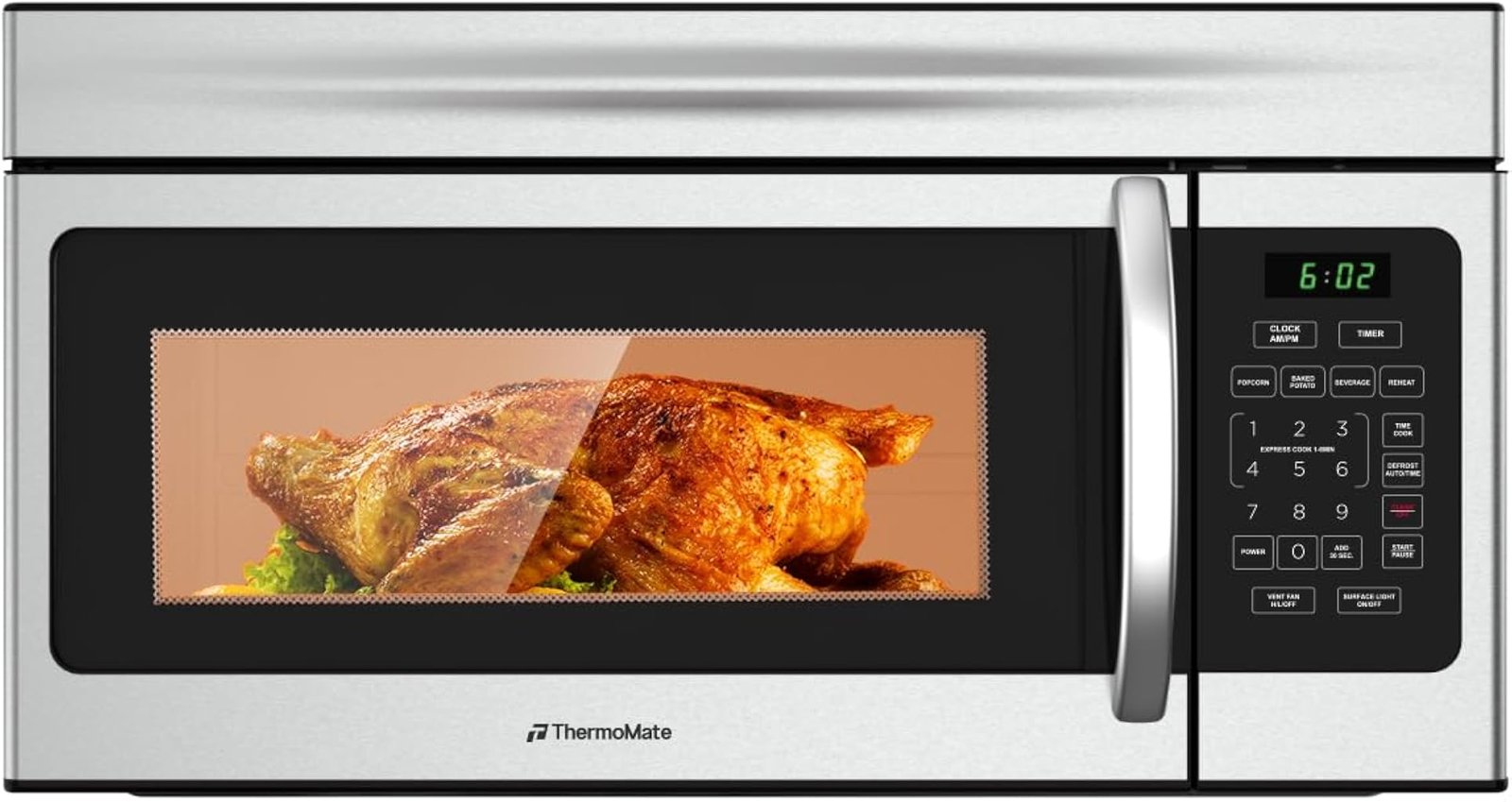
The ThermoMate 1.7 cu. ft. Over-the-Range Microwave approaches that assignment conventionally rather than theatrically. It is a 30-inch stainless-steel model with a 1.7 cu. ft. cavity, 1,000 watts of cooking power, 10 power levels, 300 CFM ventilation, two fan speeds, LED cooktop lighting, one-touch controls and a removable glass turntable. ThermoMate’s official listing confirms the 30-inch installation format and 1.7 cu. ft. capacity.
At $369.99, it enters a mature appliance category where practical details carry more weight than novelty. There is no elaborate connected ecosystem to justify, and no secondary cooking technology trying to turn the microwave into a countertop oven. This machine’s argument is simpler: provide conventional microwave cooking and basic range ventilation in the same 30-inch opening.
Our score is 8.52/10. Customer Sentiment is 8.5, Buyer Confidence reaches 8.88, and Value stands at 8.28. The relationship among those ratings is revealing. The product’s specifications make its purpose unusually easy to understand, which supports the higher Buyer Confidence figure. Value is more conditional because $369.99 buys competent fundamentals rather than unusually advanced cooking technology.
The Specifications Establish a Familiar Formula
ThermoMate lists the stainless-steel configuration with a 1.7 cu. ft. capacity, over-the-range installation, external ventilation, touch controls, 120-volt operation, 10 power levels and a child lock. Its dimensions are approximately 29.92 inches wide, 15 inches deep and 16.42 inches high.
Those measurements immediately establish the intended installation environment. This is a conventional 30-inch over-the-range appliance, not a compact model attempting to squeeze into unusually narrow cabinetry.
The capacity also fits the physical format sensibly. At 1.7 cu. ft., the cavity offers substantially more room than compact microwaves while avoiding the larger exterior demands associated with some high-capacity machines.
The specification that deserves particular attention is not capacity, however. It is the combination of 1,000 watts and 10 selectable power levels.
Microwave wattage describes maximum cooking output, while power-level adjustment governs how aggressively that energy is applied during different jobs. Maximum output suits many reheating tasks. Defrosting, melting and softening often require less aggressive treatment.
That distinction sounds obvious, yet it is frequently buried beneath preset counts and decorative interface features. A useful microwave buying guide should place basic power control ahead of novelty because those controls affect everyday cooking far more often.
1.7 cu. ft. Is a Practical Household Capacity
Capacity figures become meaningful only when connected to actual kitchen behavior.
A 1.7 cu. ft. cavity is large enough to position the ThermoMate as a primary household microwave rather than a compact supplemental appliance. ThermoMate specifically associates the capacity with dinner plates, bowls and family meals, while the removable glass turntable rotates during operation.
Still, cubic footage should never be mistaken for a guarantee that every piece of cookware will fit.
A microwave cavity is a three-dimensional space constrained by width, depth, height, door geometry and turntable diameter. A large rectangular casserole dish can encounter a clearance problem even when the total cavity volume looks generous on paper.
The sensible pre-purchase exercise is therefore surprisingly low-tech: measure the widest plates and containers used regularly.
This matters more with an over-the-range microwave because returning or replacing the appliance is considerably more troublesome than moving a countertop machine. Mounting, electrical connections and ventilation make a dimensional mistake expensive in time even when the appliance itself can be returned.
The 1.7 cu. ft. specification is reassuring, but physical compatibility remains the better standard.
1,000 Watts Places Cooking Power Where It Needs to Be
The ThermoMate supplies 1,000 watts of cooking power. That figure is supported by the manufacturer’s current product information and sits alongside 10 adjustable power levels from 0% to 100%.
The specification is hardly exotic, which is precisely why it works.
For comparison, Whirlpool currently markets a 1.7 cu. ft. over-the-range microwave with the same 1,000-watt cooking output. The model also pairs 1.7 cu. ft. of capacity with 300 CFM ventilation, placing the ThermoMate’s central specifications within an established configuration for this appliance class.
That comparison is useful because it prevents specifications from sounding more exceptional than they are. ThermoMate is not rewriting the engineering conventions of the category. It is using a familiar combination of cavity size, microwave output and ventilation capacity.
For the buyer, familiarity can be useful. Packaged-food instructions and common microwave recipes are often easier to adapt to a 1,000-watt machine than to a substantially lower-output compact oven.
Ten power levels also allow the machine to reduce intensity for tasks that do not benefit from maximum output.
The Presets Are Focused on Familiar Food
ThermoMate identifies four automatic cooking programs on the stainless-steel configuration: reheat, popcorn, baked potato and beverage. It also provides a quick-cook function that can add 30 seconds.
There is restraint in that feature list.
Microwave control panels can accumulate dozens of labeled functions, many of which merely encode combinations of time and power that a user could enter manually. A smaller group of frequently used presets can be easier to navigate.
Reheat is likely to see regular use. Popcorn remains a conventional microwave shortcut. Beverage and baked-potato settings address foods with familiar heating patterns. The Add 30 Seconds function may prove more consequential than any named preset because microwave use often consists of short adjustments rather than full programmed cycles.
That is one of the small ironies of appliance design. The feature requiring the least explanation can become the one pressed most frequently.
The ThermoMate’s interface appears to understand that reality.
The 300 CFM Ventilation System Needs Context
The microwave’s second job begins underneath the cavity.
ThermoMate rates the ventilation system at up to 300 CFM with two fan speeds. The manufacturer says the system is intended to address smoke, steam and cooking odors generated below the microwave.
CFM means cubic feet per minute. It describes airflow volume, but the headline number does not describe the entire installed ventilation system.
Duct layout, restrictions and installation configuration affect actual performance. Whirlpool explicitly adds a qualification to the 300 CFM rating on one of its comparable 1.7 cu. ft. models, stating that performance varies with installation.
That qualification applies as a useful general principle even though it is attached to Whirlpool’s own appliance.
Air does not care about the number printed on the carton. Long ducts, turns and restrictions create resistance. A nominal fan rating should therefore be interpreted as a capability figure, not a guarantee that every installation will move exactly that amount of air through the exterior vent.
For routine cooking, 300 CFM is a recognizable specification in mainstream over-the-range microwaves. Whirlpool sells a 1.7 cu. ft. model using the same two-speed, 300 CFM configuration.
For frequent high-heat frying, heavy searing or cooking that generates substantial grease and smoke, a dedicated range hood may offer a more suitable ventilation strategy. The ThermoMate should not be asked to become something its specification does not claim to be.
External Venting Is a Meaningful Detail
ThermoMate lists the stainless-steel model’s ventilation type as external.
That detail deserves more attention than it normally receives.
An externally vented system moves captured cooking air through ductwork away from the kitchen. A recirculating configuration instead filters air before returning it to the room. Those approaches are not equivalent when moisture, heat and airborne cooking residue are considered.
External ventilation makes the ThermoMate more dependent on correct installation, but it also gives the system a direct route for removing captured air.
Existing kitchens should therefore be inspected before the microwave is ordered. A cabinet opening that measures 30 inches does not by itself establish installation readiness. Duct position, electrical supply, mounting surfaces and clearance above the cooking appliance also matter.
The microwave may be a single product, but installation is a small construction project.
Two Fan Speeds Keep Ventilation Simple
The ThermoMate provides two ventilation speeds rather than an elaborate range of fan settings.
There are obvious limitations to that simplicity. A system with more speed increments can give users finer control over noise and airflow.
Yet two speeds cover the basic distinction most users need: lower airflow for moderate steam or odors and higher airflow when cooking activity increases.
More settings are not automatically more useful. The practical question is whether the available settings correspond to real behavior in the kitchen.
The larger concern is maximum capacity. No number of intermediate buttons changes the 300 CFM ceiling. Buyers whose cooking habits demand substantially greater extraction should focus on airflow and duct design rather than fan-speed count.
Cooktop Lighting Adds a Second Everyday Function
The ThermoMate integrates LED lighting above the range. The stainless-steel configuration is described with cooktop illumination intended to improve visibility over the stove.
This feature rarely dominates appliance comparisons, yet it is used independently of the microwave cavity.
An over-the-range appliance replaces the physical space where a conventional hood would normally provide task lighting. Weak illumination can therefore affect stovetop use even when microwave cooking is satisfactory.
LED lighting has practical advantages for this location, particularly low electrical consumption and reduced heat generation compared with older incandescent designs.
The broader lesson is that over-the-range microwaves should be evaluated as kitchen infrastructure rather than solely as food-heating boxes. Fan controls and lighting may be used every day without the microwave magnetron operating at all.
The Turntable Is Conventional for Good Reason
ThermoMate uses a removable glass turntable that rotates through 360 degrees during cooking.
Rotating food through the microwave field is an established method of reducing uneven exposure. It cannot guarantee perfectly uniform temperatures because food composition, shape and density also influence heating, but rotation helps change the food’s position during operation.
The removable design also matters for cleaning.
Microwave spills have an unfortunate habit of reaching the surface most inconvenient to wipe. A removable glass plate can be taken to the sink rather than cleaned entirely inside the cavity.
There is little glamour here, and none is needed. The turntable performs a straightforward mechanical job and can be removed when cleaning becomes necessary.
Safety Is More Prosaic Than Popular Anxiety Suggests
Microwave discussions still attract concerns about radiation that can obscure more common household hazards.
The FDA’s microwave oven safety guidance explains that a federal standard limits microwave leakage throughout an oven’s lifetime to 5 milliwatts per square centimeter at approximately two inches from the oven surface. The agency says this limit is “far below the level known to harm people.”
Federal requirements also call for two independent interlock systems that stop microwave production when the latch is released or the door opens.
Those protections do not eliminate ordinary kitchen hazards.
Hot liquids can scald. Steam can burn. Containers can become hot through contact with heated food. An over-the-range microwave also places hot dishes above the cooktop, making installation height and user reach relevant to daily safety.
ThermoMate includes a child safety lock on the stainless-steel configuration. That feature can reduce accidental operation, but it does not alter the need for normal supervision around hot food and cooking appliances.
Installation Determines Whether the Design Works
The ThermoMate measures approximately 29.92 inches across, 15 inches deep and 16.42 inches high according to the manufacturer’s stainless-steel listing. It operates at 120 volts and 60 Hz.
These figures should be checked against the actual installation space rather than assumed compatible because the existing appliance is also described as “30 inch.”
Cabinets are not always perfectly square. Previous installations may have altered mounting holes or duct positions. Backsplashes can affect usable clearances. Electrical outlets may sit where the replacement chassis needs space.
The correct sequence is measurement first, model selection second and installation planning third.
This is especially relevant when replacing a different brand. Nominal width establishes category compatibility, not identical mounting geometry.
Professional installation may add cost, but improper mounting or ventilation can undermine the advantages that justified buying an over-the-range design in the first place.
The $369.99 Price Needs Category Context
At $369.99, the ThermoMate is not competing with inexpensive countertop microwaves. That comparison would ignore half of the appliance.
The buyer is paying for microwave cooking, an over-the-range mounting format, integrated ventilation and cooktop lighting in one chassis.
The specifications themselves are not unusual for the category. Whirlpool currently offers 1.7 cu. ft., 1,000-watt over-the-range models with 300 CFM ventilation, demonstrating that the ThermoMate’s central architecture follows an established pattern rather than an unusual technical formula.
That context helps explain our Value score of 8.28.
The ThermoMate offers the core functions expected from its format, but $369.99 still demands that those functions match the kitchen. A household that already has excellent dedicated ventilation and ample counter space may gain less from the combined architecture.
A kitchen specifically needing a 30-inch microwave-and-hood combination extracts more utility from the same expenditure.
Value therefore depends heavily on avoiding redundant equipment.
Where the Editorial Scores Land
Our overall score is 8.52/10.
That rating reflects a product with a coherent specification set: 1.7 cu. ft. capacity, 1,000 watts, 10 power levels, 300 CFM ventilation, one-touch cooking, external venting and LED lighting. Nothing about that configuration requires imaginative interpretation.
Customer Sentiment stands at 8.5, almost exactly aligned with the overall rating. The figure reflects a product whose strengths are practical rather than experimental. Its appeal rests on recognizable household functions.
Buyer Confidence is higher at 8.88. ThermoMate publishes the important installation and performance specifications directly, reducing uncertainty about what the appliance is intended to do.
Value is lower at 8.28. That gap is justified. The product combines several useful functions, but it does so with mainstream specifications rather than unusually high ventilation capacity, advanced sensing or connected controls.
The ratings therefore describe consistency more than spectacle. The ThermoMate is easiest to recommend conceptually when a kitchen needs exactly the conventional over-the-range package it provides.
Strengths That Matter in Daily Use
Several features carry practical weight:
- The 1.7 cu. ft. cavity provides useful household capacity without moving beyond the conventional 30-inch format.
- The 1,000-watt cooking output aligns with an established power level for full-size household microwaves.
- Ten adjustable power levels allow less aggressive heating for defrosting, melting and similar tasks.
- Four automatic programs address familiar foods rather than obscure preset categories.
- The Add 30 Seconds function supports rapid adjustments during ordinary use.
- A 300 CFM, two-speed fan combines ventilation with microwave placement.
- External venting gives captured cooking air a route outside when the installation is configured correctly.
- LED cooktop lighting adds useful task illumination.
- The removable glass turntable simplifies routine cleaning.
- A child safety lock helps prevent accidental operation.
- The stainless-steel exterior fits a common contemporary appliance finish without demanding a highly stylized kitchen.
The broader strength is integration. Each major feature corresponds to something a conventional over-the-range microwave is expected to accomplish.
Drawbacks That Deserve Equal Weight
The first limitation is ventilation capacity. A 300 CFM maximum is a mainstream specification, but demanding cooking conditions can justify a more capable dedicated hood.
Second, there are only two fan speeds. Buyers seeking finer ventilation control will find limited adjustment.
Third, the machine does not offer smart-home compatibility according to ThermoMate’s current product information. That omission will be irrelevant to many households and meaningful to others.
Fourth, over-the-range installation inherently creates more work than replacing a countertop microwave. Mounting, ducting, clearances and electrical access all have to cooperate.
Fifth, the feature set is intentionally conventional. Buyers seeking convection cooking, air frying or a more elaborate sensor-cooking system should recognize that this product’s emphasis lies elsewhere.
Finally, price should be assessed against the full installed project. The appliance may cost $369.99, but cabinetry or duct modifications can change the actual expenditure.
None of these drawbacks makes the ThermoMate poorly designed. They establish its boundaries.
Who Is Most Likely to Appreciate It?
The strongest buyer fit is a household replacing or installing a conventional 30-inch over-the-range microwave and wanting a familiar feature set without unnecessary connected functions.
It also makes sense in kitchens where countertop area is limited. Moving the microwave above the range releases work surface while combining two appliance functions in one location.
The 1.7 cu. ft. capacity should suit households that regularly heat full-size plates and moderate serving dishes, although frequently used cookware should still be measured.
The product is less suitable for serious high-heat cooking environments where ventilation is the dominant requirement. A dedicated hood with greater airflow may deserve priority there.
It is also less compelling for someone seeking multifunction cooking technologies. This is not an air-fryer microwave, convection oven or elaborate connected cooking system. Its job description is narrower.
That narrower purpose is not inherently a weakness. Appliances often become easier to evaluate when they stop pretending to replace everything else in the kitchen.
What a Microwave Buying Guide Should Check Before Purchase
The ThermoMate illustrates a sensible order for evaluating over-the-range microwaves.
First, measure the opening. Confirm width, depth, height and the relationship between the cabinet and cooking surface.
Second, inspect ventilation. Determine where the existing duct runs and whether it matches the installation configuration.
Third, verify electrical access. A nominally correct cabinet opening is not installation-ready if the power arrangement conflicts with the appliance.
Fourth, measure cookware. Capacity figures should be tested against the dishes the household actually uses.
Fifth, evaluate cooking power and controls. The ThermoMate’s 1,000 watts and 10 power levels provide a straightforward foundation.
Sixth, assess ventilation against cooking habits. Someone who boils pasta and reheats soup presents a different ventilation workload from someone who regularly sears meat at high heat.
Only after those questions are answered does price become especially informative.
That sequence turns microwave shopping from feature collecting into kitchen planning.
Final Considerations
The ThermoMate 1.7 cu. ft. Over-the-Range Microwave is refreshingly straightforward once its specifications are separated from marketing language. It is a 30-inch stainless-steel microwave with 1.7 cu. ft. of capacity, 1,000 watts of cooking power, 10 power levels, one-touch programs, a removable turntable, 300 CFM two-speed ventilation, external venting, LED cooktop illumination and a child safety lock.
Our 8.52/10 score reflects the coherence of that package. Customer Sentiment at 8.5 stays closely aligned with the overall assessment. Buyer Confidence reaches 8.88 because the product’s identity, dimensions and major specifications are clearly established. Value at 8.28 reflects a more conditional judgment: $369.99 makes sense when the combined microwave-and-ventilation format solves a real kitchen requirement.
Its compromises are equally visible. The ventilation system is rated at 300 CFM rather than engineered as a substitute for every dedicated range hood. Two fan speeds offer basic rather than granular airflow control. The product does not attempt to fold air frying, convection cooking or smart-home features into the package.
For some buyers, those omissions will narrow its appeal. For others, they remove distractions.
An over-the-range microwave ultimately succeeds by making several repetitive kitchen tasks easier without creating new spatial problems. Food needs to fit. Controls need to make sense. Hot dishes need to be reachable. The fan needs to match cooking habits. Lighting needs to illuminate the range. The chassis needs to fit the cabinet opening.
The ThermoMate addresses those requirements with conventional engineering rather than novelty. That makes the installation plan-not the longest feature list-the deciding factor.
Where a 30-inch opening, 1.7 cu. ft. cavity, 1,000-watt microwave and 300 CFM externally vented fan correspond to the kitchen’s actual needs, the ThermoMate presents a coherent package. Where ventilation demands are substantially higher or advanced cooking modes are a priority, another appliance category will make more sense.
That is a useful dividing line for a product designed to live above a stove for years: buy for the kitchen that exists and the cooking that actually happens there, not for specifications that merely look impressive on a comparison page.