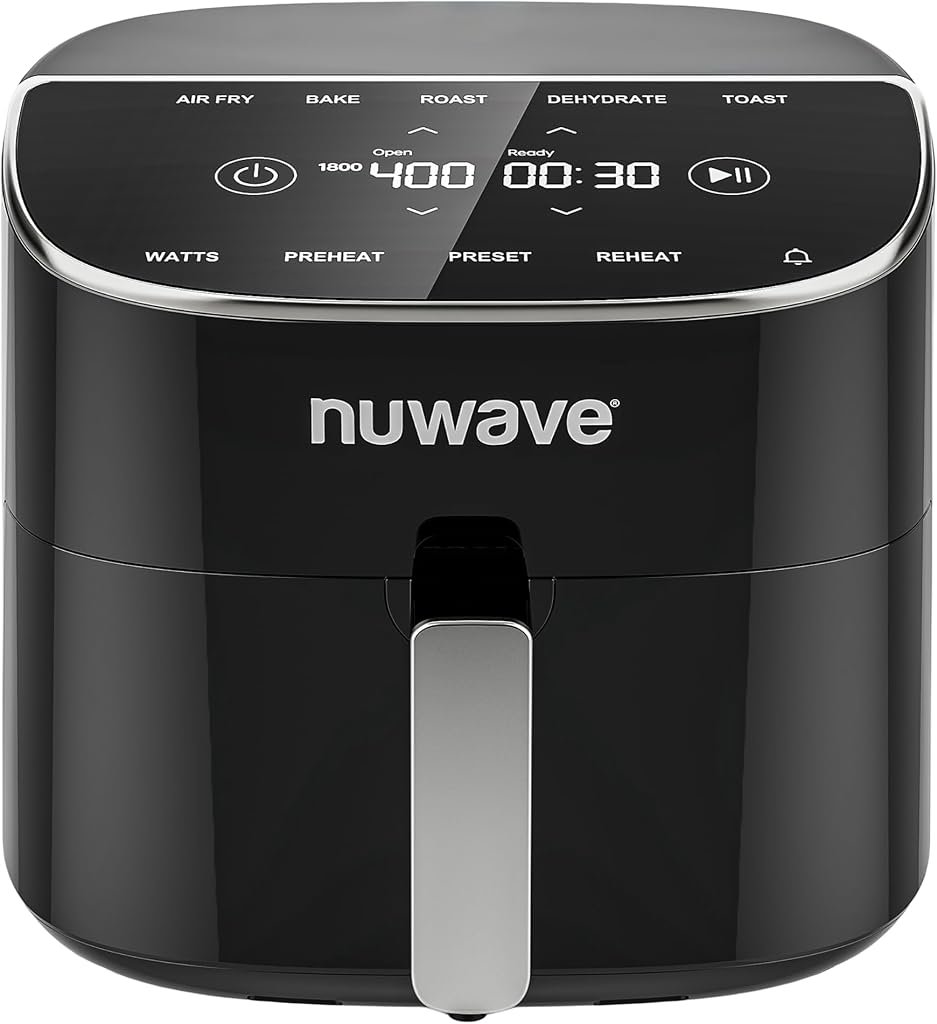
The Nuwave Brio Plus Air Fryer takes a different route from the increasingly elaborate dual-basket machines competing for kitchen counters. There is one 8-quart cooking chamber, one control system and a design centered on temperature adjustment rather than simultaneous independent zones.
That relative simplicity should not be mistaken for a lack of engineering ambition.
The current Nuwave Brio Plus 8 QT Air Fryer is rated at 1,800 watts and provides an unusually broad 50°F to 400°F temperature range adjustable in 5°F increments. Nuwave lists five cooking functions, a digital touch interface, an 8-quart capacity, an air-circulation riser and automatic pause-and-resume behavior when the basket is opened and closed. The company also specifies a ceramic cooking surface without PFAS.
The result is an air fryer whose identity depends less on adding multiple cooking chambers and more on giving one chamber relatively fine temperature control.
Our score is 8.55/10. Customer Sentiment stands at 8.28, Buyer Confidence at 9.8 and Value at 8.15. Those figures describe an appliance with a clearly defined purpose and straightforward buyer fit, but also one facing intense competition from dual-zone and convertible-basket alternatives. Buyer Confidence is particularly high because the Brio Plus is easy to evaluate before purchase: its dimensions, capacity, power requirement, temperature range and basket format are clearly defined.
Eight Quarts Provide Meaningful Single-Basket Capacity
An 8-quart basket sits in an interesting part of the air-fryer market.
It is substantially removed from the compact personal fryers intended for snacks or one modest portion, yet it avoids the permanent split found in many large dual-zone appliances.
That distinction affects what can physically fit.
Two 4-quart baskets may provide the same total numerical capacity as one 8-quart chamber, but food does not experience capacity as arithmetic. A whole chicken, broad layer of vegetables or larger piece of meat benefits from uninterrupted space.
The Brio Plus therefore favors continuous capacity over independent capacity.
That creates an obvious trade-off.
A cook preparing chicken at one temperature and vegetables at another cannot assign them separate environments simultaneously. Either the foods need compatible settings, one needs to join the basket later, or they must cook sequentially.
Yet the single chamber offers freedom from a permanent central divider.
For households that frequently cook one large item or one substantial batch, that can be more useful than having two smaller zones.
The distinction should influence any comparison among the best air fryers. Total quart capacity alone says remarkably little about how an appliance behaves with real food. Basket geometry determines whether that capacity is available as one space or fragmented across several compartments.
The 50°F To 400°F Range Is Unusually Broad
Nuwave gives the Brio Plus a temperature range from 50°F to 400°F, adjustable in 5°F increments.
The upper boundary is familiar. Many air-frying tasks occur near the hotter end of the scale because browning and moisture removal benefit from high heat and rapid airflow.
The 50°F lower boundary is more distinctive.
Low temperatures widen the range of possible heating and drying tasks. They also give the control system considerably more granularity than an appliance restricted to conventional high-temperature air frying.
The 5°F adjustment interval deserves attention too.
A cook can move from 350°F to 355°F rather than jumping between broad temperature steps. That precision does not guarantee that the actual temperature of every point inside the basket will remain exactly at the selected number. Real cooking chambers contain airflow patterns, food moisture, thermal inertia and thermostat behavior.
What the fine adjustment does provide is control resolution.
That distinction is important.
A control panel can allow precise input without implying laboratory-level uniformity throughout the chamber. Nuwave’s design gives the user more precise commands; food, airflow and heating hardware determine how those commands translate into cooking.
Linear T Technology Is The Central Heating Claim
Nuwave describes its heating system as Linear T Technology and says the Brio Plus maintains steady heat across its 50°F to 400°F operating range rather than relying on broad temperature fluctuations. The company also identifies a five-coil heating tube and nine-blade fan as parts of its 360-degree baking system.
These claims are more relevant than a long list of decorative presets because they concern the mechanism doing the cooking.
Air fryers are convection appliances.
The heating element raises air temperature while the fan moves that heated air around the food. Basket design then determines how easily the air reaches different surfaces.
Nuwave’s combination of a multi-coil heater, fan and circulation riser is therefore directed at the basic engineering problem every basket fryer faces: distributing heat across a compact chamber.
The system does not eliminate the influence of food placement.
A thick pile of fries still obstructs airflow differently from a shallow layer. Large pieces of meat still create thermal mass. Moist foods still release water vapor.
Heating control can manage the air entering that environment. It cannot make the contents irrelevant.
The Air Circulation Riser Has A Practical Purpose
The Brio Plus uses an air circulation riser inside its base tray rather than treating the bottom of the basket as one uninterrupted flat surface.
The Brio Plus owner’s manual identifies the power base, base tray, air circulation riser, silicone components and rubber feet among the main parts. It also instructs owners not to operate the appliance without the base tray or circulation riser.
The riser’s purpose fits the broader logic of air frying.
Food needs separation from the bottom of the tray so heated air can reach more of its surface. A raised cooking surface provides space beneath ingredients and gives moving air another path through the chamber.
That does not guarantee perfectly uniform browning.
Contact points between food and the riser receive different exposure from surfaces facing directly into moving air. Dense loading can still create sheltered areas.
Shaking, turning or rearranging appropriate foods can therefore remain useful even in a carefully engineered circulation system.
Five Cooking Functions Keep The Interface Focused
Nuwave describes the Brio Plus as a five-function appliance. Its controls include Air Fry, Bake, Roast, Dehydrate and Toast.
The restrained function count is refreshing in a category where preset numbers can become detached from meaningful hardware differences.
Selecting Bake rather than Air Fry does not physically transform the appliance into a conventional oven. The same chamber, fan and heater remain present. Cooking modes change how those components are controlled.
That is not a criticism.
Presets are useful when they provide repeatable starting conditions for familiar jobs. The problem arises when the sheer number of modes is treated as a measure of cooking capability.
The Brio Plus avoids much of that distraction.
Air Fry addresses high-convection cooking. Bake and Roast broaden the appliance toward oven-style preparation. Dehydrate makes use of lower temperatures and longer durations. Toast addresses another common dry-heat task.
The machine’s larger advantage remains its adjustable temperature system rather than the labels attached to five buttons.
1,800 Watts Is Serious Countertop Power
Nuwave rates the current Brio Plus 8 QT at 1,800 watts.
That is a substantial electrical load for a countertop appliance.
The rating should not be interpreted as a statement that every cooking cycle consumes 1.8 kilowatt-hours. Watts describe power. Energy consumption depends on power across time, and heating controls alter electrical demand as cooking progresses.
Still, placement should account for the appliance’s electrical requirements.
A high-power heating appliance deserves an appropriate outlet and adherence to the manufacturer’s safety instructions. The Brio Plus should not be treated like a trivial low-power accessory simply because it sits on a counter.
The wattage also makes sense in relation to the basket.
Eight quarts represent meaningful cooking volume. Heating a chamber of that scale rapidly requires considerable thermal output, particularly when cold or frozen food is introduced.
Power, capacity and cooking time are connected variables.
A low-wattage appliance is not automatically more economical if it needs substantially longer to perform the same job.
Energy Use Is More Complicated Than Wattage
The common claim that air fryers save electricity deserves more precision than it often receives.
The USDA describes air fryers as essentially countertop convection ovens and states that they can cook faster and consume less energy than larger ovens.
Independent testing helps put that general statement into numbers.
A September 2026 Which? comparison between an air fryer and built-in electric oven measured 0.54 kWh for an air-fried roast chicken against 1.157 kWh for the oven. Cooking 320 grams of frozen chips required 0.287 kWh in the air fryer and 0.863 kWh in the oven.
A jacket potato consumed 0.392 kWh in the tested air fryer versus 1.084 kWh in the oven. Cake required 0.223 kWh compared with 0.71 kWh.
Those figures are measurements from the appliances Which? tested, not Brio Plus performance data.
Their relevance lies in the underlying pattern.
Which? science team leader Steph Kipling reported that its research found substantial savings particularly when cooking small amounts, while repeated batches reduced the advantage.
An 8-quart basket becomes interesting in that context.
It can accommodate more food than a compact fryer, potentially reducing the need for repeated cooking cycles. Yet a full-size oven retains far more absolute capacity and can cook several trays simultaneously.
The relevant energy question is therefore not whether 1,800 watts sounds high.
It is how much electricity is required to complete the entire meal.
The Basket-Open Sensor Is A Sensible Safety Feature
The Brio Plus automatically pauses cooking when its basket is opened and resumes after the basket is returned. Nuwave lists this behavior among the appliance’s safety features.
This is useful for a practical reason.
Air-fryer cooking often involves inspection. Food may need shaking, turning or checking before the programmed time expires. Opening the basket is part of ordinary use rather than an exceptional event.
Automatic pausing removes the need to stop the machine manually before every inspection.
It also makes the operating state easier to understand: basket out, cooking paused; basket in, cooking resumes.
The feature should not be confused with food-safety monitoring.
The appliance can detect the position of its basket. It cannot determine whether a chicken breast has reached a safe internal temperature.
Those are separate problems requiring separate tools.
Eight Quarts Still Cannot Be Packed Without Consequences
An 8-quart capacity sounds generous, and it is.
Yet air frying rewards restraint.
The USDA warns that overcrowding an air fryer can prevent adequate air circulation and contribute to uneven cooking or undercooking. Its guidance recommends cooking large quantities in batches when necessary rather than overfilling the basket.
This is fundamental to evaluating the Brio Plus.
An 8-quart basket should not be interpreted as a container that produces its best results when every available space is filled.
The useful advantage of additional capacity is often the opposite.
A larger basket can give the same amount of food more room.
Fries distributed across a broader area expose more surface to moving air than the same fries compressed into a smaller chamber. Chicken pieces separated from one another create better pathways for convection than tightly packed pieces.
Capacity can therefore improve cooking before it increases portion size.
That is a more useful way to think about the Brio Plus’s 8 quarts.
Food Safety Requires More Than Browning
Air frying produces visual changes quickly.
Surfaces brown. Breaded coatings become crisp. Chicken skin develops color. None of these observations establishes the internal temperature of the food.
The USDA specifies 165°F for poultry, 160°F for ground meats, and 145°F for fish. Whole cuts of beef, pork, veal and lamb require 145°F followed by a three-minute rest. These temperatures should be measured with a food thermometer.
The Brio Plus does not change those requirements.
Its 5°F control increments may give the cook precise command over the appliance’s selected temperature, but oven setting and food temperature are entirely different measurements.
A chicken breast cooking in 375°F air is not safe merely because the control panel displays 375°F.
Its center still needs to reach the appropriate minimum internal temperature.
This distinction becomes more important as basket loads increase because food thickness, spacing, starting temperature and moisture can change heating rates.
A thermometer remains one of the most useful accessories for any air fryer used with raw meat.
PFAS-Free Ceramic Coating Addresses A Specific Buyer Concern
Nuwave states that the Brio Plus uses a ceramic nonstick cooking surface free from PFAS. The owner’s manual similarly describes an all-natural ceramic coating applied to the cooking surface and identifies it as PFAS-free.
That specification is likely to matter to buyers deliberately avoiding fluorinated nonstick coatings.
The more practical issue after purchase is preserving the surface.
Nonstick coatings benefit from appropriate utensils and nonabrasive cleaning. The manual specifically cautions against using utensils to remove the circulation riser in a way that could scratch its coating.
This is where durability depends partly on owner behavior.
A ceramic surface can reduce sticking, but it should not be treated like bare stainless steel. Aggressive scraping or abrasive cleaning can shorten the useful life of a coated cooking surface.
The riser and tray therefore reward routine cleaning before residue becomes heavily baked on.
The Brio Plus Is Compact Relative To Its Capacity
Nuwave lists the current 8-quart model at 11.5 inches deep, 11.25 inches wide and 12.75 inches high, with a weight of 16 pounds.
Those figures are notable because 8-quart air fryers can become physically imposing.
The Brio Plus’s relatively square footprint avoids the extreme width of a side-by-side dual-basket machine.
That can make it easier to place on counters where lateral space is scarce.
The trade-off is already familiar: there is only one cooking zone.
Counter efficiency therefore depends on what the household wants the appliance to accomplish.
A family that regularly needs two independent temperatures may accept a wider dual-zone fryer. A household prioritizing uninterrupted basket space may find the Brio Plus’s shape more rational.
Sixteen pounds also makes the appliance more movable than some 20- to 25-pound XL dual-zone competitors, though repeated cabinet storage still introduces friction.
Measuring the intended location remains sensible.
Product photography rarely communicates appliance scale as reliably as a tape measure.
Cleaning Is Simpler Than A Dual-Basket System
One basket has an obvious maintenance advantage over two.
The Brio Plus uses a base tray and removable air circulation riser rather than two independent baskets, two crisper plates and additional dividers or racks. Its manual provides separate cleaning and maintenance instructions for these components.
Fewer major food-contact pieces generally mean fewer objects moving between counter, sink and drying rack.
That does not make cleaning optional.
Grease and food residue repeatedly exposed to high heat can smoke, smell and become harder to remove. The circulation riser also creates edges and contact points where residue can collect.
The most practical cleaning strategy is routine rather than heroic.
Allow the hot components to cool, remove food residue before it hardens through repeated heating cycles and avoid abrasive treatment of the coated surfaces.
The Brio Plus’s relatively simple basket architecture makes that process easier to understand.
Where The Brio Plus Is Strongest
The Brio Plus’s strengths form a fairly coherent group:
- Its 8-quart basket provides substantial uninterrupted cooking capacity.
- The 50°F to 400°F temperature range covers both low-temperature and high-heat tasks.
- Temperature can be adjusted in 5°F increments.
- Nuwave specifies a five-coil heating tube and nine-blade fan in its heating architecture.
- Five cooking functions cover Air Fry, Bake, Roast, Dehydrate and Toast.
- The ceramic cooking surface is specified as PFAS-free.
- Opening the basket automatically pauses cooking, with operation resuming after reinsertion.
- Its approximately 11.25-inch width is relatively modest for an 8-quart single-basket appliance.
- The current model carries a one-year manufacturer warranty.
The pattern is clear.
This is an appliance focused on one comparatively large cooking chamber and unusually granular temperature adjustment rather than dual-zone scheduling.
The Limitations Are Equally Clear
The Brio Plus cannot cook two foods under independent settings simultaneously.
That is the largest structural difference between it and a dual-zone fryer.
A household preparing a main and side at different temperatures must manage timing manually or cook them separately.
The 400°F ceiling is also conventional rather than unusually high. Competing fryers reaching 450°F may appeal to buyers prioritizing maximum-temperature crisping, though maximum temperature alone does not determine cooking quality.
Then there is the 1,800-watt electrical rating.
It provides substantial heating capability but also represents a serious countertop electrical load.
The appliance’s single basket is both its advantage and its restriction.
There is no permanent divider stealing space from broad foods, but there is also no second independently controlled chamber waiting beside it.
The right choice depends on which limitation matters less.
Interpreting Our 8.55/10 Score
Our overall score for the Nuwave Brio Plus Air Fryer is 8.55/10.
That rating reflects an appliance with a focused design, substantial 8-quart capacity and unusually fine temperature adjustment. Its 50°F lower boundary broadens the useful heating range, while the ceramic PFAS-free cooking surface addresses a specific material preference among buyers.
Customer Sentiment stands at 8.28.
The figure sits below our overall score because the Brio Plus occupies a difficult middle position. It is large enough to demand meaningful counter space and electrical power, yet it lacks the independent cooking zones increasingly common among large-capacity competitors.
Buyer Confidence reaches 9.8.
That is the strongest rating because the purchasing decision can be made with relatively little ambiguity.
The basket is one uninterrupted 8-quart chamber. The machine is 11.5 by 11.25 by 12.75 inches. It weighs 16 pounds. It draws 1,800 watts. Its temperature range runs from 50°F to 400°F in 5°F increments. Nuwave states that its ceramic cooking surface is PFAS-free.
Those are concrete characteristics a household can compare directly with its cooking habits and kitchen.
Value is 8.15.
That score recognizes a competitive category where an 8-quart single-basket fryer must justify itself against both cheaper compact appliances and more elaborate dual-zone designs.
The Brio Plus creates value when the buyer actually benefits from its large uninterrupted chamber, broad temperature range and precise controls.
If independent simultaneous cooking is the priority, the value equation changes.
Who Is The Brio Plus For?
The strongest candidate is a household wanting substantial single-basket capacity without the width of a conventional dual-drawer fryer.
It is also a logical fit for cooks who care about low-temperature flexibility and fine temperature adjustments.
The 8-quart chamber gives larger foods room that permanently divided baskets cannot provide. That can matter for whole proteins, larger batches of vegetables and foods whose shape does not cooperate with narrow drawers.
The Brio Plus is less compelling for households routinely preparing two unrelated foods at once.
A dual-zone fryer handles that workflow more naturally because each basket can receive separate settings.
Small households face another calculation.
Eight quarts can provide useful room for batch cooking, but someone preparing one modest portion at a time may find a smaller fryer easier to store, clean and justify.
The Brio Plus therefore works best when its uninterrupted capacity is an asset rather than unused space.
Final Considerations
The Nuwave Brio Plus Air Fryer is an 8-quart, 1,800-watt single-basket appliance built around precise temperature control rather than multiple independent cooking zones. Its operating range extends from 50°F to 400°F in 5°F increments, while five cooking functions cover Air Fry, Bake, Roast, Dehydrate and Toast. Nuwave also specifies a five-coil heating tube, nine-blade fan, automatic basket-open pause and PFAS-free ceramic cooking surface.
Its strongest characteristic is the combination of uninterrupted basket space and fine control.
An 8-quart single chamber can accept foods that may fit awkwardly into divided fryers. The broad temperature range gives the appliance work beyond conventional high-heat air frying. The relatively modest 11.25-inch width also limits the lateral counter space demanded by that capacity.
Its weaknesses follow from the same architecture.
There is no second cooking zone. Different foods requiring incompatible temperatures cannot run independently. The 1,800-watt rating deserves appropriate electrical placement. An 8-quart basket can still produce poor results when overloaded because convection depends on air movement.
USDA guidance reinforces that last point: overcrowding can interfere with circulation and lead to uneven or inadequate cooking. Safe internal temperatures still need verification with a food thermometer regardless of how browned the exterior appears.
Our 8.55/10 score reflects an appliance with a clear technical identity rather than an attempt to imitate every competing format. Customer Sentiment at 8.28 acknowledges the compromises of a large single-zone design. Buyer Confidence at 9.8 reflects how easily its fit can be evaluated before purchase. Value at 8.15 recognizes that fine temperature control and an uninterrupted 8-quart basket will matter far more to some households than others.
For buyers comparing the best air fryers, the Brio Plus raises a useful question: is one large, precisely controlled cooking chamber more useful than two smaller independent ones?
There is no universal answer because the foods determine the geometry.
A household regularly cooking broad items or one substantial batch can make good use of the Nuwave’s uninterrupted basket. A household routinely preparing a protein and side at different temperatures may gain more from a dual-zone machine.
The Brio Plus does not disguise that choice.
Its 8-quart chamber, 50°F to 400°F range, 5°F adjustment steps and relatively compact footprint establish a specific proposition: one sizable cooking space with unusually granular control.
That focus is why the Brio Plus earns an 8.55/10 editorial score. It avoids unnecessary complexity while providing enough capacity and temperature flexibility to handle a broad range of everyday cooking.
The final buying decision should therefore begin with the meal rather than the control panel. If the household usually needs one generous convection chamber, the Brio Plus makes a coherent case. If dinner regularly demands two independent cooking environments, its greatest strength-the single uninterrupted basket-also becomes its defining limitation.