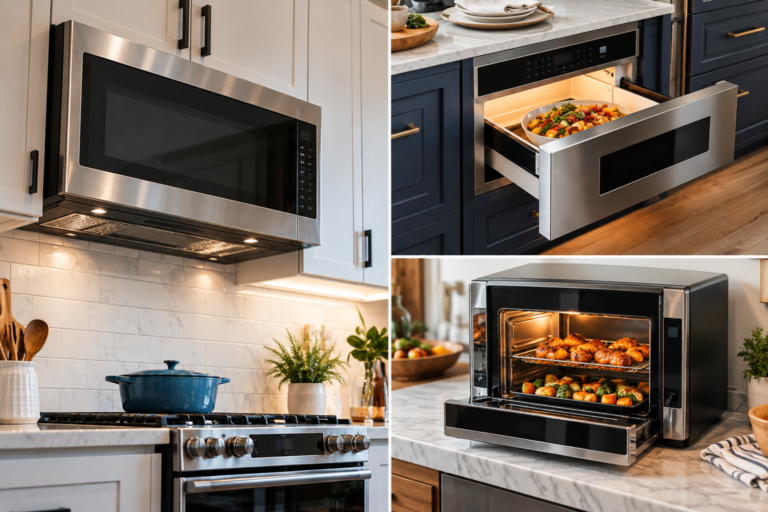
Microwave capacity looks wonderfully mathematical. A 1.9-cu.-ft. oven is larger than a 1.7-cu.-ft. oven, which is larger than a 1.2-cu.-ft. oven. The numbers are indisputable. Their usefulness, however, is much less straightforward.
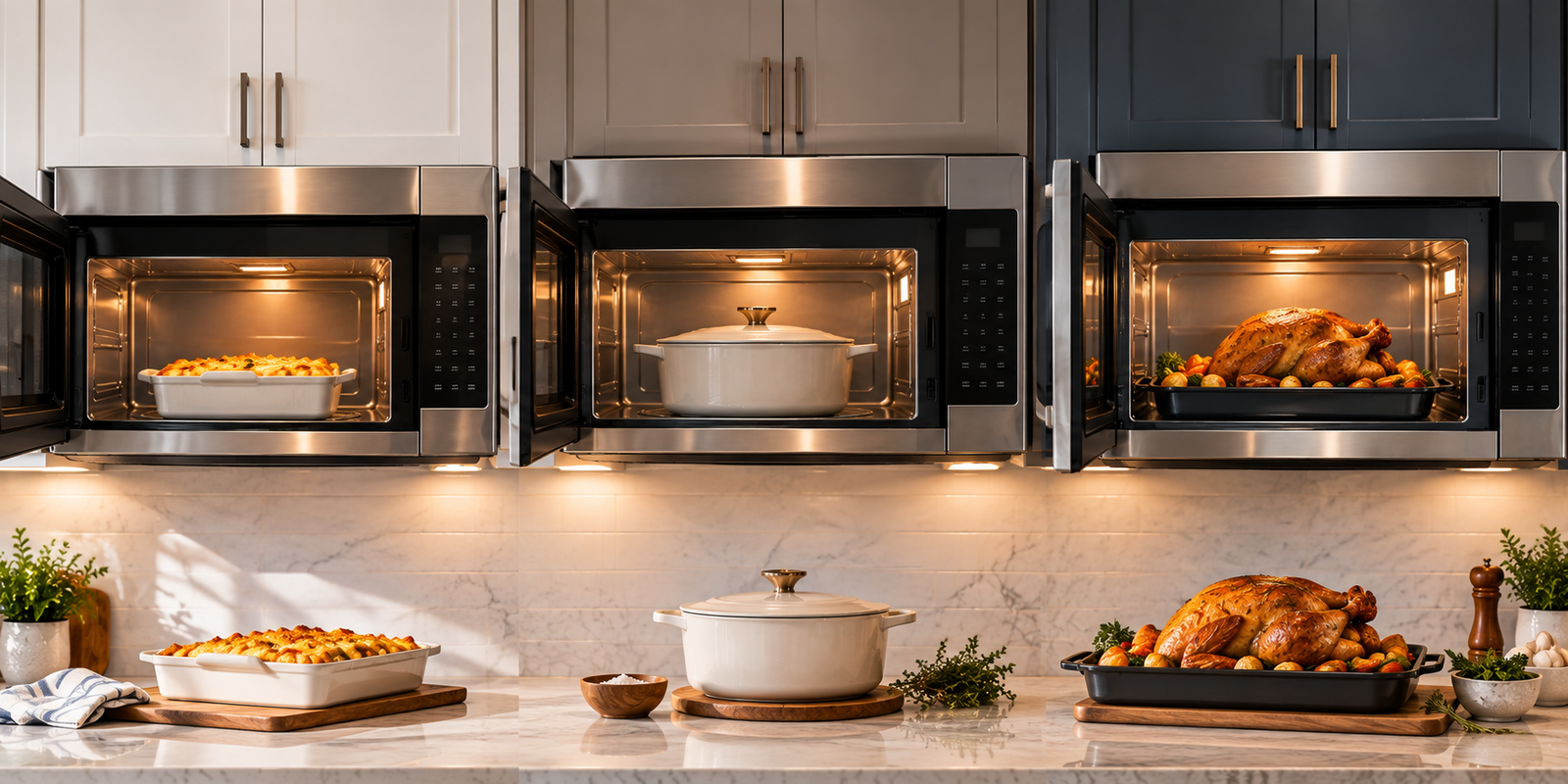
A microwave does not cook cubic feet. It cooks plates, bowls, casserole dishes, vegetables, frozen meals and yesterday’s dinner. That distinction is where a sensible microwave buying guide begins.
Moving from 1.2 to 1.7 cu. ft. increases stated cavity volume by about 42%. Moving from 1.7 to 1.9 cu. ft. adds only about 12%. Across the full 1.2-to-1.9 range, the numerical increase is approximately 58%.
Those percentages sound substantial, particularly at the lower end. Yet a 58% increase in cubic capacity does not necessarily produce 58% more useful cooking space. Interior width, height, depth, turntable diameter, rack configuration and the shape of the cavity determine whether that additional volume helps with actual cookware.
Installation format complicates the picture further. A 1.2-cu.-ft. countertop microwave and a 1.9-cu.-ft. over-the-range microwave solve different spatial problems. The first consumes counter area. The second consumes space above the range and may double as the cooktop ventilation system.
Capacity, then, is not a hierarchy in which 1.9 automatically defeats 1.7 and 1.7 automatically defeats 1.2. It is a sizing decision.
The Capacity Numbers Are More Different Than They Look
The arithmetic provides a useful starting point:
| Capacity | Volume in Cubic Inches | Increase From Previous Size | Typical Buying Question |
|---|---|---|---|
| 1.2 cu. ft. | 2,073.6 cu. in. | – | Will everyday plates and bowls fit without wasting counter space? |
| 1.7 cu. ft. | 2,937.6 cu. in. | 41.7% over 1.2 | Is more room needed for family-size dishes or an OTR installation? |
| 1.9 cu. ft. | 3,283.2 cu. in. | 11.8% over 1.7 | Will the extra cavity room actually accommodate larger cookware? |
One cubic foot contains 1,728 cubic inches. Multiplying that figure by each stated capacity shows how much theoretical interior volume separates the three classes.
The jump from 1.2 to 1.7 cu. ft. adds 864 cubic inches. The jump from 1.7 to 1.9 adds only 345.6 cubic inches.
That asymmetry deserves attention.
A shopper moving from 1.2 to 1.7 is making a comparatively large capacity change. Someone deciding between 1.7 and 1.9 is working within a much narrower band.
This is one reason the 1.7-versus-1.9 decision should rarely be made from cubic feet alone.
A 1.2-cu.-ft. Microwave Is Not Necessarily Small in Practice
A 1.2-cu.-ft. microwave can make considerable sense for households whose microwave use revolves around individual meals, beverages, leftovers and routine reheating.
The key question is cookware compatibility.
If the household’s standard dinner plates rotate without striking the cavity walls, its bowls fit comfortably and its most frequently reheated containers clear the interior height, additional volume may accomplish little.
That is particularly true on a countertop.
Every increase in external microwave dimensions competes with food-preparation space. A larger appliance may technically provide more cooking capacity while making the kitchen less functional during the other 23 hours of the day.
This trade becomes more pronounced in apartments, galley kitchens, dorm-compatible settings, office kitchens and homes where several small appliances already compete for counter area.
A 1.2-cu.-ft. model can therefore be the rational choice for:
- One- or two-person households with modest microwave use.
- Kitchens where counter depth is restricted.
- Buyers primarily reheating individual portions.
- Secondary kitchens, offices or break rooms.
- Households with a full-size conventional oven handling large cookware.
- Buyers who have measured their common plates and confirmed that a 1.2-cu.-ft. model provides sufficient clearance.
The last point is decisive. Capacity should be verified against objects, not household size stereotypes.
A single person who regularly uses wide serving dishes may need more room than a family that mainly reheats individual bowls.
The 1.7-cu.-ft. Class Is a Practical Middle Ground
At 1.7 cu. ft., cavity volume rises approximately 42% over 1.2 cu. ft.
That is a substantial mathematical difference, and the size class appears frequently among over-the-range microwaves.
GE, for example, lists 1.7-cu.-ft. OTR models alongside larger 1.9- and 2.1-cu.-ft. alternatives in its current over-the-range microwave comparison. The comparison also demonstrates why capacity cannot be isolated from other specifications: the referenced 1.7-cu.-ft. GE model uses a 300-CFM ventilation system, while the 1.9-cu.-ft. model is listed at 400 CFM.
Those airflow differences are characteristics of those particular models, not automatic consequences of capacity.
That distinction matters. A shopper should never infer that every 1.9-cu.-ft. microwave has stronger ventilation, greater wattage or more features than every 1.7-cu.-ft. microwave.
Capacity measures cavity volume. It does not measure appliance capability as a whole.
For many buyers, 1.7 cu. ft. represents an appealing balance because it provides substantially more theoretical volume than 1.2 cu. ft. without chasing the largest cavity available.
It is especially logical when the kitchen already contains a 30-inch OTR opening. In that setting, external installation dimensions may constrain the purchase more tightly than interior capacity preferences.
The 1.9-cu.-ft. Case Is About Cookware, Not Prestige
The move from 1.7 to 1.9 cu. ft. sounds meaningful because the first digit after the decimal changes. Numerically, however, the increase is only about 11.8%.
That does not make 1.9 cu. ft. pointless. It means the additional space should solve a known problem.
Perhaps a large casserole dish does not fit comfortably in the smaller cavity. Perhaps the household routinely reheats family-size portions. Perhaps the internal geometry of a particular 1.9-cu.-ft. model provides more useful width or a larger turntable.
Those are measurable reasons.
Buying 1.9 cu. ft. merely because 1.9 exceeds 1.7 is much weaker logic.
The issue becomes especially visible among OTR appliances. GE currently identifies both 1.7- and 1.9-cu.-ft. models within the same broad over-the-range category, showing that capacity can vary while the appliances remain designed for conventional range installations.
A larger cavity may therefore be achieved through differences in internal packaging rather than a dramatic change in the kitchen footprint.
That can be advantageous. It can also make the capacity label seem more transformative than it is.
Turntable Diameter Can Matter More Than Cubic Feet
Cubic capacity is a three-dimensional measurement. Many common microwave tasks are effectively two-dimensional.
A dinner plate needs enough horizontal clearance to rotate. A casserole dish needs sufficient width and depth. A tall container needs vertical clearance.
This creates a simple but frequently overlooked problem: two microwaves with similar cubic capacity can accommodate cookware differently.
Imagine two cavities with identical volume. One is relatively wide and shallow. The other is narrower and taller. The cubic-foot figure can be the same while the cookware that fits inside differs substantially.
Turntable diameter is therefore one of the most useful specifications to examine after capacity.
The practical pre-purchase method is simple:
- Measure the widest dinner plate used regularly.
- Measure the household’s common microwave-safe storage containers.
- Measure the casserole or serving dish most likely to enter the microwave.
- Check turntable diameter.
- Check interior width and depth where manufacturers publish them.
- Allow clearance for rotation rather than assuming an exact fit will work.
A 1.7-cu.-ft. microwave that comfortably rotates the household’s largest plate is more useful than a poorly shaped 1.9-cu.-ft. cavity that does not.
External Size and Internal Capacity Are Different Measurements
This distinction is fundamental.
Cubic feet describe interior volume. Width, height and depth describe the physical appliance.
They should not be treated as interchangeable.
Countertop buyers need to measure the complete appliance footprint and preserve the ventilation clearances required by the manufacturer. OTR buyers have an even more rigid problem because cabinetry, range clearance, mounting points, electrical supply and exhaust routing can all constrain installation.
A nominally larger-capacity microwave may fit into a similar external width as a smaller model because manufacturers package components differently.
That is why replacing a microwave by capacity alone is risky.
The old appliance might be 1.7 cu. ft. and the new one 1.7 cu. ft. while their external heights, depths or mounting arrangements differ.
The cavity number does not guarantee physical interchangeability.
Capacity and Wattage Should Never Be Confused
Another common mistake is treating larger capacity as a proxy for greater microwave power.
The two measurements describe different things.
Capacity indicates cavity volume. Wattage indicates microwave cooking output.
A smaller oven can have high cooking wattage. A larger oven can have the same wattage as a smaller model. The relationship must be checked model by model.
The U.S. Department of Agriculture’s Food Safety and Inspection Service advises consumers to find microwave wattage on the oven door, serial plate, owner’s manual or manufacturer’s website. Its microwave wattage guidance also explains that food can require longer cooking when an oven’s wattage is lower than the wattage assumed by package directions.
That has practical consequences.
A buyer moving from a 1.2-cu.-ft. model to a 1.9-cu.-ft. model should not assume that frozen-food instructions will suddenly become more accurate or that reheating will become faster.
The wattage specification needs its own line on the comparison sheet.
Larger Capacity Does Not Eliminate Uneven Heating
A spacious cavity can accommodate larger food portions, but large portions create their own cooking problem: microwave energy does not guarantee perfectly uniform heating.
The FDA explains that microwaves are absorbed by food and produce heat as water molecules vibrate. It also notes that thick foods are not cooked from the inside outward; outer areas receive microwave heating while heat reaches deeper portions substantially through conduction.
Food-safety guidance consequently emphasizes stirring, rotation, standing time and temperature checks rather than assuming that a larger oven produces uniform results.
The FDA’s microwave safety and cooking explanation also notes that microwave energy becomes heat when absorbed by food and does not make the food radioactive.
Capacity cannot solve the physics of a dense casserole.
In fact, a larger cavity may encourage larger portions, making proper stirring and standing time more relevant rather than less.
The 1.2-cu.-ft. Buyer Should Prioritize Footprint
For the 1.2-cu.-ft. shopper, the strongest reason to stay near this capacity is usually spatial efficiency.
A household that rarely places oversized dishes in the microwave gains little from dedicating extra counter area to unused cavity volume.
The decision process should run in this order:
- Measure the available counter width and depth.
- Preserve the manufacturer-required clearances.
- Measure common plates and containers.
- Confirm turntable compatibility.
- Compare wattage.
- Compare controls and sensor functions.
- Evaluate price only after the physical fit is established.
This order prevents a common shopping error: purchasing a feature-rich microwave that makes everyday food preparation around the appliance more awkward.
Counter space has value even when no appliance manufacturer assigns it a dollar amount.
The 1.7-cu.-ft. Buyer Should Focus on Balance
The 1.7-cu.-ft. class makes sense for buyers who want more flexibility than a midsize countertop cavity typically provides but do not have a specific reason to seek nearly 2 cu. ft.
For an OTR installation, 1.7 cu. ft. can be particularly logical because the microwave is already using otherwise specialized space above the range rather than consuming a preparation surface.
The buyer should compare:
- Interior geometry.
- Turntable diameter.
- Microwave wattage.
- External height and depth.
- Door-opening clearance.
- Ventilation capacity on OTR models.
- Ducted versus recirculating installation options.
- Sensor functions.
- Lighting.
- Filter access.
- Electrical and mounting requirements.
Capacity belongs on that list, but it should not dominate it.
A well-matched 1.7-cu.-ft. model can offer more practical utility than a 1.9-cu.-ft. alternative whose extra cavity volume is rarely used.
The 1.9-cu.-ft. Buyer Should Identify the Extra-Space Use Case
A 1.9-cu.-ft. purchase is easiest to justify when the buyer can name the dish, portion or cooking pattern that needs the additional room.
That test is deliberately demanding.
If the answer is a wide casserole, large serving bowl or frequent family-size reheating, the larger cavity may be worthwhile.
If the answer is simply that 1.9 seems safer for future needs, the buyer should compare the actual interior dimensions before paying more or accepting a larger external appliance.
The difference from 1.7 cu. ft. is 0.2 cu. ft., or 345.6 cubic inches.
That is real space. It is not an enormous increase.
The geometry determines whether those additional cubic inches appear where the cookware needs them.
Household Size Is Only a Rough Shortcut
Microwave capacity guides sometimes attempt to assign oven sizes directly to household headcount.
That can be convenient, but it is imprecise.
Two four-person households may use microwaves completely differently. One reheats four individual plates. Another routinely heats large shared casseroles. One cooks vegetables in the microwave. Another uses the microwave almost exclusively for beverages and leftovers.
The number of people living under a roof therefore predicts capacity needs less reliably than cooking behavior.
A better household audit asks:
- How many portions are usually heated at once?
- What is the widest plate used?
- Are large serving dishes microwaved?
- Is the microwave a primary cooking appliance or mainly a reheating tool?
- Is counter space scarce?
- Is the appliance going above a range?
- Does the household use large microwave-safe cookware?
- Will convection or air-fry accessories need interior room?
These questions turn an abstract capacity choice into an observable one.
Over-the-Range Buyers Have an Additional Constraint
For OTR shoppers, cavity capacity is only one part of a larger appliance system.
The microwave may also provide cooktop ventilation and lighting. It must fit between cabinets, clear the cooking surface and connect correctly to power and, where applicable, ductwork.
That means a 1.9-cu.-ft. OTR model is not automatically an upgrade over a 1.7-cu.-ft. model.
GE’s current comparison provides a useful illustration: its referenced 1.7-cu.-ft. OTR model lists 300-CFM ventilation, while its 1.9-cu.-ft. model lists 400 CFM. Those differences happen together on those particular products, but they are separate specifications rather than proof that cavity size determines airflow.
An OTR buyer therefore needs two parallel checklists: cooking cavity and installation system.
Ignoring either can produce an expensive mismatch.
Food Safety Does Not Change With Capacity
A larger microwave does not lower the temperature needed for safe reheating.
The FDA advises reheating leftovers to 165°F, or 74°C, and warns that microwave cooking can create hot and cold areas in food. Its food-safety guidance recommends stirring or turning food, observing standing times and checking temperature in multiple places.
Those practices matter whether the cavity holds 1.2 or 1.9 cu. ft.
Capacity can determine how much food physically fits. It cannot verify whether the center of that food has reached a safe temperature.
This distinction becomes particularly relevant when larger microwaves are used for bigger dishes. Greater volume makes it physically possible to heat more food at once, but it does not remove the need for temperature verification.
Safety Standards Also Apply Across Size Classes
Microwave capacity has little bearing on federal radiation requirements.
The FDA has regulated microwave oven manufacturing since 1971. Federal rules limit microwave leakage throughout an oven’s lifetime to 5 milliwatts per square centimeter measured at approximately two inches from the oven surface. The standard also requires two independent interlock systems that stop microwave production when the door is opened.
The FDA considers compliant microwave ovens used according to manufacturer instructions safe under current knowledge.
For consumers, the practical inspection is physical. A microwave with a damaged door, hinges, latch or seals requires attention regardless of whether its cavity measures 1.2, 1.7 or 1.9 cu. ft.
Bigger does not mean safer. Smaller does not mean safer. Condition, compliance and correct operation are what matter.
A Better Way to Choose Among 1.2, 1.7 and 1.9 cu. ft.
The most reliable capacity decision can be reduced to a short sequence.
- Choose 1.2 cu. ft. when preserving counter space matters and ordinary plates, bowls and individual portions fit comfortably.
- Choose 1.7 cu. ft. when larger cookware or family-size reheating requires more flexibility, particularly when shopping within the common OTR category.
- Choose 1.9 cu. ft. when a measurable cookware or portion-size requirement benefits from the additional cavity room.
- Compare turntable diameter and interior geometry before treating capacity as usable space.
- Compare external dimensions independently from interior capacity.
- Check wattage separately.
- For OTR models, evaluate ventilation, mounting, ducting and clearance separately from cavity size.
- Measure existing cookware before shopping rather than estimating what might fit.
- Avoid paying for unused volume when space elsewhere in the kitchen is scarce.
This framework treats capacity as a practical constraint rather than a status indicator.
Final Considerations
The difference between 1.2, 1.7 and 1.9 cu. ft. is mathematically simple but functionally uneven.
A 1.7-cu.-ft. cavity offers roughly 42% more theoretical volume than a 1.2-cu.-ft. cavity. Moving from 1.7 to 1.9 adds only about 12%. From 1.2 to 1.9, the total increase is approximately 58%.
Those percentages are useful. They are not sufficient.
A microwave’s real usefulness is shaped by interior width, depth, height, turntable diameter, wattage, external dimensions and installation format. An OTR model adds ventilation and mounting considerations. A countertop model adds pressure on work surfaces.
For buyers with modest reheating needs and limited counter area, 1.2 cu. ft. can be entirely adequate. For households seeking more flexibility without a specific need for the largest cavity, 1.7 cu. ft. offers a substantial increase over 1.2. For households that routinely use large cookware or heat larger portions, 1.9 cu. ft. can provide worthwhile additional room.
The 1.7-to-1.9 decision deserves particular discipline because the numerical difference is smaller than the labels may suggest.
The final measurement should therefore happen outside the appliance store.
Open the cupboard. Take out the largest plate that regularly enters the microwave. Measure the casserole dish. Measure the available counter or cabinet opening. Check the current microwave’s wattage and dimensions. Identify what does not work about the existing setup.
Then select the capacity that fixes that problem.
Cubic feet describe empty space. A well-chosen microwave is defined by what the household can actually do with it.