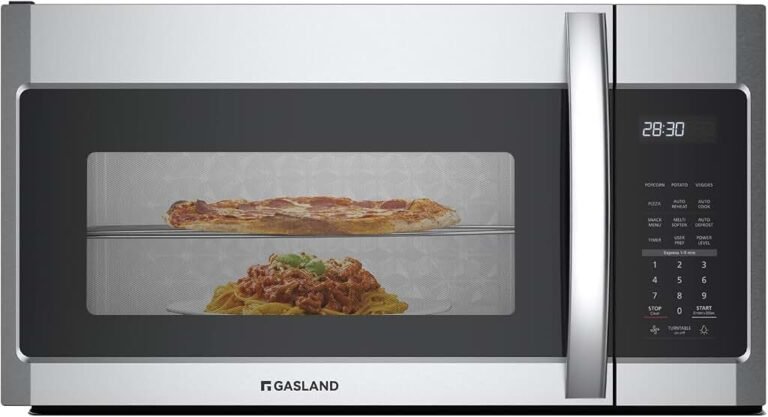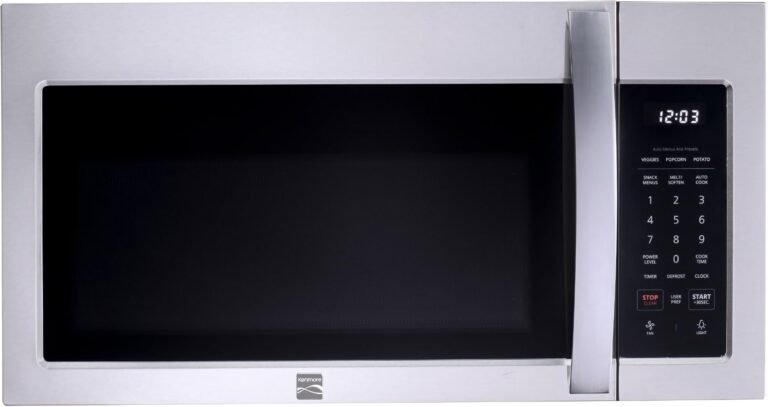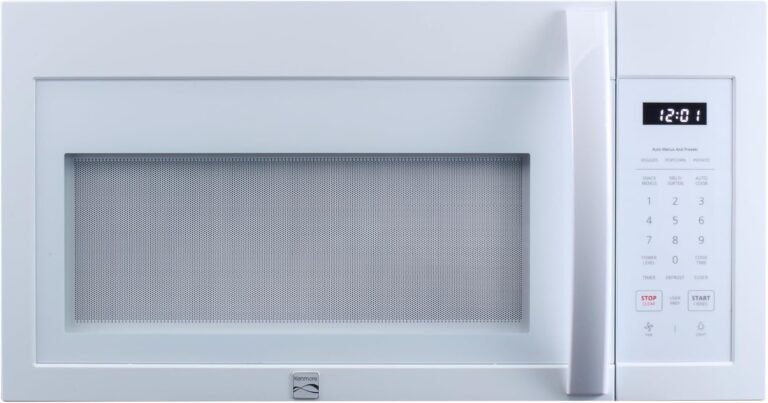
Over-the-range microwaves live a more complicated life than their countertop relatives. They heat dinner, surrender their underside to cooktop lighting, manage airborne grease through filters, and attempt to ventilate the stove while hanging from cabinetry. A microwave that performs only its cooking duties well has therefore completed only part of the assignment.
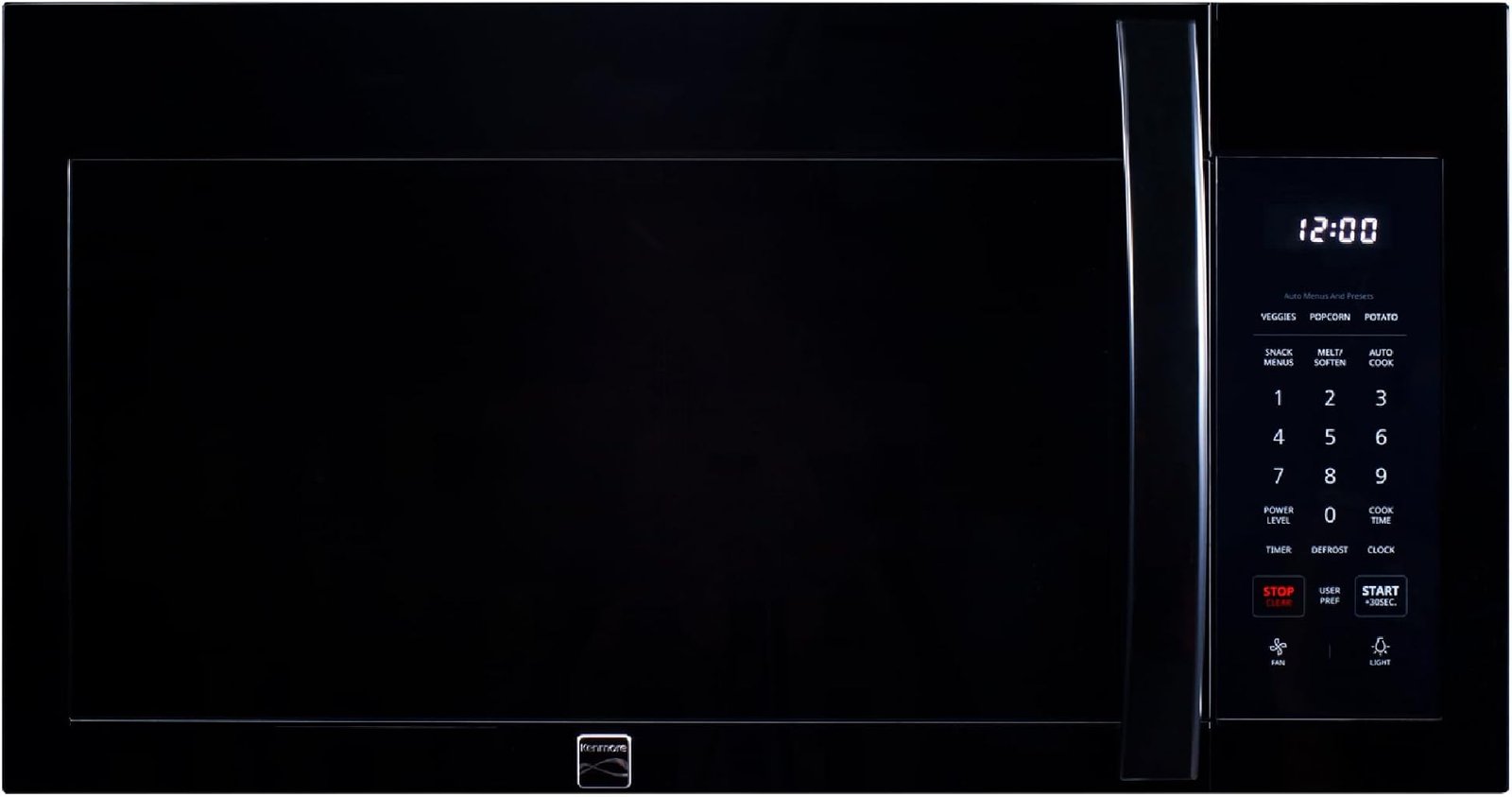
The Kenmore 1.7 cu. ft. Over-the-Range Microwave in black, model 22-87069, follows the established full-size formula closely. Kenmore specifies a 1.7 cu. ft. cavity, 1,000 watts of cooking power, a 12.4-inch glass turntable, 300 CFM ventilation, two fan speeds, three-way venting, LED lighting, six presets and 26 control settings. The manufacturer’s current product page also identifies carbon air and grease filtration, a child safety lock, Delay Start, Keep Warm and Broil among its functions.
At $399.99, the Kenmore is not positioned as a stripped-down replacement microwave. Nor does it attempt the increasingly common trick of turning a microwave into an air fryer, connected appliance hub or compact convection oven. Its design remains centered on traditional microwave cooking and the secondary duties expected above a range.
Our score is 8.13/10. Customer Sentiment stands at 8.06, Buyer Confidence at 8.45 and Value at 8.03. Those ratings describe a credible but highly conventional appliance. Buyer Confidence leads because Kenmore publishes a specific and coherent feature set. Value sits lower because the $399.99 price buys mainstream cooking and ventilation specifications rather than unusually ambitious technology.
The 1.7 cu. ft. Capacity Hits a Familiar Household Target
Capacity is often the first specification shoppers encounter and one of the easiest to misinterpret.
The Kenmore provides 1.7 cu. ft. of interior volume. That puts it squarely in full-size over-the-range territory. Whirlpool’s current over-the-range microwave buying guidance places typical capacities from approximately 0.8 cu. ft. for compact models to around 2.1 cu. ft. for larger designs, and specifically identifies 1.7 cu. ft. or more as a potentially useful range for larger households.
The comparison gives the Kenmore’s capacity useful context. A 1.7 cu. ft. cavity is not unusually large, but neither is it a compact compromise.
Kenmore pairs that cavity with a 12.4-inch glass turntable. The turntable rotates food through the microwave field, changing its position during operation. Rotation cannot eliminate every temperature difference because food shape, density, moisture distribution and placement also affect heating. It can, however, reduce the consequences of leaving one part of the dish in the same physical position throughout the cycle.
The 12.4-inch diameter also provides a more useful buying reference than cubic footage alone.
Anyone comparing microwaves should measure frequently used dinner plates and cookware. A nominal cavity volume describes three-dimensional space; it does not guarantee that a particular wide dish will rotate without striking the cavity wall.
That distinction belongs near the front of any microwave buying guide because usable dimensions matter more at dinner than an abstract volume figure.
1,000 Watts Keeps the Cooking Specification Conventional
Kenmore rates the microwave at 1,000 watts of cooking power.
That figure places the appliance close to the reference point around which many household microwave instructions are written. Whirlpool states that microwave cooking power generally ranges from about 600 to 1,700 watts and notes that many recipes are geared toward roughly 1,000 watts.
This matters because microwave wattage influences cooking time.
A recipe developed around a 1,000-watt appliance will often require adjustment when used in a substantially lower-powered machine. The Kenmore’s specification therefore offers familiarity rather than excess.
That is an appropriate characteristic for an appliance likely to spend much of its life reheating leftovers, cooking frozen foods, preparing vegetables and performing other repetitive tasks.
Raw wattage still does not describe heating quality by itself. Food geometry, placement, moisture and programmed power all affect the result. A microwave with greater output can heat faster while still producing uneven temperatures if food is poorly arranged.
The Kenmore’s 12.4-inch rotating platform addresses one part of that equation mechanically, while its control settings provide the user with another layer of adjustment.
Twenty-Six Settings Create a Broader Control Set Than the Exterior Suggests
The black Kenmore has a visually conventional identity, but the control system is more extensive than a basic timer-and-start arrangement.
Kenmore identifies 26 settings, including Delay Start, Keep Warm and Broil, along with six cooking presets.
That distinction deserves careful interpretation.
A large setting count does not automatically translate into better food. Presets generally encode combinations of time, power and other programmed behavior. Their value depends on whether the household actually cooks the foods those programs address.
Keep Warm has an obvious practical purpose when meal timing becomes uneven. Delay Start may suit particular routines. Presets can reduce repeated button presses for familiar foods.
The control architecture therefore provides flexibility without changing the fundamental cooking technology.
There is a broader design question here. Microwave manufacturers have spent decades adding dedicated buttons because a keypad has abundant space and software-controlled settings are relatively easy to implement. Yet a household may repeatedly use only a small fraction of them.
The Kenmore’s 26 settings are best treated as available tools rather than 26 independent reasons to purchase the appliance.
The 300 CFM Fan Defines the Ventilation Ceiling
An over-the-range microwave is also a ventilation appliance, and the Kenmore is rated at 300 CFM with two fan speeds.
CFM means cubic feet per minute. It describes the volume of air a ventilation system can move under its rated conditions.
The figure requires context.
Three hundred CFM is a familiar specification for mainstream microwave-hood combinations. It is sufficient to establish the Kenmore as a genuine ventilation appliance rather than a microwave with a token fan. It should not be interpreted as equivalent to every dedicated range hood or as a promise of identical airflow after installation.
Duct geometry matters. Bends, transitions and restrictions introduce resistance. Recirculating operation behaves differently from exhausting cooking air outdoors. Filters also require maintenance if the system is to function as intended.
The Kenmore’s two fan speeds provide basic control but little granularity. Someone simmering a pot does not necessarily need maximum airflow, while more aggressive stovetop cooking can justify the higher setting.
The more consequential number remains the 300 CFM maximum. A third or fourth fan button would not change that ceiling.
Households that regularly produce substantial smoke, grease or heat through high-temperature stovetop cooking should evaluate ventilation as its own appliance requirement rather than assuming that every microwave hood is an adequate substitute for a dedicated range hood.
Three-Way Venting Makes Installation More Flexible
Kenmore specifies three ventilation configurations: top, rear and recirculating.
This is one of the product’s more practical attributes because kitchens do not all provide the same duct path.
Top venting can connect with ductwork running upward through cabinetry. Rear venting can accommodate installations where exhaust travels through the wall. Recirculating mode allows filtered air to return to the kitchen when exterior ducting is unavailable.
Those arrangements solve different installation problems, but they should not be treated as environmentally identical.
Exterior exhaust can remove captured moisture and cooking contaminants from the room. Recirculation instead relies on filtration before returning air indoors.
Kenmore includes carbon air and grease filters for the ventilation system. The manufacturer describes them as trapping odors, smoke and airborne grease during operation.
Filters are consumable maintenance items in practical terms even when their service interval varies. Grease accumulation reduces cleanliness and can interfere with airflow. Carbon filtration also does not remain infinitely effective.
The ventilation system should therefore be considered part of the appliance’s maintenance schedule, not a permanently self-sufficient feature.
LED Lighting Matters More Than Appliance Advertising Usually Suggests
The Kenmore uses LED lighting both for cooktop illumination and within the microwave cavity.
Cooktop lighting deserves particular attention because the microwave physically replaces the range-hood area above the stove.
A poorly illuminated cooking surface can be irritating regardless of how well the microwave heats food. The underside lamp may be used during nearly every stovetop cooking session, including occasions when the microwave itself remains off.
LED technology also makes sense in this application because it provides illumination with relatively modest energy consumption and heat output.
This illustrates why an over-the-range microwave cannot be evaluated solely by cavity specifications.
The appliance becomes part of the working environment around the stove. Lighting, filtration and fan controls influence tasks completely unrelated to microwave cooking.
A shopper comparing two models with similar wattage and capacity should therefore inspect these secondary functions carefully. They may account for more daily interactions than rarely used cooking presets.
The Black Finish Is a Practical Design Decision
The reviewed configuration uses a black exterior. Kenmore also offers related versions in stainless steel and white.
Color has no effect on cooking performance, but an over-the-range appliance is visually prominent. Unlike a toaster that can be stored, the microwave becomes part of the cabinetry line and sits directly above one of the kitchen’s focal points.
Black can coordinate naturally with black ranges and mixed dark appliance packages. It may also show certain kinds of residue differently from stainless steel.
The more significant design issue is not color but longevity of visual compatibility. An installed over-the-range microwave is inconvenient to replace purely because a kitchen’s finishes change.
That favors neutral finishes and conventional styling over unusually distinctive design treatments.
Kenmore’s approach is conservative. In this category, conservative styling has a practical argument behind it.
Installation Is Not a Countertop-Appliance Exercise
The space-saving benefit of an over-the-range microwave comes with installation work.
The appliance must be supported securely, aligned with cabinetry, connected to suitable electrical service and configured for the intended ventilation path. A replacement model also needs to cooperate with the geometry left behind by the previous installation.
General industry guidance demonstrates the workload. Whirlpool’s over-the-range microwave installation guide describes a multi-step process involving mounting brackets, wall studs and positioning the appliance above the range.
Those instructions are not a substitute for Kenmore’s model-specific documentation. They illustrate why installation should be budgeted alongside purchase price.
A $399.99 microwave going directly into a compatible existing location presents one cost scenario. The same microwave requiring duct modification, electrical work or cabinetry changes presents another.
Nominal size does not guarantee identical mounting geometry between brands.
That point is easily overlooked when replacing an older 30-inch microwave with another 30-inch appliance. Width is only one measurement in the installation.
Standard Width Does Not Mean Universal Fit
Over-the-range microwaves are commonly built around approximately 30-inch cabinet openings. Whirlpool’s current dimensional guidance notes that standard over-the-range microwaves are generally 30 inches wide, while compact models commonly measure 24 inches. It also places typical closed-door depths between 15 and 18 inches.
Those category norms are useful but should never replace the Kenmore installation manual.
The existing opening should be measured cabinet to cabinet. The relationship between the cooking surface and microwave should also be checked, along with door clearance, backsplash height and duct position.
A historical Whirlpool installation document, for example, specifies a 30-inch cabinet opening for the models covered by that manual and calls for two-person installation. That does not establish Kenmore’s exact mounting requirements; it demonstrates how many dimensional conditions accompany the seemingly simple phrase “30-inch microwave.”
The practical rule is straightforward: model-specific installation documentation outranks category averages.
A microwave can have the right capacity, wattage and finish and still be the wrong purchase if the mounting environment is incompatible.
Microwave Safety Is Governed by Federal Performance Requirements
Microwave radiation can provoke more anxiety than more ordinary hazards such as hot liquids and steam.
Federal regulation provides useful perspective.
FDA documentation on microwave oven performance standards states that microwave ovens must incorporate at least two safety interlocks. The agency’s compliance material also identifies leakage limits of 1 milliwatt per square centimeter before acquisition or 5 milliwatts per square centimeter after purchase.
The safety systems are intended to prevent microwave generation when access to the cavity is possible.
That regulatory framework does not mean every damaged microwave should remain in use indefinitely. Door alignment, latches and seals remain relevant physical components, and damaged equipment deserves inspection or repair rather than improvisation.
Everyday burns are a more immediate household issue.
Microwave-heated liquids can become extremely hot, containers can absorb heat from food, and steam released from covered dishes can burn skin. With an over-the-range microwave, another factor enters the equation: the user is handling hot food at an elevated position.
Mounting height therefore has an ergonomic dimension as well as an installation dimension.
The Kenmore’s child safety lock can disable the control panel to reduce accidental operation. It is a useful safeguard, though it cannot replace supervision or careful handling of heated food.
The 12.4-Inch Turntable Is a Small Specification With Large Consequences
Microwave capacity receives more attention than turntable diameter, but the latter can be more immediately useful when checking cookware.
Kenmore specifies a 12.4-inch glass turntable.
A plate that fits comfortably on that surface can rotate as intended. Oversized rectangular dishes present a more complicated problem because their corners may approach the cavity walls during rotation.
This is another reason cubic footage alone should not settle a buying decision.
A 1.7 cu. ft. microwave can have plenty of theoretical volume while still being inconvenient for a specific dish. Conversely, a household using ordinary dinner plates may never approach the cavity’s practical limits.
The glass platform is removable, which also simplifies cleaning after spills.
That is mundane engineering, but microwave ownership consists largely of mundane events. Soup boils over. Sauce splatters. Butter erupts after ten seconds too many.
Easy access to washable components has lasting value.
The Price Requires More Than a Capacity Comparison
At $399.99, the Kenmore should not be compared solely with countertop microwaves offering similar interior volume or cooking wattage.
The over-the-range format combines multiple pieces of kitchen infrastructure.
The purchase includes the microwave cavity, mounting architecture, 300 CFM ventilation system, filters and cooktop illumination. The appliance also releases counter space that a conventional countertop microwave would consume.
Those benefits explain why comparing prices solely by watts or cubic feet produces misleading results.
The harder question is whether this particular combination justifies $399.99.
Our Value rating of 8.03 says yes, but conditionally.
The Kenmore has a useful specification package, yet its core figures-1.7 cu. ft., 1,000 watts and 300 CFM-belong to an established mainstream formula. Buyers are paying for competent integration and the Kenmore configuration rather than an unusually powerful ventilation system or radically different cooking technology.
Installation can further alter the economics.
If the kitchen already has a compatible over-the-range location and suitable ducting, the purchase remains relatively contained. If significant installation work is necessary, total project cost can move well beyond the appliance price.
The Scores Reveal Where the Kenmore Is Strongest
Our overall score of 8.13/10 places the Kenmore in favorable territory without suggesting that its specifications transcend the category.
Customer Sentiment stands at 8.06. That rating reflects a product centered on established household functions rather than novelty. Its feature set is easy to understand, but its benefits depend heavily on whether the household actually wants a conventional over-the-range arrangement.
Buyer Confidence reaches 8.45, the highest component.
That difference is meaningful. Kenmore identifies the capacity, cooking output, turntable diameter, ventilation rating, fan speeds, venting configurations, lighting, presets and filtration directly. Buyers can establish much of what matters before committing to installation.
Value sits at 8.03.
The slightly lower rating reflects the $399.99 price against mainstream specifications. The Kenmore does many useful things, but most of them are familiar things. Its economic case rests on integration, installation fit and long-term daily utility rather than novelty.
The spread among the scores is relatively narrow. That is appropriate for an appliance whose strengths and compromises are both easy to identify.
Strengths That Matter in Routine Use
The Kenmore’s strongest characteristics are practical:
- The 1.7 cu. ft. cavity provides full-size household capacity without moving into an unusually large format.
- Its 1,000 watts of cooking power align with a common reference point for microwave recipes and packaged foods.
- The 12.4-inch rotating glass turntable provides a useful physical reference for plate compatibility.
- Twenty-six settings give the control panel considerable flexibility.
- Six presets reduce repeated input for familiar cooking jobs.
- Keep Warm can help when food preparation and serving schedules do not align.
- The 300 CFM ventilation system integrates range ventilation into the microwave installation.
- Two fan speeds provide basic airflow adjustment.
- Top, rear and recirculating venting create useful installation flexibility.
- Carbon air and grease filters address airborne residue in recirculating operation.
- LED lighting illuminates both the cavity and cooktop.
- The child safety lock can disable the control panel against accidental use.
- The black finish provides an alternative to stainless steel without changing the underlying appliance architecture.
The strongest theme is integration. The Kenmore does not ask one specification to carry the entire product.
Drawbacks That Deserve Equal Attention
The ventilation ceiling is the first limitation. Three hundred CFM is useful for ordinary cooking, but households generating substantial smoke or grease may need a more capable dedicated hood.
Two fan speeds also provide limited control compared with systems offering more increments.
The large number of cooking settings can be either useful or superfluous. A household that repeatedly uses manual time entry and a few presets may leave much of the interface untouched.
The $399.99 price is another consideration. The product’s core specifications are conventional, so the value proposition relies heavily on installation fit and the usefulness of its integrated hood functions.
Installation itself is a cost and complexity factor. Over-the-range appliances require more planning than countertop microwaves, particularly when ductwork or electrical changes are involved.
Finally, 1.7 cu. ft. describes volume rather than universal cookware compatibility. The 12.4-inch turntable and cavity geometry should be considered alongside capacity.
None of these limitations is unusual for the category. That does not make them irrelevant. Familiar compromises remain compromises.
Who Is the Kenmore Best Suited For?
The clearest buyer is replacing an existing full-size over-the-range microwave and wants a conventional black appliance with established cooking and ventilation features.
The Kenmore also makes sense where counter space is scarce. Moving the microwave above the stove preserves work surface while integrating lighting and ventilation into the same area.
Its 1.7 cu. ft. cavity should suit many household cooking and reheating jobs, particularly for users working primarily with ordinary dinner plates and serving dishes.
The model becomes less compelling when ventilation performance is the kitchen’s dominant concern. Serious high-heat stovetop cooking can justify prioritizing a dedicated hood.
It is also less compelling for buyers whose priority is multifunction oven technology such as air frying or convection cooking. The Kenmore’s identity remains closer to the traditional microwave-hood combination.
That narrower identity makes the product easier to judge.
A Better Microwave Buying Guide Starts With the Kitchen
The Kenmore illustrates why the best appliance comparison begins with physical requirements rather than feature counts.
First, measure the cabinet opening and surrounding clearances.
Second, identify the ventilation route. Determine whether the kitchen can use top exhaust, rear exhaust or requires recirculation.
Third, inspect the electrical arrangement and compare it with the model-specific installation instructions.
Fourth, measure frequently used plates and cookware against the turntable and interior dimensions.
Fifth, evaluate microwave power. The Kenmore’s 1,000-watt output sits near the level around which many recipes are written.
Sixth, examine ventilation in relation to actual stovetop behavior. Boiling, simmering, frying and high-temperature searing impose different demands.
Seventh, assess controls according to likely use rather than total feature count.
Finally, calculate the installed cost rather than focusing exclusively on the $399.99 appliance price.
That sequence turns the purchase into an exercise in compatibility rather than feature accumulation.
Final Considerations
The Kenmore 1.7 cu. ft. Over-the-Range Microwave is a conventional appliance in the productive sense of the word. Its specifications are recognizable and easy to interpret: 1.7 cu. ft. of capacity, 1,000 watts of microwave cooking power, a 12.4-inch glass turntable, 300 CFM ventilation, two fan speeds, three-way venting, six presets, 26 settings, LED lighting, filtration and a child safety lock.
Our 8.13/10 score reflects that coherence.
Customer Sentiment at 8.06 stays close to the overall assessment because the appliance’s strengths are rooted in familiar everyday functions. Buyer Confidence rises to 8.45 because Kenmore documents the central cooking and ventilation specifications clearly. Value at 8.03 is slightly more restrained because $399.99 buys a solid mainstream configuration rather than unusually high airflow or a radically expanded cooking system.
Its strongest argument is not a single feature. It is the ability to combine several recurring kitchen jobs in one location.
The microwave heats food. The turntable keeps it moving. The fan handles routine cooking exhaust. The filters address airborne residue. The LEDs illuminate the stove and cavity. The presets reduce repetitive control inputs. None of these functions sounds revolutionary, and none needs to.
Its limitations are similarly straightforward. Three hundred CFM will not satisfy every ventilation requirement. Two fan speeds offer modest adjustment. A 12.4-inch turntable imposes physical boundaries regardless of the 1.7 cu. ft. capacity figure. Installation can add labor and expense. Twenty-six settings matter only when people use them.
That leaves the Kenmore with a relatively clear buyer profile: a household needing a traditional full-size over-the-range microwave, especially one replacing an existing unit in a compatible installation.
The larger lesson is less about Kenmore than about appliance buying itself. A microwave mounted above a stove becomes part of the kitchen’s architecture. Its success is determined not only by how rapidly it heats dinner, but by whether cookware fits, whether the door opens comfortably, whether hot dishes can be reached safely, whether ventilation matches cooking habits and whether installation works with the existing cabinetry and ductwork.
The Kenmore’s 8.13/10 assessment follows from how competently it addresses that collection of ordinary demands. It does not need to reinvent microwave cooking to make sense. It needs to fit the kitchen, perform its recurring jobs predictably and avoid turning convenience into another remodeling problem.
For the kitchen aligned with its 1.7 cu. ft. capacity, 1,000-watt output and 300 CFM ventilation system, that proposition is credible. For households needing substantially stronger extraction or a broader set of cooking technologies, the same specifications provide an equally useful signal to keep comparing.