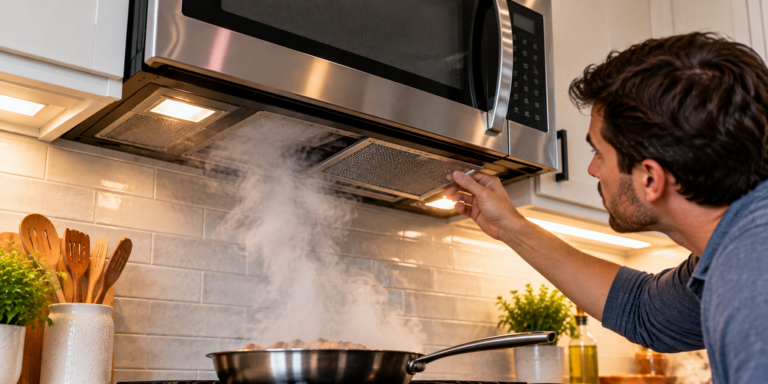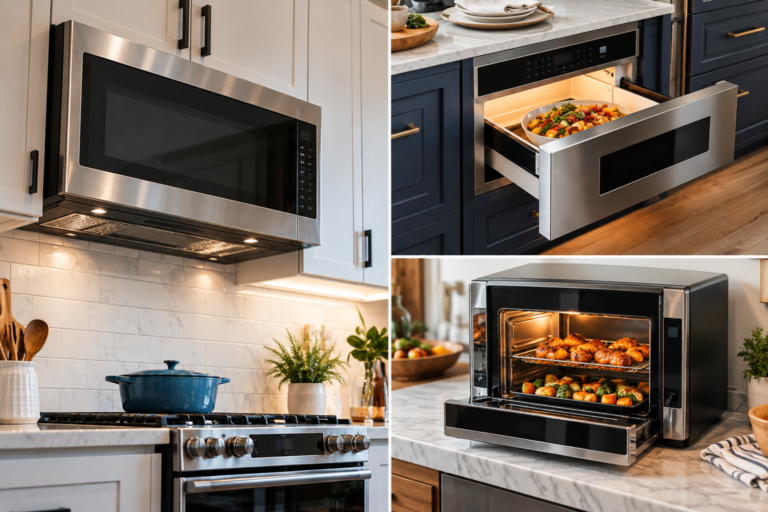
Air fryers have spent years hiding dinner inside dark drawers. Glass air fryers reverse that arrangement. The cooking vessel becomes transparent, food remains visible as it browns, and in some newer designs the same container can move from preparation to cooking, serving and refrigerated storage.
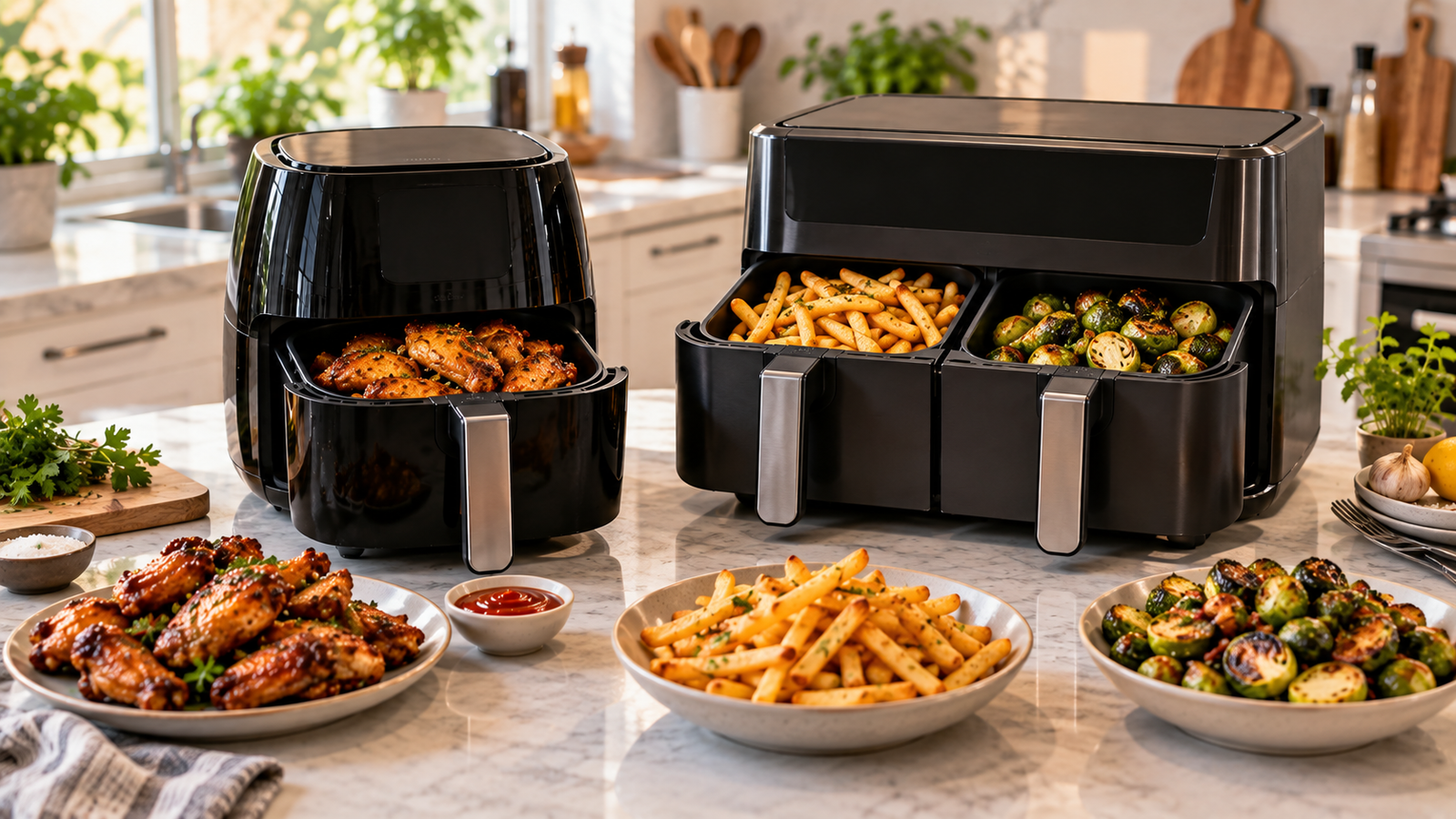
That sounds like a modest material substitution. It is not.
Replacing a conventional metal basket with glass changes weight, visibility, cleaning, handling, storage and the relationship between the cooking vessel and heating unit. What it does not fundamentally change is air frying itself. Glass does not invent a new method of crisping food. The appliance still relies on heated, rapidly circulating air.
The USDA describes air fryers as essentially countertop convection ovens in which rapidly circulating hot air cooks and crisps food. Food becomes crisp because hot air circulates quickly around it. The cooking vessel may be glass, coated metal or another heat-compatible material, but airflow, heating power, food arrangement and temperature control remain central to performance.
The appeal of glass is therefore not that transparency somehow improves the physics. Its appeal lies in what transparency and removable glassware allow the cook to do before, during and after heating.
Those benefits are real. So are the tradeoffs.
What Is a Glass Air Fryer?
“Glass air fryer” can describe several designs, but the defining characteristic is a transparent glass cooking chamber rather than the opaque metal drawer associated with conventional basket machines.
Some resemble bowls beneath a heating head. Newer designs integrate glass containers with compact heating modules or countertop bases. The glass vessel can sometimes double as cookware, serving ware and storage.
A useful contemporary example is the Ninja Crispi 4-in-1 Portable Glass Air Fryer Cooking System. Ninja specifies a 1,500-watt heating unit with 6-cup and 4-quart CleanCrisp glass containers, storage lids and crisper plates. The manufacturer identifies the containers as thermal-shock-resistant borosilicate glass and provides four cooking functions: Max Crisp, Bake, Air Fry and Recrisp.
The larger Crispi Pro takes the concept further. The Ninja Crispi Pro AS101LG uses an 1,800-watt system with 6-quart and 2.5-quart glass containers and six functions: Max Crisp, Air Fry, Bake/Proof, Roast, Recrisp and Dehydrate. Its modular base also accommodates a separately available 4-quart container.
These machines illustrate why glass air fryers deserve to be treated as an architectural category rather than a cosmetic variation.
Glass Does Not Create Crispness
Transparency can make the cooking process look different without making its fundamental mechanism different.
Air frying depends on hot moving air transferring heat to food while surface moisture evaporates. A crisper plate or similar raised surface helps expose more of the food to circulation rather than leaving it pressed against the bottom of the container.
This explains why simply placing food in an oven-safe glass bowl inside a conventional oven does not recreate every characteristic of an air fryer. The fan, heater, airflow path, chamber dimensions and relationship between food and moving air all matter.
Glass itself is not the crisping technology.
That distinction should temper claims surrounding the best air fryers. A transparent cooking chamber can improve observation and alter cleanup, but a conventional basket machine can still outperform a glass model if its airflow, temperature management and basket geometry are better suited to the food.
Independent testing illustrates the point. RTINGS measured the Ninja Crispi Pro AS101 against the conventional Ninja Pro AF141 and found different strengths rather than a simple material-based victory. The conventional model preheated and cooked faster and maintained more stable temperatures in that comparison, while the glass Crispi Pro produced somewhat more evenly crisped food in the test methodology.
The lesson is straightforward: vessel material alone cannot predict cooking performance.
Visibility Is the Most Immediate Advantage
A glass air fryer removes one of the stranger rituals of conventional basket air frying: opening a drawer to discover what happened inside.
That benefit sounds trivial until foods with narrow doneness windows enter the chamber.
Cheese can brown rapidly. Bread can move from pale to dark within minutes. Vegetables develop char unevenly. Breadcrumb coatings change color before a timer necessarily predicts readiness. With transparent glass, these changes can be observed directly.
A conventional basket requires the user to pull out the drawer unless the model incorporates a viewing window. That action may temporarily interrupt cooking and releases some heated air.
Glass reduces the need for speculative checking.
Visibility also helps new users learn how time and temperature interact. A printed cooking chart might recommend 15 minutes, but food size, initial temperature, moisture and load can alter actual results. Watching browning develop provides information that a countdown timer cannot.
Still, visual monitoring has limits.
A golden chicken breast can remain undercooked internally. Browned meat is not a thermometer.
The USDA advises measuring safe internal temperatures and lists 145°F for fish, 145°F with a three-minute rest for whole cuts of beef, pork, veal and lamb, 160°F for ground meat, and 165°F for poultry.
Glass can reveal color. It cannot reveal internal temperature.
The Cooking Vessel Can Become Part of the Meal Workflow
The more interesting advantage of some glass systems appears after cooking.
Traditional basket air fryers use a drawer engineered primarily for the appliance. Food is prepared elsewhere, transferred into the basket, cooked, moved onto serving dishes and later placed into storage containers.
A removable glass system can compress those stages.
Food can potentially be prepared in the container, cooked there, brought to the table and then refrigerated with an appropriate storage lid after cooling and following the manufacturer’s instructions.
The Crispi systems are explicitly built around this sequence. Ninja supplies storage lids with the glass containers, while the Crispi Pro describes the same vessels as suitable for preparation, cooking, serving and storage.
That design can reduce transfers between dishes.
The benefit is not merely fewer dishes to wash. Every transfer creates an opportunity for sauce to spill, crumbs to scatter or food to lose heat. A vessel that remains useful across several stages simplifies the physical choreography of preparing leftovers or small meals.
The arrangement is especially coherent for reheating. Leftovers already stored in compatible glassware can move back into the cooking system rather than being transferred into a separate basket.
Not every glass air fryer works this way, however. Buyers should distinguish between a transparent fixed cooking chamber and a modular glass container explicitly approved for storage and reuse.
Glass Can Reduce Reliance on Coated Basket Surfaces
Some buyers approach glass air fryers because they prefer food to cook primarily against glass rather than a coated metal basket.
That preference requires careful wording.
Glass cooking vessels can reduce the amount of coated surface forming the primary container. They do not necessarily eliminate every coating from the appliance. Crisper plates, racks or other accessories may use separate materials or finishes.
The current Ninja Crispi specification states that its CleanCrisp glass containers are designed for cooking and storing without PFAS and PTFE. That is a product-specific material statement, not evidence that every glass air fryer on the market has the same construction.
Buyers concerned about materials should therefore inspect every food-contact component rather than stop at the word “glass.”
The basket, crisper plate, rack, seals, lid and any adapters may be made from different materials.
Glass makes one part of the construction unusually easy to identify. It does not make the entire appliance chemically identical to a glass casserole dish.
Cleaning Is Different Rather Than Automatically Easier
Glass offers an obvious cleaning advantage: residue is visible.
Grease hiding against a dark basket surface can be difficult to see. Transparent walls reveal films, baked-on spots and crumbs immediately.
Glass also lacks the delicate feel associated with some nonstick basket coatings. Users do not have to inspect a transparent wall wondering whether a dark mark is food residue or a damaged finish.
Yet glass creates its own cleaning realities.
Cooked grease can bake onto transparent walls and become visually conspicuous. A streak that would disappear against black metal remains visible on clear glass. Transparency therefore raises the aesthetic standard for cleanliness.
Weight matters at the sink as well. A large glass vessel filled with warm soapy water is heavier than a thin metal basket of similar dimensions.
Some systems reduce the burden through dishwasher-compatible components. Ninja states that Crispi glassware, crisper plates and lids are dishwasher safe on current models.
That is useful, but dishwasher compatibility does not erase handling risk. Large pieces of glass still need to be loaded, unloaded and stored without impact.
The cleaning calculation is therefore unusually personal: visible residue and smooth glass surfaces on one side, extra mass and breakability on the other.
Weight Is the Tradeoff That Product Photos Hide
Glass photographs beautifully because transparency visually reduces bulk.
Physics is less charitable.
A substantial glass container can be heavy, particularly after food is added. That affects carrying, washing, serving and storage.
The issue becomes more pronounced with larger capacities. A six-quart glass vessel holding a large roast or chicken combines the mass of the food with the mass of the container itself.
People with limited grip strength may find that materially different from sliding out a lightweight metal drawer.
Handles help. So does a stable base. Neither removes mass.
This is one area where buyers benefit from physically handling a glass air fryer before purchase when possible. The relevant question is not whether an empty vessel can be lifted comfortably with two hands. It is whether the user can safely move it when hot, loaded with dinner and perhaps slick with condensation or cooking residue.
A glass air fryer that is uncomfortable to carry will quickly lose some of its supposed serving and storage flexibility.
Breakability Cannot Be Engineered Away Entirely
Glass can be highly heat resistant without becoming unbreakable.
Borosilicate glass is selected for many heat-related applications because of its resistance to temperature change, but thermal stress remains a genuine property of glass systems. The FDA’s guidance for industrial glass-container thermal processing, for example, notes that thermal shock can break glass containers when temperature differences are poorly managed. That guidance concerns food-processing equipment rather than domestic air fryers, but the underlying material principle is relevant.
Modern glass air-fryer manufacturers can engineer around this problem through material selection, wall thickness, heat protection and operating instructions.
Ninja explicitly identifies the Crispi’s borosilicate containers as thermal-shock resistant and says they can move from frozen conditions into cooking. The Crispi Pro likewise specifies thermal-shock-resistant glass.
Those statements apply to those particular containers under their intended operating conditions.
They should not be generalized into a rule that any glass bowl can be moved directly from freezer to high heat.
Generic cookware should never be substituted merely because it appears to fit. The vessel needs to be approved by the appliance manufacturer for the relevant temperature, airflow and mechanical arrangement.
Impact is another matter entirely. Thermal resistance does not make glass immune to being dropped onto tile.
Glass Changes How Countertop Heat Is Managed
A transparent container can make a glass air fryer look like ordinary food-storage ware with a heater attached. The temperatures involved remain those of a cooking appliance.
That means surface protection matters.
Some systems engineer heat protection into the container assembly. Ninja’s original Crispi uses permanently attached heat-safe feet, and the manufacturer states that the vessel can be placed on surfaces including granite, laminate, quartz, butcher block and marble.
Such a feature should be interpreted narrowly: it describes the manufacturer’s approved system.
A different glass air fryer may require a trivet or heat-resistant surface. A removable glass bowl from another appliance may have completely different handling instructions.
The broader rule is simple. Transparency should not create psychological familiarity that leads users to treat hot air-fryer glass like a cold food-storage bowl.
Hot glass remains hot cookware.
Capacity Becomes Easier to Understand Visually
Air-fryer capacity is often marketed in quarts or liters, measurements that say surprisingly little about usable cooking area.
Glass offers one subtle advantage: the buyer can see the chamber.
That visibility makes it easier to understand how food is distributed and how much unused vertical space exists above it. It also reveals crowding while cooking.
The USDA specifically warns that overfilling an air fryer can impede circulation and contribute to uneven or insufficient cooking.
A transparent chamber makes crowding visible.
This matters because food does not cook in abstract volume. Four quarts of theoretical space cannot guarantee room for four chicken breasts in a single layer. A tall vessel may have generous volume while offering modest floor area.
The original Crispi illustrates this distinction through interchangeable sizes. Its 6-cup container is oriented toward small portions, while the 4-quart container accommodates larger meals; Ninja states that the latter can fit a four-pound chicken with vegetables.
The Crispi Pro increases the large container to six quarts, and Ninja states that it can accommodate a 7.5-pound chicken.
Those examples show why glass capacity should still be judged by dimensions and food shape rather than volume alone.
The Ninja Crispi Shows the Compact Version of the Idea
The Ninja Crispi FN101 family provides a useful case study because its design pushes glass beyond simple visibility.
The Stone FN101ST and Green FN101SG configurations assessed here share the same basic 4-in-1 architecture. Both pair a 1,500-watt PowerPod with a 6-cup container and a 4-quart glass container. Cooking modes include Max Crisp, Bake, Air Fry and Recrisp. Ninja also supplies two storage lids and two crisper plates.
At the $152.99 prices assessed here, both color configurations receive our 8.55/10 overall score. Customer Sentiment is 8.28/10, Buyer Confidence is 9.8/10 and Value is 8.15/10.
The identical scoring is deliberate. Color changes appearance, not the underlying cooking architecture.
The Stone configuration can be inspected through the Ninja Crispi FN101ST retail listing, while the Green FN101SG configuration offers the same core proposition in a different finish.
Its strongest design idea is modularity. A small container can handle modest portions without requiring the larger vessel, while the 4-quart container expands capacity when necessary.
That flexibility also creates more pieces to store. The PowerPod, adapter, containers, lids and crisper plates collectively form a system rather than a single drawer.
For organized kitchens, that can be useful. For cramped cabinets, modularity can turn into inventory.
The Crispi Pro Expands the Glass Concept
The Crispi Pro AS101LG moves away from the original model’s portable emphasis and toward a more conventional countertop role.
Its 1,800-watt system includes 6-quart and 2.5-quart glass containers, a modular base, two crisper plates and two storage lids. It adds Roast and Dehydrate to the broader cooking repertoire, while Bake/Proof combines another set of lower-airflow cooking tasks. Temperature can be adjusted up to 450°F according to the manufacturer.
At the $249.99 price assessed here, our score is 8.86/10. Customer Sentiment is 8.72/10, Buyer Confidence is 9.8/10 and Value is 8.4/10.
That places it above the 4-in-1 Crispi configurations in our assessment, but the difference reflects expanded capacity and control rather than a claim that every household needs the larger machine.
The Crispi Pro AS101LG retail configuration costs $97 more than the $152.99 FN101 configurations assessed here. That is approximately a 63.4% increase relative to the smaller model’s price.
The extra expenditure makes more sense when six-quart capacity, adjustable temperature control and the additional functions will be used regularly.
For small portions and leftovers, the original design remains conceptually coherent precisely because it does less.
Portability Requires a More Careful Definition
“Portable” can be misleading around heated kitchen appliances.
The original Crispi’s detachable heating module and lidded glass containers make the system easier to reorganize and transport than many fixed basket air fryers. That does not turn it into a cordless appliance.
The FN101 specification lists a 36-inch power cord and 1,500-watt electrical system. Cooking still requires an appropriate electrical outlet and a suitable environment.
Glass also makes the food containers useful for carrying prepared or stored food after they have cooled and been fitted with the proper lids.
The portability advantage is therefore modular rather than electrical.
That distinction matters because countertop appliances should not be casually used in vehicles, enclosed spaces or unsuitable temporary settings simply because their components can be carried.
Glass Does Not Remove the Need to Shake or Turn Food
Being able to watch fries cook can create another misconception: if the food is visible, intervention is somehow less necessary.
Airflow still has geometry.
Food resting against another piece has less exposed surface. A crisper plate can improve circulation beneath the food, but piles of fries or vegetables may still need redistribution.
Glass makes uneven browning easier to detect. It does not automatically correct it.
This is where transparency becomes an operational tool rather than a passive aesthetic feature. A user can see that the top surfaces are browning faster and shake or turn the food accordingly.
That can make the cooking process more intuitive.
The same visibility can discourage unnecessary interruption. If food is browning evenly, there is less reason to open the system merely to inspect it.
Storage Versatility Comes With Food-Safety Rules
A glass container that moves from cooking to storage can reduce dish transfers, but leftovers still need appropriate temperature management.
The USDA states that cooked leftovers should be refrigerated within two hours to avoid extended time in the 40°F-to-140°F range associated with rapid bacterial growth.
A storage lid therefore does not mean a hot meal should simply sit sealed on the counter until someone remembers it later.
Nor should storage convenience blur raw-versus-cooked separation. Containers and utensils that have contacted raw meat require proper cleaning before reuse with ready-to-eat foods.
Glass can simplify the physical workflow. It does not rewrite microbiology.
Who Benefits Most From a Glass Air Fryer?
Glass air fryers make particular sense when visibility and container versatility solve recurring kitchen frustrations.
Their case becomes stronger when:
- Food is checked frequently during air frying.
- Seeing browning without opening a drawer is appealing.
- The cooking vessel will also be used for serving or storage where the manufacturer supports those uses.
- Avoiding a coated main basket is a purchasing priority.
- Smooth, transparent container walls are preferred for cleaning.
- Small and large interchangeable vessels would both receive regular use.
- The user is comfortable lifting heavier glass cookware.
- Suitable cabinet or counter storage exists for modular components.
These priorities describe a particular workflow rather than a universal upgrade.
A conventional basket can remain more practical for users who value low weight, one-piece simplicity and a drawer that can be shaken quickly.
Who Should Think Carefully Before Choosing Glass?
The disadvantages become more relevant in kitchens where handling simplicity matters more than transparency.
A conventional basket design may fit better when:
- Lightweight handling is a priority.
- The appliance will frequently be moved between a cabinet and counter.
- Breakable cookware creates concern.
- Young children or crowded counters increase the chance of impact.
- The user prefers shaking a drawer rather than lifting or manipulating glassware.
- Storage space for multiple containers and lids is limited.
- Food visibility is not especially useful.
- The glass system costs substantially more than a conventional alternative that meets the same cooking needs.
The last point deserves emphasis.
Glass is a material and workflow choice, not a guarantee of better food.
A Practical Buying Checklist
The most useful glass-air-fryer comparison begins with the container rather than the control panel.
Before purchasing, a buyer should check:
- Glass type: Is the material explicitly identified, and what thermal conditions does the manufacturer approve?
- Usable capacity: What foods fit in a single layer rather than merely fitting by volume?
- Container weight: Can the vessel be comfortably lifted when loaded?
- Surface protection: Can hot glass be placed directly on the intended countertop?
- Cleaning: Which components are dishwasher safe?
- Crisper plate materials: Is the entire food-contact system compatible with the buyer’s material preferences?
- Replacement parts: Can glass containers, lids and plates be purchased separately if one is damaged?
- Storage: Do containers nest, and where will lids and adapters go?
- Temperature control: Is the temperature adjustable or primarily governed by preset modes?
- Cooking functions: Are additional modes genuinely relevant to the household?
- Electrical requirements: Does the intended location provide the outlet and clearance specified by the manufacturer?
That checklist exposes a recurring pattern. The transparent wall is only the visible part of the decision.
Final Considerations
Glass air fryers do not replace the physics of conventional air frying. They rearrange the relationship between food, cooking vessel and cook.
Their clearest advantage is visibility. Browning can be observed without repeatedly opening an opaque drawer. That makes cooking easier to monitor and can help users understand how a particular food responds to time and temperature.
Their more consequential advantage, in modular systems, is continuity. The same glass vessel can move through preparation, cooking, serving and storage when the manufacturer explicitly supports those uses. That can reduce transfers and make leftovers easier to manage.
Material preference adds another reason for interest. Glass can reduce reliance on a coated main basket, although buyers still need to inspect crisper plates and other food-contact components rather than assuming the entire appliance is coating-free.
The disadvantages are equally physical.
Glass is heavier than many metal baskets. It can break through impact. Thermal-shock resistance must be established by the manufacturer rather than assumed. Larger vessels become more demanding to carry when filled with food, and transparent surfaces display every streak of cooked grease.
Performance also refuses to follow a simple material hierarchy. Independent comparisons show that conventional basket models can outperform glass machines in cooking speed or temperature stability, while particular glass models can perform well in crisping or evenness. Airflow, heating architecture, controls and basket geometry remain decisive.
The Ninja Crispi family illustrates how far the format can move beyond the novelty of seeing dinner cook. The 4-in-1 FN101 system combines 6-cup and 4-quart vessels with a compact 1,500-watt heating module, while the 1,800-watt Crispi Pro expands capacity to six quarts, adds a 2.5-quart vessel and broadens its cooking controls. Our respective scores of 8.55/10 and 8.86/10 reflect that difference in capability without turning size into an automatic virtue.
A household cooking modest portions may find the smaller system more proportionate. A household expecting to roast larger foods or use a broader range of modes can make better use of the Pro’s added capacity.
Neither example establishes glass as the inevitable future of the air fryer. The category instead corrects a peculiar assumption built into many earlier designs: that the cooking vessel has to disappear inside an opaque machine.
For some kitchens, seeing the food, serving from the cooking container and storing leftovers in that same vessel are substantial improvements. For others, a light metal basket that slides out, gets shaken and returns to the machine remains simpler.
The useful distinction is not old versus new. It is whether transparency, modular glassware and multi-stage container use justify extra weight, breakability and cost.
Glass makes an air fryer easier to see through. It does not make the purchasing decision transparent until those tradeoffs are measured against the way the kitchen actually works.