An over-the-range microwave is easy to underestimate. The microwave portion gets most of the attention, yet the appliance also replaces a range hood, illuminates the cooktop, consumes valuable vertical space and becomes physically integrated with cabinetry and ductwork. A poor choice can therefore create problems that have little to do with reheating food.
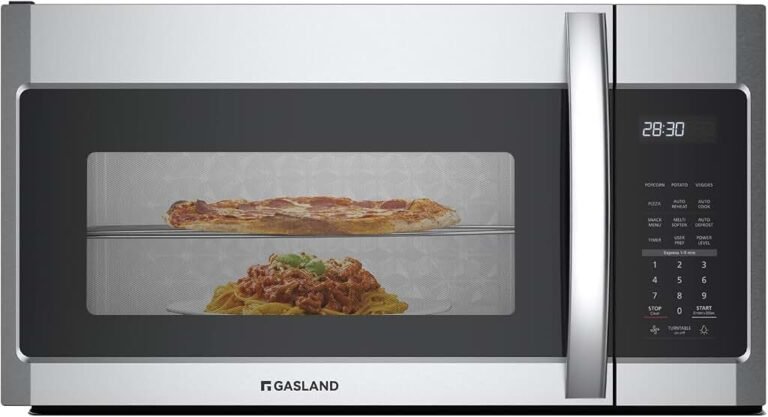
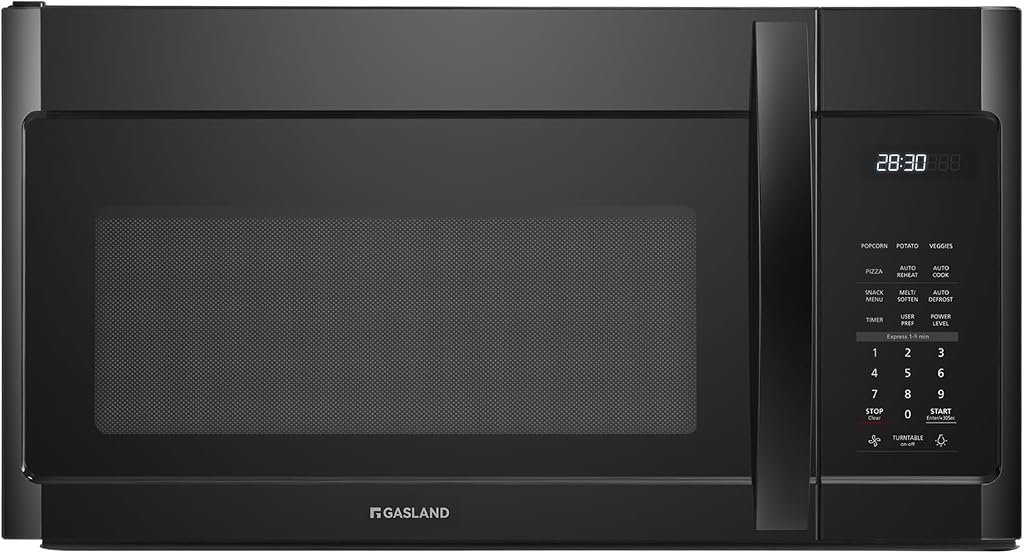
The GASLAND 1.9 cu. ft. over-the-range microwave takes a decidedly practical approach to that combination. The company’s OTR1902S family is built around a 1.9-cubic-foot cavity, 1,000 watts of cooking power, 11 adjustable power levels, sensor cooking, nine automatic cooking programs, a removable rack and a 13.5-inch rotating glass turntable. The GASLAND product specifications also identify a two-speed ventilation system rated at 400 CFM, LED cooktop lighting and exterior dimensions of 29.92 inches wide, 15.28 inches deep and 16.42 inches high.
Our score is 8.19/10. Customer Sentiment stands at 7.84/10, Buyer Confidence at 9.49/10, and Value at 7.91/10.
The unusually high Buyer Confidence rating deserves attention. GASLAND’s proposition is not difficult to understand: this is a large conventional microwave with substantial stated ventilation capacity and a relatively straightforward control package. The weaker Customer Sentiment and Value scores suggest a more nuanced judgment. The appliance is easiest to justify when its 1.9-cu.-ft. capacity and 400-CFM ventilation are features the household will genuinely use.
That distinction runs through the entire review. The GASLAND has meaningful specifications, but the numbers need to be interpreted in the kitchen where the appliance will actually operate.
The 1.9-Cubic-Foot Cavity Is a Genuine Strength
Capacity is the most immediately visible advantage.
At 1.9 cubic feet, the GASLAND provides substantially more interior volume than compact or low-profile OTR microwaves. The manufacturer pairs that cavity with a 13.5-inch glass turntable and a removable rack.
Those two details give the capacity practical meaning.
Cubic feet describe total cavity volume, but users do not cook cubic feet. They cook plates, bowls, casserole dishes and containers. Turntable diameter offers a more intuitive reference for whether ordinary dinnerware can rotate without striking the cavity walls.
The removable rack addresses another issue: vertical space.
A tall microwave cavity can waste much of its volume when a single shallow plate sits on the turntable. A manufacturer-approved rack allows some arrangements to use a second level, giving the interior height a more practical purpose.
That does not mean arbitrary metal accessories belong inside the microwave. The supplied rack should be used according to the appliance instructions.
The capacity is particularly relevant for larger households, meal preparation and kitchens where broad serving dishes regularly move between refrigerator and microwave.
It is less consequential for someone whose microwave workload consists mainly of beverages, small bowls and occasional popcorn.
This is why cavity size needs context. Large capacity can be useful, but it also contributes to appliance dimensions.
Full-Size Capacity Has a Physical Cost
The GASLAND measures 29.92 inches wide, 15.28 inches deep and 16.42 inches high.
The width fits the conventional 30-inch OTR category. The height and depth deserve more scrutiny.
At 16.42 inches high, this is not a low-profile microwave. Installing it above a cooking surface consumes a meaningful amount of vertical space.
That matters in kitchens where the existing microwave already feels too close to tall pots or large cookware.
Depth matters as well.
At 15.28 inches, the microwave may project beyond shallower upper cabinetry. Some projection is normal for an OTR microwave, but buyers should understand the geometry before installation rather than discovering it after the mounting plate is attached.
This is one area where a microwave buying guide should resist reducing fit to nominal width.
“30-inch microwave” describes a category. It does not prove that a particular appliance will fit a particular kitchen.
The 1,000-Watt Output Provides a Familiar Cooking Baseline
GASLAND specifies 1,000 watts of microwave cooking power and 11 adjustable power levels ranging from 0% to 100%.
That is a sensible combination.
Maximum wattage affects heating speed, while adjustable power gives the appliance more flexibility for foods that respond poorly to uninterrupted full-power cooking.
A bowl of soup can tolerate aggressive heating more readily than chocolate, butter or frozen meat being defrosted.
Lower power settings allow microwave energy to be delivered more gradually. That can reduce the tendency to overheat edges while the center remains cold, although food composition and shape still affect results.
The 1,000-watt rating should not be treated as proof of perfectly uniform heating.
Microwave cooking is influenced by moisture, density, starting temperature, container geometry and placement. The rotating glass turntable helps change the food’s position within the cavity, but it cannot eliminate every hot or cold region.
The more useful assessment is that GASLAND combines mainstream full-size cooking power with enough adjustment to handle both rapid heating and gentler tasks.
Sensor Cooking Reduces Some of the Guesswork
Sensor cooking is one of the more meaningful convenience features.
GASLAND identifies nine automatic cooking options: popcorn, potato, vegetables, pizza, snack menu, melt/soften, auto reheat, auto cook and auto defrost.
These programs address the repetitive nature of microwave use.
A microwave rarely needs a dramatic new cooking technique. It needs to make common tasks faster without forcing the user to calculate a new time and power combination for every plate of leftovers.
Sensor cooking is intended to automate part of that process by adjusting operation according to detected cooking conditions.
The feature still has boundaries.
Container choice, food quantity, starting temperature and covering instructions remain relevant. An automatic program cannot make two physically different portions behave identically.
Melt/soften is particularly useful because ingredients such as butter and chocolate are easy to overheat at full power.
Automatic reheating and defrosting similarly address jobs where fixed full-power cooking can produce uneven results.
The result is a control package focused more on everyday utility than novelty.
The Add-30-Seconds Function Deserves More Credit Than It Usually Gets
GASLAND includes quick-start operation and an add-30-seconds control.
This is hardly a glamorous feature. It may also be one of the most frequently useful.
Microwave cooking often happens in corrections.
A plate is nearly warm enough. Soup needs another half minute. Frozen vegetables need a short extension after stirring.
In those situations, navigating a menu or re-entering cooking time adds unnecessary friction.
The ability to extend a cycle by 30 seconds fits how microwaves are actually used: imperfectly predicted cooking followed by short adjustments.
That small convenience is more meaningful than many specialized cooking modes that look impressive on a feature list but see little daily use.
The 400-CFM Ventilation Rating Is a Major Specification
The GASLAND’s ventilation system is rated at 400 CFM and provides two fan speeds.
That maximum airflow figure is one of the strongest specifications in the package.
Yet CFM needs careful interpretation.
Cubic feet per minute measures airflow. It does not directly measure how much smoke, steam or particulate matter generated by cooking will enter the microwave’s intake.
Capture happens before exhaust.
Smoke rising from a pan forms a plume. Burner position, cooking temperature, cookware, room air currents and hood geometry influence where that plume travels.
A fan cannot remove smoke that bypasses its intake.
This distinction has measurable consequences. A 2012 study catalogued by the EPA’s HERO research database found substantial differences between front- and rear-burner particle reduction as range-hood airflow changed. The researchers reported number-weighted particle reductions ranging from 31% to 94% for the front burner and 54% to 98% for the back burner across the airflow rates studied.
That research should not be treated as a performance test of the GASLAND. It demonstrates a broader ventilation principle: blower airflow and burner position both affect pollutant reduction.
Why Rear Burners Matter
The front-versus-rear burner issue is not merely theoretical.
The EPA’s guidance on indoor particulate matter identifies cooking as a source of indoor PM and advises using a range hood whenever cooking. The agency recommends venting outdoors where possible, leaving the hood running for 10 to 20 minutes after cooking and using rear burners when practical because doing so improves airflow to the hood and reduces particulate matter released into the kitchen.
Those recommendations matter when evaluating any over-the-range microwave.
An OTR microwave is typically shallower than the cooking surface beneath it. The front burners therefore present a more difficult capture problem.
The GASLAND’s 400-CFM blower gives the system meaningful airflow potential, but airflow cannot fully compensate for unfavorable capture geometry.
This is why maximum CFM should never be the only ventilation criterion.
Two Fan Speeds Are Functional but Basic
The GASLAND has two ventilation speeds.
That is enough for simple low/high control.
It is not particularly granular.
A household boiling pasta may need less airflow than one searing meat. Systems with additional speed settings provide more flexibility between minimum and maximum operation.
The number of speeds does not determine maximum ventilation capability. A two-speed 400-CFM system can have a higher maximum airflow rating than a multi-speed system with a weaker blower.
The compromise is control rather than raw capacity.
Someone who generally switches the fan directly to high whenever smoke appears may find two settings entirely sufficient.
A user who leaves ventilation running through long cooking sessions may appreciate finer adjustment, particularly if noise becomes noticeable at maximum speed.
The two-speed arrangement therefore counts as a limitation, but not one that cancels the significance of the 400-CFM maximum.
Ventilation Performance Depends on Installation
A 400-CFM blower does not operate independently of the duct attached to it.
Every duct system creates resistance.
Length, diameter, elbows, transitions, exterior dampers and accumulated debris influence how easily air moves from the appliance to the outdoors.
A short, smooth duct route presents a different workload from a long path containing several tight turns.
Installation errors can make the difference larger.
A damper that cannot open fully, a crushed duct section or a poorly aligned exhaust adapter can reduce effective ventilation despite the blower itself functioning normally.
This is why ventilation should be viewed as a system extending from the cooking pan to the exterior outlet.
The microwave is only one component.
Outdoor Exhaust Is Preferable Where Available
Recirculation and exterior exhaust solve different problems.
A recirculating system captures air, filters it and returns it to the room. Exterior exhaust physically removes captured air from the building.
For indoor particulate matter, the EPA recommends a hood vented outdoors where possible.
That distinction should affect installation decisions.
A buyer with existing exterior ductwork has an opportunity to use the microwave as part of a true exhaust path.
Where recirculation is the only practical option, filter maintenance becomes more significant and expectations about contaminant removal should be adjusted.
The fan can still collect grease and help manage odors through appropriate filtration, but recirculation is not the same process as sending captured cooking emissions outside.
The 13.5-Inch Turntable Supports the Large Cavity
GASLAND specifies a 13.5-inch glass turntable.
That diameter is useful because it gives the 1.9-cu.-ft. capacity a physical reference.
Large dinner plates and many common microwave-safe dishes should have substantial rotational space, although buyers using unusually broad square cookware should still measure their dishes.
The turntable’s purpose is not merely convenience.
Rotation moves food through different regions of the microwave field, contributing to more even energy distribution.
It does not eliminate the need to stir or reposition foods when instructions call for those steps.
The removable design also simplifies cleaning after spills.
Combined with the removable rack, the turntable helps the GASLAND make practical use of a cavity that might otherwise be impressive mainly as a volume specification.
Cooktop Lighting Is Part of the OTR Job Description
The GASLAND includes integrated LED cooktop lighting, with the manufacturer listing two 1-watt LEDs.
Lighting matters because an OTR microwave displaces the range hood that would ordinarily illuminate the cooking surface.
The wattage figure alone should not be used to infer brightness.
LED efficiency, optical design, placement and beam spread all affect actual illumination.
The defensible observation is simpler: dedicated cooktop lighting is integrated into the appliance, preserving a function that would otherwise disappear when the microwave replaces a conventional hood.
That feature will be used far more frequently than many specialized microwave modes.
Installation Measurements Need to Be Taken Seriously
Before purchase, the installation site should be measured rather than assumed.
The GASLAND’s stated exterior dimensions are 29.92 inches wide, 15.28 inches deep and 16.42 inches high.
The kitchen should be checked for:
- Actual cabinet opening width
- Upper-cabinet depth
- Distance between the cooktop and cabinet
- Existing microwave height
- Existing appliance projection
- Door-opening clearance
- Electrical receptacle position
- Exhaust direction
- Duct dimensions
- Mounting surface
- Structural attachment locations
A previous microwave’s mounting plate should not automatically be reused.
Mounting hardware and bolt positions can vary between manufacturers and models even when both appliances belong to the nominal 30-inch category.
The 16.42-inch height deserves particular attention in kitchens where vertical clearance is already limited.
Cleaning Is Part of Ventilation Performance
Cleaning an OTR microwave is not solely about appearance.
Grease filters sit directly in the airflow path.
As cooking residue accumulates, resistance can increase and airflow can suffer. Filter maintenance therefore affects ventilation as well as cleanliness.
The EPA’s current cooking-air guidance specifically recommends routinely cleaning the range hood’s grease filter.
The turntable and interior also need routine cleaning before food residue is repeatedly reheated.
This maintenance has diagnostic value.
If ventilation effectiveness appears to decline gradually, checking the filters and exhaust path is a more rational first step than assuming the blower motor has suddenly become weak.
A clean ventilation system gives the 400-CFM specification a better chance of translating into useful airflow.
Our Score: 8.19/10
Our 8.19/10 rating reflects the GASLAND’s combination of capacity, conventional microwave power and relatively substantial ventilation.
The 1.9-cu.-ft. cavity is genuinely useful for larger dishes. The 13.5-inch turntable supports that capacity. A removable rack allows more flexible use of the vertical space.
The 1,000-watt cooking output and 11 power levels create a sensible conventional cooking foundation.
Sensor cooking, nine automatic programs and add-30-seconds functionality address routine convenience.
The 400-CFM ventilation rating gives the appliance another measurable strength.
The score remains below the highest range because the product still makes compromises.
Two fan speeds provide limited adjustment. The full-height body consumes vertical space. Ventilation performance remains installation-dependent. Buyers seeking convection or air-frying capability will need a different feature set.
The 8.19 score reflects a capable conventional OTR design rather than an attempt to turn the microwave into a second full oven.
Customer Sentiment: 7.84/10
Our 7.84/10 Customer Sentiment score is the lowest of the four ratings.
That does not make the assessment negative.
It reflects a product whose advantages are strongest for a particular buyer.
Large capacity is useful only when large dishes are actually used. A 400-CFM blower matters most when ventilation is a genuine priority. A full-size appliance body becomes less attractive where vertical clearance is limited.
The GASLAND therefore asks the buyer to understand the kitchen before judging the feature list.
For the right installation, the specifications line up well.
For a kitchen needing a low-profile microwave or a more elaborate cooking system, the same design becomes less compelling.
Buyer Confidence: 9.49/10
Our 9.49/10 Buyer Confidence score is substantially higher than the other ratings.
The reason is specification clarity.
GASLAND identifies the core attributes directly: 1.9 cubic feet of capacity, 1,000 watts, 11 power levels, nine automatic cooking programs, sensor cooking, a 13.5-inch turntable, removable rack, two-speed ventilation and a 400-CFM maximum airflow rating.
The manufacturer also publishes exterior dimensions and maintains a manual-download page listing the OTR1902S and OTR1902B models, giving buyers another first-party reference when preparing for installation.
That level of documentation makes it easier to evaluate fit before the appliance reaches the kitchen.
Buyer confidence still requires measurement. No product page can establish whether a specific cabinet opening, duct route or cooktop clearance is suitable without examining the installation site.
The unusually high score reflects how clearly the buyer can identify what needs to be checked.
Value: 7.91/10
Our 7.91/10 Value rating is positive but more restrained than Buyer Confidence.
The GASLAND’s value comes from combining a large microwave cavity, conventional 1,000-watt cooking, sensor functions, lighting and a 400-CFM ventilation system in one appliance.
The strongest value case belongs to a household that needs those functions simultaneously.
A buyer using only small plates and rarely cooking on the stovetop receives less benefit from the 1.9-cu.-ft. capacity and stronger ventilation specification.
Likewise, someone who already has an effective dedicated range hood may have little reason to sacrifice that hood merely to move a microwave above the stove.
Value is therefore tied to integration.
The GASLAND makes more sense when freeing counter space, gaining large microwave capacity and obtaining cooktop ventilation are all part of the same kitchen problem.
Who Is the GASLAND Best Suited For?
The GASLAND aligns most naturally with households seeking:
- A conventional 30-inch OTR microwave
- A large 1.9-cu.-ft. cavity
- A 13.5-inch rotating turntable
- A removable cooking rack
- 1,000 watts of microwave output
- 11 adjustable power levels
- Sensor-assisted cooking
- Nine automatic cooking programs
- Add-30-seconds convenience
- Two-speed ventilation
- A 400-CFM maximum airflow rating
- Integrated LED cooktop lighting
Its fit becomes weaker where vertical clearance is limited, where low-profile dimensions are preferred or where advanced secondary cooking modes are a major priority.
Those are buyer-fit distinctions rather than defects.
The Main Strengths
The GASLAND’s strengths are unusually easy to identify.
Capacity is the first. A 1.9-cu.-ft. cavity and 13.5-inch turntable provide meaningful room for large dishes.
Cooking flexibility follows. The combination of 1,000 watts and 11 power levels supports both rapid heating and more controlled microwave work.
Sensor cooking and nine automatic programs reduce repetitive input.
The removable rack makes better use of the tall cavity.
Ventilation is another significant strength on paper. A 400-CFM maximum gives the appliance more stated airflow than many conventional 300-CFM OTR systems.
Finally, the exterior dimensions and major specifications are documented clearly enough to support careful pre-purchase measurement.
The Main Drawbacks
The first limitation is physical size.
At 16.42 inches high, the GASLAND consumes substantial vertical space above the range.
The second is ventilation control. Two fan speeds are adequate but basic.
The third is the gap between rated airflow and installed capture. A 400-CFM blower cannot remove cooking emissions that never reach its intake, and restrictive ductwork can further reduce system performance.
The fourth concerns cooking scope. The product is centered on conventional microwave functions rather than a broad collection of oven-replacement modes.
Finally, the value proposition weakens when either large capacity or ventilation is unnecessary.
The appliance is easiest to justify when the buyer actually needs the combination rather than simply preferring larger numbers on a specification sheet.
Final Considerations
The GASLAND 1.9 cu. ft. over-the-range microwave earns its 8.19/10 overall score through a straightforward combination of useful capacity, familiar microwave power and a comparatively substantial ventilation specification.
The 1.9-cu.-ft. cavity is supported by a 13.5-inch rotating turntable and removable rack. The 1,000-watt cooking system provides 11 adjustable power levels. Sensor cooking and nine automatic programs cover common microwave tasks, while add-30-seconds functionality addresses the small corrections that define much of real microwave use.
The 400-CFM ventilation rating is one of the appliance’s more meaningful specifications, but it needs to be read correctly.
Airflow is not the same as capture. Front-burner cooking can send part of the plume beyond an OTR microwave’s intake, and duct restrictions can reduce airflow after contaminants enter the system. EPA guidance favoring outdoor exhaust, regular grease-filter cleaning and rear-burner use where practical reinforces the point: kitchen ventilation works as a system, not as a single CFM number.
The 9.49/10 Buyer Confidence score is the standout figure because GASLAND documents the appliance’s principal specifications with unusual clarity. The buyer can identify the cavity size, power, turntable diameter, ventilation rating and exterior dimensions before installation.
The 7.84/10 Customer Sentiment and 7.91/10 Value scores are more restrained because the product’s strongest attributes are not universally necessary.
A household that rarely uses large dishes gains little from a 1.9-cu.-ft. cavity. A kitchen with limited vertical clearance may prefer a low-profile design. Someone requiring highly adjustable ventilation may find two fan speeds restrictive.
For the household that does need a large conventional microwave above the range, however, the GASLAND presents a coherent specification set.
That is where it belongs in a microwave buying guide: not as an appliance defined by novelty, but as a full-size OTR model built around three measurable priorities—capacity, conventional cooking power and ventilation.
Those priorities make sense only when matched to the kitchen.
The cabinet opening must fit. The 16.42-inch height must leave acceptable cooktop clearance. The duct system must allow the blower to move air effectively. Filters must remain clean. Large dishes must actually be part of the household’s routine for the generous cavity to deliver meaningful value.
When those conditions align, the GASLAND’s design becomes easy to understand. It is a 1.9-cu.-ft., 1,000-watt microwave with a 400-CFM ventilation system and enough automatic control to simplify everyday cooking without burying the basic functions beneath layers of unnecessary complexity.
That balance, rather than any single headline feature, explains the 8.19/10 assessment.