A 5,000-watt generator sounds straightforward until the arithmetic begins. The number on the label describes only one part of the machine’s electrical capability. Sustained output, fuel capacity, engine size, outlet configuration, noise, runtime, portability, and maintenance determine what a generator can actually accomplish after the extension cords are connected.
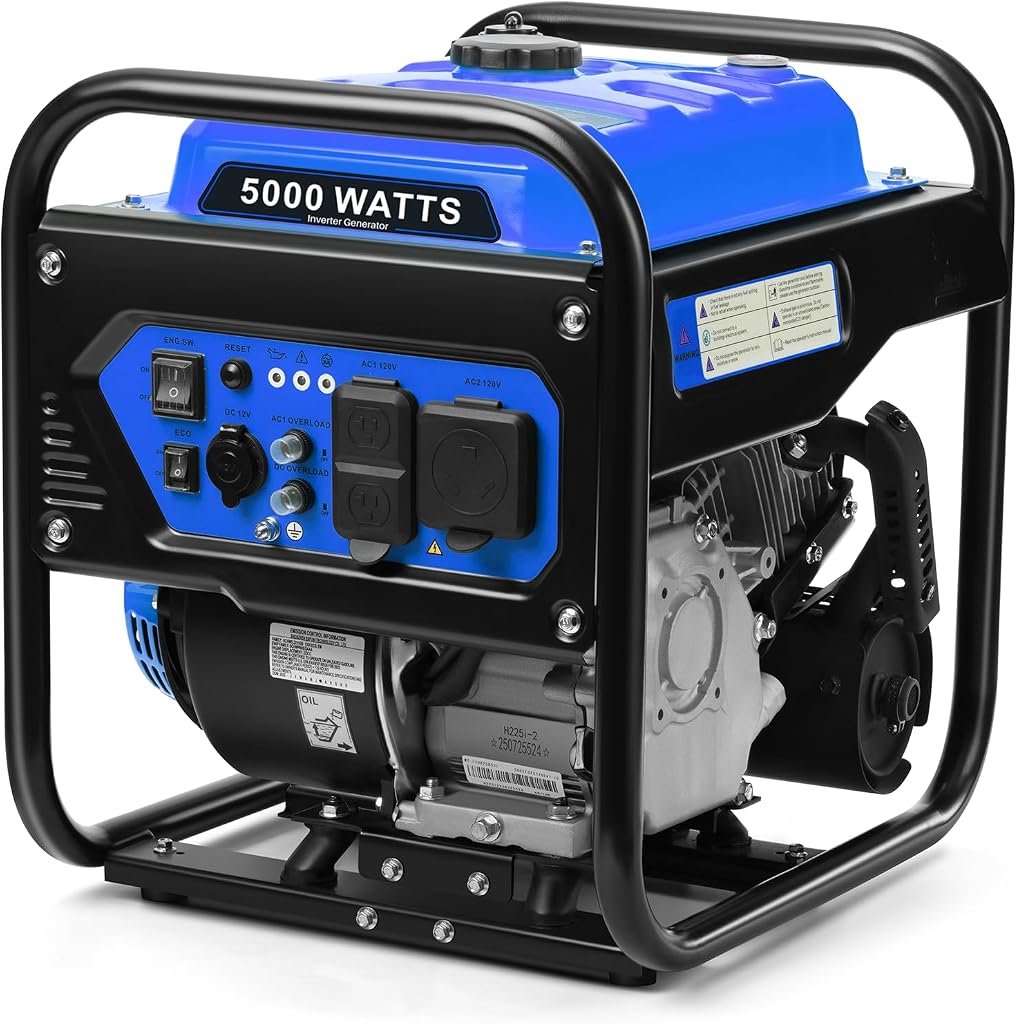
The Oxseryn 5000W Portable Inverter Generator illustrates that distinction particularly well. The relevant OXOG08 configuration is a gasoline-powered, open-frame inverter generator rated for 5,000 starting watts and 4,000 running watts. It uses a 223cc four-stroke OHV engine, operates at 120V, carries a 2-gallon fuel tank, and includes a 30A RV connection alongside conventional AC and DC outputs.
Our score is 8.22/10, with Customer Sentiment at 8.06, Buyer Confidence at 8.91, and Value at 8.03. Those numbers describe a generator whose strongest quality is specification clarity and practical output rather than elaborate convenience features.
The machine also presents an interesting proposition. Open-frame generators are often associated with basic conventional generation, while inverter models are frequently enclosed in suitcase-style bodies. The Oxseryn combines an open frame with inverter electronics. That approach helps explain its approximately 59-pound weight, but it also shapes the noise and portability discussion.
The 5,000W Figure Is Only the Starting Point
Oxseryn’s published specifications identify 5,000 watts as starting output and 4,000 watts as running output. The distinction is fundamental.
Starting wattage exists primarily to accommodate short surges from electrical equipment. Motors and compressors can require considerably more power while starting than after reaching normal operating speed. Refrigerators, pumps, air-conditioning equipment, and many power tools can exhibit this behavior.
Running wattage is the sustained electrical budget.
A buyer should therefore design the ordinary load around 4,000 watts, not 5,000. That does not mean loading the generator continuously to exactly 4,000 watts is the ideal strategy. Leaving headroom allows intermittent loads to start without forcing the machine against its operating ceiling.
This is one of the most useful rules in any portable generator buying guide: calculate both running and startup requirements before choosing a generator.
A refrigerator consuming several hundred watts during ordinary operation may require a substantially larger burst when its compressor engages. A power tool can behave similarly. Simply adding steady-state wattages can therefore produce a deceptively comfortable total.
The Oxseryn’s 1,000-watt difference between running and starting ratings provides 25% additional short-duration capacity above its sustained rating. That is useful headroom, but it remains finite.
A 223cc Engine Provides the Mechanical Foundation
The OXOG08 uses a 223cc four-stroke OHV gasoline engine. Its fuel tank holds 2 gallons, equivalent to approximately 7.57 liters. The specified electrical system is 120V at 60Hz.
Those specifications place the machine firmly in the medium-output portable-generator category.
Four-stroke architecture means gasoline and lubricating oil remain separate rather than requiring a gasoline-oil mixture. The engine still requires routine oil monitoring and maintenance, and the available OXOG08 manual specifies SAE 10W-30 oil during initial setup.
The generator also uses manual starting rather than the remote electric-start architecture found on some heavier inverter models.
That simplicity has competing effects.
A recoil-start system avoids dependence on a dedicated electric-start battery and reduces hardware. Conversely, repeated manual starting can be less convenient, particularly for users with limited strength or mobility.
For a generator expected to sit in storage and emerge during outages, mechanical simplicity can have merit. For someone starting and stopping a generator repeatedly during RV travel or regular worksite use, electric starting can become more attractive.
The Oxseryn’s approach favors straightforward machinery over added starting convenience.
Inverter Technology Matters More Than the Open Frame Suggests
The open-frame construction makes the Oxseryn look more like a traditional generator than many enclosed inverter products, but the electrical architecture is different.
Oxseryn identifies the OXOG08 as an inverter generator and describes its output as suitable for sensitive electronics. The available product documentation also identifies Eco mode as part of the generator’s operating system.
Inverter generation is relevant because modern backup loads are increasingly electronic.
Internet routers, computers, televisions, battery chargers, control boards, cameras, communication equipment, and many household appliances incorporate electronics that benefit from stable electrical output.
The inverter architecture also allows engine operation to respond more closely to electrical demand. That matters because generators rarely spend an entire operating session under one constant load.
A refrigerator cycles. A circular saw runs for minutes rather than hours. Lights remain relatively stable. Chargers taper their demand. A microwave may add a large load for only a short interval.
Eco operation can reduce unnecessary engine speed during lighter demand, helping fuel economy and lowering sound output relative to running the engine aggressively regardless of load.
The limitation is physical rather than electrical. An open frame provides less acoustic isolation than the substantial molded enclosures used by many suitcase-style inverter generators.
That leads directly to one of the Oxseryn’s more consequential trade-offs.
Approximately 70 dBA Is Not Suitcase-Generator Quiet
Oxseryn lists sound output at approximately 70 dBA from 23 feet for the 5000W open-frame inverter model.
That number deserves careful interpretation.
Decibels are logarithmic rather than linear, and generator measurements vary according to distance, electrical load, environment, surface reflections, and measurement procedure. A published figure therefore should not be treated as a universal description of what every user will hear.
Even so, 70 dBA at 23 feet makes the product’s positioning relatively clear. This is not an ultra-quiet enclosed inverter machine.
The open frame helps keep weight and structural complexity under control, but it provides less sound isolation. Buyers considering the generator for residential neighborhoods, campgrounds, or nighttime operation should give noise more attention than someone planning to use it on a remote worksite.
Campground regulations can also impose generator hours independent of the generator’s sound rating.
The editorial trade-off is therefore straightforward: the Oxseryn provides 4,000 running watts from a roughly 59-pound open-frame machine, but buyers should not assume that inverter electronics automatically mean extremely quiet operation.
“Inverter” describes electrical architecture. It does not guarantee silence.
Ten-Hour Runtime Requires a Quarter-Load Asterisk
The 2-gallon tank is rated for up to 10 hours of operation at 25% load.
Since the generator produces 4,000 running watts, 25% corresponds to approximately 1,000 watts.
That is the operating condition that gives the runtime figure meaning.
Ten hours at approximately 1,000 watts is useful for modest overnight or emergency loads. It does not imply ten hours while producing 4,000 watts.
As demand rises, fuel consumption rises. The generator’s Eco system can help manage engine behavior under lighter loads, but it cannot repeal the basic energy relationship between gasoline and electrical output.
This matters during outages because household demand can fluctuate sharply.
A refrigerator may consume modest energy averaged across several hours. Lighting and communications equipment can also remain relatively restrained. Electric heaters, cooking appliances, large pumps, and air conditioners create a very different load profile.
The owner who expects long runtime should therefore manage loads deliberately rather than simply connecting every available appliance.
Oxseryn’s operating guidance also identifies altitude, temperature, fuel condition, air-filter condition, maintenance, and startup surges as variables that can affect actual runtime.
The ten-hour specification is best treated as a planning reference tied to a defined light-load condition.
The 30A Outlet Gives the Generator a Clear RV Role
The OXOG08 includes four power connections: two 120V AC outlets, one 30A RV outlet, and one 12V DC connection.
That arrangement is sensible for a 4,000-running-watt generator.
The 30A connection gives RV owners a direct reason to consider the machine. Instead of relying exclusively on conventional household receptacles, the generator provides an outlet architecture intended for recreational-vehicle applications.
The electrical ceiling still applies.
At 120V, a theoretical 4,000-watt load corresponds to approximately 33.3 amps. The generator’s actual connections, breakers, wiring, and rated output must govern operation, and an RV’s total connected equipment can easily produce large combined demand.
Air conditioning is often the deciding factor.
An RV air-conditioning compressor can demand substantially more electricity during startup than during stable operation. Other simultaneous loads-microwave ovens, electric water heating, battery chargers, refrigerators, coffee makers, or portable heaters-can consume the remaining power budget quickly.
The generator’s 5,000-watt starting capability provides useful surge capacity, but RV owners still need to manage simultaneous loads.
A 30A receptacle makes connection easier. It does not create unlimited 30A service under every operating condition.
Fifty-Nine Pounds Changes the Portability Equation
The OXOG08 is specified at approximately 59 pounds, with dimensions of roughly 19 by 15 by 18.5 inches.
For 4,000 running watts, that weight is noteworthy.
It is heavy enough that carrying it over long distances will be uncomfortable for many users, yet light enough to remain meaningfully transportable. It is far removed from 100-pound-plus inverter generators that effectively require wheels for ordinary movement.
This matters because portable generators are often moved under poor conditions.
During an outage, the machine may have to travel from storage to a safe outdoor operating position. At a campsite, it may need to move from a vehicle to an approved generator location. On a worksite, it can shift repeatedly as work progresses.
Every additional pound becomes more noticeable when stairs, uneven ground, mud, gravel, or vehicle loading enters the equation.
The open-frame architecture appears to help the Oxseryn strike a useful compromise between output and mass. The penalty is the weaker acoustic isolation already discussed.
There is no engineering magic here. Enclosures, wheels, larger fuel tanks, batteries, electric starters, and sound insulation all add material and weight.
Oxseryn has favored lower mass and structural simplicity.
Cold-Start and Protection Features Add Practical Value
The generator’s listed features include cold-start technology, low-oil shutdown, and overload protection.
These are not glamorous specifications, but they matter more over years of ownership than many cosmetic additions.
Low-oil shutdown protects the engine when lubrication reaches an unsafe level. An engine operating without adequate oil can suffer severe damage rapidly.
Overload protection addresses a different problem: excessive electrical demand. A portable generator can be pushed beyond its rated capacity when users connect multiple appliances without calculating their combined requirements.
Cold-start functionality is intended to assist operation in lower temperatures, where gasoline engines can become more reluctant to start.
None of these systems eliminates the need for correct operation.
Oil still needs to be checked. Loads still need to be calculated. Fuel must remain suitable for use. The generator needs maintenance. Protection systems are defensive layers rather than substitutes for preparation.
That distinction is especially relevant for emergency equipment. A generator that spends most of the year in storage should not be assumed ready merely because it worked the last time it was used.
Gasoline Storage and Maintenance Remain Part of Ownership
The Oxseryn is gasoline-powered, which creates both its greatest endurance advantage and a substantial ownership obligation.
Unlike a battery power station, a combustion generator can be refueled quickly. A household with an adequate supply of gasoline can extend operation far beyond the energy capacity of a comparably portable battery system.
The trade-off is machinery.
Engine oil needs attention. Fuel quality matters. Air intake and ignition components require maintenance. Gasoline must be stored appropriately. The machine produces heat and exhaust.
The OXOG08 manual instructs owners to use fresh unleaded gasoline with an octane rating of 87 or higher and specifically excludes E85. It also directs users to add engine oil before initial operation.
Those instructions underline an often-overlooked characteristic of generator ownership: emergency reliability is prepared in advance.
Buying a generator does not create preparedness by itself.
Fuel needs to be available. Extension cords need appropriate ratings. The owner needs to know which loads will be connected. Maintenance should be current. A safe outdoor operating location should already be identified.
The machine is only one component of the backup plan.
Carbon Monoxide Demands More Attention Than Wattage
Every gasoline generator creates a hazard that no inverter circuit can eliminate: carbon monoxide.
Public-safety guidance warns that portable generators must be operated outdoors, away from enclosed spaces and building openings. Generator exhaust can create lethal carbon-monoxide concentrations, making working carbon-monoxide alarms inside occupied buildings an important part of emergency preparation.
This safety issue deserves particular emphasis with an open-frame gasoline generator because the machine’s intended applications-home backup, RV use, camping, and remote work-can tempt users to seek shelter from rain or theft by moving equipment closer to buildings.
That is precisely where risk can increase.
Garages, sheds, basements, crawlspaces, porches, and partially enclosed structures are not substitutes for safe outdoor operation. Opening doors or windows does not transform an enclosed location into a safe generator site.
Exhaust direction also matters. A generator positioned outdoors can still create danger if exhaust is directed toward doors, windows, vents, tents, or occupied RV spaces.
Electrical safety deserves similar preparation. Outdoor-rated cords need sufficient current capacity, and generators should not be improvised into household wiring through unsafe backfeeding arrangements.
A generator’s usefulness during an emergency depends on operating it without creating a second emergency.
What the Scores Say About the Oxseryn
Our 8.22/10 overall score places the Oxseryn firmly in very-good territory.
The strongest rating is Buyer Confidence at 8.91. The generator has an unusually understandable core proposition: 5,000 starting watts, 4,000 running watts, a 223cc four-stroke engine, a 2-gallon tank, a defined 25%-load runtime, a 30A RV connection, inverter architecture, and approximately 59 pounds of weight.
Those specifications allow meaningful pre-purchase calculations.
Customer Sentiment is 8.06, somewhat below Buyer Confidence. That difference reflects the compromises inherent in the design. The open frame helps control weight but does less for acoustic isolation. Recoil starting is mechanically straightforward but less convenient than electric start. A 2-gallon tank keeps dimensions manageable but requires more attention under sustained heavy loading.
Value is 8.03, the lowest of the four ratings but still positive.
That score reflects a generator built around functional output rather than an extensive convenience package. The buyer receives inverter generation, Eco operation, a 30A RV connection, useful protection systems, and a favorable output-to-weight relationship.
The design is less compelling for someone seeking remote starting, dual-fuel operation, a fully enclosed acoustic housing, or sophisticated digital monitoring.
Value therefore depends heavily on whether simplicity is seen as an advantage or an omission.
Where the Oxseryn Makes the Most Sense
The Oxseryn’s strongest buyer fit is someone who wants substantial portable output without moving into the size and weight of many enclosed 5,000-watt-class inverter generators.
Likely applications include:
- selective household backup during temporary outages;
- 30A RV applications with managed electrical loads;
- outdoor work requiring power tools and battery chargers;
- camping where higher output matters more than minimum possible noise;
- users who need inverter power for electronic equipment;
- buyers willing to use recoil starting in exchange for mechanical simplicity;
- situations where approximately 59 pounds is materially easier to transport than a 100-pound generator.
The less suitable buyer is someone seeking silent operation, whole-house backup, automatic starting, or multi-day unattended operation.
The generator is also gasoline-only. Buyers wanting propane as a storage-friendly second fuel will need a different machine.
The Strengths and Drawbacks Are Closely Connected
The Oxseryn’s strengths largely arise from the same decisions that create its limitations.
The open frame contributes to a relatively manageable 59-pound weight but provides less acoustic isolation. The 2-gallon tank keeps physical scale under control but limits fuel reserve compared with larger machines. Manual starting avoids electric-start hardware but demands more physical effort.
Its inverter architecture is a genuine advantage for mixed household, RV, electronic, and worksite loads. The 4,000-watt continuous rating provides a useful electrical budget. The 30A connection improves RV suitability. Eco operation addresses light-load efficiency. Low-oil and overload protection provide sensible safeguards.
The drawbacks remain concrete: approximately 70 dBA at 23 feet is not especially quiet by enclosed-inverter standards; 5,000 watts describes starting rather than sustained output; ten-hour runtime applies at only 25% load; gasoline requires storage and maintenance; and manual starting will not suit every user.
The product makes more sense when those trade-offs are accepted before purchase rather than discovered afterward.
Final Considerations
The Oxseryn 5000W Portable Inverter Generator earns its 8.22/10 score by offering a straightforward combination of useful sustained output, inverter electronics, RV connectivity, manageable weight, and uncomplicated gasoline-engine architecture.
The machine should be evaluated as a 4,000-running-watt generator with 5,000 watts of starting capacity, not as a source of 5,000 continuous watts. That single distinction resolves much of the ambiguity surrounding its capability.
Its 8.91 Buyer Confidence score is the strongest editorial rating because the important specifications form a coherent package. A 223cc four-stroke engine drives 4,000 watts of continuous output. A 2-gallon tank supports up to ten hours at quarter load. Four output connections include a 30A RV outlet. The generator weighs approximately 59 pounds. Eco operation, low-oil shutdown, overload protection, and cold-start functionality round out the practical design.
Customer Sentiment at 8.06 and Value at 8.03 are more restrained because the machine makes visible compromises. Open-frame construction trades acoustic isolation for simplicity and weight. Manual starting trades convenience for fewer components. Gasoline-only operation limits fuel flexibility.
For the right buyer, those are rational exchanges.
The most useful purchase process begins with the loads rather than the generator. Add continuous wattage requirements. Identify appliances with motors or compressors and determine their startup demand. Leave electrical headroom. Decide whether the 30A connection is relevant. Consider whether approximately 70 dBA at 23 feet fits the intended environment. Decide whether 59 pounds is genuinely portable for the people who will move the machine.
Then address the less exciting questions: where gasoline will be stored, how maintenance will be scheduled, where the generator will operate safely outdoors, and how electrical loads will be connected without unsafe shortcuts.
That analysis reveals the Oxseryn’s character more accurately than the 5,000W label alone. It is a relatively light, open-frame inverter generator with 4,000 watts of sustained 120V output and enough startup reserve for many mixed residential, RV, camping, and worksite loads.
It is not silent, automatic, dual-fuel, or intended to remove the need for load management.
Its merit lies elsewhere: useful output without extreme mass, inverter power without an elaborate enclosure, an RV-ready connection without pushing the machine into a much larger physical category, and specifications clear enough for a buyer to decide whether the generator fits the job before the first gallon of gasoline is poured.