The TOSHIBA OptiChef PRO MAX asks a more ambitious question than an ordinary countertop microwave: how many cooking appliances can reasonably share one box before convenience turns into complexity?
Officially identified as model ML2-STC13SAIT(SS), the OptiChef PRO MAX combines a 1.3-cu.-ft. microwave, inverter power control, convection baking, air frying, broiling, combination cooking, sensor reheating, automated defrosting, connected controls, and 25 automatic menus. Its microwave output is rated at 1,100 watts. A 2.4-inch color display sits at the center of the interface, while Toshiba’s ChefFry Plus system adds a top-mounted fan and heating element for air-fryer-style cooking.
This is therefore not merely a microwave with an unusually long feature list. It is a countertop cooking system attempting to consolidate functions normally divided among a microwave, air fryer, toaster oven, and small convection oven.
At a reference price of $409.97, our score is 8.12/10. Customer Sentiment is 7.84, Buyer Confidence reaches 9.13, and Value stands at 7.91.
The spread between those ratings reveals the product’s central tension. The hardware and documented functions make the OptiChef unusually easy to understand on paper, explaining the high Buyer Confidence score. The more restrained Customer Sentiment and Value ratings recognize that combining several cooking methods creates demands that a conventional microwave avoids: more counter depth, more accessories, more cleaning, more interface decisions, and a price above that of many ordinary countertop models.
The OptiChef PRO MAX succeeds or fails according to whether those additional modes replace appliances a household would otherwise use.
This Is Model ML2-STC13SAIT(SS), Not a Generic Combo Microwave
Toshiba’s official OptiChef product page identifies the 1.3-cu.-ft. appliance as ML2-STC13SAIT(SS) and highlights four central technologies: its advanced interface, ChefFry Plus, an intuitive humidity sensor, and Origin Inverter power control. The manufacturer also documents 25 preset automatic menus and its ChefDefrost system.
Those details establish an important distinction.
A conventional microwave generates microwave energy and distributes it through the cavity. The OptiChef adds conventional heating hardware and moving hot air. That allows it to perform tasks microwave energy alone cannot accomplish effectively, particularly surface browning and crisping.
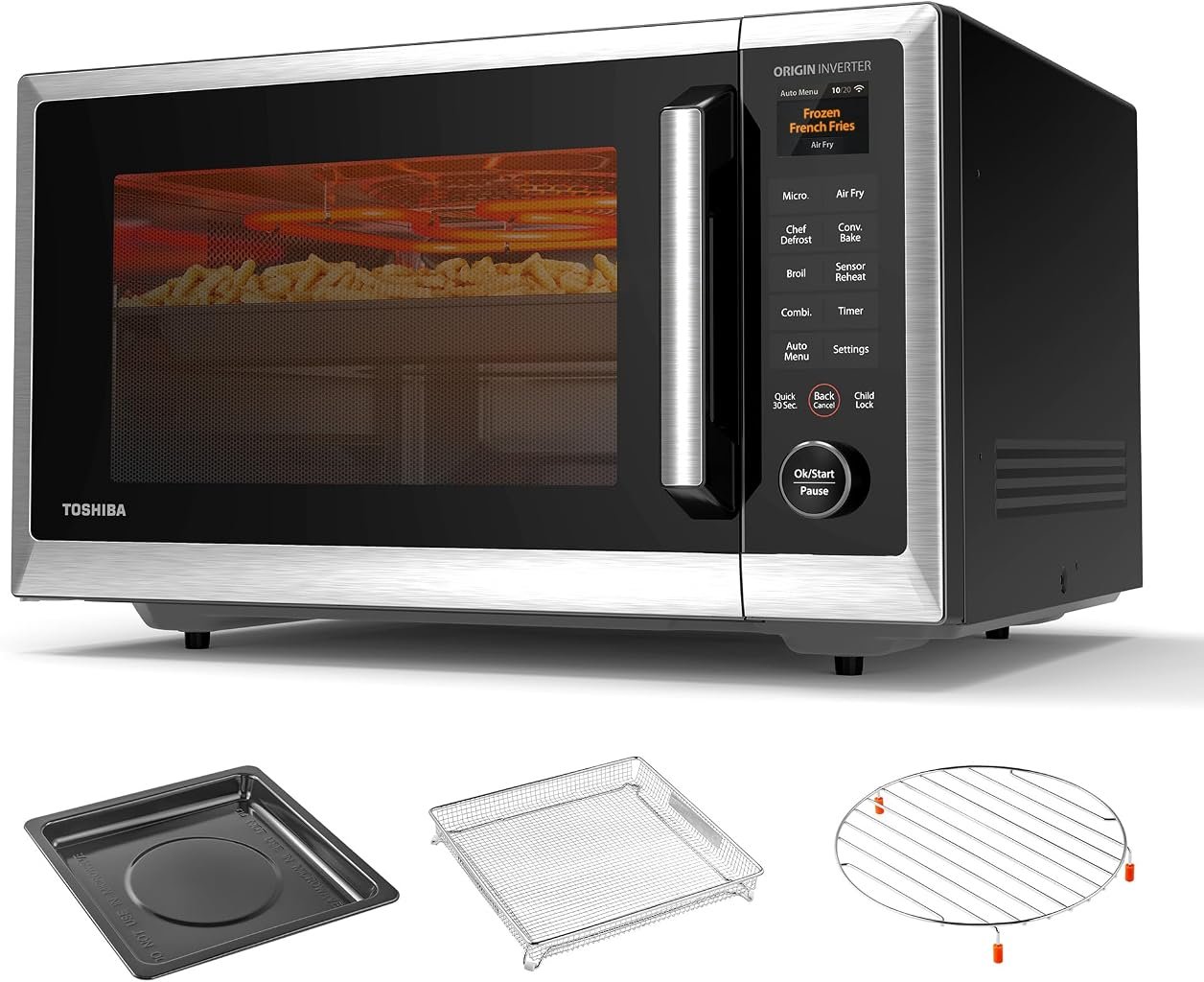
The oven therefore provides dedicated controls for microwave cooking, Air Fry, Convection Bake, Broil, Sensor Reheat, Chef Defrost, Combi operation, a timer, automatic menus, and quick 30-second operation. Its control panel combines dedicated buttons with a central selection dial and the 2.4-inch color display.
That breadth is meaningful only if the interface prevents it from becoming a maze.
The color screen is not decorative in this context. It has actual work to do.
A 1.3-Cubic-Foot Cavity Is Spacious, but the Exterior Is Substantial
The OptiChef provides 1.3 cubic feet of cooking capacity. Documented exterior dimensions are approximately 21.8 inches wide, 19.4 inches deep, and 12.8 inches high. Interior dimensions are approximately 14.5 inches wide, 16.4 inches deep, and 9.3 inches high. The appliance weighs about 36 pounds and uses a roughly 13.6-inch turntable.
Those measurements deserve attention because countertop appliances consume more space than their capacity numbers imply.
A depth approaching 19.4 inches is substantial. Required ventilation space increases the practical footprint further.
A microwave buying guide focused only on cubic feet can therefore mislead shoppers with limited counter depth. The correct question is not whether 1.3 cubic feet sounds adequate. It is whether a 21.8-inch-wide appliance nearly 20 inches deep can remain on the intended countertop without interfering with cabinets, outlets, food preparation, or other appliances.
The interior is usefully broad. Toshiba states that the cavity can accommodate a 13-inch pizza or a whole chicken.
That capacity makes sense for the appliance’s convection and air-fry functions. A multifunction oven needs room not merely for dinner plates but also for foods spread across baskets, racks, or trays.
Vertical space is more constrained at 9.3 inches inside, particularly because conventional heating hardware occupies space near the top.
That geometry should be considered before assuming 1.3 cubic feet translates directly into unrestricted cookware compatibility.
The Included Accessories Are Part of the Cooking System
The OptiChef is not designed around a glass turntable alone.
Documentation identifies an air-fry basket, enamel tray, and wire rack among the cooking accessories.
That is necessary because the different heating methods require different relationships between food and heat.
Microwave cooking usually benefits from microwave-safe dishes positioned on the turntable. Air frying works differently. Hot air needs to circulate around exposed food surfaces, making a perforated basket useful. Broiling requires exposure to radiant heat. Convection baking uses circulating hot air and may benefit from elevated or tray-based positioning.
The accessories therefore expand capability, but they also create storage obligations.
A dedicated microwave may need little more than its turntable. A combo oven adds pieces that have to live somewhere when they are not in use.
Small kitchens should account for that space.
There is also a behavioral issue. The wrong accessory should not simply be left inside for every mode. Microwave operation has different material requirements from convection, air fry, or broil cooking.
A multifunction oven rewards owners willing to understand its modes rather than treating every setting as interchangeable.
Origin Inverter Is More Relevant Than the Smart Branding
Toshiba prominently identifies Origin Inverter as one of the OptiChef’s central features.
The practical reason inverter technology matters is power control.
Traditional microwave designs can achieve lower average power by cycling full microwave output on and off. An inverter architecture can regulate power more continuously.
That difference is particularly relevant during lower-power tasks such as defrosting, softening, or gently reheating foods.
Maximum power is rated at 1,100 watts, with 1,250 watts of documented input power. The oven operates on 120 volts.
The distinction between output and input should not be overlooked. The 1,100-watt figure describes microwave cooking output; 1,250 watts describes electrical input under the documented microwave specification.
Toshiba’s manual documentation identifies 10 microwave power levels.
For everyday ownership, those fundamentals matter more than the word “smart.” A microwave spends much of its life reheating food, defrosting ingredients, warming beverages, and adding another 30 seconds to something that remains cool in the center.
Inverter control directly affects that core job.
The Humidity Sensor Addresses Microwave Guesswork
Sensor reheating is another function with practical rather than merely decorative value.
The OptiChef incorporates a humidity sensor that detects moisture during cooking and adjusts time and power during sensor operation.
Microwave reheating is difficult because the machine cannot visually inspect the food.
A fixed-time cycle treats a small serving of rice and a large plate of leftovers according to whatever duration the user entered. Sensor systems use conditions inside the cavity to make a more informed decision about when heating has progressed far enough.
This does not remove the physics of uneven food.
A thick piece of meat, sauce, vegetables, and rice can all respond differently to microwave energy. Stirring, repositioning, standing time, and container shape remain relevant.
Yet sensor reheating can reduce one common form of waste: repeatedly opening the door, checking the food, adding time, and accidentally overheating the edges.
For an appliance this expensive, sensor operation is an appropriate inclusion.
ChefFry Plus Changes What the Appliance Can Actually Cook
Air frying is where the OptiChef stops behaving like a conventional microwave.
Toshiba’s ChefFry Plus system uses a top fan and heating element to create the hot-air environment associated with an air-fryer oven.
This matters because microwave energy is poor at producing the dry, browned exterior expected from fries, breaded foods, wings, or roasted surfaces.
Microwaves are extremely effective at heating water-rich food. Crisping requires a different mechanism.
The OptiChef’s air-fry hardware provides that mechanism.
The automatic menu illustrates the intended uses. Documented air-fry presets include French fries, frozen pizza, chicken wings, onion rings, chicken nuggets, chicken legs, chicken tenders, butterfly shrimp, fish sticks, spring rolls, mozzarella sticks, and bacon.
Those choices reveal the function’s strongest practical role: foods where surface texture matters.
The appliance should therefore be judged less as “a microwave that can air fry” than as two different heating systems sharing one cavity.
That distinction sets realistic expectations.
Convection Bake and Broil Expand the Case for Appliance Consolidation
The OptiChef also provides Convection Bake and Broil modes, along with Combi cooking.
Convection baking circulates heated air through the cavity, moving the appliance toward the operating principles of a compact oven.
Broiling applies intense heat from above.
Combination cooking can use more than one heating approach during a program.
These modes matter because they address a weakness that no amount of microwave wattage can solve: microwave energy alone does not produce oven-style browning.
A household using the OptiChef only to reheat coffee and leftovers would leave much of the hardware idle.
A household that would otherwise keep a microwave, compact air fryer, and toaster oven on the counter has a much more interesting calculation.
One appliance can consume considerable space while still using less total space than three separate appliances.
That is the strongest conceptual argument for the OptiChef.
It is not small.
It is consolidated.
Twenty-Five Automatic Menus Are More Coherent Than They Sound
Twenty-five presets can initially sound excessive.
The manual’s menu structure is more logical than the raw number suggests. It divides functions across microwave cooking, air frying, and defrosting.
Microwave presets cover popcorn, frozen pizza, potato, beverages, soup, oatmeal, melting butter, and melting chocolate. Air-fry menus address the crisping foods already described. Defrost programs cover vegetables, fruit, chicken, fish, and meat.
Several air-fry programs also prompt the user to turn food during cooking.
That detail is useful.
Air frying depends on exposing surfaces to circulating hot air. Turning food can improve the amount of surface area receiving direct airflow.
The automatic menus therefore do not eliminate participation. They structure it.
A person who enjoys manual cooking may ignore many of them. Someone transitioning from separate appliances may appreciate having mode, temperature, and time decisions partially organized by the interface.
The menus are most useful when treated as starting points rather than evidence that the oven can independently understand every food placed inside it.
ChefDefrost Uses the Inverter for a Sensible Purpose
Toshiba states that its Advanced ChefDefrost technology can achieve up to 40% faster defrosting while using different power levels for more even results. The manufacturer’s claim is specifically presented as a comparative performance feature of this system.
The manual’s automatic menu includes separate defrost categories for vegetables, fruit, chicken, fish, and meat, with documented weight ranges reaching 70 ounces.
This is a sensible application for inverter power.
Defrosting is one of the most difficult microwave jobs because frozen food does not thaw uniformly. Thin edges can begin cooking while the center remains frozen.
Variable power and food-specific programs attempt to reduce that mismatch.
No preset can eliminate differences in shape and thickness. A tightly packed block of ground meat presents a different problem from individually frozen fish portions.
But defrosting is precisely the kind of task where controlled power is more useful than simply increasing maximum wattage.
Smart Controls Are Useful, but They Should Remain Secondary
The OptiChef connects to Toshiba’s TSmartLife app and supports Alexa voice control. The documented network functions include remote control, monitoring, recipe access, and connectivity settings.
Toshiba also describes cloud recipe updates and over-the-air firmware functionality around its smart cooking platform.
These capabilities broaden the interface beyond the front panel.
Their practical value will vary sharply by household.
Voice control can be convenient when hands are occupied with food preparation. App monitoring can be useful when a cook moves elsewhere in the home. Connected recipes may help users explore unfamiliar modes.
None of those functions should determine whether the OptiChef is fundamentally suitable.
A microwave is an appliance with a heating cavity, high electrical demand, hot accessories, and-in convection or air-fry operation-very hot surfaces. Physical interaction with food and cookware remains unavoidable.
The local controls therefore remain more important than remote novelty.
Fortunately, Toshiba has not made the app the only route to the appliance’s major cooking modes.
Counter Space Is the Hidden Cost
The OptiChef’s 21.8-inch width is not extraordinary for a countertop microwave.
Its 19.4-inch depth is more demanding.
The installation instructions call for ventilation clearance around the appliance, including space above and behind it.
That means a countertop barely deep enough for the chassis is not necessarily deep enough for proper installation.
Cabinets above the counter also matter. A 12.8-inch-high appliance plus required ventilation clearance can create a tight fit beneath low cabinetry.
This is why countertop dimensions should be measured before purchase.
A buyer should verify:
- Available counter width.
- Counter depth.
- Clearance beneath upper cabinets.
- Rear ventilation space.
- Access to a suitable 120-volt outlet.
- Room for the door to open normally.
- Storage for the air-fry basket, enamel tray, and wire rack.
- A heat-safe place to set hot accessories after convection, broil, or air-fry cooking.
- Enough surrounding workspace to load and unload food safely.
The appliance may replace several machines, but it still needs a permanent home.
Cleaning Is More Demanding Than With a Microwave-Only Model
The OptiChef uses a ceramic-enamel interior rather than relying solely on a conventional painted cavity.
Cleaning demands nevertheless increase when an appliance begins air frying and broiling.
Microwave splatter is often moisture-rich food residue. Air frying introduces grease aerosol and browned particles. Broiling can produce spatter at higher surface temperatures.
The air-fry basket and enamel tray also become part of the cleaning routine.
This is an unavoidable consequence of multifunction cooking.
An appliance capable of browning chicken wings will require more cleanup than one used primarily to warm soup.
Owners should clean residue before repeated high-temperature cycles bake it onto surfaces.
The door, seals, turntable area, cavity roof, heating-element area, racks, basket, and tray all deserve routine attention according to the appropriate cleaning instructions.
Consolidating appliances reduces the number of boxes on the counter. It does not eliminate the work those cooking methods generate.
Safety Changes When Microwave and Oven Functions Share a Cavity
The OptiChef requires users to think in more than one safety mode.
During ordinary microwave cooking, microwave-safe containers and proper door operation dominate the discussion.
During convection, broil, and air-fry modes, the cavity, trays, racks, and food can reach oven-like temperatures.
That means cookware acceptable for one mode may be inappropriate for another.
The U.S. Food and Drug Administration’s microwave-oven guidance explains that federal microwave standards limit radiation leakage and require safety interlocks that stop microwave production when the door opens. The FDA also identifies hot containers, overheated foods, and liquids among the more ordinary sources of microwave-related injury.
The OptiChef adds another obvious hazard: accessories heated by conventional elements.
Oven mitts and a safe landing surface for hot trays are therefore part of normal ownership, not optional precautions.
Reading Our Editorial Scores
Our overall score is 8.12/10.
That reflects an appliance with unusually broad cooking capability but equally visible complexity. The OptiChef can microwave, sensor-reheat, defrost, air fry, convection bake, broil, and combine cooking methods. It offers 25 automatic menus, inverter technology, connected controls, and a 1.3-cu.-ft. cavity.
Customer Sentiment is 7.84, the lowest of our four ratings.
That restraint is appropriate for a product asking one interface and one cavity to handle several different cooking methods. More capability creates more opportunities for friction: accessories need swapping, high-temperature modes require cleanup, the appliance is deep, and users interested only in microwave cooking are paying for hardware they may rarely use.
Buyer Confidence reaches 9.13.
This is the OptiChef’s strongest editorial measurement. Toshiba identifies the exact model, capacity, cooking technologies, automatic menus, connectivity platform, inverter system, sensor architecture, and principal operating modes clearly. The supporting manual adds dimensions, power figures, turntable diameter, cavity measurements, accessories, and operating procedures.
Value stands at 7.91.
At $409.97, the appliance is easier to justify when it eliminates the need for another countertop oven or air fryer. The economics are less attractive if most of its life will be spent reheating leftovers for 90 seconds.
That difference explains why Buyer Confidence substantially exceeds Value.
The product is easier to understand than it is to justify universally.
Who Is Most Likely to Benefit
The strongest fit is a household actively seeking appliance consolidation rather than merely a new microwave.
Its documented attributes include:
- 1.3 cubic feet of capacity.
- 1,100 watts of microwave output.
- Origin Inverter power control.
- Approximately 13.6-inch turntable.
- ChefFry Plus air frying.
- Convection Bake.
- Broil.
- Combination cooking.
- Humidity-based sensor reheating.
- ChefDefrost.
- 25 automatic menus.
- 2.4-inch color display.
- Quick 30-second operation.
- TSmartLife connectivity.
- Alexa compatibility.
- Air-fry basket.
- Enamel tray.
- Wire rack.
- Child safety features.
- Eco mode.
The weaker fit is equally identifiable.
A household that already owns and enjoys a dedicated air fryer and full-size oven may gain relatively little from duplicating those functions inside the microwave.
Someone with shallow counters should examine the 19.4-inch depth carefully.
A user who values extreme simplicity may prefer a conventional microwave with fewer modes and fewer accessories.
And households that air fry large quantities at once should compare usable basket area, not merely cubic capacity.
Final Considerations
The TOSHIBA OptiChef PRO MAX ML2-STC13SAIT(SS) is not a conventional microwave dressed up with a few extra presets. Its additional heating hardware materially changes what can happen inside the cavity.
Microwave energy handles rapid reheating and defrosting. Origin Inverter technology gives the appliance more controlled power delivery. The humidity sensor supports automatic reheating. ChefFry Plus adds a fan and upper heating element for air frying. Convection Bake circulates heated air. Broil supplies direct upper heat. Combination cooking allows those systems to work within a broader cooking strategy.
That is substantial functional breadth.
The price for that breadth is physical and operational complexity.
At 21.8 inches wide, 19.4 inches deep, and 12.8 inches high, this is a serious countertop appliance rather than a compact microwave. The basket, enamel tray, and rack require storage and cleaning. Air-fry and broil modes create grease and high-temperature residue that ordinary microwave reheating does not. Hot accessories require handling habits closer to oven use.
The 1.3-cu.-ft. cavity is nevertheless large enough for Toshiba to specify compatibility with a 13-inch pizza or whole chicken, while the approximately 13.6-inch turntable gives the microwave side of the appliance generous plate capacity.
Our score of 8.12/10 reflects that balance.
Customer Sentiment at 7.84 recognizes that multifunction appliances demand compromises in simplicity and daily workflow. Value at 7.91 reflects a $409.97 price that makes the most sense when the OptiChef displaces other appliances rather than joining them. Buyer Confidence at 9.13 is considerably higher because Toshiba’s documentation makes the machine’s capabilities, dimensions, modes, accessories, and requirements relatively concrete.
The decisive buying question is therefore not whether the OptiChef has enough features. It has more than enough.
The question is whether those features correspond to cooking jobs the household actually performs.
A kitchen routinely reheating leftovers, defrosting meat, air frying frozen foods, baking small dishes, crisping pizza, and using a compact oven has a coherent reason to consolidate those jobs. A kitchen needing only a fast microwave does not.
Before purchase, the counter should be measured with the required ventilation space included. The intended outlet should be checked. Storage for the basket, tray, and rack should be identified. Frequently used dishes should be compared with the cavity dimensions. Most importantly, the household should identify which existing appliance the OptiChef will replace.
If the answer is “none,” $409.97 buys considerable duplication.
If the answer is a microwave, air fryer, and part of a toaster oven’s workload, the calculation changes substantially.
That distinction defines the TOSHIBA OptiChef PRO MAX. Its appeal does not come from having the longest feature list on the counter. It comes from whether one well-documented cooking cavity can take over enough separate jobs to earn the considerable amount of counter space it asks a kitchen to surrender.