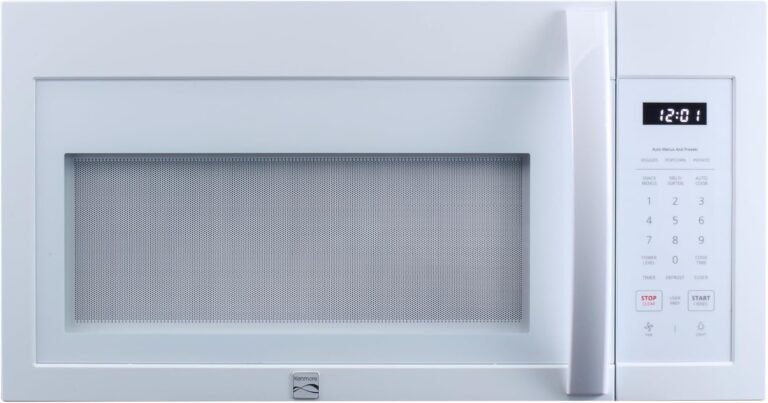
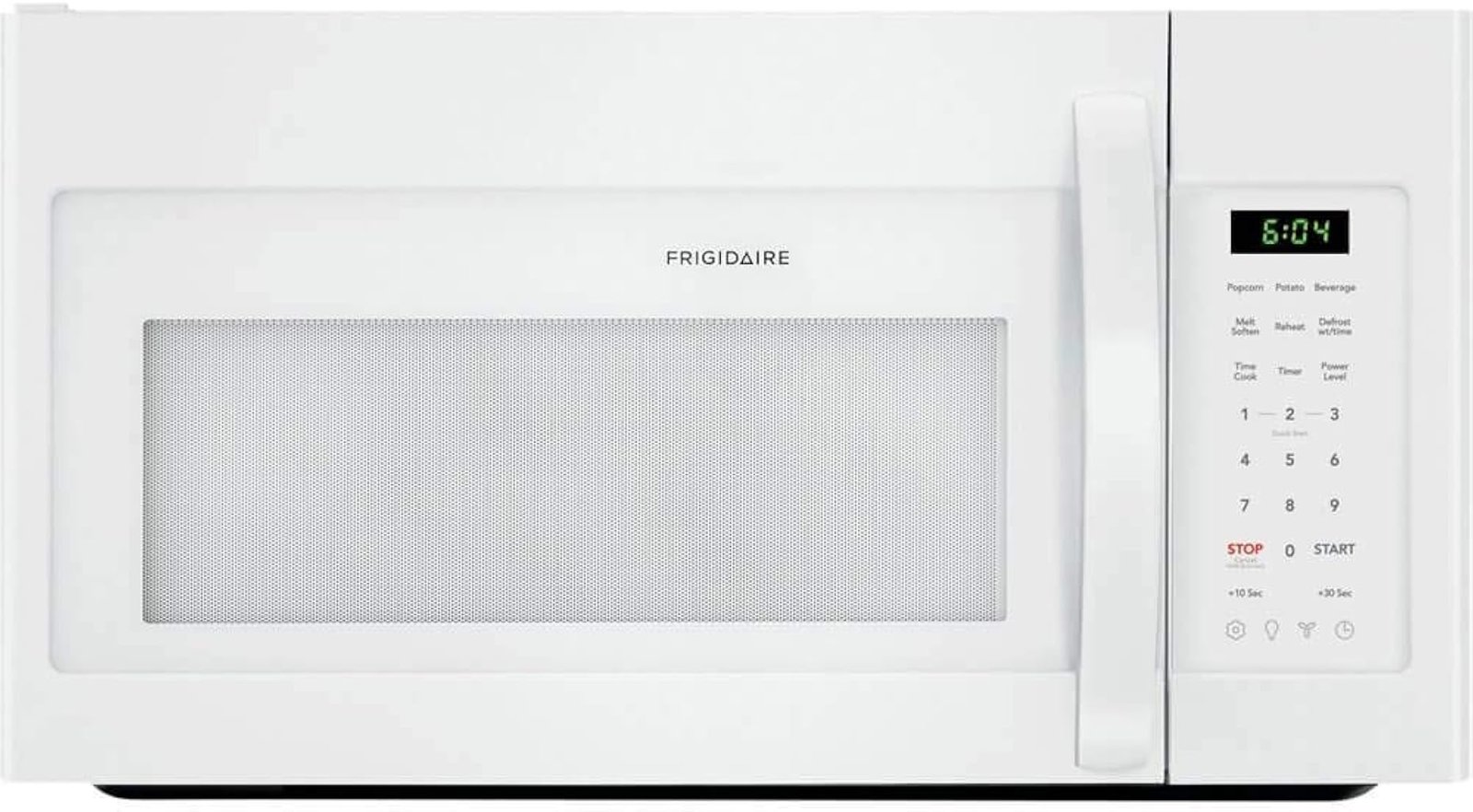
A product described simply as a white, 1.80-cu.-ft. microwave sounds almost anonymous. Follow the identifying details, however, and a more useful picture emerges. The appliance belongs to Frigidaire’s 30-inch over-the-range microwave family, associated with the white FFMV1846VW and its newer FMOS1846BW successor. That distinction matters because the basic cooking architecture is remarkably similar across the generations, while the newer model introduces refinements such as Frigidaire’s PureAir filtration arrangement.
The central proposition remains unchanged: 1.8 cubic feet of microwave capacity, 1,000 watts of cooking power, 10 power levels, a rotating glass turntable, one-touch controls, integrated cooktop ventilation, and a white exterior intended for a conventional 30-inch installation.
Frigidaire’s current documentation for the white FMOS1846BW establishes the modern version’s dimensions at 29 7/8 inches wide, 16 3/8 inches high, and 15 3/4 inches deep. It specifies a 12.4-inch glass turntable, 1,000 watts of cooking power, 10 power levels, 120-volt operation, and 1.8 cubic feet of capacity. Historical documentation for the earlier white FFMV1846VW confirms the same broad cooking formula, including 1.8 cubic feet, 1,000 watts, 10 power levels, LED cooktop lighting, and two-speed ventilation reaching 300 CFM.
At a reference price of $349, our score is 8.28/10. Customer Sentiment is 8.28, Buyer Confidence reaches 8.46, and Value stands at 8.15.
Those scores are unusually close together. There is no single rating dramatically pulling the assessment upward or downward. Instead, the Frigidaire presents a balanced case: substantial interior capacity, mainstream cooking power, familiar installation dimensions, direct controls, and an integrated hood function, offset by the limitations inherent in a conventional OTR microwave and a price that must be considered alongside installation costs.
The 1.8-Cubic-Foot Figure Tells Only Part of the Story
Capacity is the specification that gives this microwave its generic identity, but cubic feet should never be interpreted without geometry.
A 1.8-cu.-ft. cavity is large enough to move the appliance firmly away from compact-microwave territory. Frigidaire’s current white model has an interior approximately 21.09 inches wide, 10 9/16 inches high, and 14 9/16 inches deep. The turntable measures roughly 12.4 inches in diameter.
That turntable measurement is particularly useful.
A microwave buying guide can list capacities endlessly, but a household ultimately places physical dishes inside the machine. A favorite dinner plate does not care how many cubic feet appear on a specification sheet. It cares whether there is enough diameter to rotate.
A 12.4-inch turntable should accommodate many standard plates, bowls, storage containers, and microwave-safe dishes. Larger rectangular cookware requires more attention because total cavity width and depth do not guarantee unobstructed rotation.
Historical Frigidaire material for the earlier FFMV1846VW specifically described the cavity as capable of accepting larger cookware, including a 13-by-9-inch baking dish. That is a useful illustration of interior scale, although large rectangular dishes may be used differently from ordinary rotating plates.
The broader point is that 1.8 cubic feet is meaningful capacity for a conventional household microwave. It gives the appliance enough room to serve as a primary microwave rather than merely a compact reheating station.
The 30-Inch Format Matters as Much as Capacity
An over-the-range microwave is partly an architectural product.
The older FFMV1846VW was documented at approximately 29 5/8 inches wide, 15 5/8 inches deep, and 15 7/8 inches high in commerce records associated with the product identifier. The current FMOS1846BW measures 29 7/8 inches wide, 15 3/4 inches deep, and 16 3/8 inches high.
Those differences demonstrate why replacement buyers should never assume that every nominal 30-inch OTR microwave shares identical mounting geometry.
The category name describes a class, not an interchangeable block.
Wall brackets can differ. Upper-cabinet bolt locations can differ. Height can change. Vent openings can move. Even two appliances from the same manufacturer can require new mounting hardware.
This makes measurement one of the most consequential parts of the purchase.
A buyer should establish the opening width, cabinet depth, mounting height, electrical outlet location, wall construction, exhaust configuration, and door clearance before ordering. Existing ductwork also needs inspection rather than blind reuse.
A microwave that physically fits the width can still produce a frustrating installation if the exhaust or mounting arrangement differs from the previous appliance.
1,000 Watts Keeps Cooking Power in Familiar Territory
Frigidaire rates this 1.8-cu.-ft. family at 1,000 watts of cooking output.
That is a practical specification because many household microwave tasks and packaged-food directions are written around familiar power ranges. It also prevents the large cavity from being paired with unusually low cooking output.
Yet wattage should not be mistaken for a universal measure of cooking quality.
Microwave heating depends on food composition, moisture, shape, density, initial temperature, placement, and container material. A dense frozen meal and a mug of liquid behave differently under identical nominal power.
The 10 available power levels therefore deserve nearly as much attention as the maximum output.
Lower settings allow the microwave to approach delicate tasks more gradually. Defrosting is the obvious case. Maximum power can begin cooking thinner sections of frozen food while the center remains solid. Reduced-power operation helps manage that imbalance.
The current FMOS1846BW adds documented time and weight defrost controls, along with Auto Cook, Beverage, Melt/Soften, Popcorn, Potato, Reheat, and Veggies functions.
Those controls do not transform the appliance into an oven. They simply make common microwave jobs faster to program.
That is an appropriate priority for this category.
Quick Controls Matter Because Microwaves Are Used Quickly
One of the oddities of appliance marketing is that complicated features can receive more attention than frequently used ones.
Microwaves often operate in extremely short cycles. Thirty seconds here, another 10 seconds there, perhaps a minute to warm a drink or a few minutes for leftovers.
Frigidaire provides +10 Seconds and +30 Seconds controls on the current model, along with Quick Start operation.
These are not glamorous features.
They are useful precisely because they reduce the number of interactions required for routine heating.
The same logic applies to dedicated popcorn, beverage, potato, vegetable, reheat, and melt/soften programs. Their value depends less on how impressive the control panel looks than on whether a household repeatedly performs those tasks.
A microwave with dozens of obscure presets can appear sophisticated while forcing the owner to search through menus. Direct controls can produce the opposite experience: less apparent sophistication but lower friction.
The Frigidaire’s interface belongs to the latter philosophy.
The Newer Generation Adds Better-Defined Air Filtration
The transition from the older FFMV1846VW family to the current FMOS1846BW is most interesting on the ventilation side.
Frigidaire’s current product documentation identifies an included PureAir microwave filter intended to capture odors and filter recirculated air from the exhaust fan. It also incorporates a push-to-open filter door and a filter indicator light tied to ventilation-fan usage.
That is a meaningful usability refinement for recirculating installations.
Filters are easy to forget because they are mostly invisible. An indicator does not clean or replace a filter automatically, but it makes maintenance harder to ignore.
The push-to-open access door addresses another mundane problem: serviceability.
A filtration system that is awkward to access is more likely to be neglected.
Still, filtration and ventilation should not be confused. Capturing some grease and odors from recirculated air is not equivalent to exhausting cooking emissions outdoors.
That distinction becomes central when evaluating any OTR microwave.
The Ventilation System Is More Than an Accessory
A microwave installed over a stove takes the physical place normally assigned to a range hood.
That means ventilation is not a secondary feature.
Frigidaire documents two exhaust-fan speeds, with current support information specifying airflow from approximately 105 CFM at the lower setting to 300 CFM at maximum. Historical documentation for the FFMV1846VW reports the same 105/300 CFM two-speed arrangement.
This continuity is useful because it establishes 300 CFM as part of the product family’s ventilation identity rather than a feature borrowed from an unrelated model.
CFM describes cubic feet of air moved per minute. It does not measure how effectively every cooking plume will be captured.
Real ventilation performance depends on duct resistance, bends, filters, hood geometry, mounting position, burner location, cooking method, fan speed, and whether the air actually leaves the building.
A long duct with multiple turns can impose more resistance than a short, direct path outside.
Likewise, smoke produced on a front burner can be harder for an OTR hood to capture than emissions rising directly beneath the rear of the appliance.
These details matter more than simply comparing fan numbers.
EPA Guidance Puts 300 CFM in Perspective
Cooking is itself a source of indoor particulate matter.
The U.S. Environmental Protection Agency states that cooking method, food, and cooking fat can all affect the amount of indoor particulate matter produced. The agency recommends using a range hood whenever cooking and says outdoor venting is preferable where possible. It also recommends leaving the hood operating for 10 to 20 minutes after cooking and using back burners when practical to improve capture.
Those recommendations make the integrated fan more consequential than a convenience feature.
The EPA separately reports that ASHRAE and the Home Ventilation Institute recommend 100 CFM for a typical kitchen range, while cautioning that larger fans may require makeup air to avoid excessive depressurization and possible backdrafting of combustion equipment.
Against that reference point, a maximum rating of 300 CFM is substantial for ordinary residential cooking.
But rated maximum airflow is not identical to installed airflow.
That distinction should temper simplistic comparisons between two microwaves based entirely on their CFM labels.
Outdoor Exhaust Is the Better Configuration Where Feasible
An OTR microwave can be installed in ways that produce very different air-quality outcomes.
A ducted configuration sends air outdoors. A recirculating configuration filters air and returns it to the kitchen.
Frigidaire’s current white model supports both ducted and ductless ventilation, with charcoal and removable grease filtration documented for the system.
The EPA specifically advises installing a range hood that vents outside rather than one that merely recirculates air. Its current guidance also calls for routine cleaning of the range hood’s grease filter.
This has practical implications for replacement projects.
A kitchen may already have an OTR microwave without having an outdoor duct. The presence of an exhaust fan does not prove that air leaves the building.
Prospective owners should determine the ventilation path before installation.
That knowledge affects expectations far more than the appearance of the fan button.
LED Lighting Solves an Everyday Visibility Problem
The current Frigidaire uses LED lighting both inside the microwave and over the cooktop. The interior LED is specified at 1.2 watts, while a separate surface cooking light illuminates the range below.
The earlier FFMV1846VW also documented LED cooktop and interior lighting.
This is another feature whose importance becomes clearer after installation.
A ceiling fixture often illuminates the kitchen from behind the person cooking, creating shadows directly over pans. An OTR microwave is positioned in an unusually useful location for task lighting because it sits immediately above the cooking surface.
The interior light solves a different problem by allowing food to be observed during operation.
Neither feature changes microwave performance, but both affect daily usability.
An appliance used several times per day can benefit more from good visibility than from a rarely used advanced preset.
Zero-Clearance Door Design Helps Tight Cabinet Layouts
The current FMOS1846BW documents a zero-clearance door opening.
This feature is particularly relevant where the microwave sits beside a wall or tall cabinet.
A door that requires substantial side clearance can create a problem even when the appliance body fits perfectly into the opening. Kitchens with a microwave positioned at the end of a cabinet run are especially susceptible.
Zero-clearance geometry reduces that risk.
It does not remove the need to measure. Surrounding handles, trim, uneven walls, and adjacent appliances can still interfere.
But it shows that usable clearance involves more than width.
The door has to work after the microwave is mounted.
Installation Cost Can Change the Value Calculation
The $349 reference price should not be treated as the complete cost of ownership on installation day.
An OTR microwave requires secure mounting, suitable electrical service, appropriate clearance, and a correctly configured ventilation system.
If an existing appliance can be removed and the new unit installed using compatible cabinetry, power, and ductwork, the project may remain relatively straightforward.
If not, costs can rise quickly.
Potential additions include:
- Professional removal and installation.
- New mounting holes or wall reinforcement.
- Cabinet modification.
- Electrical work.
- New or altered exhaust ducting.
- Exterior vent installation.
- Repair of wall or cabinet surfaces exposed by the previous appliance.
- Disposal of the old microwave.
- Replacement filters over time.
These expenses explain why Value at 8.15 sits slightly below the overall 8.28 score.
The microwave itself can be reasonably priced while the installation around it becomes expensive.
That distinction matters particularly in older kitchens.
Maintenance Extends Beyond Wiping the Cavity
The glass turntable is the obvious removable cleaning component, but an OTR microwave has maintenance responsibilities beneath the cavity as well.
Grease filters collect material rising from cooking. Frigidaire’s current system uses two removable, dishwasher-safe grease filters, along with a charcoal filter for recirculating operation.
Those components should be treated as functional ventilation equipment.
A grease-loaded filter can restrict airflow. A neglected recirculation filter can lose effectiveness against odors.
The newer PureAir filter indicator addresses part of this maintenance problem by prompting attention based on fan usage.
Inside the microwave, spills should be cleaned before repeated heating turns them into hardened residue. The turntable and support area also need routine attention.
Door condition deserves inspection as well.
Microwave safety depends partly on proper closure and functioning interlocks, making a damaged latch, hinge, or door more significant than an ordinary cosmetic defect.
Microwave Radiation Is Heavily Regulated
The word “radiation” can make microwave safety discussions unnecessarily dramatic.
Microwave ovens are regulated radiation-emitting electronic products in the United States. The FDA’s Electronic Product Radiation Control program specifically includes microwave ovens among regulated non-medical electronic products.
Federal requirements address both leakage and safety interlocks.
FDA compliance guidance identifies a post-purchase leakage limit of 5 milliwatts per square centimeter and requires two independent safety interlocks or equivalent monitoring architecture.
For normal ownership, this regulatory framework redirects attention toward more immediate issues: damaged doors, improper operation, hot food, steam, superheated liquids, and poor installation.
The microwave should never be operated when its door or latching system is visibly damaged.
That is a more useful safety habit than generalized fear of the technology itself.
Reading Our Editorial Scores
Our overall score is 8.28/10.
Customer Sentiment is also 8.28, producing an unusual alignment between the overall editorial assessment and the sentiment score. The microwave’s strengths and compromises are balanced rather than extreme.
Buyer Confidence is the highest measure at 8.46.
That reflects the product’s well-established format. Capacity, cooking output, power levels, dimensions, turntable size, ventilation architecture, and control functions can all be described concretely. The Frigidaire identity behind the generic product description also removes much of the uncertainty that initially surrounds the listing.
Value reaches 8.15.
That score is positive but deliberately restrained. At $349, the appliance provides 1.8 cubic feet, 1,000 watts, 10 power levels, integrated ventilation, lighting, and a familiar 30-inch installation format. Yet it remains a conventional microwave rather than a convection-equipped multifunction appliance, and installation expenses can materially alter the final cost.
The narrow spread from 8.15 to 8.46 is revealing.
There is no dramatic contradiction between what the product is, what it costs, and how confidently its buyer fit can be judged.
Who Is Most Likely to Appreciate It
The Frigidaire is best suited to households replacing or installing a conventional 30-inch OTR microwave and prioritizing straightforward operation over advanced cooking modes.
Its useful attributes include:
- 1.8 cubic feet of capacity.
- 1,000 watts of cooking output.
- 10 power levels.
- Approximately 12.4-inch glass turntable.
- Quick-start controls.
- Automatic cooking programs.
- Time and weight defrost functions on the current generation.
- Two-speed ventilation reaching 300 CFM.
- LED cooktop and interior lighting.
- Child lock on the current model.
- Ducted and recirculating ventilation options.
- Zero-clearance door design on the current generation.
- Removable grease filtration.
The weaker fit is a kitchen requiring very high smoke-capture capacity, a low-profile microwave for increased cooktop clearance, or convection cooking.
Likewise, households with unusually large microwave cookware should measure dishes against the cavity and turntable rather than assuming 1.8 cubic feet guarantees compatibility.
Final Considerations
The 1.80 cu. ft. Microwave is far less anonymous once its Frigidaire identity is established.
The product identifier traces to the white FFMV1846VW generation, while Frigidaire’s current FMOS1846BW carries the same basic 1.8-cu.-ft., 1,000-watt, 10-power-level formula into a newer design with PureAir filtration, a filter indicator, zero-clearance door geometry, and clearly documented LED lighting.
The underlying appeal is straightforward.
A 30-inch OTR microwave removes a large appliance from the countertop while combining food heating, cooktop lighting, and ventilation in one installed unit. The 1.8-cu.-ft. cavity is large enough for ordinary household dishes and larger cookware, while the approximately 12.4-inch turntable provides a more practical reference for plate compatibility than capacity alone.
Cooking power is equally conventional in a useful sense. A 1,000-watt output and 10 power levels provide enough flexibility for reheating, defrosting, beverages, vegetables, popcorn, potatoes, and other everyday microwave jobs without pretending that maximum wattage guarantees uniform results.
The ventilation system requires more careful interpretation.
A maximum 300 CFM specification gives the appliance meaningful airflow capacity, but duct design, installation, filter condition, burner position, and cooking method determine how much of that potential translates into effective capture. EPA guidance favoring outdoor exhaust makes the existing duct path one of the most consequential details a buyer can inspect before installation.
Our score of 8.28/10 reflects that balance. Customer Sentiment at 8.28 sits in exact alignment with the overall assessment. Buyer Confidence at 8.46 is modestly higher because the product’s dimensions and functions are relatively easy to establish. Value at 8.15 recognizes that $349 is reasonable for the feature set without ignoring the potential cost of installation or the absence of more advanced cooking systems.
The most useful purchase preparation therefore involves a tape measure and an inspection of the kitchen rather than another hour comparing preset buttons.
Measure the cabinet opening. Check the mounting height. Locate the electrical outlet. Inspect existing ductwork. Determine whether ventilation reaches outdoors. Measure frequently used plates and cookware. Account for removal and installation costs. Identify which Frigidaire generation is actually being purchased so that filter arrangements and other model-specific details are not assumed across generations.
Those steps turn a generic-looking product into a much more precise buying decision.
The Frigidaire 1.8-cu.-ft. OTR platform does not attempt to reinvent microwave cooking. Its purpose is narrower and more practical: provide substantial cavity space, familiar 1,000-watt cooking power, direct controls, useful lighting, and moderate integrated ventilation inside the dimensions expected of a conventional 30-inch installation.
For a kitchen already built around that format, such predictability has considerable practical value. For a kitchen demanding stronger ventilation, unusual dimensions, low-profile clearance, or oven-like cooking functions, the limitations are equally apparent before money is spent.
That clarity explains the tightly grouped editorial scores. This is a microwave whose strengths and boundaries are unusually easy to define-and an appliance is easier to buy intelligently when both are visible at the same time.