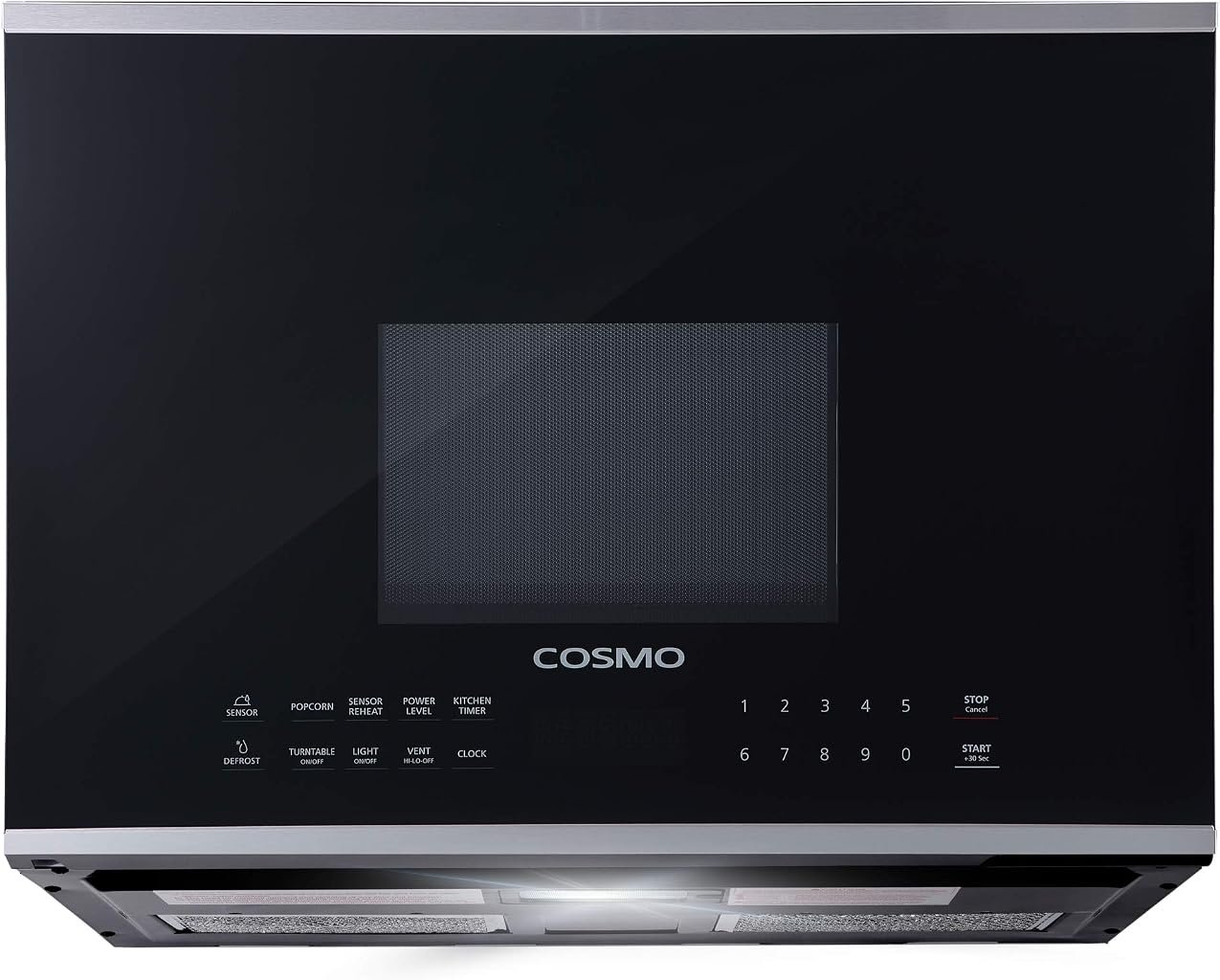
A 24-inch over-the-range microwave exists in a peculiar corner of the appliance market. Most kitchens built around a conventional range expect something close to a 30-inch appliance above it, leaving owners of narrower cabinetry, compact kitchens, secondary cooking areas, and certain older layouts with fewer choices. That dimensional problem, rather than an exotic cooking feature, is the central reason the Stellar Collection microwave deserves examination.
The product sold as the 24-inch Stellar Coll 1.3 cu. ft. Over-the-Range Microwave corresponds to Cosmo’s COS-2413ORM1SS Stellar Collection model. Its actual documented capacity is 1.34 cubic feet. The manufacturer’s specifications put the exterior at 23.8 inches wide, 16.1 inches deep, and 17 inches high, with a net weight of approximately 57.3 pounds. Inside sits a 13.6-inch glass turntable. Microwave output is rated at 1,000 watts.
Those figures immediately establish the product’s purpose. This is not merely a smaller-capacity microwave. It is a deliberately narrow over-the-range appliance that retains cooking power associated with many larger machines.
The ventilation specification is equally concrete. Cosmo states that maximum airflow is 300 CFM, with high, low, and off fan settings documented in the controls. The appliance can also be configured for ductless recirculation with a separate carbon filter kit.
At a reference price of $339.99, our score is 8.49/10. Customer Sentiment stands at 8.28, Buyer Confidence at 9.48, and Value at 8.15. The unusually high Buyer Confidence figure is revealing: this is a specialized product whose dimensions and purpose are unusually easy to define. Value is somewhat lower because paying roughly $340 for a 1.34-cu.-ft. microwave makes the most sense when the 24-inch format solves an actual installation problem.
The 24-Inch Width Is the Real Headline
Appliance capacity attracts attention because cubic feet provide an easy comparison. Yet capacity is not necessarily the decisive measurement for an over-the-range microwave.
Width can determine whether the appliance can be installed at all.
The Stellar model measures 23.8 inches across. By comparison, the dominant OTR format is roughly 30 inches wide. Six inches may not sound dramatic until cabinetry makes those six inches unavailable. At that point, the difference separates an appliance that fits from one that requires reconstruction.
This makes the Stellar unusually dependent on context.
Placed in a purpose-built 24-inch opening, its dimensions are an advantage. Placed into a conventional 30-inch space without appropriate planning, the narrow body can create aesthetic and installation questions. Buyers therefore need to distinguish between “compact” as a general virtue and 24-inch width as a specific architectural requirement.
That distinction belongs near the beginning of any serious microwave buying guide. Installed appliances should be evaluated against the kitchen first and competitors second.
The remaining dimensions matter as well. At 17 inches high and 16.1 inches deep, this is not a low-profile OTR microwave in the modern sense of an unusually short chassis. Its space saving happens primarily across the width. Someone seeking additional vertical clearance above a cooktop should not assume that “24-inch” means short in every direction.
That is a subtle but consequential distinction.
A 1.34-Cubic-Foot Cavity With a Surprisingly Useful Turntable
A smaller exterior naturally produces questions about usable interior space.
Cosmo documents 1.34 cubic feet of oven capacity and a 13.6-inch turntable. The latter measurement may be more useful to a household deciding whether the microwave will accommodate its normal dishes.
Cubic-foot measurements describe total cavity volume. They do not tell a buyer whether a favorite dinner plate can rotate without contacting the walls.
A 13.6-inch turntable gives the Stellar enough diameter for many conventional plates, bowls, and microwave-safe containers. Oversized casserole dishes remain another matter. Anyone replacing a larger OTR microwave should measure frequently used cookware rather than assuming that dishes fitting the old machine will fit the new one.
The turntable can also be switched off, according to the product manual. That feature can be useful with containers whose geometry makes rotation inconvenient, though switching off rotation does not eliminate the underlying possibility of uneven microwave heating.
Capacity is therefore one of the model’s clearest compromises. A household accustomed to a 1.7-, 1.8-, or 2.0-cu.-ft. OTR microwave will notice the reduction. A household constrained by a 24-inch cabinet opening may view 1.34 cubic feet very differently.
That is the recurring pattern with this appliance: dimensions that appear restrictive in isolation can become attractive when evaluated against a genuinely narrow kitchen.
1,000 Watts Prevents Compactness From Becoming a Power Penalty
The Stellar’s rated microwave output is 1,000 watts, backed by 10 selectable power levels. Its rated microwave input is 1,550 watts.
That distinction between input and output is useful. Input describes electrical power consumed by the microwave system, while cooking output describes microwave energy available for heating food. Shoppers should not confuse the two when comparing machines.
The 1,000-watt output places this compact model in familiar household territory. Its narrow body has not been accompanied by an obvious reduction to a much lower cooking-power specification.
Still, wattage alone cannot predict results.
Food geometry, water content, density, initial temperature, container material, placement, and cooking duration all affect microwave heating. A 1,000-watt rating cannot guarantee that the center of a dense meal will reach the desired temperature at exactly the same moment as its edges.
The ten power settings provide greater control over that process. Lower power is useful when maximum output would be too aggressive, particularly during defrosting, softening, or controlled reheating.
That flexibility matters more than simply advertising maximum wattage.
Sensor Cooking Gives the Stellar More Than Basic Timer Controls
Compact does not mean stripped down here.
The control system includes Sensor Cook and Sensor Reheat, alongside popcorn, automatic defrost, timed cooking, instant cooking, a kitchen timer, power adjustment, and a 30-second addition control. Cosmo’s user documentation explicitly lists those functions rather than leaving them to retailer descriptions.
Sensor operation addresses one of the oldest inconveniences in microwave cooking: estimating time.
A conventional timed cycle follows the user’s instruction regardless of what is happening to the food. Sensor programs attempt to respond to conditions during cooking, reducing dependence on a manually guessed duration.
That does not make sensors infallible. Portion composition and container choice still matter, and no automatic program should replace food-safety judgment. Yet sensor reheating is particularly well suited to the repetitive work microwaves perform.
Leftovers illustrate the problem. A plate containing rice, vegetables, and protein does not behave like a cup of water. Moisture content and density vary across the meal. The ability to use a sensor-controlled reheating program therefore adds practical utility beyond another decorative preset.
The same reasoning applies to automatic defrost. Automation can reduce calculation, but thick or irregular frozen foods can still require separation, repositioning, or additional time.
The Stellar is therefore best viewed as a conventional microwave with useful automation rather than a multifunction oven.
What It Does Not Try to Be
Some limitations are just as informative as features.
For some buyers, those omissions will barely register.
A microwave installed above a stove has an unusually mundane job description. It reheats food, defrosts ingredients, cooks simple dishes, ventilates the cooktop, and illuminates the work surface. Smartphone control does not automatically improve any of those functions.
Convection is a more substantive omission because it changes cooking capability rather than merely adding connectivity. A convection-equipped microwave can potentially take on tasks associated with an oven. The Stellar remains fundamentally a microwave and ventilation appliance.
That narrower identity helps explain the Value score of 8.15. At $339.99, buyers are paying partly for an uncommon form factor rather than an enormous feature catalog.
If a household has a standard 30-inch opening, a broader market of competing OTR microwaves becomes available. If the opening is approximately 24 inches, the comparison set shrinks sharply, and the Stellar’s value proposition changes with it.
The 300 CFM Ventilation System Deserves Its Own Evaluation
Over-the-range microwaves are easy to assess as microwaves and surprisingly easy to neglect as range hoods.
That is a mistake.
Cosmo specifies maximum airflow of 300 CFM. The manufacturer’s support documentation explicitly answers the airflow question: “The maximum CFM for your over-the-range hood is 300.”
That figure establishes fan capacity, not guaranteed capture performance.
Ventilation effectiveness depends on more than the blower. Duct length, bends, diameter, filter condition, mounting geometry, fan speed, cooking method, burner position, and whether exhaust is discharged outdoors all influence what happens to smoke and moisture rising from the cooktop.
The Stellar supports outside top exhaust, outside back exhaust, and recirculating installation configurations in its installation documentation. That flexibility is useful, but the configurations are not functionally identical.
Recirculation passes air through filtration and returns it to the room. Outdoor exhaust physically removes air from the kitchen. Cosmo specifies that converting the microwave to ductless operation requires a carbon filter kit that is not included with the purchase.
That additional requirement should enter the project budget before installation rather than appearing as an unpleasant discovery afterward.
Installation Is Where the Compact Format Becomes Serious
A 57.3-pound appliance mounted above a stove is not a casual installation project.
Cosmo’s installation manual covers wall studs, wall-plate positioning, upper-cabinet preparation, blower configuration, exhaust arrangements, mounting, and charcoal-filter installation for recirculating use.
The manual exists for good reason. An OTR microwave is simultaneously a heavy wall-mounted appliance, an electrical device, and part of the kitchen ventilation system.
Before purchase, buyers should verify:
- The actual cabinet opening width rather than relying on a nominal measurement.
- Available height above the cooking surface and all manufacturer-required clearances.
- Cabinet depth and whether the 16.1-inch microwave depth works with surrounding cabinetry.
- Wall construction and suitable mounting locations.
- Electrical requirements and outlet position.
- Existing duct dimensions, direction, and condition.
- Whether ventilation will discharge outdoors or recirculate.
- Clearance for the microwave door.
- Whether frequently used cookware fits the 13.6-inch turntable.
- Whether the 57.3-pound appliance can be safely lifted and mounted during installation.
These checks are not bureaucratic preliminaries. They determine whether a $339.99 appliance remains a $339.99 appliance or becomes the center of a larger cabinet, duct, and electrical project.
The Vent Fan and Cooktop Light Replace More Than Counter Space
Removing a countertop microwave creates obvious workspace. Installing one above a range also removes the location where a conventional hood would normally sit.
The Stellar therefore needs to perform another daily task: supporting cooking below it.
The control panel provides high and low fan settings, and the appliance incorporates surface lighting beneath the microwave. These functions can look secondary in a product photograph but become routine controls after installation.
Cooktop illumination is particularly easy to undervalue. Ceiling lights frequently place the cook between the fixture and the stove, creating shadows over pans. Lighting directly above the cooking surface helps reveal boiling, browning, spills, and burner conditions.
The ventilation fan deals with another less visible problem. Steam is obvious; fine cooking particles and odors can be less so. The effectiveness of the system will depend heavily on installation, especially whether air reaches an exterior discharge.
The 300 CFM rating should therefore be understood as available airflow capacity rather than a promise that every cooking plume will be captured.
Cleaning and Maintenance Should Include the Hood Half
Microwave maintenance tends to focus on the cavity because spills are visible.
An OTR microwave needs attention underneath as well.
Cosmo documents grease filters among the appliance’s components. Those filters intercept airborne grease before it enters the ventilation system. Their condition affects airflow and cleanliness, particularly in kitchens where frying and sautéing are frequent.
The glass turntable and its support components also need routine cleaning. Spills allowed to remain through repeated heating cycles can become substantially harder to remove.
The door sealing surfaces deserve particular care. Accumulated debris should not interfere with closure, and a microwave with a damaged door, hinges, latches, or sealing surfaces should not simply remain in service because it still appears to heat food.
Maintenance is rarely the glamorous part of an appliance review, but an OTR microwave lives directly above one of the messiest areas in a kitchen. Grease, vapor, heat, and food residue are unavoidable parts of that location.
Safety Engineering Is More Relevant Than Radiation Folklore
Microwave ovens remain surrounded by persistent misconceptions about radiation.
The more useful discussion centers on design safeguards and correct operation.
The Stellar manual identifies an interlock system as part of the appliance and includes specific warnings against operating the oven with a damaged door or interfering with safety interlocks. These precautions align with the basic safety architecture expected of microwave ovens.
The appliance also includes a lockout function. That feature is useful in households where children can reach the controls, although no electronic lock replaces normal supervision around a range.
More ordinary hazards deserve equal attention. Heated liquids can become dangerously hot, steam can burn, containers can retain substantial heat, and unevenly heated food may require stirring and standing time.
The Stellar’s sensor programs can reduce guesswork, but they do not remove the need for appropriate containers or food-temperature judgment.
Why Buyer Confidence Reaches 9.48
Buyer Confidence is the strongest component of our editorial assessment at 9.48.
The reason is not that the Stellar promises unusually exotic performance. Almost the opposite is true.
Its core identity is well defined. Manufacturer documentation establishes a 23.8-inch width, 17-inch height, 16.1-inch depth, 1.34-cu.-ft. capacity, 13.6-inch turntable, approximately 57.3-pound weight, 1,000-watt microwave output, 10 power levels, sensor functions, and documented installation options.
Cosmo also maintains a dedicated support hub for the COS-2413ORM1SS covering installation, microwave troubleshooting, fan troubleshooting, warranty information, service, and frequently asked questions.
Those resources reduce ambiguity before purchase.
Buyer confidence does not mean universal suitability. It means a prospective owner has enough concrete information to determine whether the product belongs in a particular kitchen.
For an installed appliance, that is unusually valuable.
Reading the Other Editorial Scores
Our overall score of 8.49/10 places the Stellar Coll firmly in very-good territory.
Customer Sentiment is 8.28. That score reflects a favorable overall position while acknowledging the compromises inherent in a 1.34-cu.-ft. compact OTR format. Interior capacity is lower than that of many mainstream 30-inch alternatives, and the 300 CFM ventilation system should not be mistaken for a high-capacity dedicated range hood.
Value scores 8.15.
At $339.99, the economics are closely tied to installation need. A buyer with a 24-inch opening may see substantial value because the Stellar addresses a dimensional constraint without dropping below 1,000 watts of rated cooking output. A buyer with an ordinary 30-inch opening has many more products to compare and may find larger cavities at similar price points.
Buyer Confidence at 9.48 sits substantially above both scores because the Stellar’s purpose is unusually precise.
The difference matters. Value asks how much useful appliance is received for the money. Buyer Confidence asks how clearly the buyer can understand the likely fit before committing. A specialized appliance can score very well on the latter without automatically dominating the former.
Where the Stellar Makes the Most Sense
The ideal buyer is not simply someone who wants a small microwave.
It is someone who needs a narrow over-the-range microwave.
That can include compact kitchens, older cabinetry arrangements, accessory dwelling units, small secondary kitchens, and other installations where approximately 24 inches of width is available but a conventional 30-inch OTR appliance is impractical.
The Stellar also suits households that want normal microwave output without paying for convection or connected-home functions. Sensor cooking and reheating provide useful automation while leaving the interface centered on direct appliance controls.
Its strengths are therefore concentrated:
- A genuine 23.8-inch-wide chassis for narrow installations.
- 1,000 watts of rated microwave output.
- Ten power levels.
- 1.34 cubic feet of documented capacity.
- A 13.6-inch glass turntable with an on/off function.
- Sensor Cook and Sensor Reheat.
- Automatic defrost and quick 30-second additions.
- 300 CFM maximum ventilation.
- High and low fan operation.
- Cooktop lighting.
- Multiple ventilation configurations.
- Lockout functionality.
The limitations are equally identifiable. Capacity is smaller than mainstream full-width OTR machines. There is no convection mode, Wi-Fi, Alexa integration, or Google Assistant support. A ductless installation requires a separately purchased carbon filter kit. And the 24-inch width creates little inherent advantage for a kitchen already designed around a 30-inch microwave.
Those boundaries make the buying decision easier rather than harder.
Final Considerations
The Stellar Coll 1.3 cu. ft. Over-the-Range Microwave is better understood by examining a tape measure than by counting presets.
Its defining figure is 23.8 inches.
Around that narrow chassis, Cosmo has assembled a surprisingly conventional microwave specification: 1,000 watts of output, 10 power levels, sensor cooking and reheating, automatic defrost, a 13.6-inch turntable, cooktop lighting, and an integrated ventilation system reaching 300 CFM. The documented cavity is 1.34 cubic feet, making the common 1.3-cu.-ft. description a rounded figure rather than a separate specification.
Our score of 8.49/10 reflects how coherently those elements fit the appliance’s purpose. Customer Sentiment at 8.28 acknowledges that compact dimensions inevitably create capacity compromises. Value at 8.15 recognizes that $339.99 is easiest to justify when the 24-inch format solves a real installation constraint. Buyer Confidence at 9.48 is the standout because dimensions, cooking power, ventilation capacity, operating functions, and installation configurations are documented clearly enough to support an informed purchase decision.
The Stellar is therefore not an appliance that benefits from being judged against every OTR microwave as though kitchen dimensions were irrelevant.
For a household with a conventional 30-inch opening, larger alternatives deserve consideration. More cavity volume may be available without a major price increase. For a kitchen constrained to roughly 24 inches, the equation changes dramatically. The Stellar retains 1,000-watt cooking power and a 13.6-inch turntable inside a body less than two feet wide, while simultaneously taking responsibility for cooktop lighting and ventilation.
Its 300 CFM blower deserves realistic expectations. Duct design, filters, installation, cooking style, and whether exhaust reaches outdoors all affect ventilation performance. Likewise, its sensor functions add convenience without changing the physical realities of microwave heating.
The final purchase decision should therefore begin with measurements rather than feature comparisons. Cabinet width, mounting height, depth, door clearance, duct configuration, outlet position, and frequently used cookware should all be checked before ordering. The 57.3-pound weight also argues for treating installation as a structural task rather than an improvised one.
Once those practical questions are settled, the Stellar’s identity becomes unusually clear. It is a compact-width OTR microwave, not a miniature countertop machine hung over a stove and not a technology-heavy multifunction oven. It combines conventional 1,000-watt microwave capability with sensor controls, a useful turntable diameter, lighting, and moderate ventilation inside an uncommon 24-inch footprint.
That specialization is both its limitation and its strongest argument. A kitchen that does not need 24-inch width has broader choices. A kitchen that genuinely does need it has far fewer. In that narrower field, the Stellar Collection COS-2413ORM1SS presents a disciplined set of features around the measurement that matters most: whether the appliance actually fits.