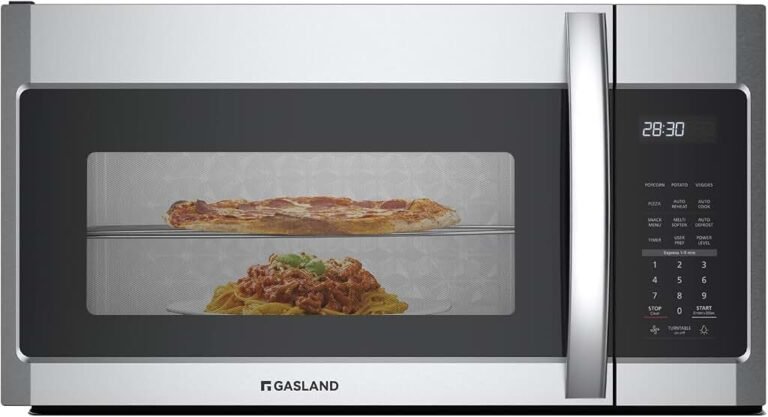
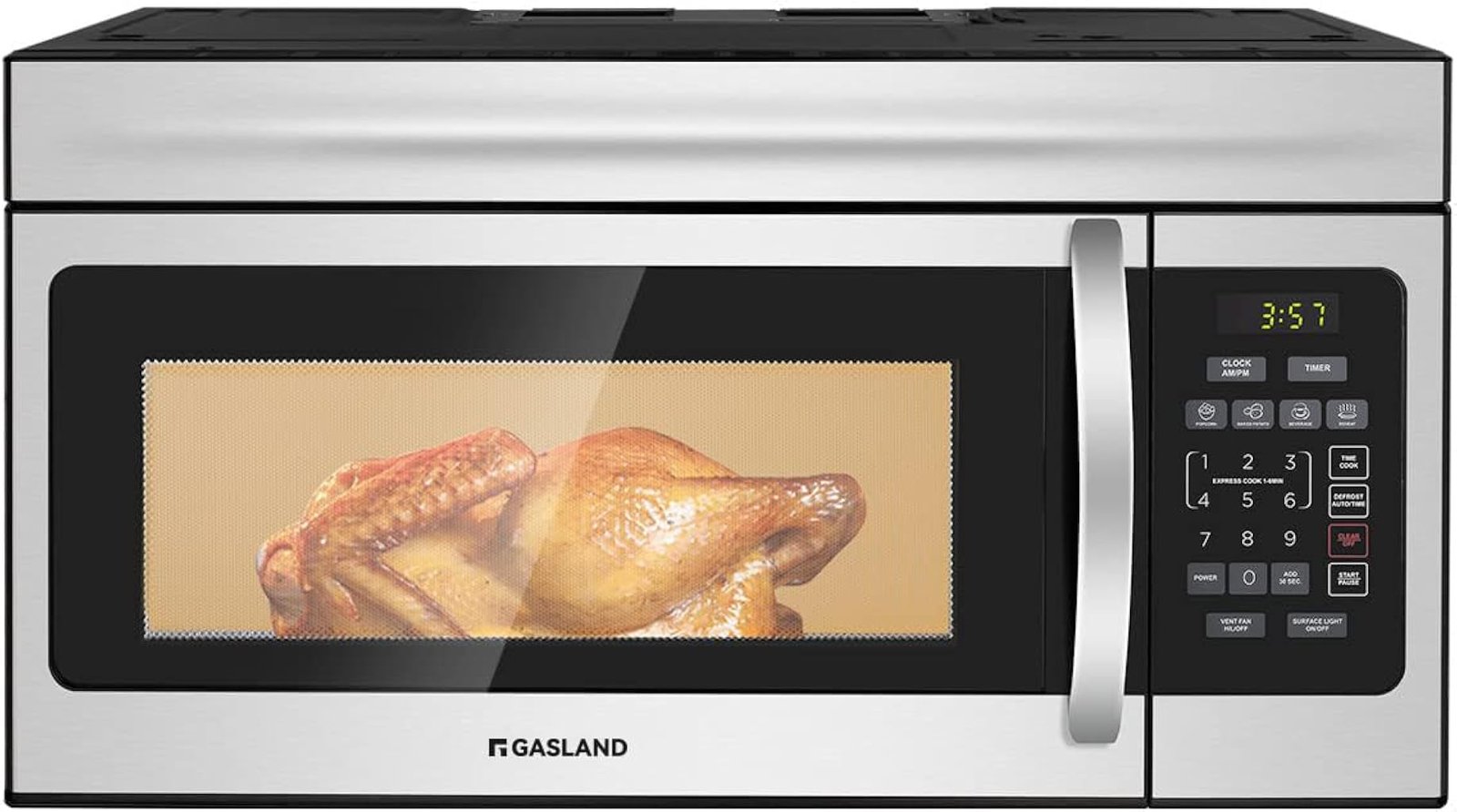
An over-the-range microwave has two jobs that are easy to describe and surprisingly difficult to combine. It must heat food with the speed expected of a modern microwave while functioning as part of the ventilation system above the stove. It also has to fit existing cabinetry, illuminate the cooking surface, remain accessible at shoulder or eye level, and surrender as little usable kitchen space as possible.
The GASLAND 30-inch over-the-range microwave considered here enters that equation with a straightforward specification package: a nominal 1.7-cu.-ft. class cavity, 1,000 watts of cooking power, 10 power levels, one-touch cooking, a rotating turntable, cooking presets, and a two-speed ventilation system rated at 300 CFM. Its reference price is $329.99.
There is an immediate specification wrinkle worth addressing. The current GASLAND OTR1603S product documentation describes the closely associated OTR1603S model as having 1.6 cubic feet of interior capacity, despite retail listings for the product family describing it as 1.7 cubic feet. The manufacturer lists dimensions of 29.92 by 15 by 16.42 inches and a 13.5-inch glass turntable. That discrepancy is small in practical volume but relevant in an appliance category where fractions of a cubic foot are routinely used as marketing distinctions. Buyers should shop by model number and measured dimensions rather than relying exclusively on the rounded capacity appearing in a listing headline.
Our score is 8.19/10. Customer Sentiment stands at 7.84, Buyer Confidence at 9.49, and Value at 7.91. The spread between those figures is more informative than the overall score alone. This is an appliance with a clearly documented basic specification and conventional installation footprint, producing unusually high buyer confidence, while the value and sentiment figures suggest a more measured assessment of what the machine delivers for its price.
The result is a microwave that looks strongest when judged as a functional 30-inch kitchen appliance rather than as a showcase for premium technology.
The 30-Inch Format Is Central to the Design
Over-the-range microwaves are constrained by architecture in a way countertop models are not. A countertop microwave can move to another section of the kitchen if its dimensions prove inconvenient. An OTR unit must coexist with upper cabinets, mounting hardware, electrical service, the cooking surface, and potentially an exhaust duct.
GASLAND’s chassis measures approximately 29.92 inches wide, 15 inches deep, and 16.42 inches high. The documented built-in dimensions are 30 inches wide, 13 inches deep, and 16.5 inches high. Those numbers make the model broadly recognizable as a conventional 30-inch OTR appliance rather than a specialized low-profile design.
That distinction matters.
A buyer using a microwave buying guide may naturally focus first on wattage and capacity. For an installed microwave, cabinet geometry deserves equal attention. A difference of half an inch can determine whether an appliance fits cleanly or turns into a cabinetry project.
The GASLAND weighs approximately 61.7 pounds, according to current manufacturer specifications. Installation therefore involves considerably more than sliding an appliance onto a shelf. Correct wall attachment, cabinet mounting, electrical access, and ventilation configuration all deserve inspection before purchase.
The roughly 16.4-inch appliance height also means this is not designed around the same philosophy as the increasingly common low-profile OTR microwave. It consumes more vertical space, but the conventional-height body creates room for a larger interior than many slim alternatives.
That is a sensible exchange when cavity space matters more than preserving extra clearance above the range.
Capacity Is More Than a Cubic-Foot Number
The difference between 1.6 and 1.7 cubic feet sounds significant when products are lined up in a comparison chart. In everyday microwave use, internal geometry can matter just as much.
The GASLAND uses a 13.5-inch glass turntable. That figure is particularly useful because it provides a tangible reference for cookware compatibility. A buyer can measure the dinner plates, casserole dishes, and microwave-safe containers already in the kitchen instead of trying to visualize a cubic-foot figure.
The rotating turntable is intended to move food through different regions of the microwave field during operation. Rotation cannot guarantee uniform heating in every food, but it is a familiar engineering response to the uneven energy distribution that can occur inside microwave cavities.
The cavity should be large enough for common family plates and bowls without moving into the oversized dimensions associated with some larger OTR models. There is no removable cooking rack documented for the OTR1603S specification, so the interior remains fundamentally a single-level microwave space.
That simplicity will appeal to households primarily reheating leftovers, preparing packaged foods, warming beverages, defrosting ingredients, and handling other routine microwave tasks. Buyers expecting a second oven, convection system, or elaborate multi-level cooking arrangement are looking at the wrong category of machine.
1,000 Watts Keeps the Cooking Specification Conventional
The 1,000-watt output is one of the GASLAND’s more reassuring specifications.
A microwave’s wattage should not be mistaken for a complete measure of cooking quality. Food composition, shape, moisture, starting temperature, container material, power modulation, and placement all affect the result. Yet wattage remains useful because packaged-food instructions are frequently written around common household microwave power ranges.
The U.S. Food and Drug Administration’s explanation of microwave cooking describes microwaves as a form of electromagnetic radiation that is reflected by metal, passes through materials such as glass and paper, and is absorbed by food. A magnetron generates the microwaves, which cause water molecules in food to vibrate and generate heat.
One common misconception deserves removal from the discussion: microwaves do not simply cook food from the center outward. In thicker items, heat must still move from warmer regions into cooler ones.
That physics explains why 1,000 watts should be treated as useful capacity rather than a guarantee of perfect results.
GASLAND provides 10 variable power levels. Lower settings matter for jobs where maximum output can produce poor texture or uneven temperatures. Defrosting is the obvious example, but controlled power is also useful when softening ingredients or gently reheating foods that react poorly to aggressive heating.
The appliance also includes express cooking from one to six minutes and an add-30-seconds function. Those controls may look mundane beside more elaborate appliance technology, yet they correspond closely with how microwaves are actually used: frequently, briefly, and often without a desire to navigate menus.
One-Touch Cooking Prioritizes Repeated Tasks
GASLAND’s current documentation identifies four automatic programs: reheat, popcorn, baked potato, and beverage. Retail descriptions associated with the 1.7-cu.-ft. listing also identify sensor cooking, though the manufacturer’s current OTR1603S page emphasizes automatic programs rather than detailing the operation of a separate sensor system. The distinction is worth preserving rather than assuming that every automated setting operates through humidity sensing.
What can be assessed confidently is the control philosophy.
This is not a microwave built around an enormous catalog of specialized food programs. Its convenience controls concentrate on repetitive tasks. Popcorn, potatoes, beverages, reheating, express cooking, and 30-second additions cover a large share of normal microwave interactions.
That restraint can be an advantage.
Preset counts have limited meaning if most buttons remain unused for the life of the appliance. A well-placed express key can save more cumulative time than a specialized menu buried several button presses deep.
The machine also provides time- and weight-based defrost modes. Weight defrost can reduce the mental arithmetic involved in deciding how long frozen food should receive reduced microwave power, although results still depend on shape and composition. Thick portions and irregularly shaped frozen foods often require repositioning or separation as they thaw.
The 300 CFM Fan Is Adequate on Paper, but Installation Matters More
The ventilation system deserves separate treatment because an OTR microwave replaces the physical location normally given to a range hood.
GASLAND rates the exhaust system at 300 CFM and provides two fan speeds. CFM means cubic feet per minute and describes airflow volume. It does not, by itself, establish how effectively smoke, grease particles, moisture, and combustion pollutants will be captured above a particular cooking surface.
That distinction is not academic.
The U.S. Environmental Protection Agency advises using range hoods during cooking and says that hoods vented outdoors are preferable to systems that merely recirculate air. The agency also recommends using the hood whenever cooking, using back burners when possible, and leaving ventilation running for 10 to 20 minutes afterward.
Those recommendations put GASLAND’s 300 CFM figure in perspective. Airflow capacity is only part of ventilation performance. Hood geometry, mounting position, duct diameter, duct length, bends, filters, fan speed, and the location of active burners all influence what actually reaches the exhaust system.
A recirculating arrangement also cannot be treated as equivalent to outdoor exhaust. Recirculation can filter grease and reduce some odors, but it does not physically discharge cooking-generated moisture and pollutants outside the building.
For gas cooking in particular, outdoor ventilation deserves attention. EPA guidance on indoor air quality states that using a stove hood with a fan vented outdoors greatly reduces exposure to pollutants during cooking.
This makes the exhaust configuration one of the first installation questions a prospective GASLAND owner should ask.
How 300 CFM Compares With Ventilation Guidance
A 300 CFM rating is neither trivial nor exceptionally high for an OTR microwave.
EPA remodeling guidance states that ASHRAE and the Home Ventilation Institute recommend 100 CFM for a typical kitchen range, while also cautioning that larger fans can require makeup air to prevent excessive depressurization and potential backdrafting of combustion equipment.
The GASLAND’s nominal 300 CFM capacity therefore sits comfortably above that 100 CFM reference point, but comparing the two numbers directly has limits. Manufacturer-rated maximum airflow and measured airflow after installation are not necessarily identical. Static pressure created by ductwork can reduce actual flow.
Capture also matters.
A fan can move a substantial amount of air while still allowing cooking plumes to escape around the edges of the appliance. OTR microwaves necessarily combine a deep microwave body with a hood function, and their geometry differs from a large dedicated canopy hood.
The practical interpretation is simple: 300 CFM gives the GASLAND a credible ventilation specification for ordinary cooking, but it should not be treated as proof that it can replace every dedicated hood in every kitchen.
Heavy frying, frequent high-heat cooking, large gas burners, unusually deep ranges, and demanding ventilation requirements can justify a separate hood solution.
Lighting Is Functional Rather Than Decorative
The GASLAND includes two 30-watt cooktop lights beneath the appliance.
Under-microwave lighting can be easy to overlook during shopping because it has nothing to do with heating food. Once the microwave is installed, however, those lamps become part of the primary work lighting over the range.
That makes placement and serviceability relevant.
A well-lit cooking surface makes it easier to monitor browning, boiling, pan condition, spills, and burner controls. The lighting also reduces dependence on overhead room fixtures that may cast the cook’s shadow directly onto the stovetop.
The GASLAND specification is straightforward rather than elaborate. There is no need to turn cooktop lighting into a headline feature. Its value lies in performing an ordinary job every evening without requiring a separate under-cabinet fixture above the range.
Safety Is Better Understood Through Regulation Than Myth
Microwave ovens still attract concerns about radiation that are often disconnected from how the appliances are regulated.
The FDA has regulated microwave-oven manufacturing since 1971. Federal rules limit microwave leakage throughout an oven’s lifetime to 5 milliwatts per square centimeter measured approximately two inches from the oven surface. The FDA states that this limit is “far below the level known to harm people.” The federal standard also requires two independent interlock systems that stop microwave production when the latch is released or the door is opened.
For ordinary ownership, physical condition is more relevant than generalized anxiety about microwave radiation.
A damaged door, hinge, latch, or seal should not be ignored. The FDA specifically advises contacting the manufacturer when those components are damaged or the door no longer opens and closes properly.
Heat injuries are a more familiar household risk. Liquids can become superheated and erupt when disturbed. Containers and foods can also become hot enough to cause burns even when the dish itself appears harmless.
The GASLAND’s child safety lockout adds another useful barrier against accidental operation. It is not a substitute for supervision, but it is a rational feature on an appliance mounted within reach of older children.
Installation Should Be Treated as Part of the Purchase
The GASLAND’s high Buyer Confidence score of 9.49 makes sense partly because the physical requirements are unusually concrete.
Its documented body is 29.92 inches wide, 15 inches deep, and 16.42 inches high, with a listed built-in width of 30 inches. The unit weighs roughly 61.7 pounds. The package includes an exhaust adapter, installation hardware, ventilation filters, and the glass turntable.
Those numbers permit meaningful preparation.
Before ordering, buyers should verify:
- The cabinet opening rather than assuming that a nominal 30-inch range automatically guarantees compatibility.
- The required distance between the cooking surface and surrounding cabinetry.
- Wall construction and the location of studs or other structural support.
- The electrical connection and whether it meets installation instructions.
- Existing duct direction, dimensions, and condition.
- Whether the system will exhaust outdoors or operate in a recirculating configuration.
- Door clearance around adjacent cabinets and walls.
- The diameter of frequently used plates and cookware against the 13.5-inch turntable.
- The total project cost if professional removal and installation are required.
The price on an appliance page is therefore only one component of replacement cost. Duct modifications, electrical work, damaged mounting surfaces, cabinet alterations, disposal of the previous microwave, and professional labor can change the economics quickly.
Cleaning Is Simple, but Ventilation Maintenance Should Not Be Ignored
The interior is described as easy to wipe clean, while the glass turntable can be removed for washing.
Those are conventional features, but conventional does not mean unimportant. Microwave spills are easier to remove before repeated heating turns residue into a stubborn film. A removable turntable simplifies that process.
The underside of an OTR microwave deserves equal attention.
Grease carried upward from the stove accumulates in ventilation filters and surrounding surfaces. A neglected filter can restrict airflow and collect combustible residue. Cleaning schedules should therefore reflect cooking style: a household that frequently fries food produces a different grease load from one that mainly boils water and reheats soup.
EPA guidance also recommends routinely cleaning the range hood’s grease filter as part of reducing exposure to cooking-generated particulate matter. That advice applies directly to the hood half of an OTR microwave installation.
The ventilation system should be thought of as mechanical equipment requiring maintenance, not merely a button labeled “fan.”
Reading Our Four Scores
Our overall score is 8.19/10, placing the GASLAND in very-good territory. The machine earns that position through a practical combination of 1,000-watt cooking, adjustable power, a useful turntable diameter, conventional 30-inch installation dimensions, simple cooking shortcuts, and 300 CFM ventilation.
Customer Sentiment is 7.84. That is the lowest of the four editorial measures and keeps the overall assessment grounded. The GASLAND’s feature set is functional rather than lavish, and buyers expecting premium ventilation, convection cooking, elaborate smart controls, or a highly differentiated interface will find little reason to stretch the specification beyond what it actually is.
Buyer Confidence, by contrast, reaches 9.49.
That is a strikingly high figure and reflects the product’s straightforward identity. The principal specifications are easy to understand. It is a roughly 30-inch-wide OTR microwave with 1,000 watts, 10 power levels, a 13.5-inch turntable, 300 CFM ventilation, two fan speeds, cooking shortcuts, defrost controls, cooktop lighting, and a child lock. There is relatively little ambiguity about the basic job it is intended to perform.
The capacity labeling discrepancy between 1.6 and 1.7 cubic feet deserves attention, but the published external dimensions and turntable diameter give buyers more useful measurements than the rounded cavity figure alone.
Value scores 7.91 at the $329.99 reference price. That is respectable rather than exceptional. The price buys a combined microwave and ventilation appliance with a broadly conventional feature set. Its economic appeal becomes stronger when its dimensions align with an existing installation and weaker when cabinet, duct, or electrical modifications are required.
The difference between Buyer Confidence at 9.49 and Value at 7.91 captures the product particularly well: it is easier to understand what the GASLAND is than to argue that every household receives equal value from it.
Who Is Most Likely to Appreciate It
The strongest fit is a household replacing an existing conventional-height 30-inch OTR microwave and seeking a straightforward feature set without moving toward a more expensive connected or convection-equipped appliance.
The 13.5-inch turntable and roughly 1.6-to-1.7-cu.-ft. class capacity suit everyday family microwave use. Express cooking and one-touch programs favor users who prefer direct controls over app-driven operation.
The 300 CFM fan also makes sense for kitchens where moderate ventilation is sufficient and the duct arrangement allows the appliance to move air effectively.
The fit is less convincing for households that:
- Need unusually high ventilation capacity for frequent high-heat cooking.
- Want a low-profile microwave to increase clearance above the range.
- Regularly use oversized microwave cookware.
- Want convection, air-frying, or other oven-like cooking functions.
- Expect sophisticated connected-home controls.
- Need ventilation performance comparable with a substantial dedicated range hood.
These are not defects so much as boundaries around the design.
Final Considerations
The GASLAND 1.7 cu. ft. Over-the-Range Microwave is most persuasive when stripped of marketing shorthand and viewed as a practical installed appliance.
Its 1,000-watt output and 10 power levels establish a conventional cooking foundation. The 13.5-inch turntable gives buyers a tangible measure of usable space. Express controls reduce friction during brief reheating jobs, while automatic cooking programs, time and weight defrost, cooktop lighting, and child lockout cover routine household requirements.
The 300 CFM two-speed ventilation system is meaningful, but the number should never be separated from installation. Outdoor exhaust, duct resistance, hood placement, burner location, filter condition, and cooking intensity determine how useful that airflow becomes in practice. EPA guidance favoring outdoor-vented kitchen exhaust makes the configuration behind the microwave at least as consequential as the fan rating printed on its specification sheet.
Our score of 8.19/10 reflects that balance. Customer Sentiment at 7.84 is more restrained, while the 9.49 Buyer Confidence rating reflects an appliance whose fundamental purpose and dimensions are unusually easy to evaluate before purchase. Value at 7.91 recognizes that $329.99 is reasonable for the specification but does not erase installation costs or turn a 300 CFM OTR system into a substitute for every dedicated range hood.
There is also a useful lesson in the capacity discrepancy. Retail material describes this product family as 1.7 cubic feet, while current manufacturer documentation for OTR1603S specifies 1.6 cubic feet. Rather than allowing a tenth of a cubic foot to decide the purchase, buyers should focus on the harder measurements: approximately 29.92 by 15 by 16.42 inches externally and a 13.5-inch turntable internally.
Those measurements describe the appliance more honestly than a rounded capacity label.
For a kitchen already arranged around a standard 30-inch OTR microwave, the GASLAND presents a rational package: familiar dimensions, 1,000 watts, direct controls, moderate ventilation, useful lighting, and enough interior space for ordinary household reheating and cooking. For a kitchen requiring powerful smoke capture, low-profile geometry, oversized capacity, or advanced cooking modes, its limitations become apparent before installation-and that is precisely when they should.
The smartest purchase decision therefore begins away from the checkout page. Measure the cabinet opening. Measure the cookware. Inspect the duct. Determine whether exhaust actually reaches outdoors. Check the electrical arrangement. Consider how heavily the stove is used and what kind of cooking produces the greatest smoke and grease load.
Once those questions are answered, the GASLAND becomes much easier to judge. It is not an attempt to reinvent the microwave. It is a conventional 30-inch OTR appliance built around familiar controls and moderate ventilation, with an editorial profile that favors predictability over novelty. For the kitchen that needs exactly that combination, predictability can be the more useful feature.