The over-the-range microwave is one of the kitchen’s quieter exercises in compromise. It must heat food quickly, illuminate the range, move cooking exhaust, preserve counter space and fit into a cabinet opening that may already contain holes, ducts and electrical infrastructure inherited from another appliance. Failure at any one of those jobs can diminish the usefulness of the entire installation.
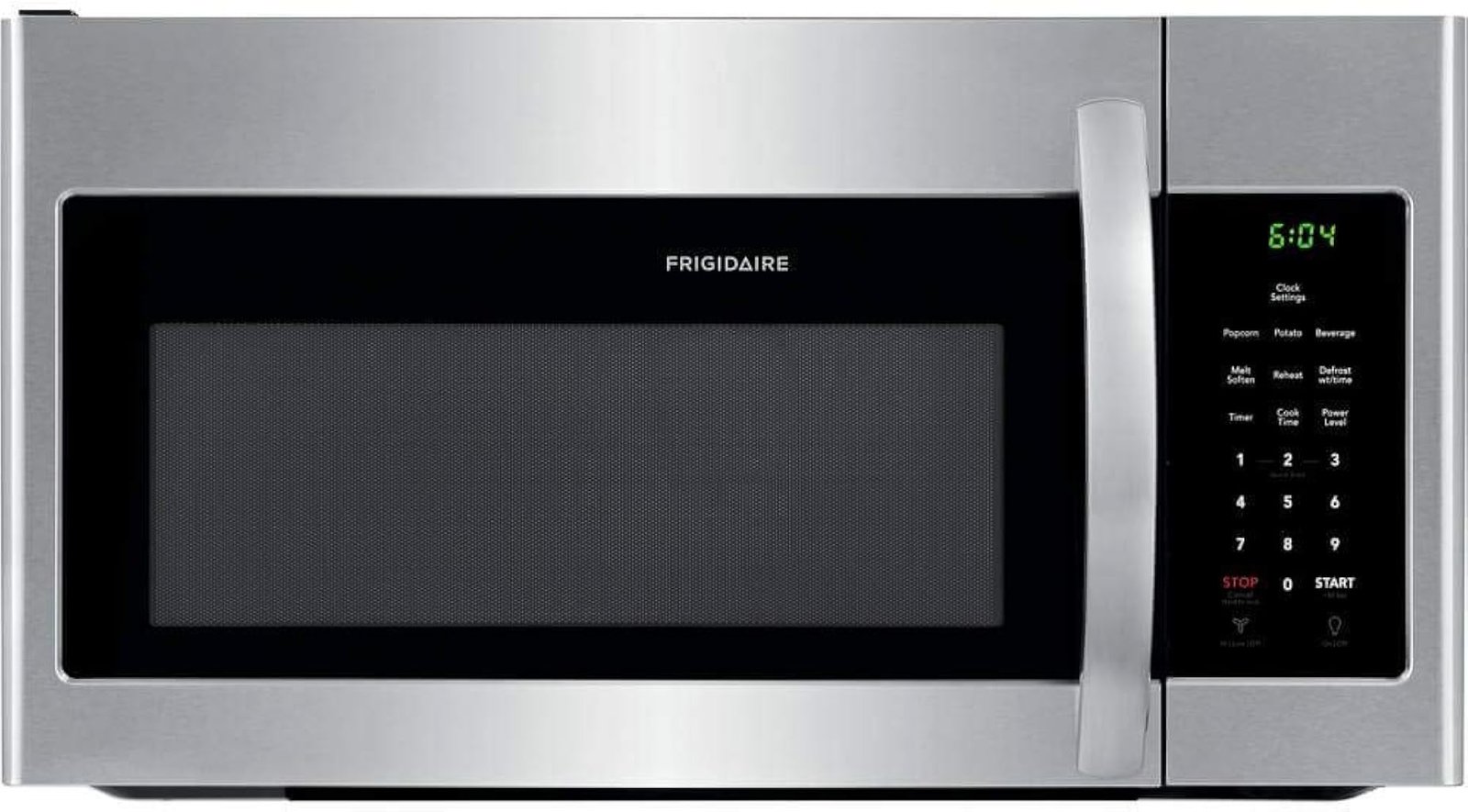
The Frigidaire 1.8 cu. ft. Stainless Steel Over-the-Range Microwave, model FFMV1846VS, approaches that assignment conservatively. Its architecture centers on a 1.8 cu. ft. cavity, 1,000 watts of cooking power, 10 power levels, a 12.5-inch glass turntable and a two-speed ventilation system rated at 105 and 300 CFM. One-touch cooking, auto reheat, auto defrost, Add 30 Seconds, LED interior and cooktop lighting, dishwasher-safe grease filters and convertible ducting round out the functional package. Current Frigidaire support documentation for the FFMV1846VS also identifies a one-year parts-and-labor warranty and a product weight of 63.65 pounds.
At $309, the appliance enters a particularly interesting part of the market. It is not attempting to justify a premium through air frying, convection baking or connected controls. Its proposition is older and simpler: provide substantial microwave capacity, established cooking power and basic range ventilation in a standard-width stainless-steel installation.
Our score is 8.51/10. Customer Sentiment stands at 8.28, Buyer Confidence reaches 9.59 and Value is 8.15. That unusually high Buyer Confidence figure deserves attention. The FFMV1846VS is not mysterious. Its dimensions, cooking output, ventilation capacity and control architecture are well documented. Value is more restrained because the appliance remains conventional, and because Frigidaire now identifies this particular model as discontinued.
The 1.8 cu. ft. Cavity Is the Central Practical Advantage
A microwave’s capacity specification sounds straightforward until cookware enters the discussion.
The Frigidaire provides 1.8 cu. ft. of interior volume. That places it comfortably within full-size over-the-range territory. A current authorized product listing identifies the FFMV1846VS as a 1.8 cu. ft., 1,000-watt stainless-steel OTR microwave.
The extra tenth of a cubic foot over a 1.7 cu. ft. competitor sounds small because it is small: roughly a 5.9% increase in nominal volume. Yet capacity comparisons become misleading when treated as simple arithmetic.
A microwave does not cook cubic feet. It cooks plates, bowls, mugs and casserole dishes.
The FFMV1846VS uses a 12.5-inch glass turntable. That diameter gives the buyer a more tangible reference than cavity volume alone. A wide dinner plate needs enough clearance to rotate. A rectangular casserole dish must avoid striking the cavity walls as its corners sweep through an arc.
For that reason, anyone following a microwave buying guide should measure frequently used cookware rather than treating 1.8 cu. ft. as proof that every large dish will fit.
The turntable is also part of the heating system in a practical sense. Rotation changes the food’s physical position while microwave energy is applied, helping reduce the consequences of stationary placement. It cannot guarantee perfectly uniform temperatures; food composition, density, moisture and geometry still matter.
1,000 Watts Keeps Cooking Performance in Familiar Territory
The Frigidaire supplies 1,000 watts of cooking power.
That specification is neither unusually low nor conspicuously high for a full-size OTR microwave. It is a familiar household reference point, and familiarity matters because packaged-food directions and microwave recipes often assume an appliance operating somewhere around this level.
The FFMV1846VS combines that output with 10 power levels. An authorized appliance listing for this exact model also documents the 1,000-watt output, 10 power levels, 1.8 cu. ft. capacity and two-speed 300 CFM exhaust system.
Power levels deserve more attention than they usually receive.
Maximum output is useful when speed matters, but microwave cooking is not a contest to keep the magnetron operating at full intensity for every food. Defrosting, softening butter, warming sauces and reheating dense leftovers can benefit from lower effective power.
Ten settings give the user room to moderate that process.
There is a larger lesson here. A microwave with 1,200 watts and poor control is not automatically more useful than a 1,000-watt appliance with predictable adjustment. Raw wattage tells the buyer how much cooking output is available. It does not describe every aspect of how that output will be used.
One-Touch Cooking Favors Familiarity Over Novelty
The Frigidaire uses a traditional control strategy rather than presenting itself as a software platform.
One-touch cooking options address repetitive tasks. Auto Reheat and Auto Defrost reduce manual programming for common situations. Add 30 Seconds handles one of the most frequent microwave interactions: food is nearly ready, but not quite.
That last feature sounds almost trivial.
It is not.
Microwave use is full of small corrections. A bowl of soup needs another half minute. Coffee has cooled slightly. A refrigerated side dish is warm around the edges but still cool in the center.
A dedicated 30-second command converts those corrections into one action.
That is a better example of practical appliance design than a long menu of obscure presets. Controls should reduce friction in recurring tasks, not merely increase the feature count.
The Frigidaire’s interface belongs firmly to the conventional school. Buyers seeking elaborate automation will find little spectacle here. Buyers who prefer recognizable microwave controls may regard that restraint as an advantage.
The 300 CFM Exhaust System Is Mainstream Ventilation
Over-the-range microwaves are not merely microwaves. They also inherit the space where a range hood would otherwise be installed.
The FFMV1846VS provides a two-speed exhaust fan rated at 105 CFM on its lower setting and 300 CFM at maximum. Another current appliance specification listing documents those two airflow levels along with ducted and ductless installation capability.
Three hundred CFM belongs to a familiar class of OTR ventilation.
The number needs careful interpretation.
CFM measures cubic feet of air moved per minute under rated conditions. Installed ventilation performance is affected by the system surrounding the fan. Long duct runs, restrictive transitions and repeated bends can increase resistance. Filters require cleaning. Capture at the front of the cooktop also depends on appliance geometry and cooking position.
A 300 CFM label therefore cannot guarantee identical results in every kitchen.
For ordinary boiling, simmering and moderate frying, the specification aligns with the mainstream OTR formula. A household that frequently produces substantial smoke and grease through high-temperature cooking has a different problem.
That kitchen may be better served by prioritizing a dedicated range hood with greater airflow rather than asking an integrated microwave fan to perform beyond its intended class.
Two Fan Speeds Are Enough to Be Useful, Not Enough to Be Precise
The Frigidaire’s ventilation controls provide two fan speeds.
The lower 105 CFM setting creates a substantial gap below the 300 CFM maximum. That gives the user a basic choice between modest and stronger ventilation, but little ability to tune airflow between those points.
The trade-off is simplicity.
Two speeds are easy to understand. There is no need to cycle through a long range of nearly adjacent settings.
Yet kitchens do not always operate in two states.
A pot simmering on the back burner may need more extraction than the low setting provides while still not requiring maximum airflow. More fan speeds can provide better adjustment between noise and extraction.
This is not a severe deficiency. It is simply an example of the FFMV1846VS’s broader design philosophy: functional rather than elaborate.
Convertible Venting Adds Installation Flexibility
The FFMV1846VS supports ducted and ductless ventilation configurations.
That flexibility matters because not every kitchen has an exterior exhaust route above the range.
A ducted installation can move captured cooking air outdoors. A recirculating arrangement instead filters the air and returns it to the room.
Those systems should not be treated as equivalent merely because the same fan is involved.
Exterior exhaust can remove captured moisture and airborne contaminants from the kitchen. Recirculation depends on filtration and cannot physically transport indoor air outside the building.
The Frigidaire incorporates grease filtration, and documented configurations identify dishwasher-safe grease filters. That makes maintenance easier, but not optional.
A filter collecting airborne grease will eventually contain grease.
Cleaning therefore belongs to ordinary ownership. A ventilation system should not be judged only by what happens on installation day; its long-term effectiveness also depends on whether airflow paths and filters remain reasonably clean.
LED Lighting Handles Two Different Jobs
The FFMV1846VS uses LED illumination inside the microwave and beneath the appliance for the cooktop.
Those lights perform different functions.
Interior lighting allows the user to observe food without opening the door and interrupting the cooking cycle.
Cooktop lighting is arguably more consequential because the OTR microwave physically replaces the hood area above the stove. Once installed, it becomes responsible for illuminating pans, burners and the cooking surface beneath it.
That feature remains useful when the microwave is off.
This is one reason over-the-range appliances should not be compared solely by microwave specifications. The appliance is part microwave, part hood and part task light.
A household may interact with its cooktop lamp every evening while using Auto Defrost once a week.
Frequency of use has a way of rearranging the hierarchy created by marketing materials.
The Dimensions Matter More Than the 30-Inch Label
The Frigidaire measures approximately 29.88 inches wide, 16.38 inches high and 15.75 inches deep. Published specifications also place its weight at 63.65 pounds. An appliance specification listing documents these physical measurements.
Those figures make it a conventional 30-inch-class OTR appliance.
They do not make installation automatic.
Cabinet openings need to be measured. The mounting surface must be suitable. Electrical access has to correspond with the installation instructions. Ductwork needs to align with the intended ventilation configuration.
An existing 30-inch microwave does not guarantee that every new 30-inch microwave will use identical mounting holes or ventilation geometry.
This is where replacement projects can become deceptive.
From across the kitchen, two OTR microwaves may look almost interchangeable. Behind them are brackets, bolts, electrical connections and duct openings that are less interested in visual similarity.
Frigidaire’s support page retains the product specification sheet, owner’s guide and installation instructions for the FFMV1846VS even though the model is discontinued. That continuing documentation is a meaningful advantage for existing owners and replacement planning.
The Discontinued Status Changes the Buying Context
Frigidaire currently labels the FFMV1846VS as discontinued.
That fact changes the review without making the appliance obsolete overnight.
A discontinued product can remain perfectly usable, and retailer inventory can persist after manufacturing or first-party sales have moved to newer models. Frigidaire also retains official support material and identifies replacement-parts and service resources for the model.
Still, a buyer purchasing remaining inventory should interpret the $309 price differently from the price of a current-production appliance.
The decision is no longer simply specification against specification. Product lifecycle enters the calculation.
Future parts availability, warranty coverage on the specific unit being sold and retailer return policies deserve attention. Frigidaire’s official support page lists a one-year manufacturer warranty for parts and labor, but a buyer should verify the warranty conditions applicable to the actual purchase channel and date.
This lifecycle issue helps explain why Buyer Confidence can remain very high while Value is more restrained.
The product itself is well documented. The buying context requires more care.
The Stainless-Steel Finish Is Conventional for a Reason
Stainless steel does not improve microwave heating or ventilation.
It does affect how a permanently installed appliance integrates visually with a kitchen.
The FFMV1846VS uses a stainless-steel exterior with a dark viewing window and right-side control panel. That arrangement belongs to a familiar appliance design language and can coordinate with a wide range of ranges, refrigerators and dishwashers.
A permanently mounted microwave benefits from visual restraint.
Countertop appliances can be moved, hidden or replaced with little structural consequence. An OTR microwave is attached to cabinetry and connected to ventilation infrastructure. Replacing it merely because a dramatic finish has aged poorly is a costly way to redecorate.
The Frigidaire does not make styling the central argument. That is appropriate for an appliance whose useful life should ideally outlast short design cycles.
Safety Standards Put Microwave Radiation in Perspective
Microwave radiation can sound more alarming than a pan of boiling water because one hazard is invisible and the other is familiar. Federal regulation provides a more useful framework.
The FDA’s microwave oven safety guidance states that the agency has regulated microwave oven manufacturing since 1971. Manufacturers must certify that their ovens meet federal safety-performance requirements.
Federal rules limit microwave leakage throughout an oven’s lifetime to 5 milliwatts per square centimeter at approximately two inches from the oven surface. The FDA describes that limit as “far below the level known to harm people.”
The same federal standard requires two independent interlock systems that stop microwave production when the door latch is released or the door opens.
The more ordinary hazard is heat.
The FDA says most microwave-oven injuries involve burns from hot containers, overheated food or liquids rather than radiation. It also specifically warns about superheated water, which can erupt after being disturbed.
That matters especially with an OTR installation because hot food is removed from an elevated position.
Safe reach, secure installation and careful handling therefore deserve as much attention as radiation questions.
The $309 Price Is Attractive, but Price Alone Is Not Value
At $309, the Frigidaire presents a straightforward economic case.
It combines 1.8 cu. ft. of microwave capacity, 1,000 watts of cooking power, 10 power levels, a 300 CFM ventilation system, two fan speeds, convertible venting, lighting and a stainless-steel exterior.
A countertop microwave may cost less, but that comparison ignores architecture.
The Frigidaire preserves counter space and takes over the ventilation and lighting positions above the stove. Those functions have economic value when the kitchen needs them.
Installation can alter the equation.
If an existing OTR location is compatible, replacement may be relatively straightforward. If the project requires duct modification, electrical work or cabinetry changes, the installed cost can exceed the appliance price by a meaningful amount.
Our Value score of 8.15 reflects both sides.
The $309 appliance price is appealing for the hardware involved. The discontinued status, conventional feature set and potential installation expense prevent price from becoming an automatic verdict.
Buyer Confidence at 9.59 Is the Standout Rating
Buyer Confidence is 9.59, the highest of our component scores.
That rating follows from documentation rather than excitement.
The FFMV1846VS has a clear model identity. Frigidaire still maintains an official support page. Capacity, cooking output, power levels, dimensions, weight and warranty information can be checked. Retail documentation also consistently identifies the 300 CFM two-speed ventilation system and related cooking features.
The product’s discontinued status is also stated openly by Frigidaire.
That transparency reduces ambiguity.
High Buyer Confidence does not mean the appliance is the correct choice for every kitchen. It means buyers can establish what they are evaluating without relying on vague descriptions.
For an installed appliance, that clarity matters.
Customer Sentiment at 8.28 Reflects a More Ordinary Reality
Customer Sentiment stands at 8.28, below the overall 8.51/10 score and substantially below Buyer Confidence.
That gap fits a conventional appliance.
The FFMV1846VS has little difficulty making sense on a specification sheet. Daily ownership is less abstract.
A two-speed fan remains a two-speed fan. Three hundred CFM remains a mainstream ventilation ceiling. A 12.5-inch turntable still determines whether a wide dish rotates comfortably. Stainless steel still needs cleaning.
There is no air fryer, convection system or connected platform to broaden the product’s identity.
That restraint will suit some households better than others.
The Customer Sentiment score therefore sits in favorable territory without suggesting universal enthusiasm. The Frigidaire addresses familiar needs competently, but it does not remove the compromises inherent to the OTR category.
Our 8.51/10 Score Rewards Balance
Our overall score is 8.51/10.
The rating is driven less by any spectacular specification than by the relationship among the specifications.
A 1.8 cu. ft. cavity provides substantial household capacity. The 1,000-watt output suits conventional microwave cooking. Ten power levels add control. The 12.5-inch turntable gives cookware a defined rotating platform. The 300 CFM exhaust system performs the range-hood function at a mainstream level.
Lighting, filtration and one-touch controls support everyday use without changing the product into something else.
That coherence matters.
Appliances can become less useful when feature ambition outruns the basic job. The Frigidaire stays close to the established microwave-hood formula.
The 8.51/10 rating recognizes that discipline while leaving room for stronger ventilation systems, more adjustable fans and newer multifunction designs.
Strengths That Matter in Daily Use
The Frigidaire’s strongest characteristics are practical rather than theatrical:
- The 1.8 cu. ft. cavity provides substantial full-size microwave capacity.
- A 1,000-watt cooking output aligns with a familiar household performance level.
- Ten power levels permit more controlled heating below maximum output.
- The 12.5-inch glass turntable provides a concrete reference for cookware compatibility.
- Auto Reheat and Auto Defrost address repetitive microwave tasks.
- Add 30 Seconds simplifies small timing corrections.
- A two-speed exhaust system provides 105 and 300 CFM airflow settings.
- Convertible ventilation supports both ducted and ductless installation approaches.
- Dishwasher-safe grease filters simplify routine ventilation maintenance.
- LED lighting illuminates both the cavity and cooktop area.
- The approximately 30-inch width fits a widely used OTR installation class.
- Frigidaire retains official manuals and support documentation for the model.
- The one-year parts-and-labor warranty is clearly identified by the manufacturer.
The product’s appeal is cumulative. Several ordinary functions combine into one installed appliance.
Drawbacks That Need Equal Weight
The discontinued status is the first issue a current buyer should investigate. Remaining inventory can still be legitimate, but warranty conditions, seller support and future parts availability deserve verification.
Ventilation is another limitation.
Three hundred CFM belongs to the mainstream OTR category, not the high-output hood category. Frequent heavy frying or high-temperature cooking may demand more extraction.
Two fan speeds also limit adjustment.
The 12.5-inch turntable is useful but sets a physical boundary that the 1.8 cu. ft. capacity figure cannot erase.
The feature set is conventional. Buyers seeking air frying, convection or other secondary cooking technologies will need a different model.
Installation adds another layer of cost and planning. Nominal 30-inch width does not guarantee identical mounting geometry with an existing appliance.
None of these drawbacks makes the FFMV1846VS incoherent. They define where its traditional design stops being the right answer.
Who Is the Frigidaire Best Suited For?
The strongest fit is a household replacing an existing 30-inch over-the-range microwave and seeking a conventional stainless-steel model with generous capacity and familiar controls.
The 1.8 cu. ft. cavity is particularly attractive where larger plates and serving dishes are common, though the 12.5-inch turntable still needs to be considered.
Kitchens short on counter space can benefit from the OTR architecture.
Households with moderate ventilation requirements also align well with the 300 CFM two-speed system.
The Frigidaire becomes less compelling where high-output ventilation is the dominant priority. A dedicated hood can be the better architectural choice there.
It also makes less sense for buyers specifically seeking multifunction cooking technologies.
Current buyers should additionally be comfortable purchasing a discontinued model after confirming warranty and seller conditions.
What a Microwave Buying Guide Should Check Before Purchase
The FFMV1846VS illustrates a useful sequence for evaluating an OTR microwave.
First, confirm the exact model number. Similar-looking Frigidaire microwaves can have different features and lifecycle status.
Second, measure the cabinet opening and surrounding clearances. Published dimensions are approximately 29.88 inches wide, 16.38 inches high and 15.75 inches deep.
Third, inspect the ventilation route. Decide whether the kitchen will use exterior ducting or a ductless configuration.
Fourth, verify electrical access and consult the model-specific installation instructions.
Fifth, measure everyday cookware against the 12.5-inch turntable rather than relying solely on the 1.8 cu. ft. capacity figure.
Sixth, evaluate microwave output. One thousand watts is a familiar level for full-size household use.
Seventh, compare 300 CFM ventilation with actual stovetop habits. Boiling pasta and high-temperature searing impose very different ventilation demands.
Eighth, account for maintenance. Grease filters need cleaning, and ventilation pathways need to remain unobstructed.
Ninth, calculate the installed cost rather than looking only at the $309 purchase price.
Finally, because this model is discontinued, verify the warranty, return conditions and service situation for the particular unit being purchased.
That sequence is less glamorous than counting presets. It is also far more likely to prevent an expensive mismatch.
Final Considerations
The Frigidaire 1.8 cu. ft. Stainless Steel Over-the-Range Microwave, FFMV1846VS, is a conventional appliance with unusually clear boundaries.
Its 1.8 cu. ft. cavity provides substantial capacity. The 1,000-watt microwave system and 10 power levels create a familiar cooking platform. A 12.5-inch glass turntable defines the rotating cooking surface. The two-speed 105/300 CFM exhaust system handles moderate ventilation duties, while convertible ducting accommodates different installation strategies.
One-touch controls, Auto Reheat, Auto Defrost, Add 30 Seconds, LED lighting and washable grease filters support routine ownership without making the appliance needlessly complicated.
Our score is 8.51/10.
Customer Sentiment at 8.28 is favorable but appropriately restrained. Buyer Confidence at 9.59 is the standout because the model is well documented and its major specifications are easy to verify. Value at 8.15 reflects an attractive $309 price while accounting for conventional hardware, installation costs and the fact that Frigidaire now lists the FFMV1846VS as discontinued.
The discontinued designation is the unusual part of an otherwise ordinary equation.
It does not erase the appliance’s functionality. Frigidaire still provides official support materials, specifications and service resources. It does mean a current buyer should investigate the purchase channel with more care than would be necessary for a current-production model.
Beyond that issue, the Frigidaire’s case is refreshingly straightforward.
It does not promise to replace an air fryer. It does not present 300 CFM ventilation as a substitute for every dedicated hood. It does not turn a 1.8 cu. ft. cavity into a claim of universal cookware compatibility.
Instead, it combines a large microwave cavity, established cooking power, basic ventilation and useful lighting in the familiar 30-inch OTR format.
For a compatible kitchen needing exactly those functions, the 8.51/10 assessment reflects a balanced piece of appliance engineering. For households prioritizing much stronger ventilation, advanced secondary cooking modes or a current-production model lifecycle, the same specifications make the limits equally apparent.
That clarity is ultimately the Frigidaire FFMV1846VS’s strongest characteristic. It is easy to see what the appliance does, what it does not do and what the kitchen must provide in return.