The over-the-range microwave is easy to underestimate because its two largest jobs are so familiar. It heats food, and it ventilates the stove beneath it. Yet those responsibilities pull appliance design in different directions. A microwave needs usable cavity space and controllable heating power. A ventilation system needs airflow, effective ducting and access to the cooktop. Both have to coexist in a chassis that fits between cabinets without turning installation into a renovation.
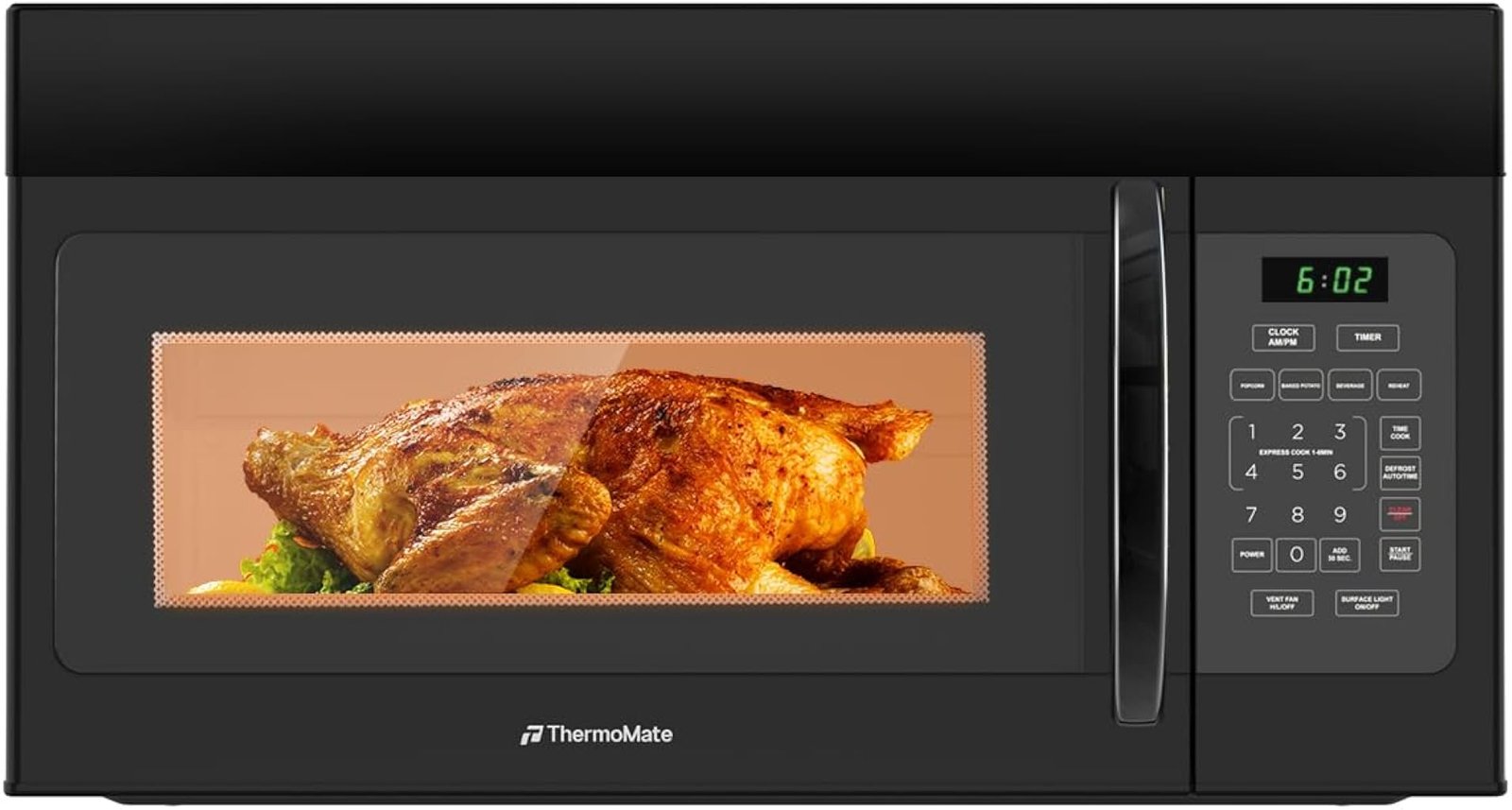
The black ThermoMate 1.7 cu. ft. Over-the-Range Microwave, model OTR773B, takes a conventional approach to that engineering problem. It combines a 30-inch format with a 1.7 cu. ft. cavity, 1,000 watts of cooking power, 10 power levels, one-touch cooking, a removable rotating glass turntable, LED cooktop lighting and a two-speed ventilation system rated at up to 300 CFM. The model is also associated with four automatic programs-reheat, popcorn, baked potato and beverage-plus an Add 30 Seconds function and child safety lock. The identifiable black OTR773B configuration measures approximately 29.9 inches wide, 15 inches deep and 16.4 inches high.
At $369.99, this is fundamentally a conventional microwave-hood combination rather than an attempt to merge half the kitchen into one appliance. There is no air-fryer identity to justify, no elaborate connected platform and no obvious effort to turn a microwave into a secondary oven. Its case rests on whether familiar specifications have been assembled into a sensible package.
Our score is 8.52/10. Customer Sentiment is 8.5, Buyer Confidence reaches 8.88, and Value is 8.28. The relatively narrow spread is revealing. This is a product with an unusually legible purpose. Buyer Confidence leads because the core dimensions and performance specifications are straightforward. Value sits lower because $369.99 buys an established OTR formula rather than unusually high ventilation capacity or an expanded cooking system.
The 1.7 cu. ft. Capacity Fits the Full-Size Formula
The 1.7 cu. ft. cavity is large enough to position the ThermoMate as a primary household microwave rather than a compact secondary appliance.
Capacity, however, is among the most abused numbers in microwave shopping.
Cubic feet describe volume. Dinner does not arrive in cubic feet.
A plate, bowl or casserole dish has a particular width, length and height. It must clear the cavity walls, door and turntable while sitting in a usable orientation. Large rectangular dishes can encounter clearance problems even when their total volume occupies only a modest percentage of the advertised cavity.
That is why a microwave buying guide should never stop at capacity.
The ThermoMate uses a removable glass turntable that rotates through 360 degrees during operation. ThermoMate’s current 1.7 cu. ft. OTR documentation describes the same core 30-inch platform with a 29.92-by-15-by-16.42-inch chassis, 1,000-watt output and removable rotating turntable.
Rotation helps change the food’s position within the microwave field. It cannot guarantee identical temperatures throughout a dish because food geometry, density, moisture and placement also influence heating.
The removable design has another advantage: cleaning.
Sauce, soup and melted cheese eventually reach the turntable. A glass plate that can be lifted out and washed is preferable to forcing every cleanup operation to happen inside the cavity.
1,000 Watts Is Familiar for a Reason
The ThermoMate provides 1,000 watts of cooking power across 10 selectable power levels.
Neither figure is exotic.
That is arguably an advantage.
A current Whirlpool 1.7 cu. ft. over-the-range model uses essentially the same fundamental cooking formula: 1.7 cu. ft., 1,000 watts and 10 power levels. It also pairs those specifications with a two-speed, 300 CFM ventilation system.
The comparison is useful precisely because it is unremarkable. ThermoMate is working inside an established performance envelope rather than presenting ordinary numbers as technological breakthroughs.
Microwave wattage affects heating rate. Higher output can shorten cooking time, although wattage alone cannot establish heating uniformity.
The 10 power levels matter because maximum power is not appropriate for every task.
Defrosting benefits from intermittent or reduced heating. Butter can move from solid to puddle with remarkable speed. Chocolate is similarly unforgiving. Reheating dense leftovers may work better when time and intensity are balanced rather than simply maximized.
The ThermoMate’s adjustable power range therefore matters more than another decorative preset would.
Four Automatic Programs Keep the Interface Restrained
ThermoMate identifies four automatic cooking programs: reheat, popcorn, baked potato and beverage. It also includes one-touch controls and an Add 30 Seconds function.
Four presets may look modest beside microwaves carrying long menus of named foods.
That is not necessarily a disadvantage.
Microwave presets are valuable only when they correspond to food people actually prepare. A control panel with twenty labeled programs can create the appearance of capability while leaving most of those buttons untouched.
Reheat has obvious daily utility. Popcorn remains a familiar microwave task. Beverage and potato settings address recognizable heating patterns.
Add 30 Seconds may prove more useful than any of them.
Microwave cooking often ends not with a carefully programmed cycle but with a judgment: almost warm enough. One additional button press is faster than entering another cooking time manually.
This is where appliance design becomes revealing. A sophisticated-looking feature may receive less use than the button whose entire purpose is to add half a minute.
ThermoMate’s interface appears sensibly grounded in that behavior.
The 300 CFM Ventilation Rating Requires Perspective
The ThermoMate’s two-speed exhaust system is rated at up to 300 CFM. The manufacturer describes it as a system for removing smoke, steam and cooking odors from the range below.
CFM means cubic feet per minute. It measures airflow volume.
The number is useful, but only within limits.
Ventilation performance is affected by the installation around the fan. Duct dimensions, bends, length and restrictions can influence how effectively air moves from the cooking surface to its destination.
Whirlpool makes that qualification explicit in its own OTR specifications, stating that ventilation performance varies according to installation. Its broader comparison material places many current OTR models between roughly 280 and 400 CFM motor class, while showing a 1.7 cu. ft., 1,000-watt configuration with a two-speed 300 CFM system.
That comparison places the ThermoMate’s airflow in useful context.
Three hundred CFM is not an unusually high ventilation figure. It is a recognizable mainstream specification.
For ordinary boiling, simmering and moderate stovetop cooking, that architecture is familiar in the category. For frequent high-temperature searing, wok cooking or other activities producing substantial grease and smoke, ventilation deserves separate consideration.
A dedicated range hood with greater airflow can be the more appropriate tool in demanding kitchens.
The ThermoMate’s 300 CFM figure should therefore be read as a defined capability, not as evidence that every dedicated hood becomes unnecessary.
Two Fan Speeds Favor Simplicity
The ventilation system has two speeds.
This produces one of the easier trade-offs to understand.
Two speeds reduce control complexity. Low and high cover the basic distinction between lighter cooking activity and situations demanding more airflow.
The limitation is equally obvious.
More fan speeds can provide finer adjustment between airflow and noise. A household may want more extraction than the low setting provides without needing maximum operation.
The ThermoMate does not offer that degree of granularity.
Still, fan-speed count should not distract from the maximum airflow specification. Four buttons controlling the same 300 CFM ceiling would not transform the ventilation system into a substantially more capable one.
The better buying question is whether 300 CFM corresponds to the household’s cooking behavior.
External Ventilation Changes the Installation Equation
ThermoMate identifies external ventilation for the documented version of this platform.
That matters.
Exterior exhaust provides a route for captured cooking air to leave the kitchen rather than relying solely on filtration and recirculation. This can be particularly relevant to moisture and cooking contaminants that filtration alone cannot simply make disappear.
The trade-off is infrastructure.
External ventilation requires a suitable duct path. That means the microwave’s performance is partly dependent on a system outside the appliance itself.
An excellent fan connected to badly designed ductwork is still attached to badly designed ductwork.
The buyer therefore needs to inspect the existing kitchen before ordering. A 30-inch cabinet opening is only the beginning. Duct position, outlet location, mounting surfaces, backsplash geometry and clearance above the cooktop all affect the project.
This is where OTR shopping diverges sharply from buying a countertop microwave.
A countertop machine needs a suitable surface and electrical outlet. An over-the-range microwave becomes architecture.
LED Cooktop Lighting Deserves More Attention
The ThermoMate incorporates LED lighting beneath the microwave to illuminate the cooking surface.
This feature is easy to reduce to a line on a specification sheet, yet it may be used as frequently as the microwave cavity.
Installing a microwave above the range removes the space where a conventional hood would otherwise provide task lighting. The microwave inherits that responsibility.
Cooktop visibility affects ordinary work: checking browning in a pan, monitoring simmering liquids, reading markings on cookware and cleaning the range after dinner.
LED technology is a logical choice because it produces illumination with relatively modest electrical consumption and heat output.
The broader point is more interesting.
Over-the-range microwaves should be judged partly by what happens when the microwave itself is not running. Lighting and ventilation remain useful independently of food heating.
That makes them central features rather than accessories.
The Black Finish Changes Appearance, Not the Engineering
The OTR773B is the black version of ThermoMate’s 30-inch, 1.7 cu. ft. OTR design. Its identifiable listing connects ASIN B0D1G1TZV5 with model OTR773B and dimensions of approximately 15 inches deep, 29.9 inches wide and 16.4 inches high.
The finish has no meaningful effect on cooking power, cavity capacity or ventilation.
It does affect visual integration.
An OTR microwave is installed at eye level and sits directly above the range, making it far more visually prominent than many small appliances. Black can coordinate with a black range, dark cabinetry or mixed appliance packages without introducing another metallic surface.
The practical question is durability of the design choice.
Unlike a kettle or toaster, an installed microwave is inconvenient to replace merely because kitchen styling changes. Conventional finishes therefore have a certain logic: they are easier to integrate across remodeling cycles.
The black ThermoMate makes no radical visual statement. For an appliance bolted to cabinetry, restraint has merit.
Installation Is the Hidden Specification
The OTR773B is approximately 29.9 inches wide, 15 inches deep and 16.4 inches high.
Those numbers deserve as much attention as wattage.
A microwave that does not fit cannot redeem itself with better presets.
Existing kitchens also contain irregularities that product photography politely ignores. Cabinet openings may not be perfectly square. Tile backsplashes can change usable depth. Old mounting hardware may leave holes in inconvenient positions. Electrical outlets may conflict with the new chassis. Duct openings may not align.
Replacing another nominally 30-inch microwave therefore does not guarantee a drop-in installation.
The sensible sequence is to measure the opening, inspect the duct route, locate the electrical supply and consult the model-specific installation instructions before removing the existing appliance.
Installation can also alter the financial assessment.
At $369.99, the ThermoMate itself sits in one price bracket. Cabinet work, duct modification or professional electrical work can push the completed project considerably higher.
The appliance price and installed price are not always the same number.
The Safety Discussion Is Less Dramatic Than the Physics Suggests
Microwave radiation still attracts anxiety disproportionate to many of the ordinary risks associated with hot food.
The FDA’s microwave oven safety guidance provides a useful factual baseline. The agency has regulated microwave oven manufacturing since 1971 and requires manufacturers to meet federal radiation-safety performance standards.
Federal rules limit leakage throughout the life of an oven to 5 milliwatts of microwave radiation per square centimeter at approximately two inches from the oven surface. The FDA describes that level as “far below the level known to harm people.”
The same standard requires two independent interlock systems that stop microwave production when the latch is released or the door opens.
The FDA also states that most injuries associated with microwave ovens result from heat-related burns involving hot containers, overheated foods or liquids rather than radiation.
That shifts the practical safety discussion toward ordinary kitchen behavior.
Steam burns. Containers become hot through contact with food. Liquids can overheat. An OTR microwave also requires users to lift and remove hot dishes from an elevated position.
ThermoMate includes a child lock intended to prevent accidental operation.
That is useful, but the most relevant safety equipment remains careful handling and a properly installed, undamaged appliance.
The $369.99 Price Has to Be Judged as a System
Comparing the ThermoMate with a cheap countertop microwave by price alone would be misleading.
An OTR appliance performs multiple structural jobs.
It provides microwave cooking while preserving counter space. It incorporates ventilation where a range hood might otherwise sit. It provides cooktop illumination. It becomes a permanently mounted component of the kitchen.
Those functions explain part of the $369.99 price.
They do not automatically prove value.
Our Value score is 8.28 because the ThermoMate’s central specifications are mainstream. The 1.7 cu. ft. cavity, 1,000-watt output and 300 CFM two-speed ventilation system have direct analogues elsewhere in the OTR category.
The economic case therefore depends on fit.
A kitchen that needs all three core functions-microwave, ventilation and lighting-can extract substantial utility from one installed chassis.
A kitchen already equipped with an excellent dedicated range hood may gain less from the OTR architecture.
Value is not simply a question of how many features appear on the control panel. It is the degree to which those features replace equipment or solve constraints that actually exist.
Our Score of 8.52/10 Reflects Coherence
Our overall score is 8.52/10.
That rating reflects how neatly the ThermoMate’s specifications align with its intended job.
There is enough capacity for a wide range of household microwave tasks. One thousand watts provides familiar cooking power. Ten power levels offer control below maximum output. Four automatic programs address common foods. Add 30 Seconds handles rapid timing adjustments. The 300 CFM fan and LED lighting address the cooktop below.
No single specification dominates the category.
The attraction lies in the absence of obvious mismatch.
A 1.7 cu. ft. cavity paired with extremely low cooking power would be awkward. A strong microwave attached to token ventilation would weaken the OTR proposition. Excessive complexity could undermine an appliance intended for repetitive daily use.
The ThermoMate instead follows a recognizable formula with relatively balanced specifications.
That is why the overall score lands above the Value rating.
Customer Sentiment at 8.5 Tracks the Overall Assessment
Customer Sentiment stands at 8.5, nearly identical to our 8.52/10 overall score.
That alignment fits the product.
The ThermoMate’s strengths are not abstract. Capacity, cooking power, ventilation, lighting and straightforward controls are features encountered during routine use.
Its limitations are equally visible.
The fan has two speeds rather than a broad adjustment range. Maximum ventilation is 300 CFM. The cooking system remains conventional rather than expanding into convection or air frying.
A household seeking precisely that simplicity is unlikely to regard the absence of advanced cooking modes as a major defect.
A buyer seeking a multifunction oven will.
Customer Sentiment therefore fits a product whose appeal depends less on novelty than on whether expectations were correctly set before installation.
Buyer Confidence at 8.88 Is the Highest Component
Buyer Confidence reaches 8.88.
That is the strongest component score, and the reason is straightforward: the core configuration is unusually easy to understand.
The black OTR773B can be identified as a 30-inch, 1.7 cu. ft. over-the-range microwave with 1,000 cooking watts, 10 power levels, 300 CFM ventilation and LED lighting. Independent current listings also associate model OTR773B and ASIN B0D1G1TZV5 with the black finish.
Those specifications allow most of the central buying questions to be answered before purchase.
Will it provide conventional full-size microwave capacity? Yes.
Does it use the familiar 1,000-watt cooking level? Yes.
Is ventilation integrated? Yes, with a defined 300 CFM maximum.
Does it fit the standard 30-inch OTR class? Its published width is approximately 29.9 inches, though actual installation still requires measurement.
Confidence does not mean universal suitability.
It means the buyer can see the trade-offs clearly enough to make an informed choice.
Strengths That Matter in Everyday Use
The ThermoMate’s strongest attributes are conventional but practical:
- A 1.7 cu. ft. cavity provides useful household capacity.
- The 1,000-watt cooking output fits an established full-size microwave formula.
- Ten power levels provide control for reheating, defrosting, melting and less aggressive heating.
- Four automatic programs cover familiar microwave tasks.
- Add 30 Seconds makes quick timing adjustments easy.
- A removable rotating glass turntable assists food movement and simplifies cleaning.
- The two-speed ventilation system provides up to 300 CFM of airflow.
- External ventilation gives captured cooking air a route outside when installed accordingly.
- LED cooktop lighting illuminates the range beneath the appliance.
- One-touch controls reduce repeated input for common tasks.
- A child lock helps prevent accidental operation.
- The black finish offers a conventional alternative to stainless steel.
- The approximately 30-inch width aligns with a widely used OTR installation format.
The common thread is predictability. These features address jobs that occur repeatedly rather than functions likely to remain unused after the first week.
Drawbacks That Deserve Equal Attention
The ventilation system is the most obvious limitation.
Three hundred CFM is common in mainstream OTR microwaves, but demanding stovetop cooking may justify substantially greater extraction.
Two fan speeds also offer only basic control.
The cooking system is conventional. There is no reason to buy this model expecting convection baking, air frying or another secondary oven function.
Installation remains more complicated than countertop microwave ownership. Cabinet dimensions, electrical access and duct routing all need to cooperate.
The 1.7 cu. ft. figure should not be treated as proof that every oversized dish will fit. Actual cookware dimensions remain decisive.
Finally, $369.99 is not an inconsequential price for specifications that are widely recognizable in the category. The strongest value case therefore appears when the OTR architecture itself solves a real spatial and ventilation need.
The ThermoMate’s drawbacks are not obscure. That makes them easier to plan around.
Who Is Most Likely to Appreciate It?
The clearest buyer is replacing or installing a conventional 30-inch over-the-range microwave and wants familiar controls, full-size capacity and integrated ventilation without paying for a broad collection of secondary cooking technologies.
Kitchens with limited counter space are another logical setting. Moving the microwave above the stove preserves work surface.
The product also suits households whose stovetop ventilation demands are moderate enough for a 300 CFM system.
Its appeal decreases when ventilation is the dominant priority. Frequent high-heat cooking can justify a dedicated hood with greater airflow.
It is similarly less appropriate for someone specifically seeking convection or air-fryer functionality.
The ThermoMate does not attempt to win those comparisons.
Its proposition is narrower: perform the traditional OTR microwave job with a balanced set of familiar specifications.
What a Microwave Buying Guide Should Check Before Purchase
The ThermoMate provides a useful framework for evaluating any over-the-range microwave.
First, measure the cabinet opening rather than trusting the nominal 30-inch category.
Second, inspect the duct route. Confirm where exhaust needs to travel and whether existing ductwork is compatible with the installation.
Third, verify electrical access and compare the kitchen with the model-specific installation instructions.
Fourth, measure frequently used cookware. Cubic capacity cannot guarantee physical clearance.
Fifth, evaluate cooking power. The ThermoMate’s 1,000 watts place it within a familiar full-size OTR configuration.
Sixth, consider how often reduced power is used. Ten levels are more meaningful for defrosting, melting and controlled heating than a maximum-wattage figure alone.
Seventh, compare ventilation capacity with actual stovetop behavior. Three hundred CFM may be entirely reasonable for one household and inadequate for another.
Eighth, consider the installed cost. Cabinet, electrical or duct modifications can alter the economics.
Finally, resist paying for features merely because they increase the length of the specification sheet.
The ThermoMate’s restrained design demonstrates why that last point matters. A useful appliance does not require the greatest number of functions. It requires the right functions for the kitchen where it will remain mounted for years.
Final Considerations
The black ThermoMate 1.7 cu. ft. Over-the-Range Microwave is straightforward enough that its strengths and compromises can be stated without theatrical language.
The OTR773B configuration combines approximately 30-inch width with 1.7 cu. ft. of capacity, 1,000 watts of cooking power, 10 power levels, four automatic cooking programs, one-touch controls, Add 30 Seconds, a removable rotating turntable, 300 CFM two-speed ventilation, LED lighting and a child lock.
Our score is 8.52/10.
Customer Sentiment at 8.5 stays almost perfectly aligned with that assessment. Buyer Confidence is higher at 8.88 because the product’s identity and core specifications are clearly established. Value at 8.28 is more restrained because the $369.99 price buys a mainstream technical formula rather than unusually advanced cooking or ventilation hardware.
That score pattern describes the appliance better than any isolated specification.
The ThermoMate is not trying to replace an oven, air fryer and dedicated high-capacity range hood simultaneously. It is trying to perform the established microwave-hood job without unnecessary complication.
Its 1.7 cu. ft. cavity provides useful household space. Its 1,000-watt output is familiar. Ten power levels allow controlled heating. The four presets address ordinary food. The 300 CFM fan handles the ventilation side of the design within a recognizable mainstream range.
The limitations remain visible. Two fan speeds provide modest adjustment. Three hundred CFM will not match every cooking environment. Installation can add expense. Large cookware still needs to be measured. Buyers seeking secondary oven technologies will find the feature set conservative.
Yet restraint can be an asset in a permanently installed appliance.
The central buying question is not whether another microwave offers more buttons. It is whether this combination of capacity, power, ventilation, lighting and physical dimensions matches the kitchen where it will be installed.
Where a 30-inch opening, 1.7 cu. ft. cavity, 1,000-watt microwave and 300 CFM ventilation system correspond to actual household needs, the ThermoMate presents a coherent package. Where high-output ventilation or multifunction cooking is the priority, another appliance configuration will be more appropriate.
That distinction gives the 8.52/10 score its meaning. The ThermoMate earns its rating through balance rather than novelty, and its value is strongest when the kitchen needs exactly the conventional work its specifications describe.