An over-the-range microwave has an unusually crowded job description. It must heat food quickly, fit into a fixed cabinet opening, illuminate the range below, capture at least some cooking vapors and coexist with ductwork that may have been installed years before the appliance arrived. A weakness in any one of those areas can make an otherwise capable microwave frustrating.
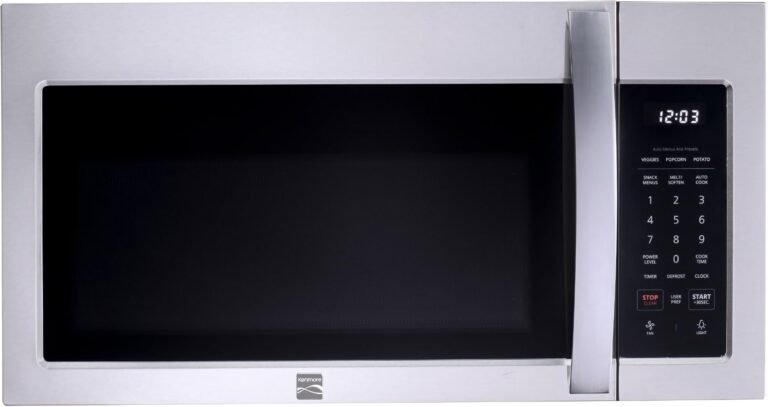
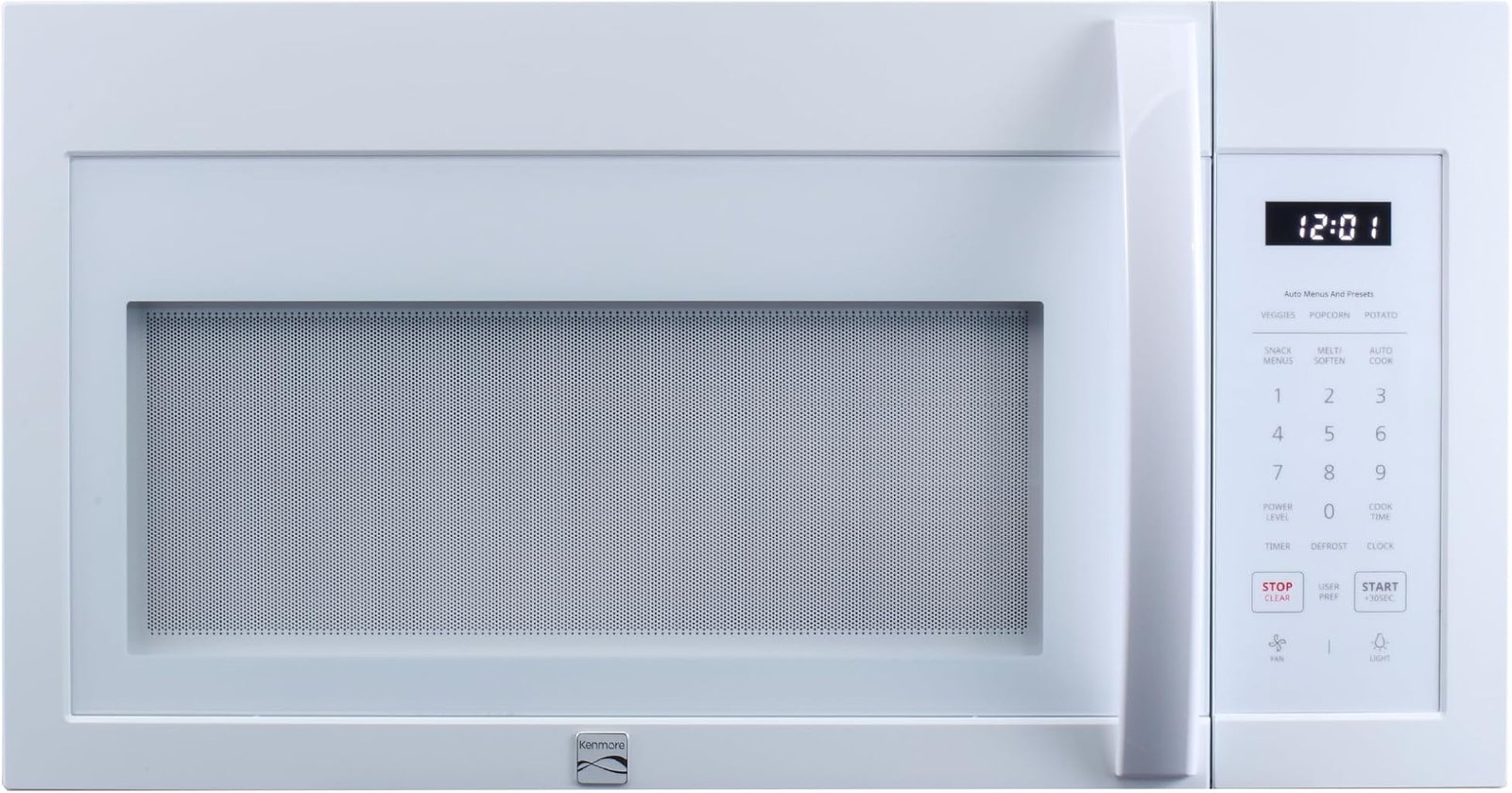
The Kenmore 1.7 cu. ft. over-the-range microwave takes a relatively conventional approach to that challenge. Kenmore’s current stainless-steel 1.7-cu.-ft. model 22-87063 combines a 1,000-watt microwave, a 12.4-inch glass turntable and a two-speed ventilation system rated at 300 CFM. According to Kenmore’s current specifications for the 22-87063, the appliance also supports top, rear and recirculating ventilation, along with six presets, 26 settings, LED lighting, grease and carbon filtration, Keep Warm, Delay Start, Broil and a child safety lock.
That collection of features earns an Our Score of 8.13/10. Customer Sentiment is 8.06/10, Buyer Confidence reaches 8.45/10, and Value comes in at 8.03/10.
The narrow spread among those ratings is revealing. This is not an appliance whose appeal rests on one spectacular specification while weaknesses accumulate elsewhere. It is a fairly balanced conventional OTR microwave. The capacity is useful without being excessive, the cooking output fits mainstream expectations, and the ventilation system is functional but restrained.
That last point deserves attention. A 300-CFM blower is not a trivial feature, but neither should it be interpreted as a substitute for a high-capacity dedicated range hood in kitchens where heavy frying and high-temperature searing are routine. The Kenmore makes the most sense when microwave cooking, moderate ventilation and space consolidation matter in roughly equal measure.
The 1.7-Cubic-Foot Capacity Is Sensibly Sized
Microwave capacity is one of those specifications that becomes less informative the longer it is examined in isolation.
A 1.7-cu.-ft. cavity sounds substantially more descriptive than it really is. What matters to the user is whether a dinner plate can rotate freely, whether a casserole dish fits without colliding with the cavity walls and whether taller containers have sufficient clearance.
The Kenmore pairs its 1.7 cubic feet with a 12.4-inch rotating glass turntable. That diameter gives buyers a more tangible reference than cavity volume alone.
The capacity lands in a useful middle ground for a conventional over-the-range appliance. It provides more room than compact and low-profile designs while avoiding the assumption that every kitchen benefits from pushing cavity volume toward two cubic feet.
Large capacity carries a physical cost. An over-the-range microwave is suspended between cabinetry and the cooking surface, so every additional inch of appliance height can reduce usable space above the stove.
That makes 1.7 cubic feet a practical compromise. It is substantial enough for ordinary family meals, broad plates and many casserole dishes without making sheer interior volume the defining feature of the appliance.
For buyers preparing a microwave buying guide comparison, this is one area where bigger should not automatically be treated as better. The more useful question is whether the cavity accommodates the cookware actually used in the kitchen while leaving acceptable clearance over the range.
The 1,000-Watt Output Fits Everyday Microwave Cooking
Kenmore specifies 1,000 watts of cooking power.
That output sits comfortably within the range associated with full-size microwave cooking and makes the appliance easier to reconcile with many packaged-food instructions than lower-powered compact units.
Yet wattage deserves disciplined interpretation.
A microwave’s rated cooking output does not guarantee perfectly even temperatures throughout a dish. Food composition, density, moisture, starting temperature, shape, placement and cooking duration all affect the result.
The rotating turntable helps by moving food through changing electromagnetic field patterns within the cavity, but rotation cannot erase every hot or cold region.
The practical advantage of 1,000 watts is therefore less dramatic than marketing language sometimes implies. It provides a familiar baseline for ordinary heating, reheating and defrosting.
For many households, that is exactly what matters.
A microwave spends much of its life performing mundane jobs: reheating yesterday’s dinner, warming soup, softening ingredients, defrosting frozen food or heating beverages. Predictable output matters more in those situations than novelty.
The Control Package Goes Beyond Bare-Bones Operation
Kenmore lists 26 settings and six presets.
That gives the appliance a broader control package than its otherwise conventional design might suggest.
The manufacturer identifies Keep Warm, Delay Start and Broil among the available functions, while preset selections reduce manual input for recurring cooking tasks.
The useful question is not how many buttons exist. It is whether those controls reduce friction during ordinary use.
Keep Warm has an understandable purpose. Meal preparation rarely proceeds with laboratory timing. One dish may finish several minutes before another. A holding function can bridge that gap without requiring repeated short reheating cycles.
Preset cooking functions have a different appeal. They remove some time and power calculations from common tasks. Their usefulness will vary according to household habits, but they provide a faster path for foods that match the programmed categories.
Delay Start is more specialized and may see less frequent use.
The overall interface nevertheless avoids an excessively stripped-down approach. Users who want direct timed cooking can still treat the microwave conventionally, while those who prefer automated settings have additional options.
A 300-CFM Vent Fan Requires Realistic Expectations
Ventilation is where an OTR microwave stops behaving like a countertop appliance and starts interacting with the building around it.
Kenmore rates the ventilation system at 300 CFM and provides two fan speeds.
CFM measures cubic feet of airflow per minute. It is useful, but it is not a universal measure of smoke-capture effectiveness.
The distinction matters because the blower can only exhaust contaminants that reach the intake.
Smoke rising from cookware forms a plume influenced by heat, burner position, room air currents and hood geometry. A front burner may place part of that plume beyond the effective capture area of an over-the-range microwave.
After air enters the appliance, another set of variables appears. Duct diameter, duct length, elbows, transitions, exterior dampers and accumulated grease can all increase airflow resistance.
The U.S. Environmental Protection Agency identifies cooking as a source of indoor particulate matter and recommends using a range hood while cooking. The agency also advises exhausting outdoors when possible and using rear burners where practical to improve capture.
Those recommendations place the Kenmore’s 300-CFM rating in useful context.
For boiling, simmering and moderate stovetop cooking, the system has a credible specification. A kitchen regularly producing substantial smoke from frying, wok cooking or high-temperature searing presents a more demanding ventilation problem.
Two Fan Speeds Favor Simplicity Over Fine Control
The Kenmore offers two ventilation speeds.
That arrangement is easy to understand. It also provides less adjustment than systems offering three, four or more blower settings.
The distinction is not about maximum airflow. A four-speed fan is not automatically more powerful than a two-speed fan. Additional settings simply allow finer control between minimum and maximum operation.
That flexibility can matter during long cooking sessions.
Boiling water generates different ventilation demands from frying food. A lower setting may be sufficient for moisture control, while smoke-producing cooking calls for maximum extraction.
With two speeds, the Kenmore reduces that decision to a broader low-or-high choice.
For many households, that simplicity will be perfectly workable. Users who frequently leave ventilation running for extended periods or who are sensitive to fan noise may prefer more incremental adjustment.
This is one reason the Kenmore earns a strong score without reaching the uppermost range. The ventilation package is useful, but it is not unusually sophisticated.
Three Ventilation Configurations Improve Installation Flexibility
The Kenmore can be installed for top exhaust, rear exhaust or recirculation.
That flexibility matters because kitchens rarely share identical ventilation architecture.
One home may have a vertical duct rising through the cabinet above the microwave. Another may exhaust directly through the rear wall. A third may have no exterior duct and therefore require recirculation.
Supporting all three arrangements makes the appliance adaptable to several common installation conditions.
They should not, however, be treated as equivalent ventilation methods.
An externally ducted installation can carry captured cooking air outside the building. A recirculating installation filters air and returns it to the kitchen.
Kenmore specifies both grease and carbon filtration.
The grease filter captures some airborne cooking residue before it reaches the blower and duct system. Carbon filtration is particularly relevant to recirculating operation, where odor reduction becomes more important because the air is returned indoors.
Filters require maintenance.
Grease accumulation can restrict airflow. Carbon filtration also has a finite service life. The owner’s documentation should determine cleaning and replacement intervals rather than visual guesswork alone.
The 12.4-Inch Turntable Gives Capacity a Practical Meaning
The 12.4-inch glass turntable deserves more attention than it usually receives in microwave comparisons.
Cubic-foot measurements describe total cavity volume. Turntable diameter tells the buyer something closer to what can actually rotate during cooking.
A large plate that technically fits inside the cavity may still be inconvenient if its corners or rim strike the walls while the turntable moves.
The Kenmore’s 12.4-inch rotating platform is sized for common dinnerware, although unusually broad or square dishes should still be measured before purchase.
Rotation also contributes to heating distribution by changing the food’s position within the microwave cavity.
That does not eliminate the need for stirring, turning or standing time where recipes call for those steps. Microwave heating remains sensitive to food composition and geometry.
The removable glass design also simplifies cleaning. Spills and splatter can be addressed outside the cavity rather than forcing all cleanup to occur inside a microwave mounted above shoulder level for some users.
LED Lighting Performs Two Separate Functions
An over-the-range microwave needs lighting in two places.
The cavity requires illumination so food can be observed during cooking. The underside of the appliance needs task lighting because the microwave replaces the space normally used by a range hood.
Kenmore provides LED lighting for both purposes.
The distinction sounds minor until a microwave is installed above a dark cooking surface. Cooktop lighting affects routine tasks ranging from checking browning in a skillet to reading markings on cookware.
LED technology also avoids treating the lighting system as a purely decorative feature.
Brightness should not be inferred without measured illumination data, so there is no basis for claiming that the Kenmore’s lighting is exceptionally bright or unusually uniform.
Its presence in both locations is the meaningful point.
Broil Adds an Interesting Secondary Function
The Broil setting distinguishes the control package from a microwave limited strictly to conventional microwave heating.
Kenmore identifies Broil among the appliance’s functions, giving users another cooking option beyond standard microwave energy.
That feature should be treated as a stated capability rather than an excuse to invent performance comparisons against a conventional oven or dedicated broiler.
The practical value depends on what a household expects from the appliance.
A buyer interested almost exclusively in reheating will care little about secondary cooking modes. Someone trying to extract more utility from the space above the range may see Broil as a worthwhile addition.
Its presence broadens the appliance’s cooking vocabulary without changing the basic identity of the machine: this remains primarily an over-the-range microwave with integrated ventilation.
Installation Can Matter More Than Another Feature
An OTR microwave is not simply placed on a shelf and plugged in.
Installation determines physical safety, clearance, ventilation configuration and, in externally ducted systems, airflow performance.
Before replacement, buyers should measure:
- Cabinet opening width
- Upper-cabinet depth
- Distance between the cooking surface and upper cabinetry
- Existing microwave height
- Existing microwave depth
- Door-opening clearance
- Electrical receptacle position
- Existing duct direction
- Duct dimensions
- Mounting surface
- Structural attachment locations
The mounting bracket from an old microwave should not automatically be reused.
Two appliances with similar exterior dimensions can use different brackets, bolt positions and mounting procedures.
Ventilation configuration deserves the same attention.
A kitchen with exterior ductwork should have the microwave configured to match the appropriate top or rear exhaust route. An installation intended for recirculation needs the correct filter arrangement.
A misconfigured blower can undermine the ventilation specification before cooking even begins.
The Difference Between Airflow and Capture Matters
The Kenmore’s 300-CFM rating is easiest to understand by separating two concepts.
Airflow describes how much air the system can move.
Capture describes whether cooking contaminants enter the system in the first place.
A blower can move air effectively while smoke from a front burner rolls past the microwave’s front edge and enters the room.
That is why hood geometry, installation height and burner choice affect real kitchen performance.
Duct resistance adds another layer. A short, smooth exterior duct presents a different workload from a long route containing multiple elbows and restrictive transitions.
The same microwave can therefore behave differently in two houses.
This is not unique to Kenmore. It is a basic characteristic of installed ventilation equipment.
For buyers whose primary concern is smoke removal, ventilation should be evaluated as a system extending from the pan to the exterior outlet rather than as a number printed beside CFM.
How 300 CFM Compares With a Familiar Alternative
The Kenmore’s ventilation specification is not unusual for a conventional 1.7-cu.-ft. OTR microwave.
For context, the GE JVM6177 is also specified with a two-speed, 300-CFM ventilation system and 1,000 watts of microwave cooking power.
The comparison does not establish that the two appliances perform identically. It shows that the Kenmore’s basic cooking-output and airflow figures sit within a recognizable part of the mainstream OTR category.
Higher-airflow alternatives are available.
Whether higher CFM is useful depends partly on cooking habits and installation conditions. Additional airflow can place greater demands on ductwork and, at sufficiently high exhaust rates, building-pressure considerations can enter the discussion.
The Kenmore’s 300-CFM system is therefore best understood as moderate rather than exceptional.
Cleaning and Maintenance Should Not Be Treated as Optional
Microwave maintenance is often reduced to wiping food splatter from the cavity.
An OTR appliance adds a ventilation system, and that system requires attention.
The grease filter sits in the path of cooking air. As grease accumulates, airflow resistance can increase. A filter that appears merely dirty may already be changing how easily the blower moves air.
Recirculating installations add carbon filtration to the maintenance equation.
The turntable and cavity also benefit from regular cleaning before spills are repeatedly reheated onto surfaces.
Cleaning has another diagnostic value. If ventilation performance deteriorates gradually, a dirty filter is a more plausible first suspect than sudden blower failure.
Maintenance therefore protects both hygiene and airflow.
Our Score: 8.13/10
Our 8.13/10 rating reflects a product with a balanced conventional specification set.
The 1.7-cu.-ft. cavity provides useful capacity. The 1,000-watt output fits mainstream microwave cooking. A 12.4-inch rotating turntable gives the cavity practical utility. The ventilation system supports three installation configurations, while LED lighting addresses both interior visibility and cooktop illumination.
The controls extend beyond basic time entry through six presets, Keep Warm, Delay Start and Broil.
The limitations are equally identifiable.
A 300-CFM maximum is moderate rather than unusually high. Two fan speeds limit ventilation adjustment. Buyers seeking convection, advanced connected features or unusually aggressive exhaust capability will find other designs more closely aligned with those priorities.
The 8.13 rating reflects balance rather than novelty.
Customer Sentiment: 8.06/10
Our 8.06/10 Customer Sentiment score sits close to the overall rating.
That alignment reflects the straightforward nature of the product.
The Kenmore does not ask buyers to accept a major weakness in exchange for one headline feature. Capacity, cooking power, ventilation and controls sit within a relatively consistent range of capability.
The 8.06 score also leaves room for buyer-specific friction.
A household expecting dedicated-hood levels of smoke extraction may find 300 CFM too restrained. A kitchen with limited vertical clearance may favor a low-profile microwave. A buyer seeking advanced oven-like functions may prefer a different appliance category.
For conventional OTR use, however, the specification package is coherent.
Buyer Confidence: 8.45/10
Our 8.45/10 Buyer Confidence rating is the highest of the four scores.
The reason is clarity.
Kenmore documents the model’s core specifications directly: 1.7 cubic feet of capacity, 1,000 watts of cooking power, a 12.4-inch turntable, 300-CFM ventilation, two fan speeds, multiple vent configurations, LED lighting and its principal control features.
That makes pre-purchase evaluation relatively straightforward.
The buyer still needs to do the physical work of measuring the kitchen.
High confidence in an appliance does not guarantee compatibility with an existing cabinet opening, duct route or mounting arrangement.
The strongest purchase decision combines clearly documented appliance specifications with equally careful measurements of the installation site.
Value: 8.03/10
Our 8.03/10 Value score reflects the usefulness of combining microwave cooking, ventilation and cooktop lighting in one appliance.
The Kenmore earns value through integration.
A 1,000-watt microwave occupies the same above-range space as a 300-CFM ventilation system and task lighting. For kitchens where counter space is limited, moving the microwave above the range can itself be useful.
Value becomes less persuasive when one of those functions is unnecessary.
A kitchen already equipped with a high-performing dedicated hood has little reason to replace it solely to gain an OTR microwave. Likewise, a household with demanding ventilation requirements may prefer to protect hood space and place the microwave elsewhere.
The 8.03 rating reflects a product that offers good utility when its combined functions align with the kitchen.
Who Is the Kenmore Best Suited For?
The Kenmore is most naturally aligned with households seeking:
- A conventional 1.7-cu.-ft. OTR microwave
- 1,000 watts of microwave cooking output
- A 12.4-inch rotating turntable
- Moderate 300-CFM ventilation
- Top, rear or recirculating exhaust flexibility
- Two straightforward fan speeds
- LED cavity and cooktop lighting
- Six presets and multiple control settings
- Keep Warm and Delay Start
- A child safety lock
- A secondary Broil function
Its fit is weaker where very high ventilation capacity, low-profile dimensions or advanced multi-mode cooking are primary requirements.
That distinction is not a criticism of the appliance. It is a recognition that an OTR microwave is part of a kitchen system rather than an isolated countertop device.
The Main Strengths
The Kenmore’s strongest qualities are practical.
Capacity is large enough for routine family use without turning cavity volume into a contest. The 1,000-watt output provides familiar microwave power. The 12.4-inch turntable translates interior volume into usable dish space.
Three-way ventilation makes installation more flexible.
The control package extends beyond bare essentials, while LED lighting addresses both food visibility and cooktop illumination.
The Broil, Keep Warm and Delay Start functions add utility without changing the appliance into an unnecessarily complicated control platform.
Most significantly, the specifications form a coherent package. Nothing appears dramatically overbuilt relative to the rest of the appliance.
The Main Drawbacks
Ventilation is the clearest limitation.
A two-speed 300-CFM blower can handle ordinary ventilation duties, but households producing substantial smoke regularly should evaluate whether that level of airflow and the OTR capture geometry meet their needs.
Recirculating installation also carries inherent limitations because filtered air returns to the kitchen instead of being exhausted outdoors.
Two fan speeds provide less adjustment than more granular systems.
The full-size format can reduce vertical clearance compared with low-profile alternatives.
And while Broil expands the cooking options, buyers seeking a microwave specifically for convection baking, air frying or broader oven replacement should compare appliances designed around those functions.
These are design boundaries, not hidden defects.
Final Considerations
The Kenmore 1.7 cu. ft. over-the-range microwave earns an 8.13/10 overall score because its major specifications work together with relatively little contradiction.
The 1.7-cu.-ft. cavity provides useful capacity. A 12.4-inch turntable makes that space practical for common dishes. The 1,000-watt cooking output sits in familiar full-size territory. Six presets and a wider group of control settings add convenience without displacing ordinary timed microwave operation.
Ventilation is more nuanced.
The 300-CFM, two-speed system provides moderate exhaust capability, while top, rear and recirculating configurations make the appliance adaptable to several kitchen layouts. Yet maximum CFM cannot guarantee smoke capture. Burner position, hood geometry, filter condition, duct resistance and whether air is actually exhausted outdoors all affect the result.
Our 8.45/10 Buyer Confidence score reflects the relative clarity of the documented product specifications. The 8.06/10 Customer Sentiment and 8.03/10 Value scores sit close to the overall rating, reinforcing the view that this is a balanced product rather than an appliance dependent on one unusually impressive feature.
The most suitable buyer is therefore not someone chasing the largest cavity or highest airflow number.
It is the household seeking a conventional full-size microwave that can free counter space, provide cooktop lighting and handle moderate ventilation duties from a single installed appliance.
The buyer with more aggressive ventilation requirements should give ducting and smoke capture greater priority. The kitchen with limited clearance should measure the available vertical space carefully. The household wanting convection or extensive oven-like cooking should compare models built around those functions.
Those distinctions matter because over-the-range microwaves are unusually permanent purchases. Once mounted, they become part of the cabinetry, electrical layout, lighting and ventilation path.
A microwave buying guide can compare wattage, cavity volume and control features, but the final decision still returns to the physical kitchen.
The Kenmore’s appeal is that its specifications are relatively easy to understand within that setting. It offers mainstream cooking power, useful capacity, moderate ventilation and a sensible collection of controls without demanding that the buyer value novelty for its own sake.
That makes the appliance neither radical nor difficult to place. It is a conventional OTR microwave with a balanced specification set, and for the kitchen that actually needs those combined functions, that balance is precisely the point.