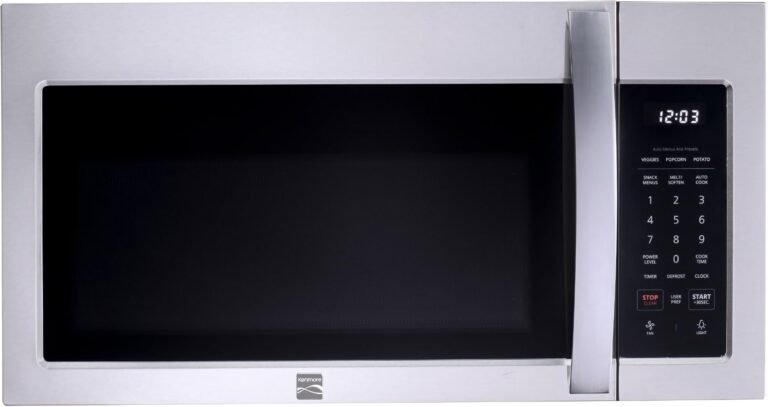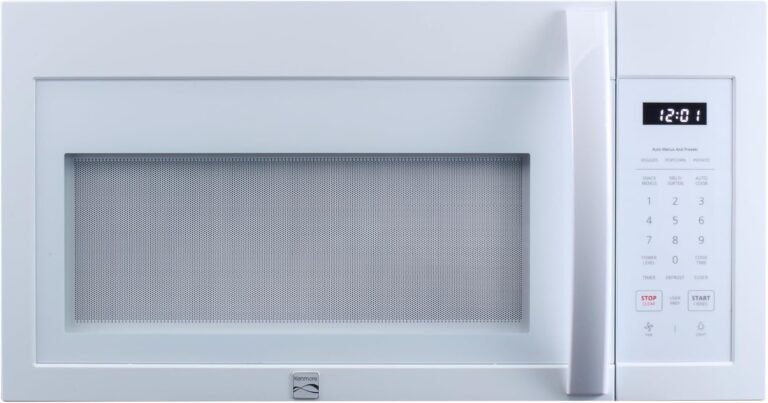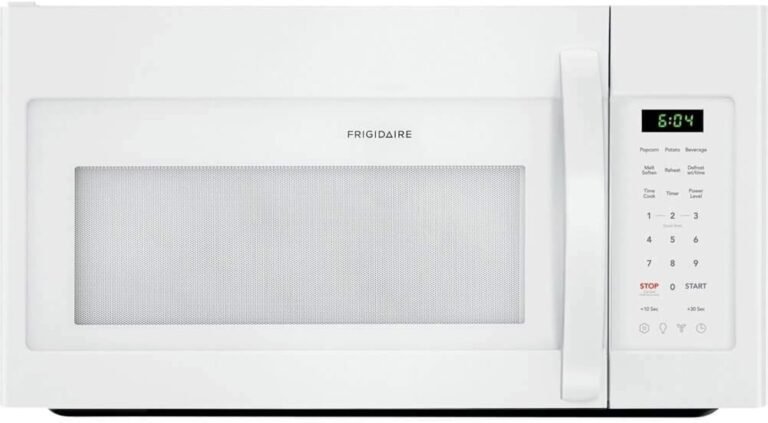
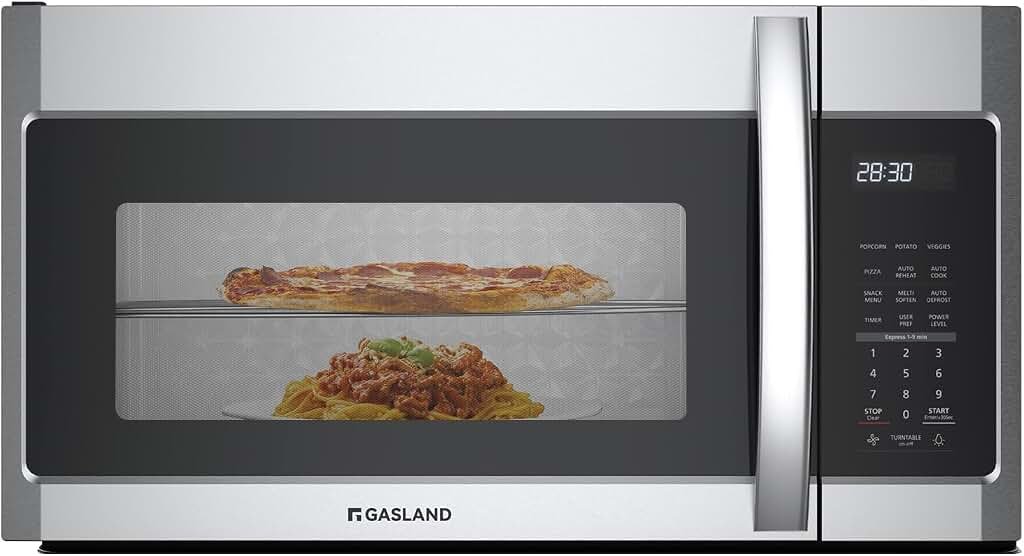
The GASLAND 1.9 cu. ft. over-the-range microwave approaches the category with a fairly traditional proposition: combine a full-size microwave cavity with cooktop lighting and a ventilation system, then package the hardware in a roughly 30-inch-wide appliance intended to replace both a countertop microwave and a separate hood.
What makes this model more interesting is the balance of specifications. The GASLAND OTR1902S pairs a 1.9-cubic-foot cavity with 1,000 watts of microwave output, 11 power levels, sensor cooking, nine automatic cooking programs, a 13.5-inch glass turntable and a two-speed ventilation system rated at 400 CFM. The manufacturer’s current OTR1902S product information lists exterior dimensions of 29.92 inches wide, 15.28 inches deep and 16.42 inches high.
Those numbers put it firmly in full-size over-the-range territory rather than the low-profile segment.
Our score is 8.19/10, placing the GASLAND in a strong position for households seeking substantial capacity, conventional microwave power and ventilation in one appliance without moving into a feature-heavy premium design. Buyer Confidence reaches 9.49/10, substantially higher than the 7.84/10 Customer Sentiment and 7.91/10 Value ratings. That gap tells the more useful story: the product’s specification set and buyer fit are relatively easy to understand, while its value proposition is less overwhelming at a price around $369.99.
The GASLAND is not trying to reinvent microwave cooking. Its appeal lies in giving a conventional 30-inch installation a generous cavity, useful automatic controls and a 400-CFM exhaust rating. Its limitations are equally straightforward: two fan speeds offer less ventilation control than some competing designs, and buyers should resist assuming that a 400-CFM specification guarantees equivalent smoke capture after installation.
A 1.9-Cubic-Foot Cavity Is the Main Attraction
Capacity is one of the GASLAND’s clearest strengths.
At 1.9 cubic feet, the cavity provides substantially more room than compact or low-profile over-the-range designs. GASLAND pairs that capacity with a 13.5-inch rotating glass turntable and a removable rack.
The rack is particularly relevant because vertical cavity volume can otherwise become wasted space. A tall microwave interior sounds useful on a specification sheet, but most everyday dishes sit close to the turntable. A removable rack allows some cooking or reheating arrangements to make use of a second level.
That flexibility should still be interpreted sensibly. Microwave racks must be used according to manufacturer instructions; metal accessories designed for a particular microwave are not an invitation to place arbitrary metal cookware inside the cavity.
For households reheating large dinner plates, serving dishes or multiple portions, 1.9 cubic feet offers meaningful room. Smaller households primarily reheating mugs, bowls and individual plates may find the capacity less consequential.
Size also comes with an architectural cost.
The appliance measures about 16.42 inches high. In kitchens where the existing microwave already hangs uncomfortably close to the cooking surface, another full-height model does not solve that problem. A low-profile microwave can preserve considerably more vertical working space.
That makes installation geometry as important as cavity volume.
The 1,000-Watt Output Hits a Familiar Cooking Baseline
The GASLAND is rated at 1,000 watts of microwave cooking power.
That output is common enough that packaged-food instructions frequently provide guidance around comparable microwave wattages, and it offers a practical balance between cooking speed and control.
Power alone does not establish heating uniformity. Food shape, quantity, starting temperature, placement, moisture and the appliance’s power-management strategy all affect results.
The GASLAND provides 11 adjustable power levels, which the manufacturer describes as covering settings from 0% to 100%.
That level of adjustment is useful for tasks where maximum power is inappropriate. Melting, softening, defrosting and gently reheating dense foods can benefit from reduced average energy delivery.
The presence of 1,000 watts therefore matters less as an isolated headline than as part of a fairly conventional cooking system: full microwave power for rapid heating, selectable lower settings for more controlled work and automatic programs for users who prefer not to set every cycle manually.
There is no convection or air-frying system listed for the OTR1902S. Buyers specifically seeking browning, roasting or crisping functions should recognize that distinction before purchase.
This is primarily a microwave and ventilation appliance.
Sensor Cooking Makes the Control Package More Useful
Sensor cooking is one of the GASLAND’s more meaningful convenience features.
The manufacturer lists sensor cooking alongside nine automatic programs covering popcorn, potato, vegetables, pizza, a snack menu, melt/soften, automatic reheating, automatic cooking and automatic defrosting.
Sensor systems are intended to reduce the amount of manual time-setting required for compatible foods. Rather than treating every reheating job as a fixed-duration exercise, the appliance can use detected cooking conditions to adjust operation.
That does not eliminate judgment.
Container choice, covering instructions, portion size and food composition still matter. Automatic cooking programs are useful shortcuts, not universal cooking intelligence.
The nine one-touch categories nevertheless cover many of the foods commonly handled by a microwave. Melt/soften is particularly practical because butter, chocolate and similar ingredients are easy to overheat at full power. Automatic reheating is another sensible inclusion for an appliance likely to spend much of its working life dealing with leftovers.
The familiar add-30-seconds function also appears in the control package.
It is a small feature, but one that often matters more in daily use than elaborate specialty modes. Microwave cooking frequently involves short corrections rather than perfectly predicted cooking times.
The 400-CFM Ventilation Rating Deserves Careful Interpretation
The ventilation system is arguably the most consequential feature after microwave capacity.
GASLAND rates the OTR1902S at 400 CFM with two fan speeds. Lowe’s archived specifications for the GASLAND OTR1902S likewise list a 400-CFM maximum exhaust capacity and two ventilation speeds.
A 400-CFM rating gives the appliance a credible specification for ordinary over-the-range ventilation. It should not, however, be read as a guarantee that 400 cubic feet of contaminated kitchen air will always be captured and removed every minute in a real installation.
The distinction is airflow versus capture.
Duct dimensions, duct length, elbows, transitions, exterior dampers and other restrictions affect installed airflow. Smoke also has to reach the microwave’s intake before the blower can remove it. Front-burner cooking can send part of the rising plume beyond the effective capture area of an over-the-range microwave.
The U.S. Environmental Protection Agency’s guidance on indoor particulate matter recommends using a range hood during cooking, venting outdoors where possible and favoring rear burners when practical because they generally improve hood capture.
That is an important distinction for any microwave buying guide. Comparing ventilation systems by maximum CFM alone can hide installation realities.
A correctly ducted 400-CFM appliance with a short, smooth exhaust path can operate under very different conditions from the same blower attached to an undersized duct with several restrictive turns.
Two Fan Speeds Are Functional but Not Especially Granular
The GASLAND ventilation system has two speeds.
That is enough to provide basic low/high control, but it is one area where the design feels comparatively simple.
More fan speeds allow a user to match ventilation more closely to cooking intensity. Boiling pasta does not necessarily require the same airflow setting as searing meat. With only two settings, the choice is broader: quieter/lower ventilation or maximum extraction.
This is not a major functional defect, but it affects refinement.
A buyer primarily concerned with removing smoke may spend much of the time using the higher setting anyway. Someone sensitive to fan noise or frequently cooking at moderate heat may prefer additional speed choices.
The specification also illustrates why feature count needs context. Four or five speeds do not automatically create stronger maximum ventilation. They create more control between minimum and maximum operation.
For the GASLAND, 400 CFM matters more than the number of intermediate settings, but the two-speed design remains a trade-off.
Cooktop Lighting Is Built Into the Package
The appliance incorporates LED cooktop lighting beneath the microwave.
This is an expected feature in the category, but it matters because an over-the-range microwave replaces physical space where a conventional hood would otherwise provide task lighting.
GASLAND lists two 1-watt LED lights on its current product page.
The practical value is straightforward: the cooking surface receives dedicated illumination without requiring another fixture beneath the cabinet.
No unsupported claim about brightness or color quality is warranted from wattage alone. LED wattage describes electrical consumption, not perceived illumination in a particular kitchen.
The useful fact is simply that cooktop lighting is integrated, as it should be for this appliance format.
Dimensions Need Attention Before Purchase
The OTR1902S is 29.92 inches wide, 15.28 inches deep and 16.42 inches high according to GASLAND.
Those dimensions make it broadly consistent with a conventional 30-inch over-the-range installation, but nominal width should never substitute for measuring the kitchen.
A buyer replacing an existing microwave should record:
- Actual cabinet opening width
- Depth of the upper cabinet
- Distance from cooking surface to upper cabinet
- Existing microwave height
- Existing microwave projection
- Door-swing clearance
- Vent location
- Electrical receptacle location
- Duct dimensions and direction
The old wall bracket should not automatically be reused. Over-the-range microwave mounting hardware and bolt locations can differ even when exterior dimensions are similar.
The 16.42-inch height deserves particular scrutiny. If a kitchen has limited clearance above the cooktop, this full-height design may hang lower than desired.
Likewise, 15.28 inches of appliance depth means some projection beyond common upper cabinetry should be expected.
Neither measurement is inherently problematic. They simply need to fit the room rather than the buyer’s assumption about what “30-inch microwave” means.
Installation Quality Will Influence the Ventilation Experience
The GASLAND combines a microwave and range-ventilation system, so installation affects more than whether the appliance stays attached to the wall.
The exhaust path has to be configured correctly.
If the installation is externally ducted, the blower and exhaust adapter need to align with the intended vent direction. The duct should meet the requirements in the installation instructions, and the exterior damper must open freely.
If the installation recirculates air, filter configuration becomes more important because cooking air returns to the kitchen rather than leaving the building.
This difference can fundamentally change the user’s impression of the 400-CFM specification.
A fan can move substantial air without capturing all smoke generated at the front edge of a large range. Conversely, poor ductwork can reduce effective airflow even when the blower itself is functioning correctly.
Installation should therefore be treated as part of product performance rather than an unrelated afterthought.
Cleaning and Maintenance Are Conventional
The maintenance burden is broadly familiar for an over-the-range microwave.
Grease filters need periodic cleaning because airborne cooking residue accumulates in their mesh. Recirculating configurations may require additional filter maintenance or replacement according to the appliance documentation.
The interior benefits from routine wiping before splatter becomes repeatedly heated onto surfaces.
The removable glass turntable simplifies cleaning because it can be taken out separately. The manufacturer’s product information also identifies a nonstick interior.
As with any microwave, aggressive abrasives should be avoided unless explicitly approved for the surface.
Ventilation maintenance deserves particular attention. A 400-CFM blower working behind a heavily clogged grease filter will not deliver the same system behavior as it will behind clean filtration.
For buyers attracted to the ventilation specification, filter maintenance is part of preserving the value of that feature.
Our Score: 8.19/10
Our 8.19/10 rating reflects a product with a well-chosen core specification set and relatively few unnecessary diversions.
The 1.9-cubic-foot capacity is generous. The 1,000-watt output is appropriate for routine microwave cooking. Eleven power levels provide useful adjustment. Sensor cooking and nine automatic programs strengthen convenience. A removable rack expands how the cavity can be organized. The 400-CFM ventilation rating is a meaningful specification for an over-the-range design.
The score stops short of the highest range because the package is still fairly conventional.
Two fan speeds limit ventilation adjustment. There is no convection or air-fry functionality listed. The full-height body will not suit kitchens where maximizing cooktop clearance is a priority. And, as with any over-the-range microwave, real ventilation effectiveness depends partly on ductwork and capture geometry rather than the appliance specification alone.
An 8.19 rating is therefore not an award for novelty. It reflects balance.
Customer Sentiment: 7.84/10
Our 7.84/10 Customer Sentiment rating is the lowest of the four editorial measures, although it remains positive.
That score suggests a product proposition that works better when judged by its core utility than when treated as a universally appealing choice.
A 1.9-cubic-foot cavity is attractive for larger dishes, but it also contributes to a full-size appliance body. A 400-CFM blower provides useful ventilation capacity, yet two speeds offer limited fine control. The interface includes the expected conveniences without moving into the more elaborate feature sets available elsewhere.
The result is a microwave that makes the most sense for buyers whose priorities line up with its design: capacity, conventional microwave output and integrated ventilation.
Someone seeking a low-profile body, advanced convection cooking or unusually sophisticated ventilation control has a different set of requirements.
Buyer Confidence: 9.49/10
Our 9.49/10 Buyer Confidence score is notably higher than the other measures.
The reason is specification clarity.
This is not a product whose purpose is difficult to interpret. It is a roughly 30-inch over-the-range microwave with 1.9 cubic feet of capacity, 1,000 watts of output, 11 power levels, sensor cooking, a 13.5-inch turntable and a two-speed 400-CFM ventilation system.
The archived Lowe’s listing corroborates key physical and ventilation specifications, including a 29.92-inch width, 16.42-inch height, 15.28-inch depth, 1.9-cubic-foot capacity and 400-CFM maximum exhaust rating.
That consistency matters.
High buyer confidence does not mean every kitchen is a suitable installation. It means the buyer can identify the appliance’s intended role and compare the measurable requirements against the kitchen before committing.
The remaining work is mostly fit verification: cabinet opening, vertical clearance, duct configuration, electrical supply and door clearance.
Value: 7.91/10
Our 7.91/10 Value rating reflects a respectable package rather than an obvious bargain.
At around $369.99, the GASLAND combines microwave capacity, sensor functions, automatic programs, lighting and 400-CFM ventilation in one appliance.
The 1.9-cubic-foot cavity and 400-CFM rating help justify the price because both are meaningful specifications rather than cosmetic extras.
Still, value is constrained by the straightforward nature of the design.
The buyer is not receiving convection cooking, air frying or a large number of fan-speed settings. Those omissions are not necessarily disadvantages for someone who wants a conventional microwave, but they limit how far the product can stretch beyond its basic role.
The strongest value case therefore belongs to a household that will genuinely use the cavity volume and integrated ventilation.
Paying for 1.9 cubic feet makes little sense if the microwave handles only coffee and occasional leftovers. For a family routinely reheating large plates or using broad serving dishes, the same capacity becomes much easier to justify.
Where the GASLAND Makes the Most Sense
The GASLAND OTR1902S is particularly well aligned with buyers who want:
- A conventional 30-inch over-the-range format
- A large 1.9-cubic-foot cavity
- 1,000 watts of microwave output
- Sensor-assisted cooking
- Common automatic cooking functions
- A removable rack
- Integrated cooktop lighting
- A ventilation system rated up to 400 CFM
- Straightforward controls rather than an elaborate connected interface
It is less naturally suited to kitchens where vertical clearance is tight or where a low-profile microwave is needed.
It also is not the logical choice for someone specifically shopping for convection baking, air frying or highly adjustable ventilation.
Those distinctions are more useful than treating every missing feature as a defect. A product can be well specified for one job without being designed for every possible job.
The Main Strengths
The most defensible strengths are rooted in measurable specifications.
First is capacity. At 1.9 cubic feet, the cavity provides room for larger dishes and broad everyday cookware.
Second is cooking power. The 1,000-watt output fits comfortably within conventional full-size microwave use, while 11 power settings provide more control than maximum-power cooking alone.
Third is ventilation. A 400-CFM maximum rating gives the GASLAND meaningful exhaust capability on paper, provided the installation does not undermine it with poor duct geometry or blocked airflow.
Fourth is convenience. Sensor cooking, nine automatic programs and add-30-seconds functionality address common microwave tasks without demanding a complicated interface.
Finally, the removable rack gives the large cavity a reason to be tall rather than simply spacious on a specification sheet.
The Main Drawbacks
The drawbacks are equally concrete.
Two fan speeds are basic. Buyers who frequently shift between low-intensity simmering and smoke-heavy searing may prefer more ventilation settings.
The 16.42-inch appliance height consumes substantial vertical space over the range. Kitchens already struggling with cooktop clearance should measure carefully.
No convection or air-fry function is listed, narrowing the appliance to conventional microwave cooking.
The 400-CFM rating also requires realistic expectations. Maximum blower airflow does not guarantee that every cooking plume will be captured, particularly from front burners or through restrictive ductwork.
Finally, at roughly $370, the product needs its capacity and ventilation to matter to the buyer. Those who do not need either can find simpler microwaves that fulfill basic reheating duties without paying for unused volume.
Final Considerations
The GASLAND 1.9 cu. ft. over-the-range microwave is a fundamentally practical appliance.
Its strongest argument is not a single unusual feature but the combination of 1.9 cubic feet of interior capacity, 1,000 watts of cooking output, 11 power levels, sensor cooking, nine automatic programs, a removable rack, LED cooktop lighting and a ventilation system rated at 400 CFM.
Our 8.19/10 overall score reflects that balance.
The 9.49/10 Buyer Confidence rating is especially revealing because the appliance’s strengths are measurable and easy to match against a household’s needs. The 7.84/10 Customer Sentiment and 7.91/10 Value scores are more restrained, reflecting a product that makes its strongest case when large capacity and ventilation are genuine priorities rather than specification-box attractions.
Its main compromises are not hidden. Two fan speeds provide limited ventilation adjustment. The full-height body demands adequate clearance above the cooking surface. Convection and air-fry functions are absent. And the ventilation rating remains dependent on proper installation, duct dimensions and smoke-capture geometry.
For a buyer comparing conventional over-the-range models in a microwave buying guide, those trade-offs make the GASLAND relatively easy to place.
It suits a kitchen that needs a large microwave cavity and wants a meaningful exhaust specification without turning the appliance into a secondary oven. It makes less sense where low-profile dimensions, extensive fan control or multi-mode cooking are higher priorities.
That distinction matters because an over-the-range microwave is never merely a microwave. It becomes part of the cabinetry, lighting, cooking workflow and ventilation system. A poor dimensional choice can hang too low. Poor ductwork can diminish an otherwise capable blower. Excess cavity volume can become wasted space if the household never uses large cookware.
The GASLAND’s specifications avoid much ambiguity about what it is trying to accomplish. It is a full-size, 1,000-watt microwave with a generous cavity and a ventilation system that deserves to be evaluated as part of the kitchen rather than in isolation.
At its best fit, that straightforwardness is an advantage. The buyer knows what the appliance is built to do, what dimensions must be accommodated and which compromises remain. For an appliance expected to spend years mounted above a stove, that clarity carries more practical weight than a long list of rarely used extras.