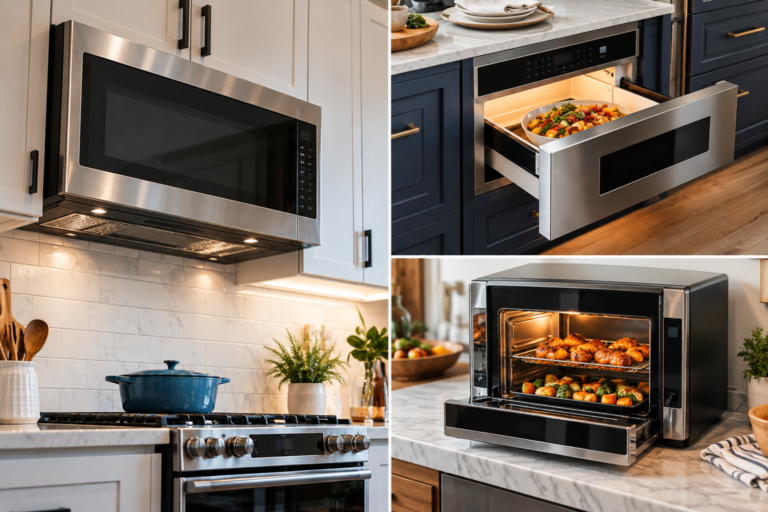
An over-the-range microwave vent fan can sound busy while accomplishing surprisingly little. The blower runs. Air noise is audible. The light works. Yet smoke from a frying pan rolls past the microwave’s front edge and spreads through the kitchen.
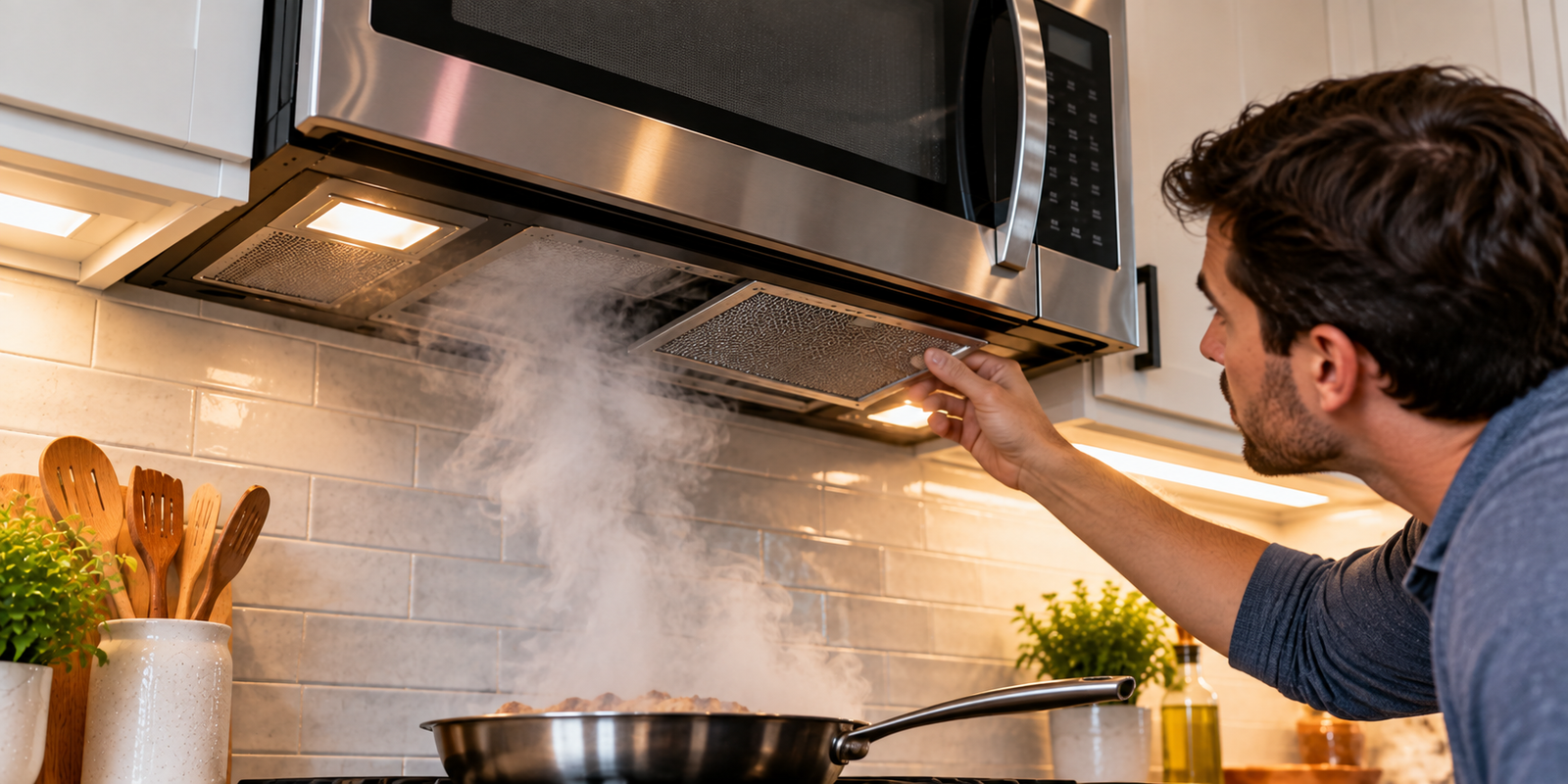
That apparent contradiction is the starting point for diagnosis.
Smoke capture depends on more than whether the fan motor spins. The system must collect the rising plume, move enough air through reasonably clean filters, overcome resistance in the duct system and discharge that air through an unobstructed exterior outlet. A recirculating installation faces an additional limitation: it returns filtered air to the kitchen instead of sending cooking contaminants outdoors.
The U.S. Environmental Protection Agency identifies cooking as a source of indoor particulate matter and says grilling, frying, baking and sautéing can all affect indoor particle levels. Burning food can generate large quantities rapidly. The agency recommends using a range hood whenever cooking and venting outdoors where possible.
When an over-the-range microwave fails to pull smoke effectively, troubleshooting should proceed from the simplest restrictions to the less visible installation faults.
First Determine Whether the Fan Is Moving Air
Before dismantling anything, establish what the ventilation system is actually doing.
Turn the vent fan to its highest manually selectable setting. Listen for a clear change between low and high speeds. Depending on the model, several fan speeds may be available. Whirlpool notes that some over-the-range microwaves have three to five vent speeds, although controls vary by model.
Then observe airflow.
If the microwave is configured for recirculation, air should generally return to the kitchen through an outlet near the upper front of the appliance. If it is externally vented, substantial recirculated airflow should not be emerging there.
Maytag offers a useful diagnostic distinction: with the fan running, absence of airflow at the top front can indicate that the unit is externally vented. Its troubleshooting guidance then directs owners of externally vented installations to inspect the outside wall-cap damper and insect screen.
This first test separates three broad conditions:
- The fan does not run or does not change speed.
- The fan runs, but airflow is weak.
- Airflow seems substantial, but smoke still escapes.
Each points toward a different investigation.
Cause 1: The Grease Filter Is Clogged
The grease filter is the first restriction to inspect because it sits directly in the incoming airflow.
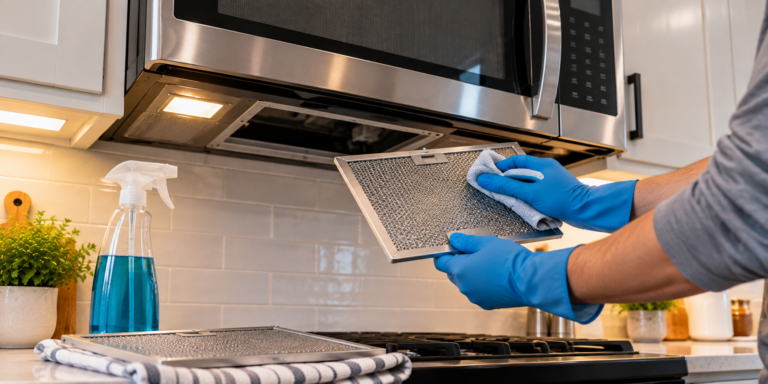
Usually found on the underside of the microwave, the metal mesh collects airborne grease generated by cooking. As residue accumulates, open passages through the mesh become restricted.
Whirlpool’s filter-maintenance guidance recommends cleaning grease filters monthly, using mild soap and water, or as prompted by the filter indicator on equipped models. It says many grease filters can also go in a dishwasher, subject to the owner’s manual.
The Fix
Switch off the appliance and allow the cooking area to cool. Remove the grease filter according to the owner’s manual.
Inspect it against a bright light. A filter heavily coated in sticky brown residue or showing little open mesh deserves cleaning.
Wash a reusable filter according to the manufacturer’s directions, let it dry fully and reinstall it securely.
If the frame is bent, mesh is torn or grease cannot be removed adequately, use the correct replacement specified for the microwave.
A dirty filter is an obvious suspect, but it should not become a convenient explanation for every ventilation problem. If cleaning produces little or no improvement, the restriction probably lies elsewhere.
Cause 2: The Charcoal Filter Is Saturated
A charcoal filter belongs mainly to a recirculating installation.
Instead of exhausting kitchen air outdoors, the microwave draws air through filtration and sends it back into the room. The charcoal filter is intended primarily to reduce cooking odors.
Unlike a metal grease filter, it generally is not washable.
Whirlpool states that charcoal filters on the over-the-range microwaves covered by its guidance cannot be cleaned and should be replaced about every six months, or when the filter-status indicator calls for replacement.
The Fix
Confirm whether the microwave is configured for recirculation and whether the model uses a charcoal filter.
Locate the filter according to the manual, identify the correct replacement by model number and replace rather than wash it.
A saturated charcoal filter can contribute resistance and poor odor control. Yet replacing it will not turn a recirculating microwave into an exterior exhaust system. Smoke that escapes the capture area or particles that are not effectively removed still remain inside the building.
That difference should influence a microwave buying guide as much as it influences troubleshooting: recirculating and externally ducted ventilation are not equivalent approaches to contaminant removal.
Cause 3: The Exterior Damper Is Stuck
An externally vented microwave must eventually push air through a wall or roof termination.
That outlet normally includes a damper intended to open when the fan operates and close when it does not. Grease, dirt, paint, corrosion, nesting material or mechanical damage can prevent free movement.
Maytag specifically advises checking whether the exterior wall-cap damper opens when the vent fan is running. It also calls attention to an obstructed insect screen as a possible airflow problem.
The Fix
With the fan running, inspect the exterior termination from a safe location.
The damper should move as intended and discharged air should be detectable. If the flap barely opens despite the fan operating at high speed, investigate for blockage or mechanical binding.
Clean accessible debris without damaging the damper.
Roof terminations introduce fall hazards and should not be treated as routine do-it-yourself access points. Where the outlet cannot be inspected safely from the ground or a stable working location, qualified service is appropriate.
A fan cannot exhaust air effectively through a door that barely opens.
Cause 4: The Insect Screen or Exterior Cap Is Blocked
Exterior screens collect more than insects.
Grease carried through the duct can combine with dust, pollen and other debris. Over time, the opening can become restricted even though the microwave itself appears clean.
This is one reason troubleshooting only from inside the kitchen can miss the problem.
The Fix
Inspect the exterior outlet while the fan operates.
Look for:
- Grease accumulation
- Dirt
- Leaves
- Nesting material
- A damaged flap
- A clogged screen
- Ice or weather-related obstruction
- Construction material left from recent work
Clean only what can be reached safely and without damaging the vent assembly.
If airflow improves immediately afterward, the fault was downstream of the microwave rather than inside it.
Cause 5: The Duct Is Too Small
Duct diameter or cross-sectional area has a direct effect on airflow resistance.
A blower that performs adequately through the intended duct can struggle when forced through an undersized passage.
GE’s current ducting guidance for its over-the-range microwaves specifies rigid 3¼-by-10-inch rectangular or rigid 6-inch round ducting for the installations it covers. GE states that both smaller and larger vents than its recommended sizes can reduce venting performance and specifies an equivalent total duct length of up to 140 feet for those products.
Those figures are manufacturer-specific, not universal specifications for every microwave.
The Fix
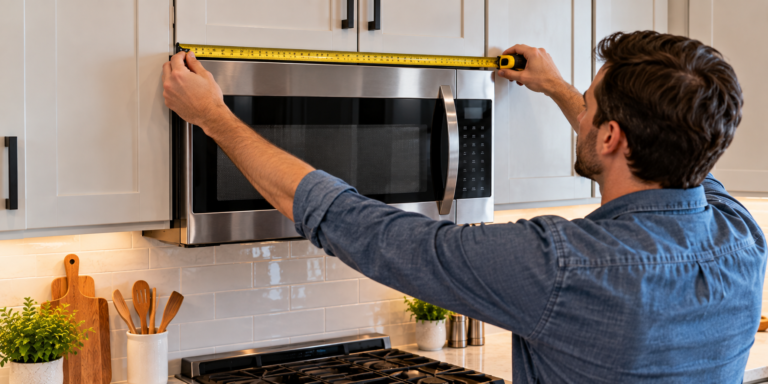
Find the installation manual for the exact microwave model and identify its required duct dimensions.
Then compare those requirements with the installed duct.
Pay particular attention to transitions. A six-inch outlet reduced immediately into a much smaller duct can create substantial resistance even if the rest of the system looks professionally installed.
Do not assume an existing duct is correct simply because the previous microwave used it.
Cause 6: The Duct Has Too Many Bends
Every turn makes airflow work harder.
The physics can be described through static pressure: resistance develops as air moves through duct surfaces, transitions, elbows, caps and other fittings. As system resistance increases, delivered airflow can fall.
Broan-NuTone’s explanation of installed range-hood airflow notes that duct length, duct size, bends and static pressure all affect actual performance. A blower’s advertised airflow therefore does not necessarily equal airflow delivered after installation.
This matters because a microwave can have a perfectly functional fan motor and still perform poorly at the cooking surface.
The Fix
Trace the duct route as far as practical.
A short run directly through the rear wall presents a different resistance profile from a system that rises into a cabinet, turns horizontally, travels across a ceiling cavity, turns again and finally reaches a roof cap.
Compare the installed route with the manufacturer’s allowable equivalent duct length.
If the duct has excessive elbows, abrupt transitions or an unnecessarily long path, redesign may be required.
Cleaning cannot correct geometry.
Cause 7: Flexible or Corrugated Duct Is Restricting Airflow
Smooth rigid metal duct offers air a relatively clean path.
Corrugated flexible duct creates repeated internal ridges. Those ridges increase turbulence and resistance.
Broan-NuTone advises using smooth metal rather than flexible metal for range-hood ducting because the ridges in flexible material diminish airflow. Its guidance also warns against using plastic or four-inch dryer duct for range-hood installations.
The Fix
Inspect accessible ductwork above the microwave and elsewhere along the route.
If flexible or improvised ducting has been used where the appliance instructions call for rigid duct, replacing it with correctly sized smooth metal duct can reduce resistance.
Duct modifications must comply with the appliance instructions and applicable local building requirements.
This is not merely a matter of making the duct look neater. Internal surface geometry affects how much of the blower’s capability survives the journey to the exterior.
Cause 8: The Blower Was Configured for the Wrong Vent Direction
Many over-the-range microwaves can be installed in several ventilation configurations.
Common arrangements include:
- Vertical exhaust through the top
- Horizontal exhaust through the rear wall
- Recirculation into the room
On models that support multiple configurations, the blower assembly may need to be rotated or repositioned during installation.
If the microwave was installed with the blower oriented incorrectly, the motor can run normally while airflow follows the wrong path or encounters severe restriction.
The Fix
Locate the installation manual for the exact model.
Compare the documented blower orientation with the actual installation configuration. This often requires removing the microwave or accessing installation components, so it is not always a simple homeowner inspection.
This fault is particularly plausible when ventilation has been poor since the day the microwave was installed.
A performance problem that appears suddenly after years of satisfactory operation points more strongly toward dirt, obstruction, mechanical failure or a changed duct condition. A problem present from installation day deserves scrutiny of the installation itself.
Cause 9: The Upper Vent Door Is Blocked
Cabinetry and trim can physically interfere with an exhaust opening.
Whirlpool’s troubleshooting guidance for certain over-the-range models says the upper vent door must be able to open and close freely. If trim, cabinetry or another obstruction blocks it, the microwave can overheat.
The Fix
Inspect the upper ventilation area for anything touching or blocking a movable vent door or discharge opening.
Recent cabinetry work is a clue. Decorative trim added after microwave installation can create a problem that did not exist originally.
Remove the obstruction only if doing so is consistent with the appliance’s installation requirements.
Do not modify the microwave’s housing or defeat designed vent components to make surrounding cabinetry fit.
Cause 10: The Fan Is Working, but Smoke Is Missing the Capture Area
This is where troubleshooting becomes less intuitive.
A vent fan can move a respectable volume of air while still failing to collect smoke from a pan.
Smoke does not wait politely beneath the filter. Heat creates a rising plume that expands and moves with surrounding room currents. A pan on a front burner can place part of that plume beyond the microwave’s effective capture area.
The EPA explicitly recommends cooking on back burners when possible because doing so improves airflow toward the hood and reduces particulate matter released into the kitchen.
The Fix
Perform a simple comparison.
With the fan on high, use the same cooking method first on a front burner and later on a rear burner when safe and practical.
If capture improves markedly on the rear burner, the problem may be geometry rather than a defective blower.
This distinction matters because increasing fan speed cannot completely compensate for smoke that never enters the intake region.
Cause 11: Cross-Drafts Are Pushing Smoke Away
A ventilation hood works by influencing a moving plume of warm contaminated air.
Other airflow in the room can interfere.
Ceiling fans, open windows, portable fans and HVAC registers can push the cooking plume sideways before it reaches the microwave intake.
The result can look like weak exhaust even though the fan and duct are functioning.
The Fix
Repeat the smoke-capture observation with nearby ceiling fans and portable fans off.
Consider whether an HVAC supply register blows across the cooking surface.
An open window immediately beside the range can also create unpredictable currents. Opening a window elsewhere may help supply replacement air, but a strong cross-draft directly across the cooktop can disrupt capture.
The location of replacement air matters almost as much as its availability.
Cause 12: The House Is Restricting Replacement Air
An exhaust fan cannot continuously remove air from a building unless other air replaces it.
In a relatively leaky older house, replacement air may enter through numerous gaps. In a tightly sealed building, a powerful exhaust system can lower indoor pressure enough to reduce exhaust performance.
This issue deserves caution because depressurization can also interact with combustion appliances.
Broan-NuTone notes that many codes require make-up air for range-hood exhaust systems above specified airflow thresholds and advises checking local jurisdiction requirements. Its support material cites code language addressing systems capable of exhausting more than 400 CFM, while also noting that local amendments can differ.
The Fix
A simple diagnostic observation can be informative: if ventilation improves substantially when an appropriate window or exterior door elsewhere in the home is opened slightly, insufficient replacement air may be contributing.
That is not a permanent design fix.
Where building pressure appears to be involved—especially in a home containing atmospherically vented gas appliances—an HVAC or ventilation professional should evaluate the system. Improvised make-up-air modifications can create safety and comfort problems.
Cause 13: The Microwave Is Recirculating When Outdoor Exhaust Is Expected
A kitchen can contain ductwork while the microwave itself remains configured for recirculation.
This can happen after replacement if the blower was never converted to the required exhaust orientation or if the appliance was installed without connecting it properly to the existing duct.
The Fix
Turn on the fan and check for airflow emerging from the microwave’s upper-front recirculation outlet.
Then verify the installation manual and, where safely accessible, the duct connection above the appliance.
If air is being discharged back into the kitchen despite an exterior duct being present, installation configuration deserves investigation.
A charcoal filter is not a substitute for correcting an appliance that was supposed to exhaust outdoors.
Cause 14: The Duct Has Become Dirty Internally
Grease filters capture a portion of airborne grease, not necessarily all of it.
Over years of cooking, residue can accumulate in ductwork, particularly around elbows, transitions and exterior terminations.
Maytag’s microwave troubleshooting guidance says that when removing the filters does not improve performance and the exterior damper and insect screen are operating correctly, the vent may need cleaning by an installer or other qualified worker.
The Fix
Inspect accessible duct sections.
Heavy internal deposits farther inside the system may require professional cleaning, especially where the route is concealed behind cabinetry, walls or ceilings.
Avoid pushing tools blindly into ductwork. Aside from damaging joints, this can simply move debris deeper into the system.
Cause 15: The Fan Motor or Blower Assembly Has a Fault
If filters are clean, the duct is open, the damper works and airflow remains abnormally weak, attention eventually turns to the blower itself.
Possible mechanical or electrical faults can include a failing motor, damaged blower wheel, loose connection or control problem.
The symptoms may include:
- Fan noise without meaningful airflow
- Grinding or scraping
- Rattling that changes with speed
- No difference between speed settings
- Intermittent operation
- Fan failure to start
- Electrical odor
- Repeated fault codes
The Fix
Basic control checks are reasonable. Internal microwave repair is different.
Microwave ovens contain high-voltage components, and internal service should not be treated like ordinary small-appliance disassembly. If diagnosis requires opening protected appliance housings or accessing electrical components, qualified service is the appropriate next step.
Whirlpool’s guidance for a vent fan that will not operate includes checking the selected fan setting and, for certain faults, resetting power at the breaker for one minute. If normal operation does not return, service may be needed.
Use the Filter-Removal Test Carefully
Manufacturer troubleshooting provides a useful short diagnostic test.
Maytag recommends removing the filter or filters and checking whether performance improves. If it does, filter restriction is implicated. If it does not, and an externally vented system has a functioning wall damper and clean insect screen, the duct system may need attention.
The test is temporary.
The manufacturer specifically warns not to keep operating the microwave without its required filters.
This approach is useful because it divides the system into sections. If airflow increases dramatically when a filter is removed, the restriction was near the intake. If nothing changes, investigation moves farther downstream.
Rated CFM Does Not Guarantee Smoke Capture
CFM—cubic feet per minute—describes airflow volume.
It is useful, but it should not be treated as a universal score for smoke capture.
Installed airflow depends on duct resistance. Capture also depends on the size and position of the intake relative to the cooking plume.
A microwave advertised with a particular airflow figure may deliver less after duct losses. Long ducts, undersized passages, multiple elbows and restrictive exterior caps all consume pressure that the blower must overcome.
This distinction belongs in a microwave buying guide because comparing maximum CFM figures without examining installation conditions can create unrealistic expectations.
Smoke capture is a system result, not a motor specification.
A Practical Troubleshooting Order
The most efficient diagnosis moves from accessible components toward concealed ones:
- Confirm the fan is running at the intended speed.
- Clean the metal grease filter.
- Replace a saturated charcoal filter if the microwave recirculates.
- Determine whether the appliance is recirculating or externally vented.
- Check whether rear-burner smoke is captured better than front-burner smoke.
- Eliminate strong cross-drafts during testing.
- Inspect the exterior wall or roof termination where safely accessible.
- Verify that the damper opens and screens are clear.
- Check accessible duct size, material and connections.
- Compare duct length and elbows with the model’s installation instructions.
- Investigate blower orientation if performance has been poor since installation.
- Consider replacement-air problems if airflow improves when safe outdoor air is introduced.
- Seek service if the blower itself remains weak, noisy or electrically abnormal.
This order avoids dismantling the microwave before obvious restrictions have been eliminated.
Improve Capture Even When Nothing Is Broken
A functioning system can still benefit from better operating habits.
The EPA recommends turning on the range hood while cooking and leaving it running for 10 to 20 minutes afterward. It also recommends rear burners where possible because they improve capture.
Turning the fan on before smoke becomes visible also establishes airflow before the cooking plume intensifies.
Keeping grease filters clean preserves available airflow.
Reducing unnecessary cross-drafts helps the plume move toward the intake rather than sideways into the room.
For high-temperature cooking, controlling the heat source can reduce the amount of smoke the ventilation system must handle. The EPA specifically advises lower burner temperatures where possible and avoiding deliberate burning or charring indoors.
Ventilation works better when it is not being asked to recover from a kitchen already filled with smoke.
When the Existing Microwave May Be the Limitation
Sometimes troubleshooting reveals no defect.
The filters are clean. The duct is short and correctly sized. The exterior damper opens. The blower works. Yet smoke from high-heat front-burner cooking still escapes.
At that point, the physical capture area and airflow capability of the appliance may simply be mismatched with the cooking style.
A household frequently searing food, wok cooking or pan-frying can generate a larger and faster-moving plume than a household mainly simmering, boiling and reheating.
The correct response is not endless repair of functioning equipment.
Future replacement decisions should evaluate ventilation configuration, verified airflow where available, capture geometry, installation height, duct requirements and whether the unit exhausts outdoors.
Those factors can matter as much as microwave cooking wattage or cavity capacity.
Final Considerations
An over-the-range microwave vent fan that fails to pull smoke should not immediately be diagnosed as a weak motor.
The system begins at the cooking surface and ends outside the building—or, in a recirculating installation, back inside the kitchen. Between those points lie the capture area, grease filter, charcoal filter where applicable, blower, damper, duct, elbows and exterior termination. Any restriction or configuration error along that path can reduce performance.
The practical investigation starts with what can be seen and cleaned.
Confirm fan speed. Clean the grease filter. Replace a spent charcoal filter rather than washing it. Determine where the air is supposed to go. Check whether the problem changes between front and rear burners. Remove disruptive cross-drafts. Inspect the exterior damper and screen. Only then should the investigation move toward duct geometry, blower orientation and mechanical failure.
The behavior of the problem also provides evidence.
Ventilation that worked well for years and suddenly deteriorated points toward a new restriction, dirty filter, blocked termination or mechanical fault. Poor capture present since installation raises different questions: duct sizing, excessive bends, incorrect blower configuration, cabinet interference or basic capture geometry.
Smoke escaping from front burners while rear-burner smoke is collected can indicate a capture problem rather than a failing fan. The EPA’s recommendation to favor rear burners reflects that physical reality.
And rated airflow alone does not settle the matter. The blower operates inside a system. Every undersized duct, abrupt elbow, clogged screen and stuck damper creates resistance. Every cross-draft can push smoke away before the fan has a chance to collect it.
The useful question is therefore not simply whether the microwave fan runs.
It is whether smoke can reach the intake, whether air can pass through the filters, whether the blower can overcome the installed resistance and whether the resulting airflow has an unobstructed destination.
Once those four questions are answered in order, a frustrating cloud of kitchen smoke usually becomes a much more manageable mechanical problem.