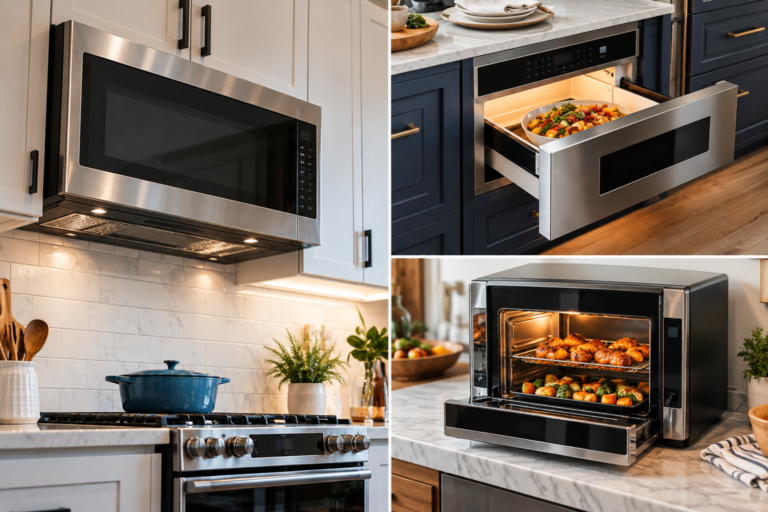
An over-the-range microwave and a microwave drawer can perform the same fundamental job while producing radically different kitchens.
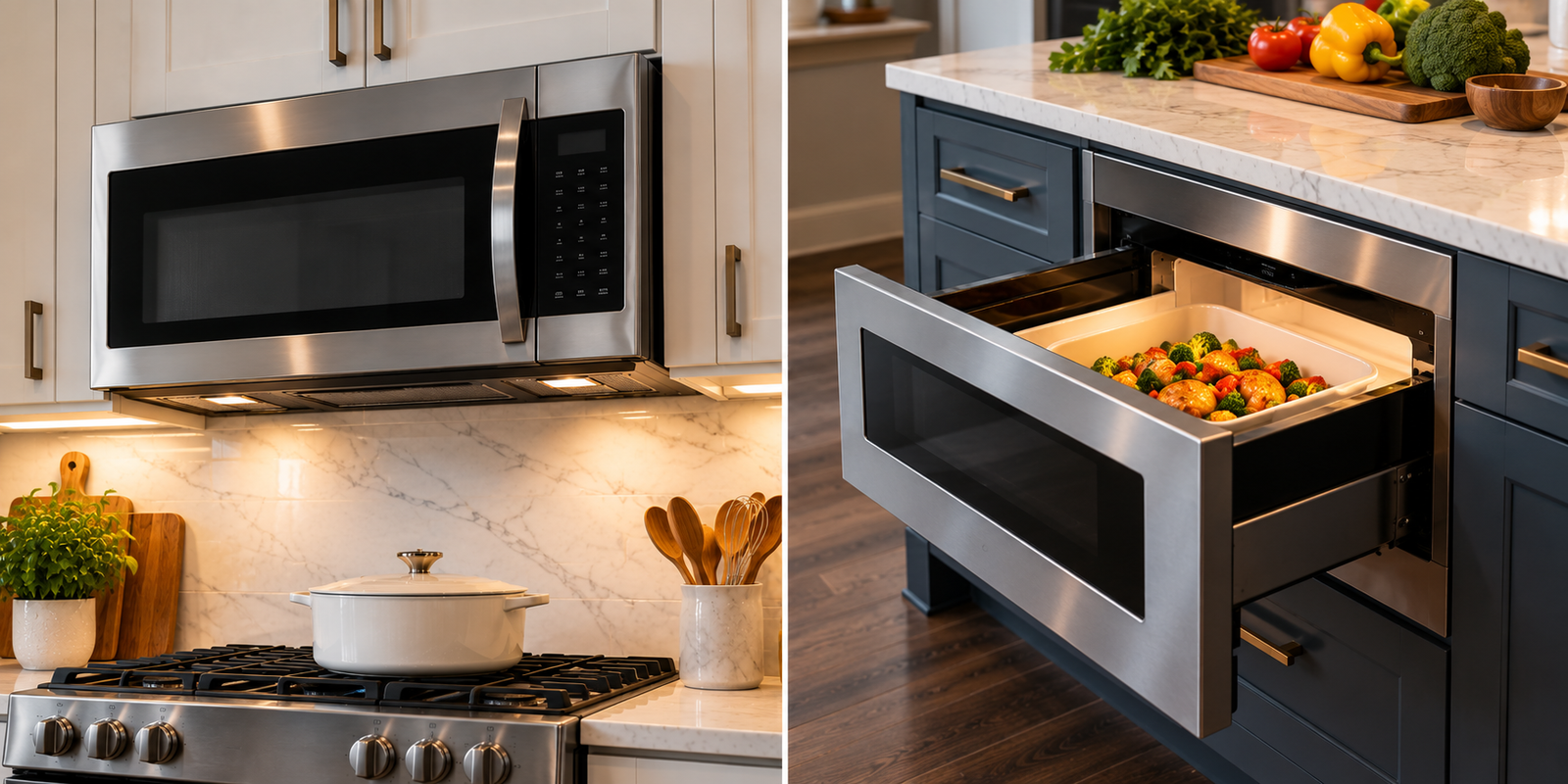
One places the microwave above the cooktop, combining food heating with lighting and ventilation. The other lowers the microwave into base cabinetry, an island or a peninsula and leaves the wall above the cooking surface available for a dedicated hood, cabinetry or another design choice.
That difference affects far more than appearance.
It changes where hot dishes are lifted, which cabinets are sacrificed, how cooking fumes are handled, how much microwave capacity is available, what installation requires and how easily the appliance can be replaced years later. A household choosing between the two is effectively choosing where an entire kitchen function should live.
The comparison also exposes an unusual contradiction. An over-the-range microwave is generally the more space-consolidated appliance because one location handles microwave cooking and cooktop ventilation. A drawer can produce a cleaner sightline and more accessible loading position, yet it consumes valuable lower-cabinet volume and still leaves ventilation unresolved.
Neither layout is universally preferable.
A useful microwave buying guide therefore needs to treat the decision as architecture first and appliance shopping second.
The Basic Difference Is Vertical Position
The defining distinction is easy to visualize.
An over-the-range, or OTR, microwave is installed above a range or cooktop, usually between upper cabinets. Whirlpool describes the format as combining microwave cooking and range-hood functions in a single appliance. Its current guide to over-the-range microwaves notes that these appliances can exhaust smoke and odors outdoors through ductwork or, depending on configuration, filter and recirculate air back into the kitchen.
A microwave drawer moves the cavity below the countertop. Instead of opening a side-hinged door, the cooking compartment slides horizontally outward.
Sharp’s 24-inch SMD2470ASY provides a useful example of the format. The manufacturer specifies a 1.2-cu.-ft. cavity, 950 watts of output and installation beneath a counter, in an island or peninsula, or within standard cabinetry.
The two layouts can therefore be reduced to a simple architectural choice:
| Issue | Over-the-Range Microwave | Microwave Drawer |
|---|---|---|
| Typical position | Above cooktop | Below counter |
| Cooktop ventilation | Usually integrated | Requires separate solution |
| Counter space used | None | None |
| Upper-wall space used | Yes | No |
| Base-cabinet space used | No | Yes |
| Door movement | Usually side-hinged | Drawer extends outward |
| Typical capacity range | Broad, often larger | Frequently around 1.2 cu. ft. |
| Loading direction | Lift upward | Lower food downward |
| Installation | Wall/cabinet mounting | Built into cabinetry |
| Relocation | Difficult | Difficult |
Both free the countertop. They simply charge different rent elsewhere in the kitchen.
Over-the-Range Microwaves Consolidate Two Appliances
The strongest argument for the OTR format is consolidation.
The appliance does not merely move a microwave off the counter. It also takes the location traditionally used by a range hood and incorporates ventilation into the same housing.
That can be highly efficient in kitchens where space is constrained.
Instead of allocating one area to a microwave and another to a hood, the kitchen uses a single opening above the range. Cooktop lighting is commonly incorporated as well.
Whirlpool’s current sizing guidance places standard OTR microwaves at roughly 17 inches tall, with low-profile models around 10.5 inches. Closed depths generally fall around 15 to 18 inches, while many conventional models use the familiar approximately 30-inch cabinet opening.
Capacity can also be generous. Whirlpool describes OTR interiors ranging from about 0.8 cu. ft. for compact designs to roughly 2.1 cu. ft. for full-size models.
That breadth gives the format a practical advantage for households that regularly microwave large dishes.
Yet consolidation always creates dependency. If the microwave fails, the kitchen may temporarily lose not only microwave cooking but also its integrated cooktop ventilation or lighting until repair or replacement.
A separate drawer-and-hood arrangement isolates those functions.
A Microwave Drawer Separates Cooking From Ventilation
A drawer reverses the logic.
Instead of asking one appliance above the stove to perform two jobs, the kitchen places microwave cooking below the counter and assigns ventilation to another appliance.
This can produce a very different cooktop environment.
The space above the range can accommodate a dedicated hood with dimensions and airflow selected specifically for the cooking equipment. Alternatively, a wall can be arranged around cabinetry or another ventilation configuration appropriate to the kitchen.
The microwave no longer dictates what happens above the stove.
That separation is especially relevant for households where cooktop ventilation is a high priority. OTR microwaves must package a microwave cavity, electronics, lighting and a blower into one housing. A dedicated hood is designed around ventilation rather than microwave cooking.
The drawer therefore creates design freedom, but that freedom has a price: a separate ventilation system still has to exist.
Replacing an OTR microwave with a drawer is not simply moving the microwave downward. It can require redesigning the area above the range.
Drawer Ergonomics Are Fundamentally Different
The microwave drawer’s most distinctive practical feature may be the direction in which food moves.
With an OTR microwave, a dish must be raised to a cavity above the cooking surface. Depending on the user’s height and installation, that can mean lifting a hot bowl or liquid container near face or shoulder level.
With a drawer, food is lowered into the cavity.
That can make the contents of bowls and cups easier to see from above. A person can inspect a container without reaching into an elevated cavity.
The advantage should not be exaggerated into a universal accessibility claim. A drawer also requires reaching downward, and the appropriate installation height depends on the cabinetry and user.
Sharp’s installation materials illustrate how deliberately the drawer position must be planned. One current 24-inch installation guide calls for a cabinet opening around 22 1/8 inches wide, at least 23 1/2 inches deep and incorporates an anti-tip block; the supporting floor is specified to handle 100 pounds.
The ergonomic question is therefore personal but measurable.
A buyer can simulate both motions before remodeling: lift a filled microwave-safe bowl to the proposed OTR height, then lower the same bowl to the proposed drawer height.
That experiment costs nothing and reveals more than a showroom photograph.
Microwave Drawers Consume Valuable Base Cabinetry
The drawer’s clean appearance can disguise a substantial spatial cost.
Base cabinets are prime kitchen storage.
They commonly hold cookware, mixing bowls, food containers, small appliances and heavy items that are awkward to store overhead. Installing a microwave drawer removes part of that storage volume.
Sharp’s 24-inch drawer example measures approximately 23 7/8 inches wide, 15 7/8 inches high and about 23 inches deep externally. Its required cabinet opening is substantial because the appliance body extends deep into the cabinet.
This is not necessarily inefficient. Islands often have ample lower-cabinet volume, and placing a microwave near the food-preparation area can produce an effective workflow.
But the storage cost should be counted.
A kitchen with limited drawer banks may value those 24 inches of base cabinetry more than a kitchen with a large island and abundant storage.
The microwave drawer eliminates countertop clutter by consuming cabinetry instead.
OTR Models Consume a Different Kind of Space
An over-the-range microwave avoids that base-cabinet sacrifice, but it takes something else: vertical space above the cooktop.
This can affect both aesthetics and cooking clearance.
Large stockpots, tall users and kitchens designed around an open backsplash can make the physical presence of an OTR appliance feel substantial. Low-profile designs reduce the height of the microwave housing, but they also alter cavity geometry.
Installation clearances matter as well.
Whirlpool advises measuring the cabinet opening rather than relying on the dimensions of the microwave being replaced. Its sizing guidance calls for attention to the distance between the cooktop and microwave, cabinet-to-cabinet width and door clearance near adjacent walls.
This is an important replacement lesson.
Two appliances described as 30-inch OTR microwaves are not automatically interchangeable in every detail. Mounting plates, depth, height, exhaust orientation and door geometry can differ.
The empty space must be measured again.
Capacity Usually Favors the OTR Format
Microwave drawers are clever at packaging, but their cavity size can be smaller than many conventional OTR alternatives.
Sharp’s current drawer lineup demonstrates the pattern clearly. Multiple 24- and 30-inch models are specified at 1.2 cu. ft., even though their exterior widths differ.
The company’s 24-inch SMD2470ASY is rated at 1.2 cu. ft. and is described as large enough for a four-quart casserole dish or a 20-ounce beverage.
By contrast, OTR models span a much broader capacity range. Whirlpool’s current guidance describes approximately 0.8 to 2.1 cu. ft. across the category.
A household moving from a 1.9-cu.-ft. OTR microwave to a 1.2-cu.-ft. drawer would therefore lose 0.7 cu. ft. of stated cavity volume, a reduction of about 37%.
Cubic feet do not perfectly describe usable cooking space, but that is too large a difference to ignore.
Buyers should measure their widest plates, tallest containers and frequently used casserole dishes before treating a drawer as a direct functional replacement for a large OTR model.
The 24-Inch vs 30-Inch Drawer Question Can Be Misleading
One might reasonably assume that a 30-inch microwave drawer provides substantially more cooking capacity than a 24-inch version.
That is not necessarily the case.
Sharp currently lists both 24-inch and 30-inch drawer models with 1.2-cu.-ft. cavities.
The additional exterior width can therefore relate more to cabinet integration and appliance proportions than to a larger cooking chamber.
This is a useful warning against shopping by exterior dimensions.
A 30-inch label can describe the width of the appliance front without indicating a 25% increase in interior volume over a 24-inch alternative.
Capacity, wattage, internal dimensions and cabinet requirements need to be compared independently.
Ventilation Is the Largest Functional Difference
This is where the comparison becomes unequal.
A microwave drawer does not replace a cooktop hood.
An OTR microwave generally does.
Whirlpool describes OTR models as appliances that combine microwave cooking with a range hood, using either exterior exhaust or recirculation depending on the model and installation.
Current Whirlpool models span roughly 280 to 400 CFM motor classes, with multiple fan-speed configurations. The manufacturer also states that ventilation performance varies according to installation.
A drawer has no equivalent responsibility for the cooktop.
That means a remodel moving from OTR to drawer must answer an additional question: what will ventilate the range?
If the answer is a dedicated hood, its cost, ducting, electrical requirements and cabinetry consequences belong in the project budget.
The microwave drawer’s purchase price is therefore only one component of the conversion.
Recirculating OTR Ventilation Has Its Own Limits
Not every OTR microwave sends cooking air outdoors.
Many can be configured to recirculate filtered air back into the room. Whirlpool explains that recirculating configurations use filtration, including charcoal filtration on applicable models, rather than exterior exhaust.
This changes the comparison.
A homeowner replacing a recirculating OTR unit with a drawer and dedicated externally vented hood could substantially change the kitchen’s ventilation architecture, even though the microwave itself is moving away from the cooktop.
Conversely, a kitchen with no practical exterior duct route may gain less from replacing an OTR appliance solely for ventilation reasons unless a workable hood system is part of the redesign.
Filters also require maintenance. Whirlpool’s service guidance says grease filters on applicable OTR models should be cleaned regularly and charcoal filters used for internal venting require periodic replacement.
Ventilation should therefore be evaluated as a system, not as a checkbox marked “fan included.”
Installation Complexity Exists on Both Sides
Neither appliance should be mistaken for a countertop microwave that simply plugs into an available receptacle.
OTR installation involves lifting a relatively heavy appliance, locating structural support, attaching a mounting plate, drilling through cabinetry, routing the power cord and configuring ventilation.
Whirlpool’s OTR installation guide describes a process involving wall studs, mounting brackets, upper-cabinet drilling and two-person lifting. It estimates roughly two hours where suitable electrical and ventilation infrastructure already exists, while recommending professional assistance when new electrical work or ductwork is needed.
A drawer eliminates overhead lifting but introduces cabinetry requirements.
Sharp’s 24-inch installation specifications require a precisely prepared opening, adequate cabinet depth, electrical access, structural support and anti-tip provisions.
For a new kitchen, those requirements can be incorporated into the cabinet plan.
For an existing kitchen, conversion may involve cutting, rebuilding or replacing cabinetry.
The easier installation is therefore usually the one the kitchen was already designed to accept.
Replacement Costs Extend Beyond the Appliance
This becomes particularly important after ten or fifteen years of kitchen ownership.
An OTR microwave is relatively standardized around the familiar approximately 30-inch opening, although exact dimensions and mounting arrangements still need verification.
A drawer is more closely integrated into base cabinetry.
If a future replacement does not match the existing cutout, modifications may be required. Cabinet face dimensions, trim, mounting method and electrical placement can become part of what would otherwise seem like a routine appliance replacement.
The reverse problem exists with OTR models: a future microwave may use a different mounting bracket or require changes to the exhaust transition.
Neither format is maintenance-free architecture.
The practical question is which type of future disruption the homeowner would rather manage.
Cleaning Is Different Rather Than Universally Easier
An OTR microwave sits directly above the cooking surface.
That location exposes its underside, filters and exterior surfaces to rising grease, steam and cooking residue. The ventilation system itself requires filter maintenance.
The drawer escapes much of that cooktop exposure.
Its challenge is different.
Because food is lowered into the cavity, spills occur inside a horizontal compartment that may require bending to inspect and clean thoroughly. Crumbs and liquid can collect on interior surfaces just as they do in any microwave.
The drawer mechanism also adds moving components absent from a conventional side-hinged microwave door.
Neither layout eliminates cleaning.
It changes where the cleaning happens.
Safety Standards Apply to Both Designs
The physical layout differs, but both remain microwave ovens subject to federal radiation safety requirements when sold in the United States.
The FDA’s microwave oven safety standard limits leakage throughout an oven’s lifetime to 5 milliwatts of microwave radiation per square centimeter at approximately two inches from the oven surface. The agency also requires two independent interlock systems that stop microwave production when the door is opened or its latch is released.
Those requirements apply regardless of whether the door swings sideways or the cavity slides outward.
Physical condition remains important. Door or drawer alignment, latching and seals should operate as designed.
Installation security also matters for both formats. An OTR microwave needs proper structural mounting; a drawer requires the cabinet preparation and anti-tip measures specified for its model.
Safety begins with choosing the correct installation, not simply the correct cooking mode.
A Drawer Can Change Kitchen Workflow
Microwave placement influences movement through the kitchen more than many appliance specifications suggest.
An OTR microwave concentrates microwave cooking and stovetop cooking in the same zone. That can be convenient when moving ingredients between the microwave and range.
It can also create congestion if one person is using the cooktop while another needs the microwave directly above it.
A drawer placed in an island can separate those activities.
One person can use the range while another reheats food elsewhere. In a larger household, that separation may improve traffic flow.
The opposite can occur in a poorly planned island. An open microwave drawer extends into an aisle. Sharp’s dimensional guidance for representative models shows that significant forward clearance is needed when the drawer is fully extended.
Placement therefore needs to account for people walking past, adjacent cabinet doors, dishwashers and seating.
A drawer installed in the wrong aisle can solve one traffic problem by creating another.
Families With Children Have Different Questions to Ask
Lower placement naturally puts a microwave closer to children.
That does not automatically make a drawer inappropriate, but controls and lock functions deserve attention.
Many drawer models provide control-lock functions, and some use powered opening and closing mechanisms. Exact behavior varies by model and should be verified in the owner’s manual.
An OTR microwave places the controls and cooking cavity higher, which can reduce access for young children. The same height can make the appliance less convenient for shorter users.
This is another example of why “accessible” has no single direction.
Lower can be easier for one user and less desirable for another.
The household should evaluate who will actually operate the microwave rather than relying on a generic ergonomic label.
Which Layout Better Preserves Counter Space?
Both do.
That fact is sometimes lost because OTR microwaves are routinely described as space-saving while drawers are presented as built-in design products.
Neither needs to consume countertop work area.
Their difference lies in what they consume instead.
The OTR uses the wall zone above the range.
The drawer uses base cabinetry.
That makes the decision surprisingly easy to frame: which storage location is more valuable in this particular kitchen?
In a small kitchen with scarce lower drawers but an existing OTR opening, the answer may favor the OTR arrangement.
In a large island kitchen with abundant base storage and a desire for a dedicated hood, the drawer may integrate naturally.
Square footage alone does not decide the issue. Cabinet configuration does.
Which Buyer Is Better Matched to an Over-the-Range Microwave?
The OTR format aligns particularly well with kitchens already designed around it.
It is especially coherent when the household wants to combine microwave cooking, cooktop lighting and ventilation in one approximately 30-inch location.
An OTR layout generally makes more sense when:
- An existing OTR opening and electrical supply are already present.
- Preserving base-cabinet storage matters.
- The kitchen does not have space allocated for a separate hood and microwave.
- Larger microwave capacity is useful.
- The household is comfortable lifting food to the installed height.
- Integrated cooktop ventilation is sufficient for the cooking style.
- Lower initial remodeling complexity is a priority in an existing OTR kitchen.
This is the architecture of consolidation.
One appliance does several jobs in one location.
Which Buyer Is Better Matched to a Microwave Drawer?
The drawer makes more sense when below-counter microwave placement solves a specific design or ergonomic problem.
It is particularly coherent in kitchens with islands, generous base cabinetry and a separate ventilation strategy.
A drawer layout generally makes more sense when:
- A dedicated range hood is desired.
- The space above the cooktop should remain free of a microwave.
- Lower loading height is preferred.
- The kitchen has sufficient base-cabinet volume.
- A suitable island, peninsula or cabinet location exists.
- A roughly 1.2-cu.-ft. cavity meets the household’s needs for the models being considered.
- The cabinet plan can accommodate the exact cutout and electrical requirements.
- Separating microwave traffic from the cooktop would improve workflow.
This is the architecture of separation.
The microwave becomes one built-in component rather than part of the ventilation system.
The Conversion Question Deserves Extra Scrutiny
Choosing between the formats in a new kitchen is much easier than converting an existing kitchen from one to the other.
Moving from OTR to drawer can require:
- Creating a new base-cabinet opening.
- Providing electrical service at the new location.
- Installing a dedicated range hood.
- Modifying upper cabinetry.
- Adding or changing exhaust ductwork.
- Repairing backsplash or wall surfaces previously hidden by the OTR microwave.
Moving from drawer to OTR reverses many of those demands.
The apparent appliance-price comparison can therefore become a remodeling-cost comparison.
A homeowner should obtain installation estimates before treating the retail prices of the two microwaves as directly comparable.
The cheaper appliance can belong to the more expensive project.
Final Considerations
Over-the-range microwaves and microwave drawers solve the same basic cooking need through fundamentally different kitchen layouts.
The OTR format concentrates functions. It places microwave cooking, cooktop lighting and ventilation above the range while preserving both counter space and lower cabinetry. Capacities can range broadly, reaching around 2.1 cu. ft. in current full-size designs.
The drawer separates functions. Representative Sharp models place a 1.2-cu.-ft. microwave cavity beneath the counter, allowing installation in islands, peninsulas and standard cabinetry while leaving the cooktop wall available for a dedicated ventilation system.
That separation changes ergonomics, storage and cost.
A drawer can make loading easier for users who prefer lowering dishes rather than lifting them overhead. It can also consume valuable base cabinetry and place the appliance within easier reach of children. An OTR microwave preserves lower storage but requires elevated loading and places the appliance directly above active cooking.
Ventilation creates the largest functional divide.
An OTR microwave generally incorporates it. A drawer does not. Any price comparison that ignores the cost and space requirements of a separate hood is incomplete when the kitchen needs one.
Capacity can also differ substantially. Many current drawer models cluster around 1.2 cu. ft., while OTR models cover a wider range and can exceed 2 cu. ft. Buyers who regularly use large plates or casserole dishes should measure them rather than assuming that every built-in microwave provides comparable usable space.
Installation ultimately decides much of the contest.
In a kitchen already designed around an OTR microwave, another OTR model can preserve the existing architecture with fewer changes, provided dimensions, mounting and venting are compatible.
In a new kitchen with a large island and dedicated hood, a drawer can place microwave cooking closer to the preparation area while keeping the wall above the range devoted to ventilation.
The decision should therefore begin with four physical measurements: the space above the range, the available base cabinet, the largest microwave-safe dish and the aisle clearance in front of the proposed drawer.
Then comes a fifth question: where will the cooking fumes go?
Once those answers are known, the difference between an over-the-range microwave and a microwave drawer stops being a matter of appliance fashion. It becomes what it should have been from the beginning—a decision about how the kitchen is meant to work.