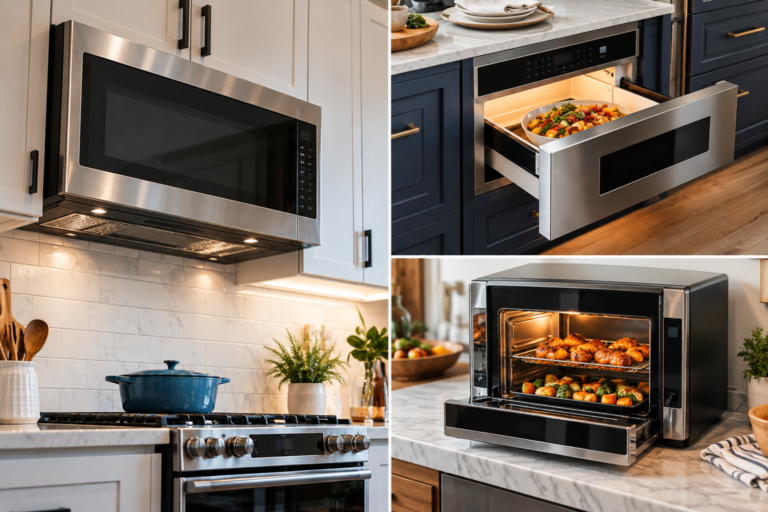
The BLACK+DECKER 1.5 cu. ft. Air Fryer Over-the-Range Microwave and TOSHIBA OptiChef PRO MAX Air Fryer Combo Microwave Oven may appear to be natural rivals. Both combine microwave cooking with air-frying capability. Both are priced above many conventional microwaves. Both appeal to kitchens attempting to consolidate appliances rather than dedicate separate machines to reheating, convection cooking and crisping.
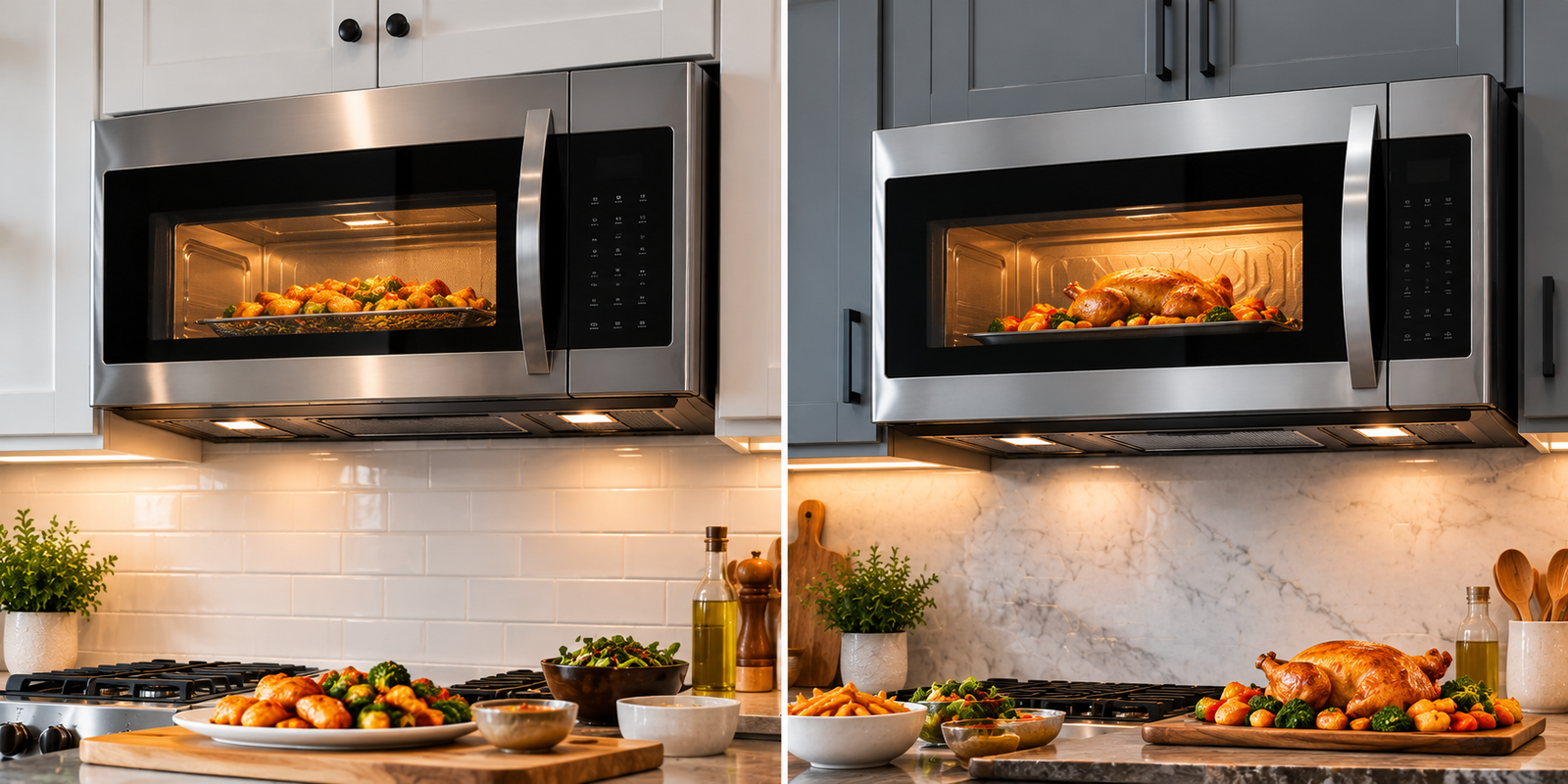
That resemblance disappears quickly once the appliances are placed on an imaginary kitchen plan.
The BLACK+DECKER is an over-the-range microwave. The TOSHIBA OptiChef PRO MAX is a countertop multifunction oven. One uses the space above a range and incorporates cooktop ventilation; the other uses counter space and concentrates its design around cooking modes.
That distinction matters more than a small difference in editorial score or purchase price. These appliances do not merely approach cooking differently. They ask the kitchen to surrender different pieces of real estate.
Our editorial assessment favors BLACK+DECKER modestly. It earns 8.25/10 compared with 8.12/10 for TOSHIBA. Buyer Confidence also favors BLACK+DECKER, 9.80 to 9.13. Customer Sentiment is tied at 7.84, while Value is tied at 7.91.
TOSHIBA counters with a referenced price of $409.97, approximately $46 below BLACK+DECKER’s $455.99.
The resulting microwave buying guide is less about declaring which machine has the longer feature list and more about identifying which appliance architecture makes sense in a particular kitchen.
The Comparison Starts With Placement
The editorial numbers establish one part of the picture.
| Measure | BLACK+DECKER Air Fryer OTR | TOSHIBA OptiChef PRO MAX |
|---|---|---|
| Referenced price | $455.99 | $409.97 |
| Product format | Over-the-range | Countertop combination |
| Stated capacity | 1.5 cu. ft. | 1.5 cu. ft. |
| Air-fry capability | Yes | Yes |
| Our Score | 8.25/10 | 8.12/10 |
| Customer Sentiment | 7.84 | 7.84 |
| Buyer Confidence | 9.80 | 9.13 |
| Value | 7.91 | 7.91 |
The $46.02 price difference represents roughly 10% of the BLACK+DECKER’s referenced price. That is meaningful but not decisive when installation enters the calculation.
More revealing is the scoring pattern.
BLACK+DECKER leads overall by 0.13 point and Buyer Confidence by 0.67. Customer Sentiment and Value are exact ties. TOSHIBA’s principal numerical advantage is therefore price rather than the editorial scorecard.
Yet comparing those figures without considering placement would distort the decision. A countertop appliance cannot replace the ventilation function of an OTR microwave. An OTR microwave cannot be moved to a corner of the counter when cabinetry changes.
The first buying question is architectural.
BLACK+DECKER Treats the Space Above the Range as Multipurpose Real Estate
The BLACK+DECKER EM044K6CE-SS is identified by the manufacturer as a 1.5-cu.-ft. over-the-range microwave with air-fry capability. BLACK+DECKER’s product documentation also identifies convection cooking, bake and roast modes, sensor cooking and a 13.6-inch turntable.
Its dimensions are approximately 29.9 inches wide, 16.4 inches deep and 17.8 inches high.
That roughly 30-inch width tells buyers where the appliance expects to live: in the conventional over-the-range opening used by many full-size American kitchen layouts.
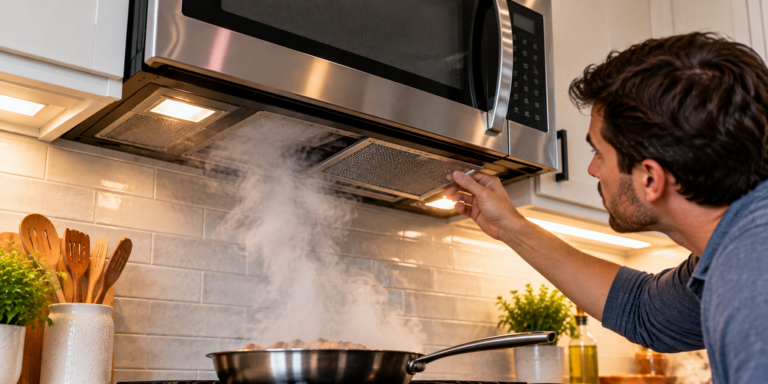
The design consolidates several functions into one location. It is a microwave. It can perform air-fry and convection functions. It provides cooktop lighting. It also contains the ventilation system expected of an OTR appliance.
This creates a form of spatial efficiency that countertop specifications cannot measure.
A kitchen replacing an existing 30-inch OTR microwave may be able to add air-frying capability without surrendering another section of counter. A household already fighting for workspace beside the sink, coffee maker and toaster can reasonably regard that as more than cosmetic.
The trade is permanence. Once installed, an OTR microwave becomes part appliance and part architecture.
TOSHIBA OptiChef PRO MAX Approaches the Problem From the Counter
TOSHIBA’s OptiChef PRO MAX belongs to a different design philosophy.
Toshiba Lifestyle identifies its OptiChef series as multifunction microwave cooking systems, with the PRO MAX combining microwave, convection and air-fry functions in a countertop format. Toshiba Lifestyle’s microwave range places OptiChef models within the company’s broader multifunction microwave lineup.
That distinction gives the TOSHIBA flexibility of placement that the BLACK+DECKER cannot match.
There is no wall mounting. No upper cabinet needs to support it. No cooktop exhaust route needs to pass through it. The appliance can be repositioned if a kitchen is reorganized, and renters or households expecting to move do not have to treat the microwave as a semi-permanent installation.
The price for that freedom is counter area.
Counter space is easy to underestimate because appliance dimensions are discussed individually. Kitchens are experienced collectively. A microwave, coffee machine, kettle, toaster and stand mixer can each seem reasonably sized until all five compete for the same uninterrupted preparation surface.
TOSHIBA therefore makes its strongest architectural argument in kitchens where countertop space is available or where a dedicated shelf or appliance station already exists.
Both Are Trying to Replace More Than a Microwave
The air-fryer microwave category exists because microwave cooking and dry-heat cooking solve different problems.
The U.S. Food and Drug Administration’s explanation of microwave cooking describes microwave energy as being absorbed by food and converted into heat. The process is particularly effective for reheating and cooking foods containing water.
Air frying takes a different route. It uses heated moving air to encourage surface drying and browning.
That distinction explains why a microwave can heat leftover potatoes quickly yet leave their exterior soft, while dry circulating heat can restore more surface texture at the cost of additional cooking time.
A combination appliance attempts to keep both methods available inside one cavity.
That is the appeal shared by BLACK+DECKER and TOSHIBA. Neither should be evaluated as merely a microwave with an unusual preset button.
The household is effectively purchasing a compact cooking system.
Capacity Produces an Interesting Tie
Both products are associated with 1.5 cu. ft. of capacity.
That creates an unusually tidy comparison on paper, but cubic feet remain an imperfect way to describe usable cooking space.
BLACK+DECKER publishes a 13.6-inch turntable for its model. TOSHIBA’s multifunction design needs to accommodate accessories and cooking arrangements associated with microwave, convection and air-fry operation.
The buyer should therefore ask what will actually enter the cavity.
A family reheating wide dinner plates has one requirement. Someone hoping to air fry a single layer of food has another. A household using convection for baking introduces yet another geometry problem.
Volume does not reveal rack area.
Nor does 1.5 cu. ft. reveal how effectively a cooking vessel can be positioned relative to convection airflow.
This is why a microwave buying guide should never translate identical cubic-foot figures into identical usable capacity. The number establishes the broad size class. Interior dimensions and accessories establish the cooking possibilities.
Air Frying Changes the Cleaning Equation
Adding air frying to a microwave creates a maintenance issue conventional microwave comparisons often overlook.
Microwave reheating can generate splatter and steam. Air frying and convection introduce grease aerosol, crumbs and browned residue. A cavity expected to perform both jobs will experience a wider range of mess.
This matters because the two appliances live in different environments.
The BLACK+DECKER already sits above a cooktop, where the exterior and ventilation components are exposed to cooking grease rising from below. Its internal air-fry function adds another source of grease inside the cooking cavity.
The TOSHIBA does not sit above the range, so it avoids that external exposure. Its countertop position, however, means surrounding surfaces can collect ordinary cooking residue, and its multifunction accessories still require cleaning.
The practical question is not simply whether air frying is available. It is how often the household intends to use it.
An air-fry function used twice a month creates a different maintenance profile from one used every evening.
BLACK+DECKER Has a Ventilation Job That TOSHIBA Does Not
This is perhaps the sharpest functional distinction.
An over-the-range microwave is also a hood. A countertop microwave is not.
That means BLACK+DECKER’s value cannot be assessed only by comparing cooking modes with TOSHIBA. Part of its purchase price is paying for installation hardware, cooktop lighting and ventilation.
The TOSHIBA requires a separate answer to the question of range ventilation.
For a kitchen already equipped with a dedicated hood, this may be irrelevant. In fact, keeping the dedicated hood can be preferable for households that prioritize cooktop ventilation and do not need a microwave above the range.
In a kitchen designed around an OTR appliance, removing that appliance in favor of a countertop TOSHIBA leaves an empty space above the range and does nothing to replace the hood function.
That can turn an apparently cheaper microwave into a larger kitchen project.
The $46 price advantage held by TOSHIBA becomes almost meaningless if choosing it requires purchasing or installing a separate range hood.
Installation Is BLACK+DECKER’s Cost That Does Not Appear on the Price Tag
The BLACK+DECKER’s $455.99 referenced price is not necessarily its finished cost.
OTR installation requires a suitable opening, mounting structure, electrical supply and ventilation configuration. Existing OTR kitchens may already provide all four, making replacement relatively straightforward.
New installations are different.
Whirlpool’s general guide to installing an over-the-range microwave describes work involving wall studs, mounting brackets, cabinet drilling, electrical connections and ventilation. The company recommends two people for the physical installation and professional assistance when electrical or ductwork changes are required.
Those instructions are not BLACK+DECKER-specific, but they demonstrate why an OTR microwave should not be compared with a countertop model using appliance price alone.
TOSHIBA’s countertop architecture avoids wall mounting. The kitchen still needs appropriate electrical service and clearance around the appliance according to its manual, but installation belongs to a different category of effort.
For renters, frequent movers and kitchens without an existing OTR opening, that distinction can dominate the purchase decision.
TOSHIBA’s Lower Price Is More Meaningful in the Right Kitchen
TOSHIBA is referenced at $409.97. BLACK+DECKER is $455.99.
The difference is $46.02.
If the kitchen already has a suitable hood and generous counter space, TOSHIBA’s lower purchase price becomes genuinely relevant. There is little reason to pay for OTR architecture that the kitchen does not need.
If the kitchen needs an appliance above the range to handle ventilation, the same $46 calculation becomes incomplete.
This is why price has to be normalized around the kitchen rather than the carton.
A $410 countertop microwave plus a new hood is not cheaper than a $456 OTR microwave merely because the microwave itself costs less.
Conversely, paying installation labor for an OTR appliance makes little sense in a kitchen already equipped with excellent dedicated ventilation.
Architecture determines whether each price is economical.
BLACK+DECKER Leads Our Editorial Assessment
Our score for the BLACK+DECKER 1.5 cu. ft. Air Fryer Over-the-Range Microwave is 8.25/10.
The TOSHIBA OptiChef PRO MAX receives 8.12/10.
The 0.13-point gap is narrow. It should be read as an edge rather than a gulf.
Customer Sentiment does not separate the products at all: both score 7.84.
Value also produces a tie at 7.91.
Buyer Confidence is where the scorecard changes character. BLACK+DECKER receives 9.80, while TOSHIBA records 9.13. A 0.67-point advantage is more substantial than the difference in overall score.
BLACK+DECKER’s editorial position therefore rests less on sweeping superiority and more on confidence. The product receives the stronger overall assessment while producing a particularly high Buyer Confidence score.
TOSHIBA’s editorial profile is still solid, but its advantage lies primarily in lower referenced acquisition cost and countertop flexibility.
TOSHIBA’s Argument Is Cooking-Centered Rather Than Installation-Centered
TOSHIBA makes sense when the microwave is being chosen as a multifunction cooking appliance rather than as part of the range-ventilation system.
This distinction sounds semantic until kitchen behavior is examined.
Someone who wants to microwave leftovers, air fry frozen foods and use convection functions from a single countertop appliance is asking the TOSHIBA to replace several small appliances.
Someone choosing BLACK+DECKER may want those same cooking functions but is also asking the appliance to illuminate and ventilate the cooktop while preserving counter space.
TOSHIBA is therefore easier to evaluate as a cooking machine in isolation.
BLACK+DECKER has to be evaluated as a cooking machine and a piece of kitchen infrastructure.
That makes direct feature counting surprisingly unhelpful.
BLACK+DECKER Makes More Sense for a Conventional OTR Kitchen
A kitchen already built around a 30-inch OTR microwave provides BLACK+DECKER with its clearest use case.
The buyer can potentially preserve the existing layout while adding air-fry and convection capability. Counter space remains untouched, and the range keeps an integrated ventilation system.
The BLACK+DECKER profile aligns most naturally with a buyer who:
- Has or wants a conventional over-the-range installation.
- Wants to preserve counter space.
- Needs integrated cooktop ventilation and lighting.
- Wants air-fry and convection functions in the same appliance.
- Values the 9.80 Buyer Confidence score.
- Accepts the $455.99 referenced price and any applicable installation cost.
The model’s 8.25 overall score gives it a modest editorial edge, but physical suitability is the stronger reason to choose it.
An OTR microwave purchased for a kitchen that needs an OTR microwave solves an architectural problem before its air-fry function is ever switched on.
TOSHIBA Makes More Sense When Flexibility Matters
TOSHIBA’s strongest use case is almost the inverse.
The OptiChef PRO MAX belongs in a kitchen that does not need the microwave to double as a range hood.
That may include kitchens with dedicated ventilation, renters who cannot modify cabinetry, households expecting to move, or cooking spaces where a countertop appliance station already exists.
The TOSHIBA profile aligns naturally with a buyer who:
- Has adequate counter or shelf space.
- Already has suitable range ventilation.
- Wants microwave, convection and air-fry functions in one countertop appliance.
- Wants to avoid OTR mounting work.
- Values portability and easier relocation.
- Prefers the lower $409.97 referenced price.
Its 8.12 overall score trails BLACK+DECKER by only 0.13 point, while Customer Sentiment and Value are tied.
That makes installation architecture a much stronger separator than the score difference.
Dedicated Air Fryers Still Complicate the Hybrid Argument
There is another question neither manufacturer can answer for every household: should air frying be inside the microwave at all?
Combination appliances consolidate functions. Dedicated appliances specialize.
A separate basket-style air fryer may provide a cooking geometry that suits frequent small batches, while a combination microwave reduces the number of appliances requiring storage or counter space.
No universal answer follows from those differences.
The household that air fries five nights a week may care intensely about basket access, cleaning speed and batch geometry. Another household may air fry occasionally and strongly prefer having one fewer machine on the counter.
Combination microwaves are most persuasive when consolidation itself has value.
If an existing dedicated air fryer already performs satisfactorily and has a permanent place in the kitchen, paying extra to reproduce that function inside a microwave deserves scrutiny.
If the counter is crowded and the air fryer is constantly being moved in and out of a cabinet, integration has a clearer purpose.
Safety Requires Attention to Cooking Mode
Multifunction appliances also demand more attention to cookware instructions.
The FDA’s microwave safety guidance explains that microwave ovens sold in the United States must comply with federal radiation safety standards and use safety interlocks that stop microwave production when the door opens.
The more immediate issue for combination appliances is that microwave mode and convection or air-fry mode are not the same cooking environment.
Cookware appropriate for microwave energy is not automatically suitable for high-temperature convection operation. Likewise, accessories intended for an air-fry or convection mode should be used according to the manufacturer’s instructions.
The owner’s manual therefore matters more with a multifunction appliance than it might with a simple reheating microwave.
The machine is changing cooking methods while using the same cavity.
The Better Comparison Is Really Kitchen vs Kitchen
The most revealing way to compare BLACK+DECKER and TOSHIBA is to imagine two kitchens.
The first has an aging 30-inch OTR microwave, limited counter space and no separate range hood. The owner wants air frying but does not want another countertop appliance.
BLACK+DECKER fits that problem naturally.
The second kitchen has a dedicated range hood, open counter space and no desire to mount a microwave over the cooking surface. The owner wants a multifunction microwave that can be moved or replaced without disturbing cabinetry.
TOSHIBA fits that problem naturally.
Neither scenario requires claiming that one machine cooks better than the other without controlled testing.
The distinction is structural, measurable and immediately actionable.
Final Considerations
BLACK+DECKER Air Fryer Over-the-Range Microwave vs TOSHIBA OptiChef PRO MAX is not a conventional head-to-head contest between two appliances competing for the same hole in the cabinet.
BLACK+DECKER is an OTR appliance with microwave, air-fry and convection capabilities integrated into the space above a range. TOSHIBA is a countertop multifunction microwave that approaches the same desire for appliance consolidation without taking responsibility for cooktop ventilation.
Their editorial scores are close. BLACK+DECKER receives 8.25/10 against TOSHIBA’s 8.12. Customer Sentiment is tied at 7.84. Value is tied at 7.91. BLACK+DECKER’s larger numerical advantage appears in Buyer Confidence, where 9.80 compares with TOSHIBA’s 9.13.
TOSHIBA is cheaper at the referenced prices: $409.97 versus $455.99, a difference of $46.02.
That $46 should not make the decision by itself.
For a kitchen that needs an OTR microwave, integrated ventilation and preserved counter space, BLACK+DECKER’s architecture provides the more natural fit. Its higher overall score and Buyer Confidence reinforce that alignment.
For a kitchen with dedicated ventilation and sufficient counter space, TOSHIBA avoids OTR installation while offering a multifunction cooking platform at the lower referenced price. Portability is another advantage that no installed microwave can reproduce.
The most useful comparison therefore begins before either appliance is powered on.
Look above the range. Look at the counter. Examine the existing hood. Measure the available workspace. Consider whether the appliance will move with the household or remain attached to the kitchen.
Then consider air frying.
Once the physical problem is defined, these two machines stop looking confusingly similar. One is a kitchen fixture that also air fries. The other is a multifunction countertop cooking appliance that also microwaves.
That distinction is more consequential than thirteen hundredths of a point on a scorecard.