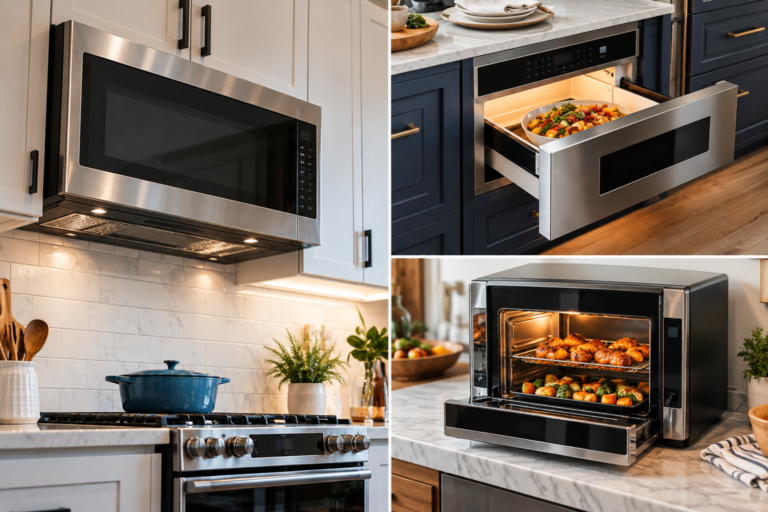
The Kenmore 1.7 cu. ft. and ThermoMate 1.7 cu. ft. over-the-range microwaves demonstrate why apparently similar appliances can produce a surprisingly substantive buying decision. Capacity is identical. Both operate in the familiar 30-inch OTR format. Both provide 1,000 watts of microwave cooking power, and both use two-speed ventilation rated at 300 CFM. Even the difference in referenced price is only $30.
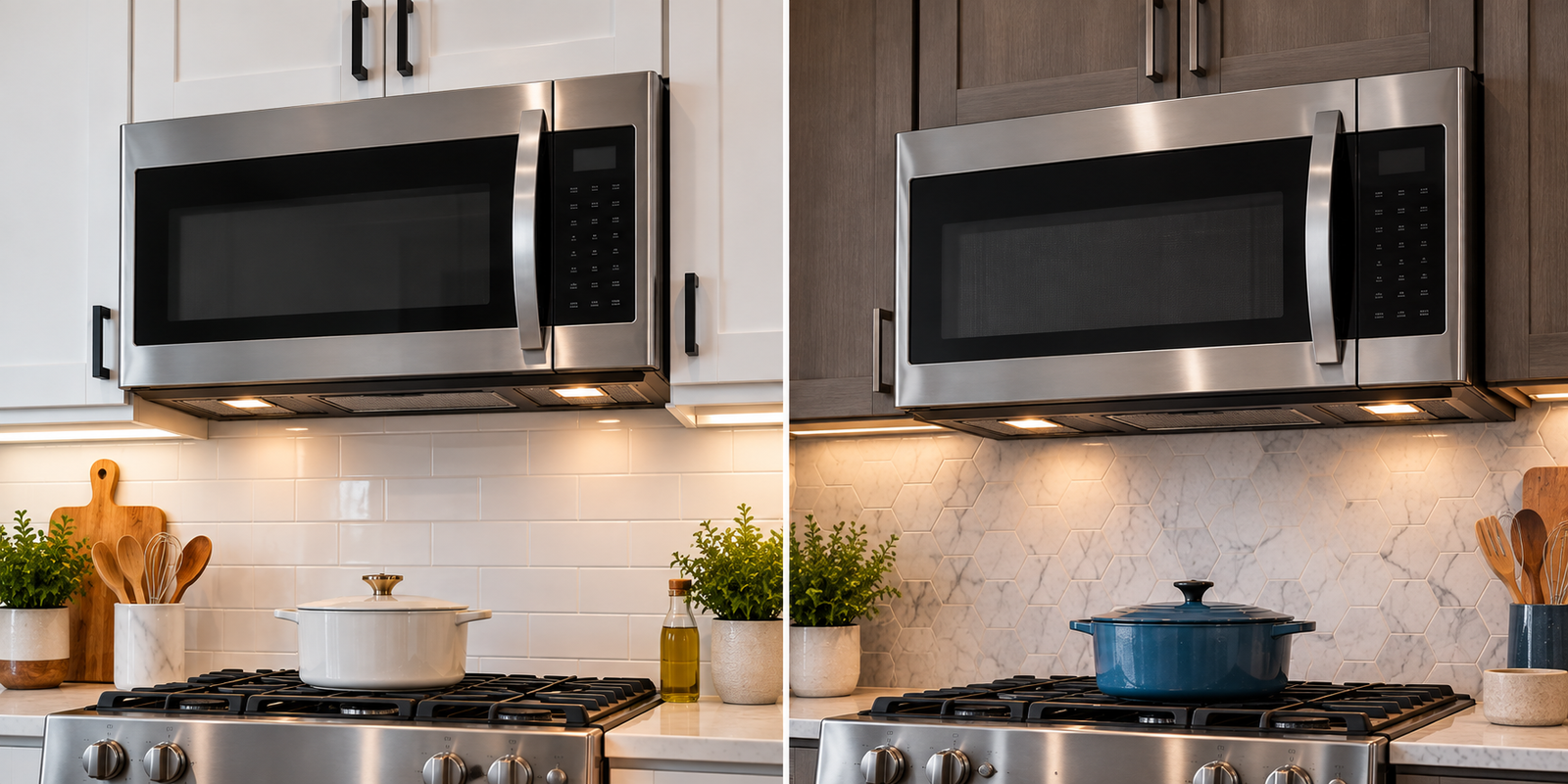
The resemblance is not superficial. Kenmore’s specifications for its 1.7-cu.-ft. OTR model identify a 1,000-watt cooking system, 300-CFM ventilation, two fan speeds and a 12.4-inch turntable. ThermoMate’s OTR7702S specifications identify 1,000 watts, 300 CFM, two fan speeds, a removable glass turntable and 29.9-inch overall width.
That leaves the comparison in an unusually revealing position. Neither appliance can win merely by placing a larger capacity number, higher wattage figure or more impressive airflow claim on a specification sheet.
The editorial scorecard provides more separation. ThermoMate costs less at the referenced prices while scoring higher in Our Score, Customer Sentiment, Buyer Confidence and Value. Kenmore counters with several clearly documented controls and installation features, including three-way venting, six presets, 26 settings and LED lighting.
A useful microwave buying guide therefore has to ask a more demanding question: which differences are likely to matter after installation?
The Core Numbers
The principal comparison looks like this:
| Measure | Kenmore 1.7 cu. ft. | ThermoMate 1.7 cu. ft. |
|---|---|---|
| Referenced price | $399.99 | $369.99 |
| Capacity | 1.7 cu. ft. | 1.7 cu. ft. |
| Cooking power | 1,000W | 1,000W |
| Ventilation | 300 CFM | 300 CFM |
| Fan speeds | 2 | 2 |
| Our Score | 8.13/10 | 8.52/10 |
| Customer Sentiment | 8.06 | 8.50 |
| Buyer Confidence | 8.45 | 8.88 |
| Value | 8.03 | 8.28 |
ThermoMate’s referenced price is $30 lower, or approximately 7.5% below Kenmore’s $399.99 price. The difference is modest in absolute dollars, yet unusual in direction: the less expensive model also carries the higher scores across all four editorial measures.
Our Score favors ThermoMate by 0.39 point. Customer Sentiment differs by 0.44, Buyer Confidence by 0.43 and Value by 0.25.
Those are not enormous gaps, but they are remarkably consistent. There is no score in this comparison where Kenmore reverses the pattern.
That does not render the Kenmore irrelevant. It changes the burden of the decision. Kenmore needs to justify its additional $30 through features, installation compatibility or individual preferences rather than through the editorial scorecard.
Capacity Does Not Separate Them
Both microwaves provide a stated 1.7 cu. ft. of interior capacity.
That places them in a common full-size OTR category. Whirlpool’s broader guidance says over-the-range microwave capacities generally span roughly 0.8 to 2.1 cu. ft. and notes that households wanting greater flexibility may look toward capacities of 1.7 cu. ft. or more. Whirlpool’s OTR microwave sizing guidance also emphasizes cabinet dimensions and open-door clearance rather than treating cubic feet as the sole measurement.
The lesson matters here because 1.7 cu. ft. is identical on the two labels but does not establish identical interior geometry.
Kenmore specifies a 12.4-inch glass turntable. ThermoMate confirms a removable glass turntable, while its manufacturer page focuses on the 1.7-cu.-ft. cavity and family-size cookware.
For the buyer, capacity should therefore become a pass-or-fail criterion rather than a scoring contest. The largest dinner plate, mixing bowl or covered container used regularly provides a more useful test than comparing identical cubic-foot figures.
If 1.7 cu. ft. meets the household’s cookware requirements, neither model gains an obvious advantage simply from capacity.
Cooking Power Produces Another Tie
Kenmore specifies 1,000 watts of microwave cooking power. ThermoMate does the same.
This figure is useful because wattage affects the context in which cooking instructions are interpreted. Yet equal wattage does not establish equal real-world heating behavior.
Cavity geometry, food placement, turntable dimensions, control programming and the food itself can affect cooking. Without controlled head-to-head testing, claims that either appliance heats more evenly or more quickly would outrun the available evidence.
What can be stated confidently is simpler: neither product asks the buyer to accept a lower headline microwave-output specification.
The ThermoMate also publishes 11 adjustable power levels, from 0% to 100%, while Kenmore lists selectable power controls among its cooking settings. ThermoMate additionally identifies Auto Cook, Defrost, Melt and Soften programs and an Add 30 Seconds control. Kenmore identifies 26 settings and six presets, including functions such as Delay Start, Keep Warm and Broil.
That gives Kenmore a more extensive documented control list, while ThermoMate presents a straightforward set of everyday microwave functions.
The meaningful question is not which control panel contains the larger number. It is whether the household will actually use the additional programs.
Kenmore Has the More Explicitly Documented Venting Flexibility
Both products state a maximum ventilation capacity of 300 CFM and provide two fan speeds. That looks like another dead heat until vent configuration enters the discussion.
Kenmore explicitly specifies three-way venting: top, rear or recirculating. It also identifies carbon-air and grease filters for applicable recirculating operation.
ThermoMate identifies a two-speed 300-CFM exhaust system. Its current OTR7702S page also lists the appliance as a 30-inch installation with dimensions of 29.9 inches wide, 16.4 inches deep and 15.4 inches high.
Kenmore’s clearly documented top, rear and recirculating arrangements deserve attention in a replacement kitchen because the direction of existing ductwork can matter more than a minor feature difference.
This is where specification-sheet comparisons meet the wall—literally.
A microwave that aligns with existing ductwork can avoid installation work. A product with an attractive price can become less attractive if adapting the ventilation path requires additional labor or materials.
Kenmore’s venting documentation therefore gives buyers unusually concrete information to take into the kitchen before ordering.
What 300 CFM Actually Means
A 300-CFM rating describes nominal airflow capacity, not guaranteed smoke capture in every installation.
The distinction is easy to miss because CFM appears as a clean numerical specification. Actual ventilation is messier.
Duct size, duct length, elbows, transitions, filters and back pressure can alter installed airflow. Whirlpool makes that relationship explicit in its ventilation documentation, where measured airflow changes according to duct orientation and static pressure. Whirlpool’s hood-performance specifications show, for example, different measured CFM figures for the same blower under different pressure conditions.
Whirlpool makes a similar qualification on a current 1.7-cu.-ft. OTR model advertised with a 300-CFM motor class: “Performance varies based on installation.” The manufacturer’s 1.7-cu.-ft. OTR specifications place that qualification alongside the ventilation rating.
That short statement deserves more attention than it usually receives.
Kenmore and ThermoMate can both carry 300-CFM specifications while performing differently in two kitchens because the kitchens themselves are different. A short, well-configured external duct presents a different airflow problem from a restrictive route with several bends. Recirculating operation is different again because air returns to the room after filtration rather than being exhausted outdoors.
A buyer dissatisfied with an existing OTR microwave’s ventilation should inspect the vent path before assuming that changing brands will solve the problem.
ThermoMate’s Price Advantage Is Small but Clean
ThermoMate is referenced at $369.99 versus $399.99 for Kenmore.
Thirty dollars rarely decides a kitchen remodel. In a straightforward replacement, however, it is still thirty dollars.
The more interesting point is that ThermoMate does not obtain its lower price by accepting obvious reductions in the three headline specifications examined here. Capacity remains 1.7 cu. ft. Cooking power remains 1,000 watts. Ventilation remains 300 CFM with two speeds.
That makes the price difference unusually easy to interpret.
If both appliances fit the opening, work with the ventilation arrangement and provide the controls the household needs, ThermoMate begins with a $30 cost advantage.
Spread over five years of ownership, that difference is $6 per year. Over seven years it falls to approximately $4.29 annually.
The numbers also reveal why price should not dominate an OTR purchase. One modest installation complication can exceed the entire difference between these appliances.
The Editorial Scorecard Favors ThermoMate Across the Board
ThermoMate receives our score of 8.52/10. Kenmore receives 8.13/10.
The 0.39-point difference is meaningful without suggesting that the products belong to radically different quality classes.
The same pattern appears in the supporting measures.
ThermoMate’s Customer Sentiment score is 8.50, compared with Kenmore at 8.06. Buyer Confidence is 8.88 versus 8.45. Value is 8.28 versus 8.03.
Unlike a comparison where one appliance wins on confidence and another wins on value, this scorecard points consistently in one direction.
ThermoMate also carries the lower referenced price.
From a strictly editorial-score-and-price perspective, therefore, ThermoMate presents the more efficient proposition. A buyer spends $30 less while receiving the higher assessment in every scoring category.
Kenmore’s case has to come from somewhere else—and it does.
Kenmore’s Case Is Feature Specificity and Venting Choice
Kenmore’s product documentation is unusually explicit about several practical features.
The 1.7-cu.-ft. model provides 1,000 watts, a 12.4-inch glass turntable, 300-CFM two-speed ventilation, three venting configurations, LED cooktop lighting, internal LED lighting, six presets, 26 settings and a child safety lock. The model is also offered in multiple finishes.
Those details create a legitimate reason to choose Kenmore even though its scores and referenced price do not lead the comparison.
A household may place particular value on rear venting compatibility. Another may prefer a specific finish. Another may regularly use Keep Warm or one of the additional documented control functions.
Those are not abstract preferences. They are use cases.
The mistake would be to assume that a longer feature list automatically makes Kenmore the better appliance. A feature unused for six years has very little practical value, no matter how prominently it appeared during shopping.
Kenmore makes more sense when one of its documented differences solves a specific requirement.
ThermoMate’s Case Is Simpler
ThermoMate’s argument requires fewer qualifications.
The OTR7702S provides a 1.7-cu.-ft. cavity, 1,000 watts, 11 power levels, 300-CFM two-speed ventilation, two-level cooktop lighting, a removable turntable, touch controls, child lock, Auto Cook, Defrost, Melt and Soften functions and Add 30 Seconds. Its published dimensions are 29.9 by 16.4 by 15.4 inches.
Against that specification package sit the stronger editorial numbers: 8.52 overall, 8.50 Customer Sentiment, 8.88 Buyer Confidence and 8.28 Value.
Then comes the $369.99 referenced price.
That combination makes ThermoMate particularly coherent for a shopper seeking a conventional 30-inch, 1.7-cu.-ft. OTR microwave without paying extra for Kenmore-specific controls or venting arrangements that may not be needed.
It is less a story of one spectacular specification than of several modest advantages pointing in the same direction.
Installation Can Overrule the Scorecard
An over-the-range microwave is not a countertop appliance that can simply be moved six inches when something does not fit.
Installation requires alignment among cabinetry, mounting points, electrical supply, cooktop clearance and ventilation.
A Whirlpool installation manual for a conventional OTR design, for example, specifies a 30-inch cabinet opening, calls for the bottom edge of the upper cabinet to be at least 30 inches above the cooking surface and specifies a separate grounded 15- to 20-amp circuit for that model. It also calls for two people during installation. The manufacturer’s installation diagram demonstrates why OTR dimensions need to be verified before purchase rather than assumed from nominal width.
Those instructions belong to a different manufacturer’s model and should not be substituted for Kenmore or ThermoMate manuals. They illustrate the category’s installation demands.
For these two candidates, the pre-purchase inspection should cover:
- Cabinet-to-cabinet opening width.
- Available appliance height and depth.
- Distance above the cooking surface.
- Door clearance against adjacent walls and cabinets.
- Electrical outlet location and circuit requirements.
- Existing exhaust direction.
- Duct dimensions and condition.
- Mounting structure.
- Backsplash projections.
- Whether recirculating operation will be necessary.
The winning spreadsheet entry can become the wrong appliance if the mounting environment disagrees.
A 1.7-cu.-ft. Microwave Should Be Judged by Real Cookware
Capacity deserves one final practical check because households tend to shop in abstract cubic feet while cooking with objects.
A 1.7-cu.-ft. cavity is useful only insofar as the household’s plates, bowls and containers fit it comfortably.
Kenmore publishes a 12.4-inch turntable. ThermoMate publishes a removable glass turntable but does not need an invented measurement added to make the comparison appear tidier.
The buyer can perform a better test at home.
Measure the widest dinner plate. Measure the casserole dish most often reheated. Check the height of the covered storage container used for leftovers. Then compare those measurements with manufacturer diagrams and interior specifications.
This mundane exercise can reveal more than an hour spent comparing preset names.
Safety Is Governed by More Than Brand Reputation
Microwave safety provides another area where brand mythology can distract from measurable standards.
The U.S. Food and Drug Administration says microwave manufacturers have been regulated since 1971 and must certify their products against federal safety-performance requirements. The agency’s standard limits microwave leakage throughout an oven’s lifetime to 5 milliwatts per square centimeter measured at approximately two inches from the surface. It also requires two independent interlock systems that stop microwave production when the door opens. The FDA’s microwave oven safety guidance explains both the federal limit and the required interlocks.
The practical lesson is not that buyers need to fear microwave radiation. It is that physical condition matters.
The FDA advises contacting the manufacturer when a microwave has damage involving door hinges, latches or seals, or when the door does not open or close correctly.
For a heavy OTR appliance, delivery inspection therefore deserves several minutes before installation begins. Door alignment, visible damage and latch operation should be checked while returning or replacing the appliance is still straightforward.
Which Buyer Is Better Matched to Kenmore?
Kenmore makes the more coherent choice when its specific documented features solve an installation or workflow requirement.
Its three-way venting—top, rear or recirculating—is particularly relevant. So are its six presets, 26 settings, 12.4-inch turntable, LED lighting and multiple finish choices.
The Kenmore profile therefore aligns most closely with a buyer who:
- Needs one of Kenmore’s documented venting configurations.
- Values its broader stated collection of settings and presets.
- Wants its specific finish or control arrangement.
- Has verified that the model fits the existing installation.
- Considers the additional $30 acceptable because a Kenmore-specific feature has practical value.
Its weaker scorecard relative to ThermoMate does not erase those advantages. It simply means the buyer should be able to identify what the additional expenditure is purchasing.
If that answer is merely the brand name, the comparison becomes harder to justify numerically.
Which Buyer Is Better Matched to ThermoMate?
ThermoMate’s buyer profile is broader because its advantages are concentrated in price and editorial scores rather than a narrow installation feature.
At $369.99, it is $30 cheaper. Its 8.52 overall score exceeds Kenmore’s 8.13. Its Customer Sentiment, Buyer Confidence and Value scores are also higher.
Meanwhile, the central hardware specifications remain closely aligned: 1.7-cu.-ft. capacity, 1,000-watt cooking output and 300-CFM two-speed ventilation.
ThermoMate therefore aligns more naturally with a buyer who:
- Wants the lower referenced purchase price.
- Gives substantial weight to our overall score.
- Values the stronger Customer Sentiment and Buyer Confidence readings.
- Wants the higher Value score.
- Needs a conventional 30-inch OTR configuration.
- Does not require a Kenmore-specific control or venting feature.
The advantage is cumulative rather than dramatic. ThermoMate asks less money while giving up no obvious ground in capacity, cooking wattage or nominal CFM.
The $30 Question Is Really an Installation Question
Comparing $369.99 with $399.99 can create the illusion that the purchase hinges on thirty dollars.
For many kitchens, it will not.
If both models drop cleanly into an existing opening and connect to the existing vent configuration without modification, ThermoMate’s lower price becomes a straightforward advantage.
If Kenmore’s three-way venting aligns more naturally with the existing duct arrangement, the arithmetic can change. Avoiding even a modest amount of installation work can overwhelm a $30 appliance-price difference.
That is why the best microwave buying guide cannot stop at capacity and wattage. Over-the-range appliances interact with the building.
Cabinetry is part of the purchase. So is ductwork. So is electrical placement. So is the wall.
The microwave is merely the visible portion.
Final Considerations
Kenmore 1.7 cu. ft. vs ThermoMate 1.7 cu. ft. looks almost perfectly balanced when reduced to the three numbers consumers encounter first.
Both offer 1.7 cu. ft. of capacity. Both specify 1,000 watts. Both provide 300-CFM ventilation with two fan speeds. Those specifications offer little basis for separation.
The differences emerge elsewhere.
ThermoMate costs $369.99 at the referenced price compared with Kenmore at $399.99. It also leads all four editorial measures: 8.52 versus 8.13 overall, 8.50 versus 8.06 in Customer Sentiment, 8.88 versus 8.45 in Buyer Confidence and 8.28 versus 8.03 in Value.
Kenmore answers with a clearly documented collection of practical features, including three-way venting, a 12.4-inch turntable, six presets, 26 settings and multiple finish options. Those differences can matter when they correspond to an actual installation or cooking requirement.
That creates two distinct buyer profiles rather than one universal answer.
ThermoMate better fits a shopper whose priorities are lower referenced cost and the stronger editorial scorecard while retaining the same headline capacity, wattage and CFM specifications. Kenmore better fits a shopper who can identify a concrete benefit in its vent configuration, controls, finish choices or other documented features.
The last comparison should happen with a tape measure rather than another score.
Cabinet dimensions, door clearance, duct direction, outlet position and cookware size can each overturn a seemingly obvious choice. In a category where the appliance is attached to both cabinetry and ventilation, physical compatibility is not a secondary specification.
It is part of the product.