A French door air fryer oven can look more like a miniature restaurant appliance than the familiar plastic-and-metal basket air fryer. Two glass doors meet at the center. Pulling the handle opens the cooking chamber from both sides. Inside are racks, trays and often a perforated air-fry basket rather than a deep drawer.
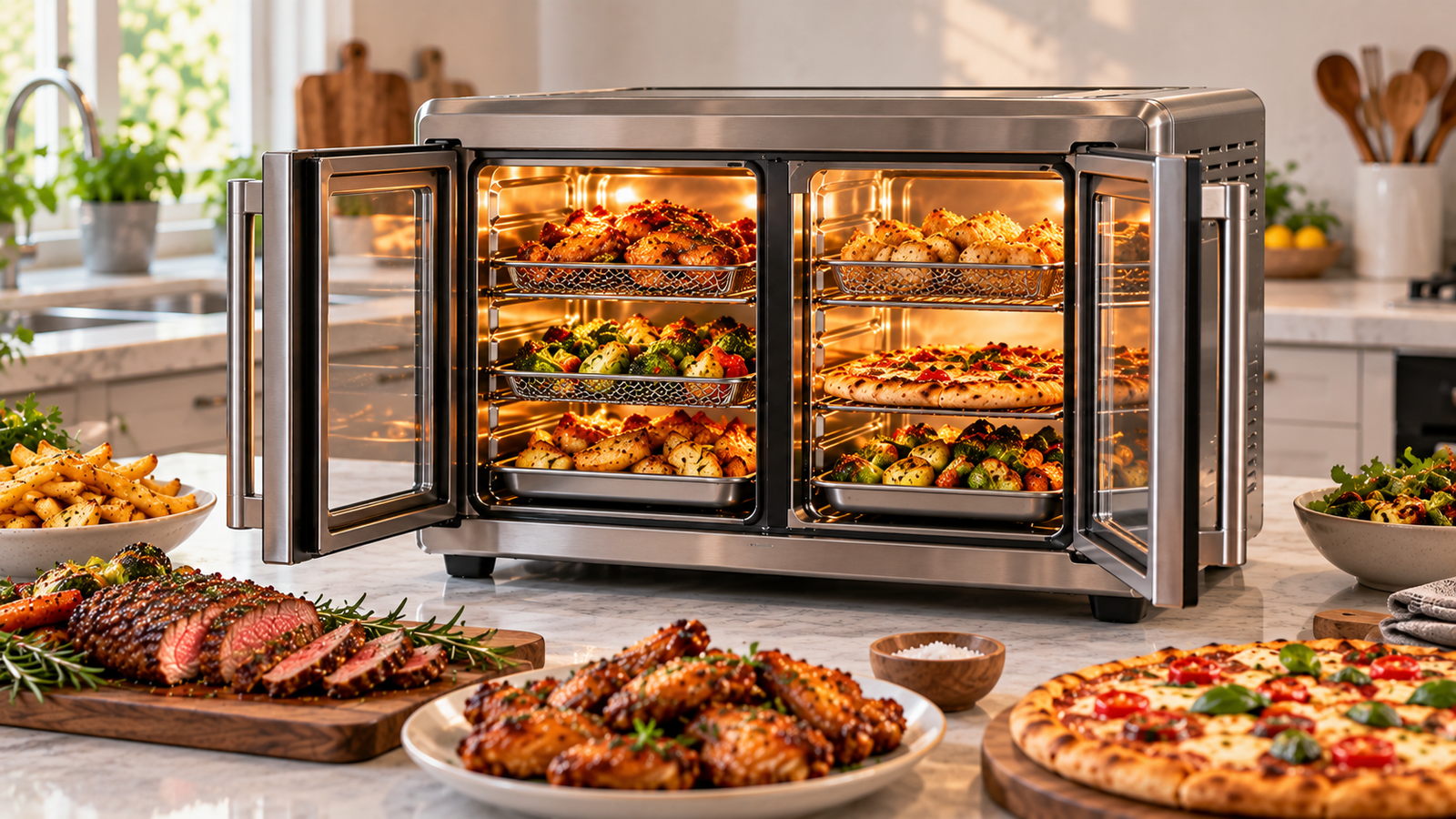
The theatrical doors attract attention, but they are not the technology responsible for crisp food.
French doors change access. Convection changes cooking.
That distinction is the foundation for understanding this category. A French door air fryer oven is fundamentally a countertop convection oven equipped to perform high-airflow cooking alongside functions such as baking, roasting, broiling, toasting and reheating. Depending on the model, it may also support pizza, dehydration, slow cooking or rotisserie cooking.
The USDA describes air fryers as essentially countertop convection ovens. Rapidly moving heated air transfers heat to food while encouraging moisture loss and browning at the surface. French doors do not alter that basic mechanism.
What they alter is the physical relationship between the cook, the counter and the oven cavity.
That makes French door models particularly interesting for households comparing the best air fryers. They are not simply oversized basket machines. They occupy the border between an air fryer and a secondary oven, and their usefulness depends heavily on whether that larger role is actually needed.
What Defines a French Door Air Fryer Oven?
The defining feature is a pair of front doors that open outward from the center rather than a single door dropping downward or swinging from one side.
On some appliances, pulling one handle opens both doors through a linked mechanism. Midea, for example, specifies that its Flexify French Door Air Fryer Oven has two glass doors that open with a single handle pull.
Behind those doors sits an oven-shaped cooking chamber.
This distinguishes the format from a conventional basket air fryer, where food is loaded into a pull-out drawer. French door models usually accept racks, baking trays, crumb trays and mesh air-fry baskets. Their interiors can accommodate foods that would be awkward in a deep basket: pizza, toast, open-faced sandwiches, baking dishes and larger roasting items.
The result is a hybrid appliance in the literal sense.
It can air fry, but its physical architecture remains that of an oven.
That distinction matters because an appliance optimized for several cooking methods necessarily makes different compromises from one built primarily around a compact perforated basket.
The Doors Solve an Access Problem
A traditional countertop oven commonly uses a single drop-down glass door. That design is simple and familiar, but the open door projects forward over the counter.
French doors move that obstruction sideways.
When both doors swing outward, the cook gains direct frontal access to the rack. A baking tray can be pulled toward the user without reaching across a horizontal glass panel.
This can be particularly useful when handling heavy cookware.
The benefit should not be exaggerated. French doors do not make a hot oven inherently safe, and open doors still consume physical space. They simply distribute that space differently.
A drop-down door requires forward clearance. French doors require lateral swing clearance.
That distinction can become surprisingly consequential in a crowded kitchen. An oven positioned immediately beside a wall, tall coffee machine or other appliance may not allow a side door to open comfortably. Handles can also project beyond the oven body.
The correct measurement therefore includes the appliance with its doors open, not merely the dimensions printed for the closed chassis.
Air Frying Still Depends on Airflow
The phrase “French door” says almost nothing about actual air-frying performance.
That is because crisping depends on factors hidden behind the doors: fan position, fan speed, heating-element arrangement, temperature control, cavity dimensions, rack placement and how densely food is loaded.
Midea’s current Flexify specification provides a useful example. The manufacturer describes a 360° Air Cyclone system using a convection fan and specifies a 26.4-quart chamber. The stainless-steel model lists capacity for a 12-inch pizza, six slices of toast or 14 chicken wings.
Another Flexify configuration identifies six heating tubes, a top convection fan, a maximum temperature of 450°F and 1,750 watts.
Those specifications reveal considerably more about the cooking system than the door style does.
A French door oven with weak airflow does not become an effective air fryer because its doors meet elegantly in the middle. Conversely, an oven with well-engineered convection can deliver effective high-airflow cooking without using French doors at all.
The doors are an interface feature.
The fan and heaters do the thermal work.
Large Capacity Is the Category’s Central Argument
French door air fryer ovens tend to make their strongest case through capacity.
A conventional basket air fryer concentrates heated air around a relatively small cooking chamber. That can be efficient for modest portions, but the geometry becomes restrictive when food is wide, tall or arranged across several dishes.
An oven cavity creates a different opportunity.
Midea’s Flexify is rated at 26.4 quarts and measures 16.92 inches wide, 15.93 inches deep and 13.74 inches high in the current stainless-steel specification. It weighs 25.57 pounds.
The Emeril Lagasse French Door AirFryer 360 is specified by the manufacturer at 26 quarts, or 24.6 liters, with exterior dimensions of 16.9 inches deep by 15.8 inches wide by 14.8 inches high. The manufacturer describes the capacity as suitable for preparing food for four to six people.
Those numbers place these machines far beyond the physical proposition of many compact basket fryers.
Capacity, however, requires interpretation.
Twenty-six quarts of oven volume does not mean 26 quarts of food should be packed into the chamber. Air circulation still needs space. A tall cavity can also contribute substantial volume without increasing the horizontal area available on one rack.
Buyers should therefore inspect rack width, rack depth and the dimensions of cookware they actually use.
A 12-inch pizza is more informative than an abstract quart figure when pizza is what will regularly go inside.
French Doors Do Not Guarantee More Usable Capacity
Large exterior dimensions can create another misconception: a physically imposing oven must offer correspondingly large usable cooking area.
Not always.
Control panels, insulation, heating hardware, fans and door mechanisms consume space. Interior geometry determines what remains.
Vertical capacity introduces another complication. An oven may support several rack positions, but placing food on multiple levels can alter airflow and expose upper and lower racks differently to heating elements.
Multi-rack cooking is therefore not automatically equivalent to multiplying single-rack capacity.
Food type matters.
Two trays of thin vegetables present a different airflow problem from two racks loaded with dense chicken pieces. Rotating trays may still be useful in some recipes even when the appliance is fan assisted.
This is why the best capacity specification is often the simplest one: what pan, pizza, chicken or number of toast slices actually fits?
The Format Is Better Understood as a Secondary Oven
Calling these appliances air fryers can obscure their broader identity.
The Emeril Lagasse 26-quart model, for example, includes a dual-speed fan and a large collection of cooking presets. Its current product page describes a 10-in-1 convection oven and lists a 26-quart chamber, while the product specification section identifies 25 cooking presets.
The manufacturer’s manual identifies the FAFO-001 model at 1,700 watts, 26 quarts and a temperature range of 75°F to 500°F.
Midea takes a similar multi-purpose approach. Its current 26.4-quart Flexify lists Air Fry, Roast, Bake, Broil, Toast, Pizza, Reheat, Slow Cook, Dehydrate and Warm among its 10 preset cooking functions.
That range changes how the appliance should be evaluated.
A buyer seeking only a machine for fries and chicken wings may be paying for a large chamber and cooking modes that rarely receive use.
A household seeking a toaster oven, small roasting oven, pizza oven and air fryer in one countertop appliance can view the same footprint very differently.
The question is not how many functions exist.
It is how many existing cooking jobs migrate to the new appliance.
Appliance Consolidation Can Justify the Footprint
Large countertop appliances create an obvious paradox.
They save space only when they replace something.
A French door air fryer oven sitting beside an existing toaster, basket air fryer and countertop convection oven represents accumulation rather than consolidation. Its broad function list does little to recover the counter area already committed to other machines.
If it replaces two or three appliances, the calculation changes.
Toast can be made on the rack. Pizza can cook in the larger chamber. Vegetables can be air fried. Small baking and roasting jobs can move away from the full-size oven.
That possibility makes the format especially relevant in households where the conventional oven is inconvenient for small meals.
The appliance becomes less like an air-frying accessory and more like a daily secondary oven.
That distinction should shape buying priorities. Reliability of the door mechanism, rack access, interior cleaning and control clarity become more consequential when the machine is expected to handle breakfast, lunch and dinner rather than occasional fries.
Energy Use Depends on What the French Door Oven Replaces
Countertop ovens are smaller than full-size ovens, but French door air fryer ovens are generally larger than compact basket fryers.
Energy comparisons therefore require a defined workload.
The Energy Saving Trust reports that around 3% of an average home’s energy use comes from cooking and explains that smaller air fryers can cost less to run than full-size electric ovens for the same small meal. Its example puts 600 grams of chicken breast at £0.14 in an air fryer versus £0.20 in an electric oven in Great Britain.
The organization also stresses the other side of the equation: larger ovens can make more sense for batch cooking because more food fits inside at once.
A French door air fryer oven sits between those cases.
Heating a 26-quart countertop cavity for two chicken wings would be a poor demonstration of capacity matching. Heating a full-size wall oven for a modest pizza may be equally disproportionate.
Efficiency follows utilization.
A household routinely filling several racks can make better use of a larger countertop chamber than one preparing a single portion.
This also means wattage alone does not determine operating cost. A higher-powered appliance that finishes quickly can use less total energy than a lower-powered appliance running substantially longer. Energy is a function of power over time.
Opening Two Doors Does Not Make Heat Loss Disappear
French door marketing often emphasizes access, but every oven door creates an opening through which hot air can escape.
The Energy Saving Trust advises avoiding unnecessary door opening because releasing heated air wastes energy.
French doors do not repeal that principle.
Their glass panels can help because food remains visible without opening the chamber. Interior lights improve observation further.
That creates a practical advantage over opaque basket air fryers. Browning can be monitored through the doors, reducing the temptation to open the appliance merely to inspect food.
Yet when the doors are opened, a large portion of the front cavity is exposed.
The best strategy remains ordinary oven discipline: inspect through the glass when possible and open the doors when food genuinely needs turning, checking or removal.
The Door Mechanism Deserves More Scrutiny Than It Usually Gets
A French door system adds mechanical complexity compared with one hinged panel.
There are two doors, multiple hinges and, on synchronized designs, a linkage allowing both doors to move from one handle.
That can improve one-handed access. It also creates additional moving parts.
Before purchase, a buyer should examine how the doors behave throughout their travel. Do they remain open securely? Do they require substantial lateral clearance? Does one handle operate both smoothly? Can racks be removed without fighting the door edges?
These questions rarely appear in headline specifications, yet they affect every cooking cycle.
Door alignment also matters because an oven depends on controlled heat retention. Damaged seals, hinges or alignment can affect operation.
The French door design should therefore be treated as functional hardware rather than decoration.
Countertop Geometry Can Decide the Purchase Before Cooking Begins
A 26-quart appliance demands a physical plan.
The Midea Flexify stainless model measures roughly 16.9 inches wide and 15.9 inches deep, while the Emeril manufacturer’s current dimensions place its model at 15.8 inches wide and 16.9 inches deep.
Those measurements describe the closed appliances.
They do not describe the entire working envelope.
Doors need swing space. Hot trays need somewhere to land. Manufacturer-specified ventilation clearances need to remain open. Upper cabinets can become relevant when heat and steam rise from the appliance.
The power cord also needs an appropriate outlet without unsafe extension arrangements.
This makes a tape measure more useful than another row of presets.
A buyer can mark the appliance dimensions on the counter with painter’s tape, then simulate door movement and tray removal. That simple exercise can expose conflicts with cabinet handles, walls, coffee machines and preparation space before a heavy appliance arrives.
French Doors Can Improve Tray Handling
One practical benefit survives close scrutiny: frontal access can be excellent.
With the doors open to either side, a rack or tray can travel directly toward the cook. There is no drop-down glass panel projecting underneath the user’s arms.
That can make a difference with a heavy casserole dish or roasting pan.
It also changes where hot accessories can be placed temporarily. With a drop-down oven door, some users are tempted to rest cookware on the open panel even when the manufacturer does not permit it. French doors remove that particular temptation because there is no horizontal door surface.
The design still requires oven mitts and deliberate handling.
A tray emerging from a 400°F or 450°F chamber is not made safer by elegant hinges.
Air-Fry Baskets and Solid Trays Have Different Jobs
French door air fryer ovens commonly include several cooking surfaces.
A perforated or mesh basket is generally intended to expose more of the food to circulating air. A solid baking tray contains drippings and supports foods unsuitable for mesh. A wire rack accommodates cookware and toast. A crumb tray catches debris at the bottom.
Using the wrong accessory can undermine the reason for selecting a cooking mode.
Fries spread over a perforated air-fry basket receive airflow differently from fries sitting in a deep solid pan. Conversely, fatty or liquid foods may require a tray to manage drippings safely.
Rack position matters too.
Manufacturers typically specify positions for air frying, broiling, baking and toasting because distance from heating elements changes heat exposure.
Preset names should not replace those physical instructions.
Large Glass Doors Create a Cleaning Reality
French door ovens expose more interior surfaces than a compact basket machine.
Crumbs fall onto the bottom tray. Grease can splatter onto walls. Mesh baskets collect residue. Racks accumulate baked-on material. The two glass doors can develop a visible film.
The larger chamber makes some areas easier to see but not necessarily easier to reach.
A removable crumb tray is therefore more than a convenience. It can prevent routine debris from becoming baked repeatedly onto the oven floor.
Greasy foods deserve particular attention because high-temperature convection can move aerosolized fat around the cavity.
Regular cleaning is not merely aesthetic. Accumulated grease and food residue can produce smoke and odors during later cooking.
The user manual should govern which surfaces, racks and trays can be washed with particular cleaners or placed in a dishwasher.
Safety Still Looks Like Oven Safety
The countertop format can create a false sense that an air fryer oven is closer to a microwave than an oven.
Thermally, it is an oven.
The exterior can become hot. Heated air exits vents. Metal racks and trays can cause burns. Cooking grease can ignite under adverse conditions.
The National Fire Protection Association states that cooking is the leading cause of home fires and home injuries, and its safety guidance identifies unattended cooking as the leading cause of kitchen fires.
Its advice for baking and roasting is straightforward: check food regularly, remain at home while it cooks and use a timer.
Those habits apply comfortably to countertop air fryer ovens.
Combustible materials should also remain away from hot cooking equipment. Towels, paper packaging and other items have no useful reason to crowd an operating French door oven.
A Large Oven Does Not Eliminate Food-Safety Verification
More cooking space can actually increase the need for disciplined temperature checking because larger foods become possible.
A whole chicken, thick roast or densely loaded tray can brown externally before the center reaches a safe temperature.
The USDA recommends using a food thermometer rather than relying on appearance. Its air-fryer guidance lists 165°F for poultry, 160°F for ground meat, 145°F for fish, and 145°F followed by a three-minute rest for whole cuts of beef, pork, veal and lamb.
French doors make browning easy to observe.
They do not make the center of food visible.
This distinction is particularly relevant when cooking on multiple racks. Different foods may have different safe temperatures and different thicknesses even when their timers end together.
The Emeril Lagasse 26QT Illustrates the Multi-Function Approach
The Emeril Lagasse 26QT French Door Multi-Function Air Fryer Toaster Oven provides a useful example of how far this category can stretch beyond basic air frying.
Its manufacturer specifies a 26-quart chamber, dual-speed fan and a broad collection of cooking presets. The current manual identifies 1,700 watts and a temperature range from 75°F to 500°F.
The design also incorporates rotisserie cooking, extending the appliance beyond the usual toaster-oven repertoire.
At the $149.99 price assessed here, our overall score is 8.4/10. Customer Sentiment is 8.06/10, Buyer Confidence is 9.8/10 and Value is 8.03/10.
The Emeril Lagasse 26QT retail configuration makes the most sense when its oven-scale versatility will actually be used.
The French doors are only one part of that proposition.
Its more significant characteristics are the 26-quart chamber, broad temperature range, convection system and ability to handle cooking methods that a basic basket air fryer cannot readily reproduce.
The Midea Flexify Approaches the Same Format Differently
The Midea Flexify Slim 26.4-quart model uses the same broad architectural idea: a relatively large countertop chamber, convection air frying and French doors.
The current Midea specification identifies 26.4 quarts of capacity and dimensions of 16.92 by 15.93 by 13.74 inches. The manufacturer states that the chamber can accommodate a 12-inch pizza, six slices of toast or 14 chicken wings.
Midea also describes a 360° Air Cyclone convection system. Its French doors open together from a single handle pull.
At the $139.99 price assessed here for the relevant Flexify configuration, our overall score is 8.4/10. Customer Sentiment is 8.06/10, Buyer Confidence is 9.8/10 and Value is 8.03/10.
The Midea Flexify Slim retail configuration sits $10 below the Emeril configuration assessed here.
That narrow price difference means architecture and intended workload deserve more attention than the receipt alone.
The two examples demonstrate something broader about the category: French doors can appear on ovens with different control systems, cooking programs, accessories and heating arrangements. Door style is not enough to establish equivalence.
Preset Counts Can Distract From More Useful Specifications
Countertop ovens are particularly susceptible to preset inflation.
A control panel can separately label chicken, wings, fries, pizza, cookies and vegetables even when several modes differ mainly in default temperature and time.
That does not make presets useless. They can reduce repetitive setup.
But buyers should distinguish between a preset and a distinct cooking capability.
Air Fry and Slow Cook represent meaningfully different operating patterns. “Wings” and “Fries” may simply provide different starting settings for the same high-airflow system.
More useful questions include:
- What temperature range does the oven support?
- Can time and temperature be manually adjusted?
- How many rack positions are available?
- What cookware fits?
- Is a perforated air-fry basket included?
- Is there an interior light?
- How powerful and controllable is the convection fan?
- Does the oven include a rotisserie mechanism if that function matters?
- Can accessories be replaced?
- How easily can the crumb tray and glass doors be cleaned?
Those answers describe ownership more accurately than a large number printed beside “functions.”
Who Benefits Most From a French Door Air Fryer Oven?
This format makes the strongest case in kitchens where a countertop appliance is expected to perform substantial oven work.
It aligns particularly well when:
- Air frying is only one of several desired cooking methods.
- Toast, pizza, baking and roasting are frequent tasks.
- Wide foods are routinely prepared.
- A secondary oven would reduce reliance on a full-size oven.
- Several portions need to be cooked at once.
- Direct frontal rack access is preferred.
- A drop-down door would interfere with tray handling.
- Sufficient permanent counter space is available.
- The household will use the larger chamber often enough to justify heating it.
Families can benefit from the capacity, but household size alone is not enough to make the decision.
A family that cooks mostly small batches may still prefer a basket air fryer. A one- or two-person household that bakes bread, pizza and casseroles may find an oven format far more useful.
Cooking behavior matters more than head count.
Who Is Better Served by a Basket Air Fryer?
French door ovens carry costs that compact basket machines largely avoid.
They are bigger. They have more interior surfaces to clean. They generally require more permanent counter area. Their large chambers can be disproportionate for a handful of fries.
A basket air fryer remains coherent when:
- Air frying is the dominant job.
- Portions are modest.
- Food is commonly shaken during cooking.
- Fast access to a removable drawer is preferred.
- Counter space is limited.
- Toasting and baking already have dedicated appliances.
- The machine must regularly be stored after use.
- Simpler cleaning matters more than oven versatility.
The basket format’s narrow specialization can be an advantage rather than a limitation.
An appliance does not become more useful merely because it knows more tricks.
A Practical French Door Buying Checklist
Before selecting a French door air fryer oven, the buyer should evaluate the physical machine rather than the photograph.
The following checks reveal most of the meaningful tradeoffs:
- Closed dimensions: Measure width, height and depth at the intended location.
- Door clearance: Confirm that both doors can swing fully without hitting walls or adjacent appliances.
- Ventilation: Follow the manufacturer’s required clearances around the oven.
- Interior dimensions: Verify that frequently used pans and pizzas fit.
- Rack positions: More levels can improve flexibility, but only if the relevant cookware fits between them.
- Air-fry basket area: Horizontal surface area matters for foods that crisp best without heavy overlap.
- Wattage: Use it as one piece of the energy calculation, not a standalone efficiency score.
- Temperature range: Match it to the cooking methods that will genuinely be used.
- Door linkage: Test whether synchronized doors open smoothly and remain stable.
- Interior light: Visibility can reduce unnecessary door opening.
- Crumb management: A removable crumb tray simplifies routine cleaning.
- Accessories: Determine whether rotisserie tools, racks and trays solve real cooking needs.
- Weight: Large ovens are inconvenient to move daily.
- Electrical placement: Confirm that the intended counter has an appropriate outlet.
- Replacement parts: Check whether racks, baskets, trays and other wear items remain obtainable.
A machine that passes those tests is far more likely to fit the kitchen than one selected because its doors looked impressive in a product photograph.
Final Considerations
French door air fryer ovens are easier to understand once the doors stop dominating the discussion.
The French door arrangement changes access. Two outward-opening panels remove the horizontal obstruction created by a traditional drop-down oven door and can provide direct access to racks and trays. Linked doors can also make opening a large oven possible with one handle.
Those are genuine ergonomic benefits.
They do not determine how well food air fries.
Cooking performance remains a function of heating elements, convection airflow, temperature management, rack placement, chamber geometry and food load. A French door appliance with mediocre thermal engineering will not outperform a well-designed conventional oven merely because its entrance is more elaborate.
The category’s more consequential advantage is capacity.
Models around 26 quarts can accommodate foods that make little sense in compact baskets. A 12-inch pizza, multiple slices of toast, roasting dishes and larger quantities of food fit naturally into an oven-shaped chamber. Some models extend that versatility through slow cooking, dehydration or rotisserie functions.
That capacity creates an equally consequential cost: size.
A French door air fryer oven is not a small appliance simply because it sits on a counter. Roughly 16-inch dimensions in multiple directions can consume a meaningful section of kitchen workspace. Open doors, ventilation requirements and hot-tray handling expand the working envelope further.
Energy use follows the same logic. A countertop convection oven can avoid heating a full-size oven for moderate meals, but a large 26-quart chamber is unnecessary for tiny portions. The most efficient appliance is often the one appropriately sized for the food being cooked.
The Emeril Lagasse 26QT and Midea Flexify illustrate the category’s central proposition. Both pair French-door access with roughly 26 quarts of oven-style capacity, yet their functions, controls, dimensions and heating systems differ. Our 8.4/10 overall assessments for both reflect capable multi-purpose designs rather than an endorsement of French doors as a cooking technology.
Their prices assessed here-$149.99 for the Emeril and $139.99 for the Midea configuration-also demonstrate that the decision can hinge more on architecture and cooking habits than on a large price gap.
For households seeking primarily fast cooking of small portions, a basket air fryer can remain the more proportionate tool.
For households seeking an appliance that can air fry tonight’s vegetables, toast tomorrow’s breakfast, bake a pizza and handle small roasting jobs without switching on the full-size oven, a French door model presents a more expansive proposition.
The doors are the visible difference. The useful difference lies behind them: a larger cooking chamber capable of taking on a broader share of the kitchen’s oven work.