The difference between a single-basket and dual-basket air fryer looks obvious from across a kitchen: one has one drawer, the other has two. That visual distinction, however, conceals the more consequential engineering question. Is it more useful to have one uninterrupted cooking chamber or two independently controlled zones?
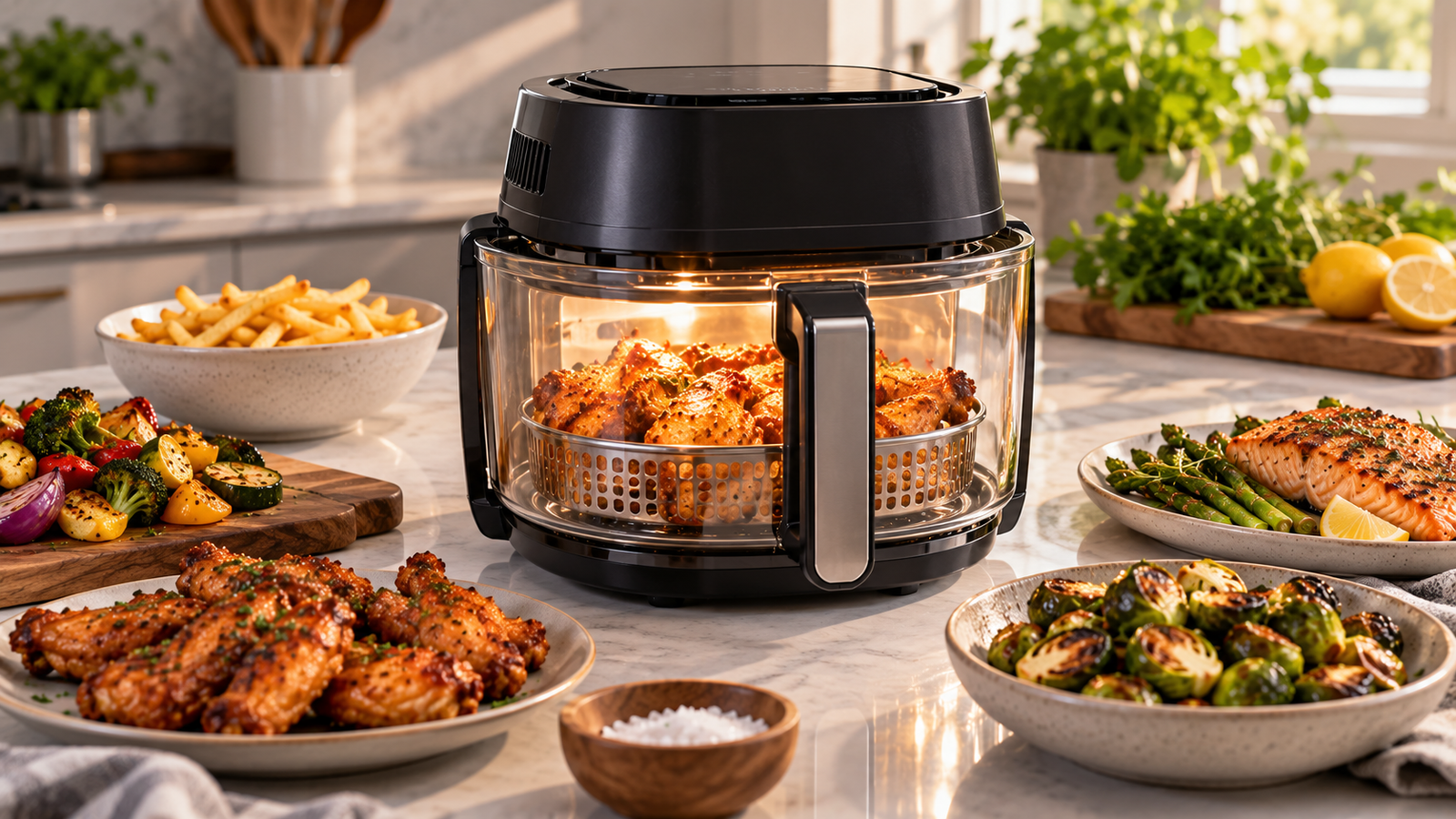
That choice affects far more than the number of foods that can be cooked at once. Basket geometry determines whether a whole chicken fits. Independent zones determine whether chicken and vegetables can cook simultaneously at different temperatures. Dividing a large advertised capacity into two smaller compartments can increase flexibility while reducing the dimensions of any single item that fits inside. One large basket reverses that equation.
The comparison is therefore not “basic” against “advanced.” It is uninterrupted space against divided control.
Both designs use the same broad air-frying principle. The USDA describes air fryers as essentially countertop convection ovens in which rapidly circulating hot air cooks and crisps food. Whether that air circulates through one basket or two does not change the underlying physics. What changes is how food can be arranged, scheduled and separated.
For households comparing the best air fryers, that architectural decision deserves more attention than preset counts or decorative control panels.
Single Basket vs Dual Basket at a Glance
| Decision Factor | Single-Basket Air Fryer | Dual-Basket Air Fryer |
|---|---|---|
| Cooking zones | One | Two |
| Independent temperatures | No | Usually available on true dual-zone models |
| Different foods simultaneously | Yes, if compatible | Yes, with greater separation |
| Large individual foods | Usually easier in a comparably sized undivided basket | Restricted by individual drawer dimensions |
| Main-and-side cooking | Requires compatible settings or sequencing | Major strength |
| Coordinated finish feature | Generally unnecessary | Available on many models |
| Basket cleaning | One basket and crisper plate | Two baskets and usually two crisper plates |
| Counter width | Often narrower | Often wider, though stacked designs exist |
| Controls | Usually simpler | More complex |
| Best use pattern | One primary food or one large batch | Two foods with different cooking requirements |
| Food separation | Limited | Strong |
| Capacity utilization | Entire chamber available to one food | Total capacity divided between zones |
The central tension becomes visible immediately. A 10-quart dual-basket air fryer does not necessarily provide the same usable geometry as a hypothetical 10-quart single basket. If the dual machine consists of two five-quart drawers, no individual food can use the entire 10-quart volume unless the divider itself is removable on a model specifically engineered for that purpose.
Capacity is therefore not merely a number. It has a shape.
Two Baskets Solve a Scheduling Problem
The strongest argument for a dual-basket air fryer is not raw capacity. It is concurrency.
Consider a simple dinner of chicken and vegetables. The chicken might require one temperature and 22 minutes. The vegetables might require another temperature and 14 minutes. A conventional single-basket air fryer presents several options, none particularly mysterious: cook the chicken first and vegetables second, add the vegetables partway through if the temperatures are compatible, or cook both together and accept a shared setting.
A dual-zone appliance can create another option. Each food receives its own basket, temperature and cooking duration.
Some dual-basket machines then coordinate the start times automatically so both zones finish together. As a concrete example of the architecture, Ninja’s 10-quart two-basket model uses two independent five-quart zones with separate fans and heaters. Its Smart Finish function is intended to coordinate foods with different settings so they complete their cycles at the same time, while Match Cook copies settings from one zone to the other.
That feature illustrates the genuine appeal of the category without proving that every dual-basket machine implements it equally well.
The advantage is logistical. Dinner does not have to become a relay race in which one food waits while another cooks.
For families routinely preparing a protein and side dish simultaneously, this can materially change how an air fryer is used.
One Large Basket Solves a Geometry Problem
Dual zones create flexibility by dividing space. Division also creates boundaries.
A large single basket has no internal wall separating left from right. That makes it better suited, all else being equal, to foods whose dimensions exceed those of one compartment in a comparable dual-drawer machine.
Whole chickens illustrate the point. So can larger steaks, long fish fillets, sizeable baking dishes and broad arrangements of vegetables.
Imagine two appliances advertised with eight quarts of capacity. One has a single eight-quart basket. The other uses two four-quart baskets. The headline capacity is identical, yet their usable dimensions can be dramatically different.
The single basket can devote every inch to one food.
The dual-basket machine cannot combine its separate compartments unless it belongs to the newer class of convertible models with removable dividers or a unified “mega zone.”
This is why capacity should never be evaluated only in quarts or liters. Width, length and usable basket-floor area deserve equal attention.
A household that routinely cooks one large centerpiece may derive more utility from one generous basket than from two smaller zones whose combined advertised capacity is greater.
Surface Area Matters More Than Many Capacity Labels Suggest
Air frying relies heavily on exposure to moving hot air.
The USDA cautions against overfilling because overcrowding can prevent sufficient circulation and contribute to uneven cooking or undercooking. This turns basket floor area into a practical specification rather than an aesthetic one.
Eight quarts of internal volume does not mean eight quarts of fries should be piled into the drawer.
Food stacked deeply creates different airflow conditions from food arranged in a shallow layer. Fries can be shaken and redistributed, but burgers, fish and breaded chicken pieces generally benefit from usable horizontal area.
A dual-basket machine divides that area. This can be beneficial when two different foods need physical separation. It can be restrictive when one food needs the full width.
Single-basket shoppers should therefore examine interior dimensions, not merely overall volume. Dual-basket shoppers should examine the dimensions of each individual drawer.
The relevant question is not “How much does the air fryer hold?” It is “How much of the food normally cooked in this household can be arranged without excessive crowding?”
That question is less glamorous than a capacity badge and considerably more useful.
Dual Baskets Change the Meaning of Meal Preparation
A single-basket air fryer is naturally oriented toward a cooking task. A dual-basket air fryer is more naturally oriented toward a meal.
That distinction explains much of the category’s appeal.
A single drawer works efficiently when dinner is one dominant item: wings, fries, roasted vegetables, chicken thighs or reheated leftovers. If everything requires similar temperatures and timing, separating the food may accomplish very little.
Dual zones become more useful as cooking requirements diverge.
Fish and potatoes present different timing. Chicken and asparagus may need different temperatures. Frozen fries and fresh vegetables may require separate treatment. Vegetarian food can be physically separated from meat, subject to appropriate food-handling practices and the actual design of the appliance.
The architecture essentially creates two small convection chambers sharing one exterior housing and control system.
This can reduce sequencing. It can also reduce improvisation. Instead of deciding when to add the second ingredient to the first basket, the cook can assign each food its own zone.
The value of that independence grows with the number of meals containing two components that benefit from different settings.
Dual Basket Does Not Automatically Mean Twice the Cooking Capacity
Marketing arithmetic can encourage an understandable mistake: two baskets must mean twice as much useful cooking.
Not necessarily.
Total volume and practical capacity are separate measurements.
A two-zone machine can advertise 10 quarts because each drawer holds five. That does not mean either drawer accepts a 10-quart-sized object. It means two smaller cooking spaces collectively provide that volume.
Ninja’s documented 10-quart DualZone configuration, for example, divides its capacity into two independent five-quart baskets. The design is explicitly oriented toward cooking two foods independently.
For wings, fries or vegetables that can be divided between drawers, this structure can use the capacity effectively. For a large whole item, the divider becomes a physical constraint.
The newer generation of flexible- basket air fryers partly addresses this issue through removable dividers, allowing one chamber to operate either as a large zone or two smaller ones. Such models blur the historical distinction between single- and dual-basket designs.
That flexibility is attractive, but buyers should verify the actual mechanism. Two cooking “zones” described in marketing material do not always mean two physically independent baskets with separate heaters and fans.
Counter Space Is the Hidden Price of Two Drawers
Dual-basket air fryers have historically tended to spread horizontally because two drawers sit beside one another.
That creates an obvious problem in smaller kitchens.
A machine can offer generous food capacity while consuming enough counter width to displace a toaster, coffee machine or food-preparation area. Kitchen work surfaces are finite, and an appliance used for 30 minutes can remain physically present for the other 23½ hours of the day.
Manufacturers have responded by stacking baskets vertically.
Ninja’s DoubleStack architecture places two drawers above and below rather than side by side. The company’s 10-quart version measures 11.25 inches in one horizontal dimension and 19.22 inches in the other, while using two five-quart baskets. It also incorporates removable racks that allow food to be arranged on multiple levels.
The existence of stacked dual-basket designs demonstrates how much countertop geometry matters to the category.
Yet vertical designs create their own questions. Cabinet clearance becomes more relevant. Basket access changes. Multi-level cooking can make food arrangement more complicated.
There is no free spatial lunch. Width, depth and height simply negotiate with one another.
Energy Efficiency Cannot Be Reduced to the Number of Baskets
Air fryers can consume less energy than full-size electric ovens for small meals because they heat much smaller spaces.
The Energy Saving Trust reports that around 3% of an average home’s energy use comes from cooking and gives an example in which cooking 600 grams of chicken breast costs £0.14 in an air fryer in Great Britain versus £0.20 in an electric oven.
Those figures illuminate the general advantage of appropriately sized cooking appliances. They do not establish that a dual-basket air fryer always uses more or less electricity than a single-basket model.
Actual consumption depends on power draw, cooking duration, temperature, quantity of food and how the appliance manages its heating elements.
The workload matters enormously.
If a single-basket air fryer requires two sequential cycles to prepare a main course and side dish, a dual-zone machine capable of cooking both simultaneously may reduce total elapsed cooking time. That does not automatically establish lower electrical consumption because power management differs between appliances.
Conversely, running a large dual-zone appliance for a tiny portion may provide little practical benefit over a compact single-basket machine.
Energy efficiency therefore follows matching appliance capacity to the meal more closely than it follows drawer count.
Independent Zones Are Most Useful When Foods Are Actually Different
Two baskets sound useful even before anyone asks what will be placed in them.
That question changes the analysis.
If both baskets contain identical frozen fries at the same temperature for the same duration, independent control has little functional value. A sufficiently large single basket could accomplish the same broad task, assuming comparable usable area and airflow.
If one basket contains salmon and the other potatoes, independence matters more.
This produces a useful purchasing exercise. A household can review a typical week of dinners and count how often two foods need different temperatures or substantially different cooking durations.
If the answer is “almost every night,” dual zones address a recurring scheduling problem.
If the answer is “rarely,” the extra controls and divided baskets may solve a problem that barely exists.
The best air fryers are not necessarily the machines with the largest number of zones. They are the ones whose cooking architecture matches recurring meals.
A Single Basket Can Be Simpler to Operate
Complexity has a cost even when the control panel is thoughtfully designed.
A single-basket machine asks relatively few questions. The user chooses a cooking mode, temperature and time, then starts the cycle. Some models add presets, but the basic workflow remains linear.
A dual-basket model may ask which zone is active, whether settings should be duplicated, whether the foods should finish simultaneously and whether each drawer requires a different program.
Experienced users may appreciate that control. Others may find themselves using both drawers at identical settings most of the time.
Interface design becomes particularly important because dual-zone controls must communicate which settings belong to which basket.
A machine that requires repeated button presses to switch between zones can make a theoretically convenient feature feel administrative.
The relevant distinction is not intelligence versus simplicity. It is control versus cognitive load.
Cleaning Favors Simplicity, but Not Always by Much
Two baskets create an unavoidable mathematical reality: there are more removable components.
A typical dual-basket machine may have two drawers and two crisper plates. A single-basket model generally has one of each.
When both zones are used, that can mean twice the basket hardware to wash.
Yet the comparison changes if the single basket is used for two sequential foods. Cooking greasy chicken first and vegetables afterward may require cleaning or wiping between cycles, particularly when flavors or allergens need separation.
Dual baskets can isolate messes more effectively.
One drawer can handle a strongly seasoned protein while another holds vegetables. Cleanup involves more pieces, but those pieces have kept the foods physically apart.
Dishwasher compatibility can also influence the practical burden, though buyers should follow each manufacturer’s cleaning instructions rather than assume that every nonstick basket belongs in a dishwasher.
Coating durability deserves attention as well. Abrasive pads and harsh cleaning methods can damage nonstick surfaces.
The best cleaning arrangement is therefore partly behavioral: one larger component washed frequently versus two smaller sets washed after multi-zone meals.
Food Safety Does Not Change With Drawer Count
Dual baskets can create the impression that separating foods automatically solves food-safety concerns. Separation can help with organization, but safe cooking temperatures remain unchanged.
The USDA advises against overfilling air-fryer baskets and recommends verifying internal temperatures with a food thermometer. Its guidance lists 145°F for fish; 145°F followed by a three-minute rest for whole cuts of beef, pork, veal and lamb; 160°F for ground meat; and 165°F for poultry.
A synchronized finish button does not verify doneness.
This matters particularly when two zones contain foods of different thicknesses. A program can coordinate timers, but the center of a thick chicken breast does not negotiate with the display panel.
Physical separation can be useful when cooking different foods, and some genuinely independent dual-zone models use separate heating systems. The design should not be interpreted as permission to disregard cross-contamination practices during preparation.
Raw meat still requires careful handling. Cutting boards, utensils and hands remain part of the safety equation.
The Single Basket Better Fits Certain Large Foods
The case for one uninterrupted chamber becomes strongest when food shape is considered.
A whole chicken does not care how many digital zones an appliance offers. It cares whether it fits.
The same applies to a long fish fillet, several large burger patties arranged side by side or a baking pan with fixed dimensions.
A wide single basket can provide greater freedom to arrange those foods without an internal divider.
This does not mean single baskets always have greater usable floor area. Many are compact. Nor does it mean a dual-basket machine cannot handle large quantities. Some dual models accommodate substantial amounts of wings or fries by distributing them between drawers.
The distinction concerns continuity of space.
When the meal consists of many small pieces, dividing the food can be easy.
When the meal consists of one large object, division becomes impossible.
That deceptively simple observation should carry considerable weight in the purchasing decision.
Dual Baskets Better Fit Main-and-Side Cooking
If whole-food geometry is the single basket’s strongest argument, coordinated meal preparation is the dual basket’s answer.
Two independent zones are especially useful when dinner naturally divides into two categories.
Examples include:
- Chicken in one basket and vegetables in the other.
- Fish in one zone and potatoes in the second.
- Meat in one basket and a plant-based alternative in another.
- Spicy food separated from mild food.
- A main course cooked at one temperature while a side uses another.
- Two frozen foods with different package instructions.
- One food requiring a short cycle and another requiring substantially longer cooking.
These are not exotic use cases. They describe ordinary dinners.
The dual-basket advantage is therefore strongest in households where the air fryer is expected to prepare much of the meal rather than one component of it.
Batch Cooking Can Reverse the Apparent Advantage
Large households introduce another complication.
A dual-basket air fryer may appear inherently better for families because it has two drawers. But if the household needs a very large quantity of one food, a large single basket can sometimes be more practical.
Suppose dinner requires a substantial batch of chicken wings. Two baskets can divide the wings effectively, provided their combined usable surface is adequate. But if the food is larger or awkwardly shaped, the partition may reduce flexibility.
The reverse also occurs. A single basket might have enough total volume for a family-sized meal but still require several foods to share one temperature.
This is why household size alone cannot determine the format.
Meal composition matters more.
Four people eating the same food create a different workload from four people eating a main dish plus two sides with different cooking requirements.
Dual Basket Controls Can Save Attention as Well as Time
Cooking is not merely a measurement of minutes. It consumes attention.
A single-basket workflow involving sequential foods requires remembering when the first batch ends, removing it, potentially keeping it warm, loading the next food and starting another program.
Dual-zone synchronization can automate part of that scheduling.
That is a meaningful convenience for busy households because simultaneous completion solves a familiar dinner problem: one component is hot while another is still cooking.
Yet synchronization should not be confused with autonomous cooking. Foods may still require shaking, turning or temperature checks.
The technology coordinates clocks. It does not eliminate cooking judgment.
That distinction keeps expectations realistic.
A Flexible Divider Can Blur the Entire Comparison
A newer category of air fryer challenges the neat single-versus-dual distinction.
Some machines use one large drawer with a removable divider. With the divider installed, the appliance operates as two zones. Remove it and the chamber becomes one larger cooking area.
Conceptually, this architecture addresses the central weakness of fixed dual baskets: the inability to combine their capacity for one large food.
It also addresses the central limitation of a conventional single basket: the inability to maintain independent cooking environments.
The trade-off is mechanical and operational complexity. Buyers need to verify whether removing a divider genuinely creates one continuous cooking zone, how heating is managed in that configuration, and whether accessories restrict usable dimensions.
The existence of these hybrid designs reinforces a broader point. Drawer count is a proxy for cooking geometry, not the final purchasing criterion.
Who Is Better Suited to a Single-Basket Air Fryer?
A single-basket model aligns more naturally with households that usually cook one primary food at a time.
Its case becomes stronger when:
- One large uninterrupted cooking area matters.
- Whole chickens or other bulky foods are common.
- Most meals use one temperature and cooking duration.
- The air fryer usually prepares only one component of dinner.
- Counter space is restricted.
- Simpler controls are preferred.
- Fewer removable pieces are desirable.
- Cooking for one or two people is routine.
- The household already uses an oven, microwave or stovetop for side dishes.
A broad single basket can be particularly effective because horizontal cooking area often matters more than raw volume.
Buyers should measure the foods they actually cook. A favorite baking dish, fish fillet or whole chicken can reveal more about required capacity than a quart figure on a box.
Who Is Better Suited to a Dual-Basket Air Fryer?
Dual baskets fit households that repeatedly cook foods with different requirements.
The architecture becomes more useful when:
- A main dish and side are regularly air fried together.
- Different temperatures are frequently needed.
- Different cooking durations are common.
- Coordinated finishing would reduce meal-management friction.
- Meat and plant-based foods are often prepared separately.
- Large quantities of small foods can be divided between baskets.
- Additional counter width or height is acceptable.
- Washing two sets of basket components is not a deterrent.
- The household intends to use both zones rather than treating one as permanent spare capacity.
A true dual-zone model should also be examined beyond the phrase “dual basket.” Independent heaters, fans, timers and temperature controls can matter more than the mere presence of two drawers.
A Better Buying Test Uses Seven Questions
The most reliable comparison begins with household behavior rather than appliance advertising.
Before choosing between one and two baskets, a buyer can answer seven questions:
- How many separate foods are usually cooked for dinner? If the air fryer regularly handles a main and side, two zones gain relevance.
- Do those foods require different temperatures? Identical settings weaken the need for independent zones.
- What is the largest individual food that must fit? Large whole foods favor uninterrupted space.
- How much horizontal counter space is genuinely available? Measurements should include manufacturer-required clearance.
- Will the appliance stay on the counter? Weight and dimensions matter more when storage is necessary.
- How objectionable is washing two baskets? Convenience during cooking can transfer labor to cleanup.
- Will synchronization actually be used? A feature has no practical value when the household’s meals never require it.
This exercise turns a vague product category into a workload calculation.
Final Considerations
Single-basket and dual- basket air fryers use the same basic cooking idea but organize it around different household problems.
The single-basket format protects uninterrupted space. It is naturally suited to one large food, one substantial batch or straightforward cooking in which everything can share the same temperature and schedule. It also tends to offer a simpler interface and fewer components to clean.
The dual-basket format protects independence. Two zones can cook different foods at different temperatures and durations, and models with synchronized finishing can coordinate those cycles so dinner reaches the table together.
Neither advantage is universal.
A 10-quart dual-basket machine should not automatically be considered more useful than a smaller single-basket model because its total volume is greater. If those 10 quarts are divided into two five-quart drawers, the size of each individual zone still governs what fits.
The opposite assumption is equally weak. One large basket may offer excellent geometry, but a household repeatedly cooking a protein and side dish can spend more time sequencing batches or compromising between settings.
Energy use follows the workload rather than drawer count. Air fryers can consume less energy than full-size ovens for appropriately sized meals, but electrical consumption depends on power, duration, temperature and how much food is being cooked. Two zones operating simultaneously are not automatically wasteful, just as one basket running several consecutive cycles is not automatically efficient.
Food safety remains unchanged. Crowding can interfere with air circulation, and safe internal temperatures should be verified rather than inferred from browning or timer completion.
The most useful dividing line is therefore behavioral.
A household that thinks of an air fryer as a machine for “the fries,” “the chicken” or “the vegetables” will often find a large single basket sufficient and potentially easier to live with.
A household that thinks of the air fryer as a machine for “dinner” has more reason to consider dual zones.
One design offers freedom inside the basket. The other offers freedom between baskets. The better architecture is the one that matches the way food is actually divided before it reaches the plate.