Ninja’s DZ302, DZ201, DZ401, and DoubleStack SL401 illustrate how quickly a simple appliance category can fragment into different kitchen strategies. All four use two independently controlled cooking zones. All four are rated at 1,690 watts. All four offer six cooking programs. Yet capacity, basket geometry, countertop footprint, vertical clearance, cooking modes, and price make them substantially different propositions.
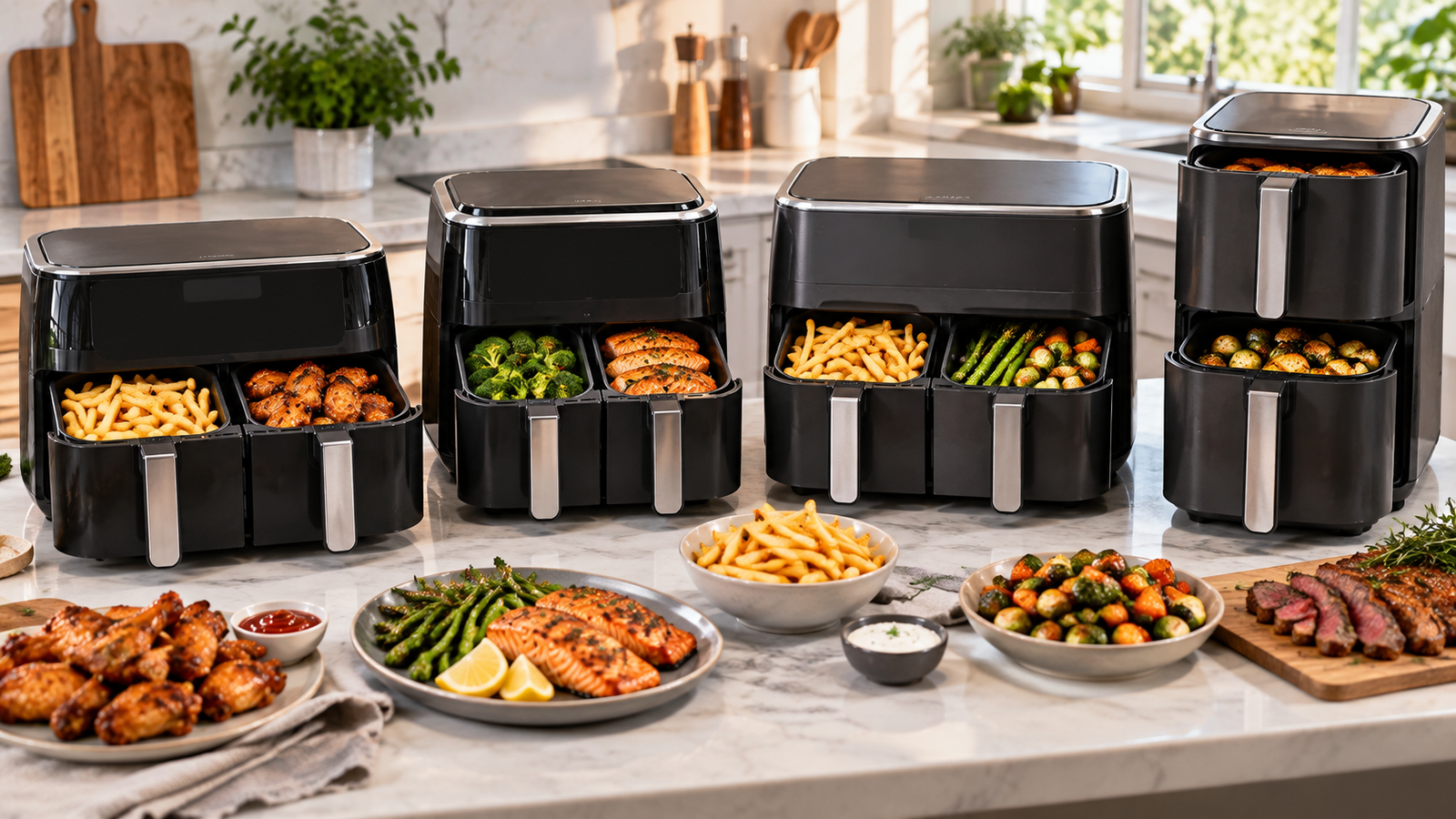
The central division is architectural. The DZ201 uses two side-by-side 4-quart baskets for 8 quarts total. The DZ302 and DZ401 expand the familiar side-by-side format to two 5-quart baskets and 10 quarts total. The SL401 retains 10-quart capacity but stacks its two 5-quart baskets vertically, then adds removable meal racks that divide each basket into two cooking levels.
That means this is not simply a progression from cheaper to more expensive.
At the reference prices used in this comparison, the DZ302 costs $149.99, the DZ201 $179.99, the DZ401 $199.99, and the SL401 $209.95. Those prices produce an unusual result: the smaller DZ201 is not automatically the value choice, while the newer DoubleStack asks buyers to pay more for space efficiency rather than additional total basket capacity.
Our scores reinforce the point. The DZ201 receives 9.16/10, the DZ302 and DZ401 each receive 9.01/10, and the SL401 receives 8.71/10. Buyer Confidence is 9.8 across all four models. Customer Sentiment and Value vary more meaningfully, reflecting the difference between proven conventional layouts and a more specialized stacked design.
The decision therefore begins with a kitchen, not a scoreboard.
The DZ201 Establishes the DualZone Formula
The DZ201 is the oldest and smallest design in this group, but its architecture remains remarkably relevant.
According to Ninja’s DZ201 specifications, it provides 8 quarts of total capacity through two independent 4-quart baskets. Each zone has its own rapid heater and fan.
The distinction between independent baskets and a divided single chamber matters.
Zone 1 can cook one food at one temperature and time while Zone 2 follows different instructions. Smart Finish coordinates those schedules so both foods complete cooking together. Match Cook copies settings from one zone to the other when the user wants the full capacity devoted to similar food.
Those features address one of the persistent weaknesses of traditional single- basket air fryers.
Dinner rarely consists of one ingredient.
Chicken and vegetables may need different temperatures. Fries and fish may require different cooking durations. A single basket often forces sequential preparation, leaving the first component cooling while the second finishes.
DualZone divides that problem physically.
The DZ201’s six programs are Air Fry, Air Broil, Roast, Bake, Reheat, and Dehydrate. Its total capacity is rated for up to four pounds of fries or wings.
For households that rarely need more than eight quarts, the design remains difficult to dismiss simply because larger models exist.
The DZ302 Expands Capacity and Changes One Function
The DZ302 moves from 8 quarts to 10 quarts, dividing that capacity between two 5-quart baskets.
That 25 percent increase in nominal capacity is significant.
A 5-quart zone gives larger foods more breathing room and increases the quantity that can be prepared without spreading a meal across several batches. The appliance retains the DualZone concept, including Smart Finish and Match Cook.
The DZ302 also reaches 450°F and is rated at 1,690 watts.
Its six-function arrangement differs slightly from the DZ201. Documentation for the DZ302 lists Air Fry, Air Broil, Roast, Bake, Dehydrate, and Keep Warm. In other words, Keep Warm takes the place occupied by Reheat on the DZ201.
That is not a trivial distinction for every household.
Reheat is useful for restoring cooked leftovers at air-fryer temperatures. Keep Warm is intended more for holding prepared food until serving.
Neither function determines the quality of the appliance, but buyers who use one regularly should notice the difference rather than assuming every six-function Ninja contains the same six programs.
The DZ302’s strongest argument in this comparison is economic.
At the $149.99 reference price, it provides 10-quart DualZone capacity for $30 less than the 8-quart DZ201 and $50 less than the DZ401.
Our Value score of 8.52 reflects that favorable capacity-to-price relationship.
The DZ401 Is the Familiar 10-Quart XL DualZone
The DZ401 is Ninja’s established 10-quart XL side-by-side model.
Ninja specifies two independent 5-quart baskets in the DZ401, along with DualZone Technology, Smart Finish, Match Cook, and IQ Boost. It is rated at 1,690 watts.
The official dimensions illustrate what greater capacity costs in physical space. Ninja lists the model at 17.1 inches long, 13.9 inches wide, and 12.8 inches high on one current product listing, though another current SharkNinja page publishes a larger dimensional envelope for the same model. Buyers working with tight clearances should therefore verify the dimensions attached to the exact retail configuration before purchase.
The underlying point remains unchanged: conventional 10-quart DualZone designs are broad appliances.
Two 5-quart baskets sitting beside each other require substantial horizontal room.
That width is manageable on a generous counter. In a narrow kitchen, it can become the defining characteristic of the appliance.
The DZ401 receives our score of 9.01/10, Customer Sentiment of 8.94, Buyer Confidence of 9.8, and Value of 8.52.
Those figures are identical to the DZ302 ratings because the two machines address closely related cooking requirements with very similar DualZone architecture.
At the stated reference prices, however, the DZ302 has the more aggressive price.
The SL401 Turns the Design 90 Degrees Conceptually
The DoubleStack SL401 attacks the counter-space problem rather than the capacity problem.
Instead of positioning two 5-quart baskets side by side, Ninja stacks them vertically.
The result is still 10 quarts.
According to Ninja’s SL401 product specifications, the appliance measures 11.25 inches in one horizontal dimension, 19.22 inches in the other, and 15.14 inches high. It weighs 23.15 pounds and draws the same 1,690 watts as the other models discussed here.
The narrower frontal footprint is the entire reason for the architecture.
Countertops are not abstract rectangles. Width can be scarce even when depth remains available. A side-by-side fryer competes with coffee makers, mixers, kettles, knife blocks, and preparation space along the wall.
DoubleStack shifts more of its bulk vertically and backward.
That can transform the usability of a narrow counter.
The price is height and depth. A stacked appliance may fit a narrow section of counter but interact differently with upper cabinets. Measuring only the width would therefore miss half the spatial equation.
DoubleStack Can Cook on Four Levels
The SL401 adds another idea absent from the three conventional DualZone machines: removable stacked meal racks.
Each 5-quart basket can hold a rack that creates upper and lower cooking levels. Ninja consequently describes the SL401 as capable of cooking four foods at once.
That claim needs careful interpretation.
The machine still has two independently controlled temperature zones, not four.
The upper and lower levels inside a single basket share that basket’s temperature and timing environment. Four foods can physically cook across four levels, but the system does not provide four completely independent cooking programs.
That distinction is central to understanding DoubleStack.
It increases physical separation more than control separation.
The racks can be useful when foods benefit from being kept apart or when greater exposed surface area is preferable to piling ingredients into a deep basket.
Yet adding a rack also changes airflow. Food positioned on one level can influence how hot air reaches another.
The SL401 is therefore more configurable than the conventional two-basket models, but configuration requires more thought.
Smart Finish Solves a Real Meal-Timing Problem
DZ201, DZ302, DZ401, and SL401 all share one of Ninja’s more useful ideas: Smart Finish.
The feature coordinates two zones with different settings so they complete cooking together.
Consider chicken requiring 22 minutes and vegetables requiring 12.
Without synchronization, the cook has to calculate when to start the vegetables. Smart Finish handles that scheduling automatically, delaying one zone until its start time aligns with the desired common finish.
Match Cook solves the opposite problem.
When both baskets contain similar foods, Match Cook copies the settings across zones.
This combination explains why dual-basket appliances can be more useful than their raw quart capacity suggests.
The advantage is not merely fitting more food.
It is coordinating different food.
A 10-quart single basket and two independent 5-quart baskets both contain the same nominal volume. They do not offer the same workflow.
Capacity Should Be Judged Per Basket
Total capacity numbers can obscure practical limits.
The DZ201 is an 8-quart machine, but each individual zone is 4 quarts. DZ302, DZ401, and SL401 are 10-quart machines divided into 5-quart zones.
That matters for large individual foods.
An ingredient must fit into one basket unless it can be divided. Two 5-quart baskets do not create one unobstructed 10-quart chamber.
For wings, fries, vegetables, or divided proteins, this arrangement is useful.
For a single oversized item, the divider becomes a hard physical limit.
Consumers comparing the best air fryers should therefore treat total capacity as only one dimension of usable space.
Basket length, width, depth, and food shape matter just as much.
DZ201 Makes Sense for Moderate Portions
The DZ201’s 8-quart total capacity can appear modest beside three 10-quart competitors.
For many households, it is enough.
Ninja says it can accommodate up to four pounds of fries or wings. Two independent 4-quart zones also allow a main dish and side to cook simultaneously.
Its physical dimensions are 15.63 by 13.86 by 12.4 inches, and its weight is 17.9 pounds.
Those numbers make it smaller and lighter than the SL401 and somewhat less demanding than the conventional 10-quart designs.
The DZ201 therefore has a straightforward buyer profile: households that value two independent zones but do not routinely need 10 quarts.
Its weakness in this particular comparison is price.
At $179.99, it costs $30 more than the larger DZ302 reference price.
That makes its Value score of 8.64 interesting. The score remains favorable because capacity is not the only measure of usefulness, but buyers comparing these exact prices have to find meaningful value in the DZ201’s smaller size, Reheat function, or established configuration.
DZ302 Has the Strongest Price-to-Capacity Argument
The DZ302 receives our score of 9.01/10, Customer Sentiment of 8.94, Buyer Confidence of 9.8, and Value of 8.52.
At first glance, that Value score may seem counterintuitive because its $149.99 reference price is the lowest in this group.
The rating considers more than nominal capacity per dollar.
Still, at these four stated prices, the DZ302 has an unusually attractive practical proposition: 10 quarts, two 5-quart independent zones, Smart Finish, Match Cook, 1,690 watts, and six functions for less money than the smaller DZ201.
Its main functional distinction is Keep Warm rather than Reheat.
For a household that stages several dishes before dinner, Keep Warm can be useful. For a household frequently reheating leftovers, the DZ201 or another model with dedicated Reheat may fit habits better.
The DZ302 is therefore particularly appealing when capacity and acquisition price carry more weight than that program difference.
DZ401 Is the Conventional Choice for 10-Quart DualZone Cooking
The DZ401 also earns 9.01/10 overall, with Customer Sentiment at 8.94, Buyer Confidence at 9.8, and Value at 8.52.
Its identity is less complicated than the DoubleStack.
There are two large baskets. They sit side by side. Each holds 5 quarts. Smart Finish synchronizes different meals. Match Cook duplicates settings.
That predictability has merit.
Air fryers already ask users to think about temperature, time, basket loading, shaking, food moisture, and airflow. A conventional side-by-side layout keeps the physical arrangement simple.
The DZ401’s disadvantage is counter width.
If there is room for it, that disadvantage largely disappears. If the kitchen has a narrow preparation area, it becomes impossible to ignore.
At $199.99, it also sits $50 above the DZ302 reference price despite their broadly similar capacity and operating concept.
The DZ401 therefore needs to be judged on the exact configuration, availability, finish, and program set being sold rather than capacity alone.
SL401 Is Primarily a Space-Efficiency Purchase
The SL401 receives our lowest overall score in this comparison at 8.71/10.
Customer Sentiment is 8.5, Buyer Confidence remains 9.8, and Value is 8.28.
Those scores should not be read as a rejection of the DoubleStack concept.
They identify its specialization.
At $209.95, the SL401 is the most expensive of these four reference configurations. It does not increase total capacity beyond the DZ302 or DZ401. Instead, the additional money buys a different spatial layout and two meal racks.
For the right kitchen, that can be decisive.
Ninja says the stacked design can cook two 5-pound chickens simultaneously and feed up to eight people. The two removable racks also allow cooking across four physical levels.
A household struggling to accommodate a wide 10-quart fryer may find that capability more useful than a lower purchase price.
A household with abundant counter width receives less benefit from the stacked geometry.
The SL401’s Height Requires Measuring Cabinets
The DoubleStack’s narrow profile can create the impression that it automatically fits smaller kitchens.
Not necessarily.
Its 15.14-inch height is greater than the DZ201’s 12.4 inches and the commonly published DZ401 height of roughly 12.8 inches.
Upper cabinets therefore matter.
The appliance also needs room for hot exhaust air. Pushing a tall air fryer tightly beneath cabinetry can make its nominal footprint irrelevant if ventilation or safe operating clearance becomes awkward.
The practical measurement should therefore include:
- Available counter width
- Counter depth
- Vertical cabinet clearance
- Space around ventilation points
- Room to remove both baskets comfortably
A tape measure can be more useful here than another comparison chart.
Four-Level Cooking Is Not Automatically More Even
The DoubleStack racks create more usable levels, but more levels also create a more complicated airflow environment.
Air frying depends on moving hot air contacting food surfaces.
A basket containing one layer presents a relatively straightforward path. Add an elevated rack and another layer of ingredients, and food itself begins redirecting airflow.
That does not make stacked cooking ineffective. It means loading technique matters.
Foods should not be packed so densely that upper layers shield lower ones from circulation.
The conventional DZ models have their own overcrowding problem, but their single-level basket arrangement is easier to reason about.
DoubleStack therefore rewards users who actually need vertical separation rather than buyers attracted simply by the promise of four foods at once.
All Four Share the Same 1,690-Watt Electrical Ceiling
One of the more revealing specifications is what does not increase with capacity.
The DZ201 is rated at 1,690 watts. So are the DZ401 and SL401, while DZ302 documentation likewise specifies 1,690 watts.
That means the 10-quart machines do not simply solve their larger capacity by drawing dramatically more household power.
They manage available heating power across their zones.
This is relevant when both baskets are operating. Cooking two independent foods simultaneously creates a power-management problem that does not exist in quite the same way for a small single-zone fryer.
It also explains why wattage alone is a poor predictor of cooking speed.
Chamber size, heater placement, fan behavior, basket loading, selected mode, and whether one or two zones are active all matter.
No responsible comparison can convert 1,690 watts into a universal claim that these four models cook identically.
Cleaning Is Similar Until the DoubleStack Racks Arrive
The conventional DZ models use removable baskets and crisper plates.
Ninja identifies the DZ201’s baskets and crisper plates as dishwasher safe.
That makes routine cleaning relatively straightforward after the appliance cools.
The SL401 adds two removable meal racks.
Those racks create more cooking surfaces and therefore more surfaces that can collect grease, breading, melted cheese, sauce, or crumbs.
This is the recurring bargain of accessory-driven versatility: every extra cooking surface eventually becomes an extra cleaning surface.
Users who rarely need four-level cooking can simply leave the racks out.
Those who use them frequently gain more food separation but also more washing.
The Scores Reveal Different Kinds of Confidence
Buyer Confidence is 9.8 for all four products.
That consistency reflects a mature, well-documented product family. Capacity, basket configuration, core cooking programs, wattage, and DualZone functions can be established with high confidence.
Customer Sentiment separates the group more clearly.
The DZ201 stands at 9.16. DZ302 and DZ401 each stand at 8.94. SL401 sits at 8.5.
The progression reflects increasing specialization.
The conventional DZ201 asks relatively little adaptation from its owner. The 10-quart DZ302 and DZ401 increase physical scale. The SL401 rearranges the cooking architecture itself.
A stacked design can solve a real space problem while introducing different loading and airflow considerations.
Innovation often works this way. Solving one constraint creates another variable that users have to understand.
Which Model Fits Which Kitchen
No single model resolves every household’s priorities.
The DZ201 makes sense for kitchens that want dual-zone independence without needing 10-quart capacity. Its two 4-quart baskets reduce overall scale, while Reheat can be useful for households that frequently revive leftovers.
The DZ302 suits buyers prioritizing 10-quart capacity at the lowest reference price in this comparison. Its Keep Warm program also favors meal staging.
The DZ401 suits households wanting the established side-by-side 10-quart XL format and the familiar DualZone workflow.
The SL401 is the most distinctive choice. It fits kitchens where horizontal counter width is sufficiently constrained that a stacked 10-quart architecture justifies the higher reference price and taller body.
The choice should follow the kitchen’s physical limitations and meal patterns rather than the model number.
Final Considerations
The Ninja DZ201, DZ302, DZ401, and DoubleStack SL401 share a common idea: two independent cooking zones can solve a meal problem that a single large basket cannot.
From that common foundation, the designs separate quickly.
The DZ201 uses two 4-quart baskets for 8 quarts total. Its compact capacity, conventional side-by-side architecture, Smart Finish, Match Cook, and six cooking programs create a balanced system. Our 9.16/10 score is the highest in this comparison, accompanied by Customer Sentiment of 9.16, Buyer Confidence of 9.8, and Value of 8.64.
The DZ302 expands the formula to two 5-quart baskets and 10 quarts total. At the $149.99 reference price, it also costs less than every other machine here. Its 9.01/10 overall score, 8.94 Customer Sentiment, 9.8 Buyer Confidence, and 8.52 Value rating reflect a capable XL platform whose Keep Warm program differentiates it from configurations centered on Reheat.
The DZ401 uses the established 10-quart XL side-by-side layout. Two 5-quart baskets provide substantial capacity without changing the familiar DualZone logic. Its scores match the DZ302: 9.01/10 overall, 8.94 Customer Sentiment, 9.8 Buyer Confidence, and 8.52 Value. At the $199.99 reference price, however, it faces direct economic pressure from the less expensive DZ302.
The SL401 changes the physical argument. Its two 5-quart baskets are stacked vertically, while removable meal racks create four cooking levels across two independently controlled zones. That architecture reduces the width demanded by a conventional side-by-side design but raises the appliance to 15.14 inches and increases loading complexity. At $209.95, it receives 8.71/10 overall, 8.5 Customer Sentiment, 9.8 Buyer Confidence, and 8.28 Value.
Those differences make the purchasing decision unusually concrete.
A household does not need to decide which Ninja is universally superior. It needs to decide which constraint is hardest to tolerate.
For limited meal volume, the DZ201 avoids paying for unused capacity. For 10-quart cooking at the lowest stated acquisition price, the DZ302 has a compelling specification-to-price relationship. For buyers who prefer the familiar 10-quart side-by-side XL arrangement, the DZ401 keeps the architecture straightforward. For narrow counters where horizontal space is more precious than vertical clearance, the SL401 approaches the problem from an entirely different direction.
That is also the broader lesson for anyone comparing these models with the best air fryers. Quart capacity alone is an incomplete measure. Two independently controlled baskets can be more useful than one larger chamber. A narrower appliance can be more practical than a cheaper one. Four cooking levels can increase flexibility without creating four independent temperature zones. A dedicated Reheat function can matter more in one household than an extra two quarts of capacity.
The most useful distinction among these four Ninjas is therefore not a hierarchy of model numbers.
It is geometry.
DZ201 conserves overall scale. DZ302 expands capacity while keeping acquisition cost comparatively low. DZ401 embraces the conventional XL side-by-side format. SL401 preserves 10-quart capacity while shifting the physical burden upward.
Once the available counter is measured and typical meals are considered, the apparent complexity of the comparison becomes much easier to resolve.