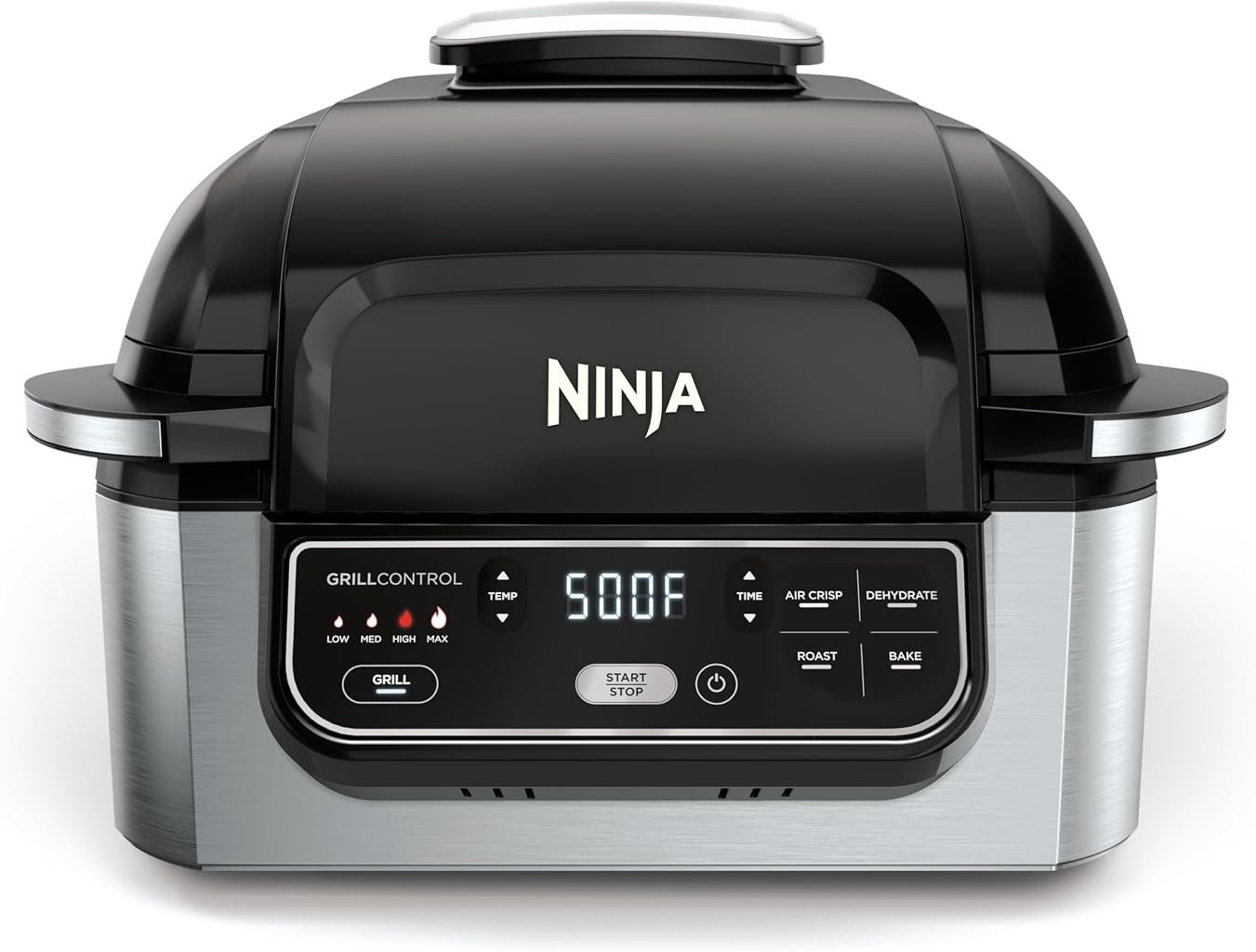
The Ninja Foodi Indoor Grill & Air Fryer AG301 is built around an unusual proposition: the countertop appliance should not merely imitate frying with circulating hot air but also attempt one of the more difficult indoor cooking jobs—high-temperature grilling.
That distinction matters. A conventional basket air fryer directs heated air around food in a compact chamber. An electric indoor grill emphasizes contact with a hot cooking surface, radiant heat, and the management of fat and smoke. Combining those methods in one appliance requires more than adding another button to an air fryer.
The AG301 addresses the problem with a removable grill grate, 4-quart crisper basket, cooking pot, splatter shield, and a 1,760-watt heating system. Ninja documentation lists five cooking settings: Grill, Air Fry or Air Crisp, Roast, Bake, and Dehydrate. The company’s published AG301 specifications also confirm its 1,760-watt rating and dishwasher-safe removable components.
Our score is 9.16/10. Customer Sentiment is also 9.16, Buyer Confidence reaches 9.8, and Value stands at 8.64. Those numbers describe an appliance with an unusually coherent combination of functions. They also reveal where the argument becomes less straightforward: at the $179.99 reference price used in this assessment, the AG301 needs to be used as both a grill and an air fryer to make its strongest economic case.
This is not a compact machine masquerading as a complete cooking station. It is a substantial countertop appliance with removable hardware, a hinged lid, high cooking temperatures, and a design intended to manage the smoke and grease that accompany grilling.
Five Functions With Meaningfully Different Jobs
The AG301’s five primary cooking functions are:
- Grill
- Air Crisp
- Roast
- Bake
- Dehydrate
The distinction between those modes is more meaningful than a long list of food-specific presets.
Grilling and air frying apply heat differently. Roast and Bake expand the appliance toward conventional oven duties. Dehydrate operates at temperatures low enough to remove moisture gradually rather than rapidly brown food.
Ninja’s AG301 quick-start guidance gives those functions separate operating ranges. The documentation lists Air Crisp at 300°F to 450°F, Roast at 250°F to 500°F, Bake at 250°F to 400°F, and Dehydrate at 105°F to 195°F.
That spread makes the AG301 more than an appliance for high-temperature browning. A 105°F dehydration setting and grilling temperatures around 500°F sit at opposite ends of a wide cooking spectrum.
The advantage is versatility. The cost is physical complexity: different foods require different inserts, temperatures, and handling methods.
The Grill Is What Separates the AG301 From Ordinary Air Fryers
The grill grate is the defining piece of hardware.
A typical air fryer suspends food in a perforated basket so hot air can move around it. The AG301’s grill function instead places food on a dense heated grate designed to create direct surface contact.
That changes the cooking process.
Contact with a hot grate can produce localized browning and grill marks that circulating air alone cannot reproduce in exactly the same way. Meanwhile, the enclosed upper section provides heat around the food rather than relying exclusively on the lower cooking surface.
Ninja’s operating guidance divides grilling into several heat levels. Its quick-start documentation lists Low at 400°F, Medium at 450°F, High at 500°F, and Max at temperatures reaching approximately 510°F, with different food categories suggested for each level.
Those temperatures explain why preheating matters.
The grill grate contains substantial thermal mass. Ninja says grill preheating can take approximately eight minutes because of the grate’s density, while Air Crisp, Roast, and Bake preheating takes roughly three minutes.
That waiting period is not wasted ceremony. A properly heated grate stores energy before cold food arrives. Without adequate preheating, the surface temperature can fall sharply when food is added, reducing immediate browning.
Indoor Grilling Still Has to Deal With Smoke
Putting a high-temperature grill indoors creates an obvious engineering problem: smoke.
Fat hitting a very hot surface can vaporize and break down. Marinades containing sugars can scorch. Oils differ considerably in their tolerance for high temperatures. Food debris left near a heating source can burn during later cooking sessions.
The AG301 addresses those issues partly through a removable splatter shield positioned near the heating system.
Ninja’s instructions explicitly connect smoke production with cooking temperature and oil choice. The company recommends higher-smoke-point oils for high-temperature grilling and warns that cooking ingredients above recommended temperatures can produce more smoke.
The splatter shield therefore should not be interpreted as a magical smoke eliminator.
It is part of a smoke-management system. The other components are appropriate heat selection, relatively clean cooking surfaces, sensible oil choice, and regular removal of accumulated grease.
This is one area where expectations deserve restraint. Indoor grilling reduces dependence on weather and outdoor space; it does not repeal the chemistry of heated fat.
Air Crisp Gives the Appliance a Second Identity
Remove the emphasis on grilling and the AG301 becomes a conventional-looking air-frying system built around a 4-quart crisper basket.
The basket sits inside the cooking pot and allows heated air to move around exposed food surfaces. Ninja specifies an Air Crisp range of 300°F to 450°F.
The physical principles are familiar.
Rapidly moving heated air transfers energy to food while helping remove surface moisture. As that exterior becomes drier, browning reactions can proceed more effectively. The result can resemble some characteristics of deep-fried food without immersing ingredients in a reservoir of oil.
The resemblance has limits. Hot oil and hot air transfer heat differently, and air-fried foods should not automatically be expected to reproduce the exact crust produced by deep frying.
For the AG301, the more useful question is whether air frying adds enough functionality to justify the machine’s size.
In many kitchens, it does. The same appliance used for burgers or chicken on the grill can later handle fries, vegetables, breaded foods, or reheated leftovers in the crisper basket.
That combination gives the AG301 a different buyer profile from many of the best air fryers. Its strongest case is not specialization. It is the ability to alternate between direct-contact grilling and high-airflow crisping.
Four Quarts Is Useful but Not Huge
The 4-quart crisper basket places the AG301 below many newer large-capacity air fryers.
That is neither inherently good nor bad.
A smaller basket can be appropriate for modest batches, particularly when ingredients can be distributed without excessive stacking. Air frying depends heavily on exposed surface area, so nominal capacity does not always translate directly into useful cooking capacity.
Four quarts of physical volume does not mean four quarts of fries should be packed densely into the basket.
Ninja’s own guidance tells users not to overcrowd ingredients and recommends arranging food with space for consistent browning. It also recommends checking and shaking the basket during Air Crisp cooking.
That advice reflects airflow rather than branding.
A loosely arranged layer allows moving air to contact more surfaces. A tightly packed pile creates sheltered areas where moisture can accumulate and browning can become less uniform.
For larger households preparing substantial batches, the 4-quart basket is therefore one of the AG301’s more obvious limitations.
The Cooking Pot Broadens the Appliance Beyond Grilling
The removable cooking pot is easy to overlook beside the grill grate and crisper basket, but it supports two of the appliance’s broader functions: roasting and baking.
Roast operates between 250°F and 500°F, according to Ninja’s operating instructions. Bake covers 250°F to 400°F.
These modes turn the enclosed appliance into a small countertop oven.
That can be useful for foods that do not need a grill surface or perforated air-fry basket. Roasted vegetables, smaller proteins, baked dishes, and some desserts fit naturally into this arrangement.
Ninja’s recipe guidance also recommends reducing conventional recipe temperatures by 25°F when adapting foods for Bake or Roast and checking food frequently to avoid overcooking.
That advice reflects the effect of a smaller chamber and active air movement. A countertop convection appliance does not necessarily cook at the same rate as a large conventional oven even when both controls display the same temperature.
Dehydrate Is More Than a Decorative Preset
Dehydrate runs from 105°F to 195°F and does not require the ordinary preheating cycle.
That low-temperature range separates dehydration from ordinary roasting.
The objective is to remove moisture gradually rather than rapidly brown the exterior. Fruit slices, vegetables, and appropriately prepared meats can therefore spend extended periods under relatively gentle heat.
This function will not matter equally to every owner.
Someone with no interest in dried fruit or jerky may never press the button. Yet its presence demonstrates that the AG301’s temperature control extends well below its high-heat grilling identity.
The contrast is unusually broad: the same machine that can operate above 500°F for grilling can run at 105°F for dehydration.
That flexibility contributes to the high overall score, but unused flexibility does not create household value. Buyers should evaluate functions by expected frequency rather than counting them.
The Hood Changes How the Appliance Feels to Use
The AG301 does not use the pull-out drawer associated with conventional basket air fryers.
Its hinged hood opens upward.
That layout makes the cooking surface directly accessible from above, which is logical for grilling. Burgers, steaks, vegetables, and other foods can be turned with tongs without sliding an entire hot basket from the machine.
Ninja also designed the controls so lifting the hood during cooking pauses operation and closing it resumes the cycle.
That behavior encourages inspection.
Grilling benefits from visual judgment. Browning, surface moisture, flare behavior, and grill marks are difficult to reduce to a timer alone.
The disadvantage is vertical clearance.
A hinged hood requires space above the appliance. Kitchens with low cabinets or crowded counters should consider the full opening motion rather than measuring only the closed machine.
This is a recurring lesson with multifunction countertop equipment: usable dimensions are more important than catalog dimensions.
Preheating Is Part of the Cooking Process
The AG301’s preheating requirement deserves emphasis because it directly affects grilling behavior.
Ninja specifies approximately eight minutes for grill preheating due to the density of the grill grate. Air Crisp, Roast, and Bake typically require approximately three minutes.
For users accustomed to air fryers marketed around immediate cooking, eight minutes can feel substantial.
For grilling, however, surface temperature matters.
A cold steak placed on a partially heated grate absorbs energy while simultaneously cooling the metal. If the grate has not stored enough thermal energy, the contact surface can struggle to brown before the interior progresses.
The AG301 therefore behaves more like conventional grilling equipment in this respect than a simple hot-air cooker.
Planning for preheat time is part of obtaining the intended result.
Cleaning Is Better Than the Grill Concept Suggests
Indoor grilling sounds like a cleaning problem because fat, protein residue, and high temperatures form an unpleasant combination.
The AG301 reduces some of that burden through removable components.
Ninja states that the cooking pot, grill grate, and crisper basket use nonstick ceramic coatings and are dishwasher safe. Its regional support documentation also lists dishwasher-safe components as a product specification.
The splatter shield requires particular attention.
Because it sits near the heating area, grease accumulating on the shield can be reheated repeatedly. Ninja’s quick-start instructions recommend removing and cleaning it after each use.
This is not merely cosmetic maintenance. Old grease exposed to grilling temperatures can contribute odors and smoke.
The included cleaning brush has a scraper end intended for stubborn residue, another indication that the manufacturer expects grilling to leave more persistent deposits than ordinary air frying.
The AG301 Is a Large Appliance for a Four-Quart Air Fryer
The machine’s physical size needs to be judged against both of its identities.
Viewed strictly as a 4-quart air fryer, it is large. The grill mechanism, hinged hood, heating assembly, cooking pot, splatter shield, and grate all consume space that a dedicated basket fryer does not need.
Viewed as an indoor grill that also air fries, the dimensions become easier to justify.
This distinction matters when evaluating Value.
A buyer replacing both a countertop grill and an air fryer gains more from the footprint than someone who only needs crisp frozen food.
The AG301 is therefore a poor candidate for kitchens where every centimeter of counter area has to defend itself.
Its size is best justified through frequency and multifunction use.
Our 9.16/10 Score Reflects an Unusually Coherent Combination
Our score is 9.16/10.
That rating reflects how logically the AG301’s major functions work together.
Grilling and air frying are not redundant. One emphasizes a heated contact surface and high-temperature browning; the other emphasizes convection and exposed food surfaces. Roast and Bake extend the appliance toward oven-style cooking, while Dehydrate reaches the opposite end of the temperature spectrum.
The 1,760-watt heating system provides the electrical foundation for those functions, while the removable grill grate, crisper basket, pot, and splatter shield give each mode purpose-built hardware.
The rating does not mean the appliance is universally appropriate.
A 4-quart air-fry basket is modest by current standards. The machine takes substantial counter space. Grilling requires preheating. The splatter shield demands routine cleaning. Smoke can still occur when fatty foods, inappropriate oils, accumulated residue, or excessive temperatures enter the equation.
The AG301 earns its score because the functions complement one another rather than because every compromise disappears.
Customer Sentiment at 9.16 Matches Our Overall Assessment
Customer Sentiment also stands at 9.16, exactly matching our editorial score.
That alignment is significant because product design and ownership experience often diverge.
A technically ambitious appliance can look impressive while proving irritating to use every day. The AG301’s core controls remain relatively understandable despite its multiple functions. Each mode corresponds to a recognizable cooking method rather than an obscure software preset.
Independent kitchen-appliance testing provides useful category context. The Good Housekeeping Institute reports that its Kitchen & Cooking Lab has tested more than 70 air fryers, while its recent indoor-grill work evaluates factors including heating speed, consistency, grease drainage, and cleanup.
Those criteria expose why an indoor grill-air fryer combination should be judged differently from a fryer alone. High-temperature grilling creates grease and smoke-management demands that ordinary air frying does not.
The 9.16 Customer Sentiment rating reflects a design whose everyday compromises remain proportionate to what the machine can do.
Buyer Confidence at 9.8 Is the Highest Score
Buyer Confidence reaches 9.8.
The AG301 has a well-established product identity and unusually accessible operating documentation. Ninja publishes the five cooking functions, 1,760-watt rating, dishwasher-safe component guidance, and operating instructions for each mode.
The controls and accessories are also clearly defined.
That matters because multifunction appliances can become confusing when closely related variants share similar names but differ in capacity, probes, presets, or included accessories.
The AG301’s documentation makes its boundaries relatively easy to establish. It is a five-function grill-and-air-fryer platform rather than one of Ninja’s later XL grill variants with different hardware.
A 9.8 Buyer Confidence score reflects that clarity. It does not predict individual product longevity or eliminate ordinary manufacturing variability.
Value at 8.64 Is Strong but More Conditional
Value is 8.64 at the $179.99 reference price.
That score sits below the 9.16 overall rating for a simple reason: the AG301’s economic logic depends heavily on using both sides of its identity.
As an indoor grill and air fryer in regular rotation, the machine can replace two separate countertop appliances while also covering roasting, baking, and dehydration.
As a 4-quart air fryer alone, the argument is much weaker.
Dedicated air fryers can provide larger baskets in smaller or simpler bodies. Buyers who never use Grill effectively devote counter space and money to a substantial amount of idle hardware.
The reverse is also true. Someone who grills regularly but occasionally wants fries, roasted vegetables, or reheated breaded foods gains considerably more utility.
Value therefore comes from consolidation, not the raw number of buttons.
Who Is Likely to Benefit Most
The AG301 is particularly well suited to households that want indoor grilling but also expect an air fryer to remain in frequent use.
Apartment dwellers and households without convenient outdoor grilling space may find the enclosed grill format especially relevant, provided ventilation and smoke management are handled sensibly.
It also suits cooks who prepare moderate quantities rather than very large batches.
The 4-quart basket is adequate for many everyday air-frying jobs but does not compete with today’s larger dual-basket machines for sheer throughput.
The grill format favors foods that benefit from direct contact with a heated grate: burgers, chicken, vegetables, seafood, and similar items.
Roast, Bake, and Dehydrate add flexibility, but they should be regarded as secondary reasons for ownership rather than excuses to purchase a machine whose primary grill and air-fry functions will rarely be used.
Who Should Choose Another Format
Large families focused mainly on air frying should look carefully at capacity.
A 4-quart basket can require multiple batches when feeding several people. Batch cooking erodes one of air frying’s main conveniences because the first portion may cool while the next is still cooking.
People with limited counter space should also consider a conventional basket fryer.
The AG301’s hinged architecture and grilling hardware make it physically substantial relative to its air-fry capacity.
Likewise, buyers expecting outdoor-grill behavior without indoor-grill compromises should moderate expectations. There is no open flame, charcoal, or wood combustion. The heat environment and flavor development are different.
The AG301 is an electric indoor grill, not a miniature backyard barbecue.
Better Results Begin With Matching the Function to the Food
The AG301 performs several kinds of cooking, and results depend on choosing the appropriate one.
Grill should be reserved for foods that benefit from high surface heat and grate contact. Preheating should be completed before food is added.
Air Crisp works best when food is distributed with room for moving air. The basket should be shaken or ingredients turned when necessary for more even browning.
Roast and Bake can handle foods ordinarily assigned to an oven, but Ninja’s own guidance recommends reducing conventional recipe temperatures by 25°F and checking progress frequently.
Dehydrate requires a different mindset entirely. Low heat and time replace aggressive browning.
Cleaning should also be treated as part of cooking rather than a deferred chore. The splatter shield in particular benefits from attention after grilling sessions, before repeated heating hardens accumulated grease.
These habits do not require culinary expertise. They simply acknowledge that a multifunction appliance contains several cooking systems rather than one universal mode.
Final Considerations
The Ninja Foodi Indoor Grill & Air Fryer AG301 succeeds conceptually because its two headline functions address genuinely different cooking jobs.
The grill grate provides direct-contact high-temperature cooking, with Grill settings reaching approximately 500°F and beyond at the highest setting. The 4-quart crisper basket provides the open structure required for effective convection-based Air Crisp cooking. The removable pot supports roasting and baking, while the 105°F-to-195°F Dehydrate range extends the machine into low-temperature food preparation.
The trade-offs are equally tangible.
The AG301 is large for a 4-quart air fryer. Grilling introduces preheating time and grease management. The splatter shield requires regular cleaning. Larger households may find themselves cooking air-fried food in batches. The hinged hood also requires sufficient vertical clearance.
Our score of 9.16/10 reflects how well the functions complement one another rather than pretending those limitations do not exist. Customer Sentiment at 9.16 mirrors that assessment, suggesting an ownership proposition in which the compromises remain proportionate to the capabilities. Buyer Confidence at 9.8 reflects clear documentation and a well-defined model identity. Value at 8.64 recognizes that the $179.99 reference price is easiest to justify when Grill and Air Crisp both receive regular use.
That last distinction defines the AG301.
Someone shopping exclusively for an air fryer can find simpler equipment with more basket capacity. Someone seeking only a grill can avoid paying for dehydration, baking, roasting, and air-frying hardware.
The AG301 makes far more sense in the overlap.
It is for the kitchen where burgers might be grilled one evening, vegetables air-crisped the next, chicken roasted later in the week, and fruit dehydrated when time permits. Its value comes not from pretending that one heating method can do everything, but from putting several genuinely different heating arrangements into one countertop machine.
That is a more demanding engineering proposition than adding presets to an ordinary fryer. It is also why the AG301 remains an unusually coherent example of the grill-air-fryer combination: the appliance’s complexity is attached to physical cooking differences that a user can actually exploit.