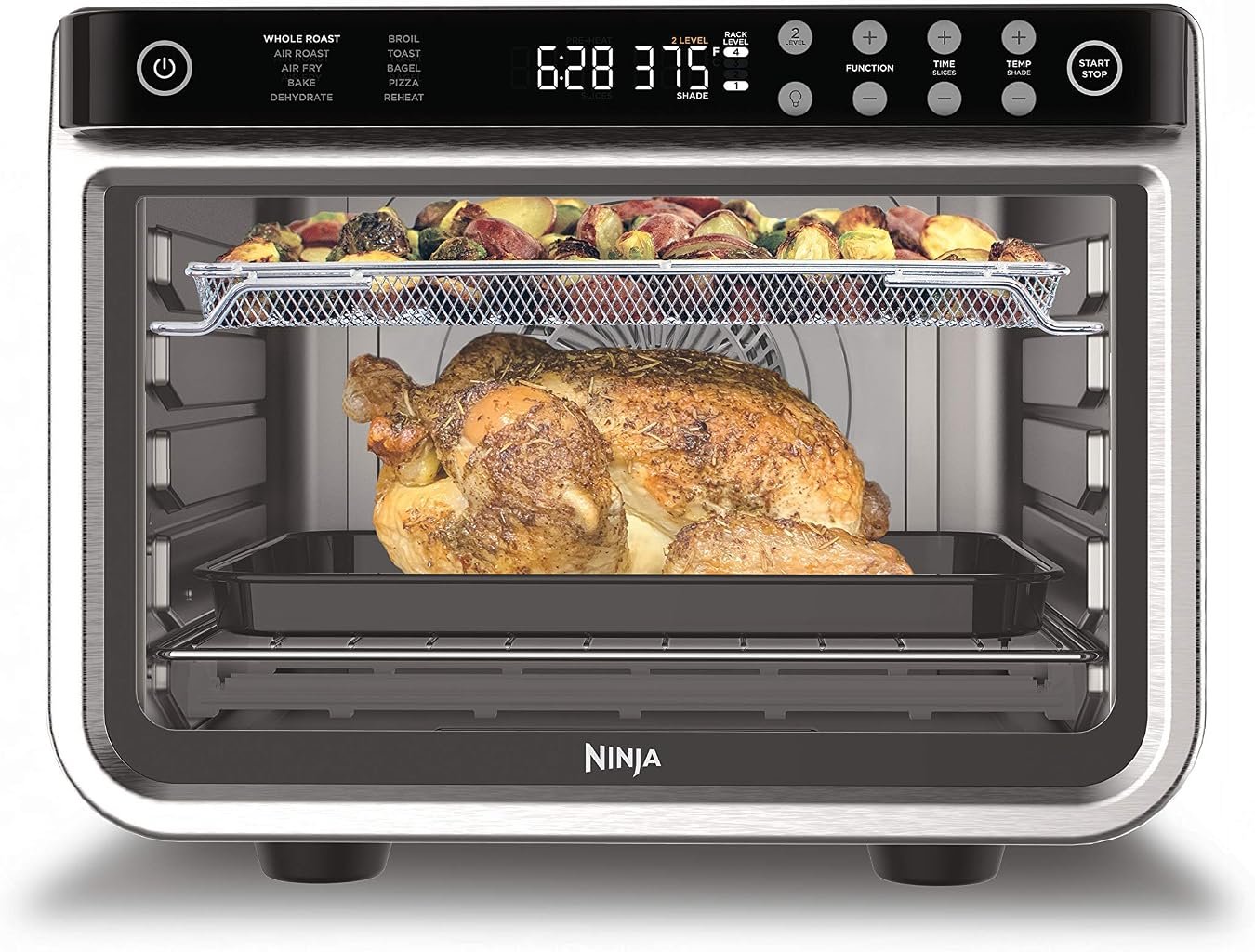
The Ninja Foodi XL Pro Air Fry Oven DT201 sits in an increasingly crowded category: countertop appliances expected to replace several other appliances without becoming cumbersome compromises themselves. Its proposition is straightforward. Rather than build a conventional basket air fryer and add a few secondary presets, Ninja built a large countertop convection oven around high-velocity airflow, multiple rack positions, and ten cooking functions.
That distinction matters. The DT201 is not merely an oversized air fryer. It is a 1,800-watt countertop oven with Air Fry, Air Roast, Whole Roast, Bake, Broil, Toast, Bagel, Pizza, Dehydrate, and Reheat modes. Independent measurements from RTINGS’ DT201 evaluation put its chamber at approximately 21 liters, with four tray positions and enough width for a 12-inch pizza. Its external dimensions are roughly 20.2 inches wide, 17.1 inches deep, and 13.3 inches high.
Those numbers explain both the machine’s appeal and its central weakness. This is a large appliance. The DT201 makes its strongest argument in kitchens where capacity and versatility matter more than preserving every square inch of countertop.
Our score is 8.55/10. Customer Sentiment stands at 8.28, Buyer Confidence at 9.8, and Value at 8.15. Taken together, those ratings describe a product with a well-established identity and considerable cooking flexibility, but one whose physical scale and price require more thought than the purchase of a compact basket air fryer.
What the DT201 Actually Is
The language surrounding modern countertop ovens can become muddy. Air fryer, convection oven, toaster oven, roaster, dehydrator, and pizza oven increasingly appear on the same box. Strip away the branding, however, and the DT201 is fundamentally a large forced-convection countertop oven.
Its defining feature is Ninja’s True Surround Convection system. Airflow is central to the design rather than treated as a secondary mode. Documentation for the DT201 describes a seven-inch fan capable of airflow up to 130 cubic feet per minute, with a rear heat source supplementing the top and bottom heating elements. Its stated temperature range extends from 85°F to 450°F.
That architecture helps explain why the machine can move between jobs that would otherwise be divided among separate appliances. High heat and aggressive airflow suit air frying and roasting; lower temperatures accommodate dehydration; conventional heating modes cover baking, pizza, toast, and reheating.
The ten functions are:
- Air Fry
- Air Roast
- Whole Roast
- Bake
- Broil
- Toast
- Bagel
- Pizza
- Dehydrate
- Reheat
The distinction between modes is more meaningful than the sheer number suggests. A buyer who routinely reheats leftovers, toasts bread, roasts vegetables, bakes frozen foods, cooks pizza, and air-fries potatoes has a plausible reason to use much of the control panel. Someone who wants only crisp fries and chicken wings is paying for considerably more appliance.
Capacity Is the Main Event
Capacity is where the DT201 separates itself most clearly from conventional basket machines.
Ninja’s published claims, also reproduced by major retailers, state that the oven can accommodate a five-pound chicken alongside a sheet pan of vegetables, two 12-inch pizzas, or a 12-pound turkey. It is designed for two-level cooking rather than forcing everything into one shallow basket.
RTINGS measured the cooking chamber at about 14 inches wide and 12.6 inches deep, producing roughly 176 square inches of chamber area, with approximately 8.3 inches of usable height. The publication also found room for nine slices of bread and a 9-by-13-inch sheet pan.
That geometry changes how the appliance fits into meal preparation.
Basket air fryers are exceptionally convenient when cooking one food in a relatively contained batch. An oven-style appliance spreads food across a wider surface and can use separate levels. For households preparing a protein and vegetables simultaneously, that configuration can be more useful than raw basket volume.
The trade-off arrives before the cooking begins: the DT201 demands permanent-looking counter space. Its footprint is substantial enough that measuring the intended location before purchase is not bureaucratic caution; it is sensible kitchen planning.
Cabinet clearance, depth, door movement, access to the crumb tray, and surrounding ventilation all deserve consideration. A machine can technically fit on a counter yet still make that counter unpleasant to use.
Air Frying Versus a Basket Air Fryer
Anyone comparing the DT201 with the best air fryers should first decide which format better matches the food normally being cooked.
A dedicated basket air fryer has a mechanical advantage in simplicity. Pull out the basket, add food, cook, shake when necessary, and remove it using an exterior handle. The cooking cavity is comparatively compact, so concentrated airflow and rapid heating can work efficiently on smaller batches.
An air-fry oven trades some of that intimacy for surface area and flexibility.
That difference is visible in independent testing of comparable Ninja oven-style designs. Good Housekeeping’s discussion of Ninja’s larger XL Pro format found that the tested Smart version took longer to air-fry wings than the company’s Max XL basket fryer, with the publication suggesting the larger capacity as a likely reason. The same testing praised the XL oven’s ability to handle a whole chicken and its straightforward controls.
This is a useful distinction rather than an indictment of either design. A buyer seeking the fastest route to a modest quantity of fries does not necessarily need a large oven. A household trying to roast a chicken, bake pizza, toast bread, reheat yesterday’s dinner, and air-fry vegetables with one countertop appliance has a different problem to solve.
The DT201 is built for the latter.
Two-Level Cooking Makes the Size More Defensible
A large exterior is easier to justify when the interior space is genuinely usable.
The DT201 provides four rack positions, while its controls indicate appropriate rack placement according to the selected function. The digital rack guidance is more than decorative interface design because rack height changes exposure to the heating elements and moving air.
Two-level cooking also addresses one of the ordinary limitations of small air fryers: usable cooking surface.
Packing food too tightly works against air frying because moving hot air needs access to exposed surfaces. A larger oven can spread ingredients rather than stack them. For batch cooking, sheet-pan meals, and households feeding several people, that can be more useful than a deep but crowded basket.
The DT201 therefore rewards a particular style of cooking. It favors people who think in trays, racks, pizzas, roasts, and multi-component meals rather than isolated basket loads.
Speed Requires Some Context
Ninja advertises a 90-second preheat and cooking up to 30% faster than a traditional full-size convection oven. Those are manufacturer comparisons, not universal guarantees; food type, starting temperature, load, rack position, and cooking temperature all affect actual time.
Still, the underlying idea is credible from an engineering perspective. A countertop chamber contains far less air and thermal mass than a full-size kitchen oven. Heating a smaller enclosure can reduce the time between deciding to cook and actually cooking.
The practical benefit is most obvious during ordinary weekday tasks. Heating a full-size oven for a modest tray of vegetables, several slices of pizza, or a small baked dish can feel disproportionate to the meal. A countertop oven reduces the scale of the equipment brought to bear on the job.
Speed should not, however, be reduced to preheating alone. Air movement, food arrangement, quantity, and temperature recovery after opening the door all influence total cooking time. The DT201’s case rests less on one dramatic stopwatch figure than on reducing friction across many smaller cooking jobs.
The Digital Handle Is Smarter Than It Looks
One of the more distinctive elements is the digital display integrated into the door handle.
The design does two things. It places controls at an easy viewing angle, and the settings freeze when the door opens, reducing the chance of accidental changes while handling food. The display also illuminates recommended rack positions according to the selected cooking function.
That is thoughtful interface design because multifunction appliances can become surprisingly irritating when their controls require constant consultation of a manual.
Ten cooking modes create complexity whether the manufacturer admits it or not. The DT201 reduces some of that complexity by giving rack placement visual guidance rather than expecting users to memorize which of four positions suits each function.
There remains a learning period. Anyone moving from a conventional oven must adapt to stronger airflow, a smaller chamber, closer heating elements, and potentially shorter cooking cycles. Familiar recipes may need time or temperature adjustments.
The machine does not remove cooking judgment. It attempts to make that judgment easier.
Cleaning Is the Less Glamorous Side of the Format
Air fryers create a peculiar cleaning problem: the airflow responsible for crisping food can also move aerosolized grease around the cooking chamber.
A basket machine contains much of that mess in a removable drawer and basket. An oven-style air fryer gives grease and crumbs a larger interior in which to travel.
The DT201 includes a removable crumb tray, which helps with loose debris, and the accessory set includes an air-fry basket, roast tray, sheet pans, and wire racks.
Yet buyers should not confuse a removable crumb tray with a self-cleaning interior. Foods that spit, drip, or release substantial fat will require attention.
This is one area where cooking technique matters almost as much as appliance design. Using the appropriate roast tray beneath fatty foods can catch drippings before they reach lower surfaces. Cleaning residue before repeated high-temperature cycles can also prevent old grease from becoming progressively harder to remove.
For households accustomed to wiping down a conventional oven only occasionally, an air-fry oven may require a change of habit. Frequent light cleaning is generally less troublesome than infrequent heavy cleaning.
What the Scores Say
Our 8.55/10 score places the DT201 firmly in the high-performing end of multifunction countertop cooking appliances. The rating reflects a machine with unusually broad cooking utility and genuine family-scale capacity, tempered by the consequences of making an appliance this large.
Customer Sentiment at 8.28 is slightly lower. That gap is informative. Products can be technically capable while imposing everyday inconveniences that specifications cannot erase. Footprint, cleanup, learning new cooking times, accessory handling, and the general presence of a large appliance on the counter all affect satisfaction.
Buyer Confidence is considerably higher at 9.8. The DT201 is not difficult to understand as a product proposition. Its function set is clearly defined, the DT200 series is well documented, and its specifications can be independently cross-checked. SharkNinja’s own patent documentation identifies the DT200 series as the Ninja Foodi 10-in-1 XL Pro Air Fry Oven family.
Value receives 8.15. At the $219.99 reference price used for this assessment, the economics make the most sense when several functions will genuinely be used. Value deteriorates rapidly if the machine spends its life performing one task that a smaller air fryer could handle.
That distinction deserves emphasis. More functions do not automatically create more value. Used functions do.
Where the DT201 Makes Sense
The strongest buyer fit is a household trying to consolidate countertop cooking equipment.
A kitchen that currently relies on a toaster, air fryer, and full-size oven for small meals can potentially shift a considerable portion of that work to the DT201. Pizza, toast, roasted vegetables, reheated leftovers, baked foods, air-fried snacks, and larger roasts all fall within its intended workload.
Its scale also suits batch preparation. Two-level cooking can make more sense for meal preparation than repeatedly cycling smaller basket loads.
There is another, less obvious use case: warm climates. Running a smaller countertop oven instead of heating a large conventional oven can make kitchen cooking more localized. The precise energy and room-temperature effect varies by appliance, cooking duration, and household conditions, so sweeping efficiency claims would be unwarranted, but the smaller cooking chamber is an intuitively useful option when a full oven would be excessive.
Where a Smaller Air Fryer Is Better
The DT201 should not be treated as the default answer merely because it can perform more tasks.
For one- or two-person households primarily interested in fries, vegetables, wings, frozen snacks, or reheating small portions, a basket air fryer is easier to accommodate. It generally occupies less space and reduces the number of racks and trays involved in everyday use.
The DT201 is also difficult to justify in a kitchen already equipped with an effective convection wall oven and a good toaster unless its air-frying capacity or countertop convenience fills a specific gap.
Its size is not an incidental drawback. RTINGS’ physical measurements describe an appliance more than 20 inches across and roughly 17 inches deep. Once clearance and working space are considered, the practical commitment is larger still.
This is why capacity must be evaluated as both an asset and a cost. An XL oven with half-empty racks is simply a large oven.
How to Get Better Results From It
The DT201 rewards airflow management. Food intended to crisp should be spread rather than piled densely. Crowding reduces exposed surface area and can create uneven browning.
Rack position deserves equal attention. Broiling requires proximity to upper heat; large roasts need vertical clearance; air frying benefits from airflow around the basket; baking demands a more balanced relationship with the heating elements. The illuminated rack guidance exists for a reason.
Users should also approach familiar recipes cautiously during the first several cooks. Convection can change browning rate and moisture loss. Checking food earlier than a conventional-oven recipe suggests is more sensible than assuming identical timing.
For meat and poultry, food safety should be determined by internal temperature rather than appearance or a timer alone. The U.S. Department of Agriculture advises cooking poultry to a safe minimum internal temperature of 165°F, measured with a food thermometer. That principle matters regardless of whether heat comes from a basket fryer, countertop oven, or full-size range.
Finally, cleaning should be treated as part of cooking rather than deferred maintenance. Emptying crumbs and wiping fresh grease is considerably easier than removing residue after repeated exposure to high heat.
The DT201’s Real Competition
The most revealing comparison is not necessarily another XL countertop oven. It is the combination of appliances a household already owns.
If a kitchen has limited counter space but already possesses a capable oven, a compact air fryer may produce a more rational arrangement. If the conventional oven is rarely used because it is slow to preheat or oversized for ordinary meals, the DT201 becomes more compelling.
That is also why comparisons based only on air-frying speed miss part of the product’s purpose.
A basket fryer can be better at being a basket fryer. The DT201’s argument is that one appliance can accept compromises at the edges while handling a much broader range of daily cooking.
Its 8.55/10 overall score reflects that balance. This is not an appliance whose appeal rests on a single spectacular trick. Its strength is the accumulation of useful functions around a genuinely large cooking chamber.
Final Considerations
The Ninja Foodi XL Pro Air Fry Oven DT201 is best understood as a countertop oven that happens to take air frying seriously, rather than an air fryer stretched into oven proportions.
Its 1,800-watt power system, ten cooking modes, four rack positions, two-level cooking design, roughly 21-liter chamber, and 12-inch pizza capacity give it far more flexibility than the conventional pull-out-basket format. The digital handle and rack guidance also make a complicated appliance more approachable.
The costs are equally tangible. It consumes substantial countertop space. Oven-style air frying involves more trays and exposed interior surfaces to clean. Small batches do not exploit its capacity. Buyers who already own strong convection equipment may discover considerable overlap.
That tension explains the ratings well. Our score of 8.55/10 reflects substantial capability. Customer Sentiment of 8.28 acknowledges that everyday ownership carries friction. Buyer Confidence of 9.8 reflects a mature, clearly documented product proposition. Value at 8.15 indicates good economics for households that will actually use its breadth rather than merely admire ten buttons.
For a family trying to move roasting, air frying, toast, pizza, reheating, baking, and smaller oven meals onto one countertop platform, the DT201 has a coherent purpose. For someone seeking only fast, crisp food in small quantities, its scale works against it.
The decisive question is therefore not whether the Ninja Foodi XL Pro DT201 can do enough. It plainly can. The question is whether a particular kitchen has enough work for it to do.