Air fryers have spent years migrating from specialized countertop machines into increasingly ambitious multicookers. The Cuisinart Air Fryer Toaster Oven TOA-70NAS sits squarely in the second camp. It is not merely an air fryer with a larger door. It is an 1,800-watt countertop oven combining eight cooking functions, a 0.6-cubic-foot interior, a three-pound air-frying capacity and a reversible grill/griddle plate.
That breadth immediately changes the question a buyer should ask. Rather than simply wondering whether the TOA-70NAS can crisp potatoes, the more useful question is whether one countertop appliance can reasonably take responsibility for air frying, baking, convection baking, broiling, convection broiling, warming, toasting and grilling.
Our score is 8.55/10. Customer Sentiment stands at 8.28/10, Buyer Confidence at 9.8/10 and Value at 8.15/10. The spread between those figures tells an interesting story. This is an unusually well-defined product with a broad feature set and clearly documented specifications, but its value depends heavily on whether a household actually needs the additional cooking modes and larger oven-style footprint.
The TOA-70NAS is therefore best understood not as a basket air fryer enlarged for the countertop, but as a compact convection oven that has absorbed the air fryer’s most useful trick.
Eight Cooking Modes Change The Proposition
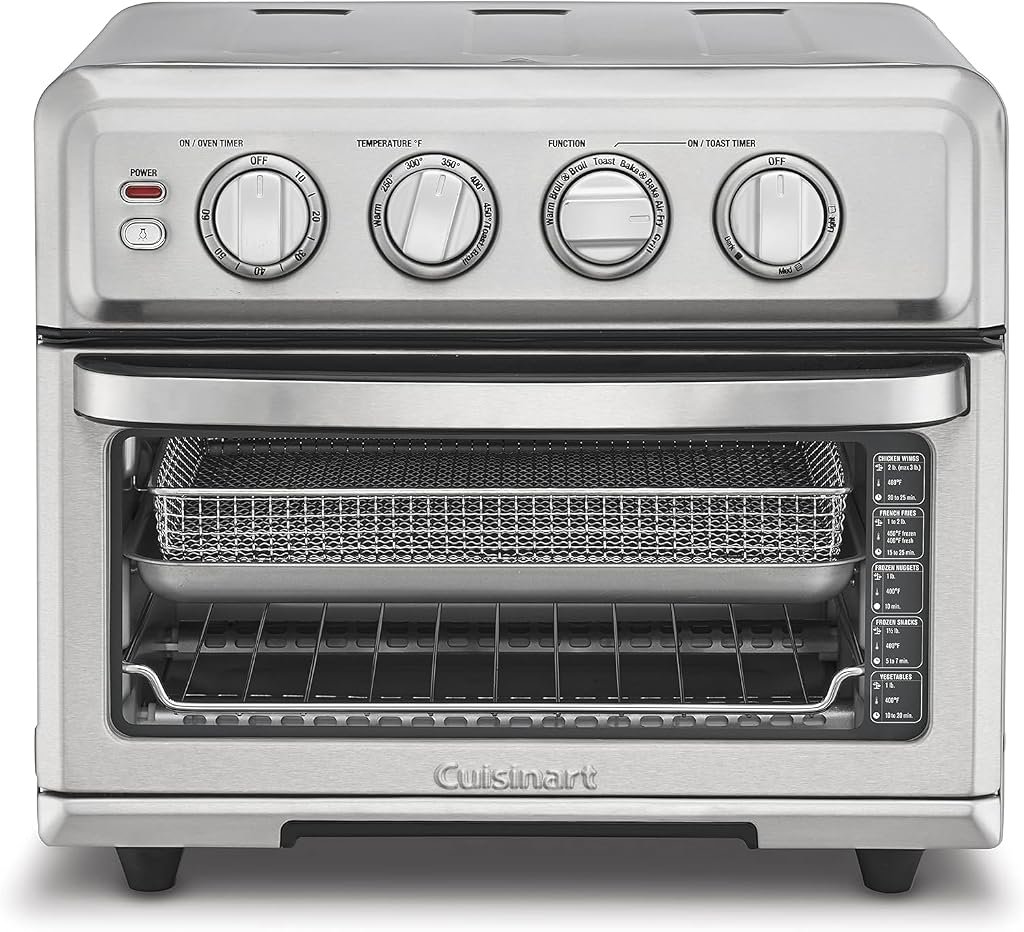
Cuisinart’s official TOA-70NAS specifications list eight functions: Air Fry, Convection Bake, Convection Broil, Bake, Broil, Warm, Toast and Grill. The oven reaches 450°F, incorporates a 60-minute timer with automatic shutoff and provides a separate toast-shade selector.
That is a materially different proposition from a dedicated basket air fryer.
A basket model is built around a narrow objective: circulate hot air rapidly around food inside a relatively confined chamber. The TOA-70NAS retains forced-air cooking but places it inside an oven-style architecture. That means racks, pans, a glass door and a cooking chamber designed for several forms of food preparation.
This architecture creates versatility without requiring digital complexity. The appliance’s controls are relatively conventional. Rather than navigating a touchscreen interface containing numerous food-specific presets, the user selects functions and settings directly.
There are consequences to that decision.
A household accustomed to one-touch programs for fries, chicken, vegetables or reheating may regard manual controls as a step backward. A cook who dislikes navigating menus may interpret exactly the same interface as an advantage. Neither position changes the underlying design: the TOA-70NAS expects the person cooking to make more decisions than many modern digital air fryers do.
That approach suits a multipurpose oven particularly well because baking, broiling, grilling and toasting are difficult to reduce to universal presets. A thick piece of bread behaves differently from a thin slice. A refrigerated steak does not cook like one approaching room temperature. Vegetables vary substantially in water content and dimensions.
Automation can simplify cooking, but direct control remains useful when the food itself refuses to be standardized.
The 0.6-Cubic-Foot Interior Is The Center Of The Design
Capacity is where the TOA-70NAS begins separating itself from compact basket machines.
Cuisinart specifies a 0.6-cubic-foot interior and an air-frying capacity of three pounds. The complete appliance measures 12.25 inches long, 15.75 inches wide and 13.75 inches high, with a listed weight of 23 pounds.
Those dimensions demand more countertop commitment than a genuinely small air fryer.
That is neither automatically positive nor negative. Countertop appliances exist in a constant negotiation between cooking capacity and physical inconvenience. A machine can be wonderfully spacious until someone needs to fit a coffee maker beside it. Conversely, an exceptionally small appliance loses much of its appeal if dinner requires three consecutive cooking batches.
The TOA-70NAS lands in the middle of that argument.
Its three-pound air-fry capacity is substantial enough for normal household portions without pushing the appliance into the dimensions of the largest countertop ovens. Yet this is not an appliance to purchase without measuring the intended location first. At nearly 16 inches wide and weighing 23 pounds, it makes more sense as a semi-permanent countertop resident than something routinely carried in and out of a cabinet.
This distinction matters when comparing the best air fryers. Capacity figures tell only part of the story. A buyer also has to decide how much kitchen space can reasonably be dedicated to the appliance delivering that capacity.
Air Frying Is Only One Part Of Its Identity
Air frying is essentially high-intensity convection cooking. Heated air moves rapidly around exposed food surfaces, promoting evaporation and browning while requiring far less cooking oil than deep-fat immersion for many preparations.
The TOA-70NAS uses a top fan and heater assembly that Cuisinart describes under its AirAdvantage technology. The manufacturer says the system circulates heated air around food for cooking and crisping.
That description should not be stretched into claims that every food will emerge indistinguishable from deep-fried food. Air frying and deep frying transfer heat differently, and the resulting crust, moisture behavior and flavor can differ.
The more useful comparison is between air frying and conventional oven cooking.
A relatively compact cavity with concentrated airflow can be practical for foods such as potatoes, vegetables, wings and reheated breaded items because the user does not have to heat a full-size kitchen oven. The TOA-70NAS then extends that same chamber to baking, broiling and toasting.
This is where the appliance’s concept becomes coherent. Air frying is not bolted onto an unrelated machine. It sits alongside several cooking methods that already benefit from controlled dry heat.
The Grill/Griddle Plate Is More Than An Accessory
The reversible grill/griddle plate is one of the TOA-70NAS’s more distinctive components.
Cuisinart includes a dual-sided ceramic nonstick plate alongside the oven rack, baking pan and air-fryer rack/basket. One surface is intended for grilling, while the opposite surface functions as a griddle. The manufacturer also states that the current model has no intentionally added PFAS.
The plate broadens the machine’s practical vocabulary.
A conventional air-fryer basket is designed primarily to expose food to circulating air. A solid cooking surface addresses a different task: direct contact between food and a heated plate. That makes the Grill mode conceptually useful for foods where surface contact is desirable.
The griddle side similarly expands breakfast and flat-surface cooking possibilities.
Still, expectations need discipline. A countertop grill plate operating inside an enclosed electric appliance is not identical to an outdoor grill over charcoal or gas. Smoke production, radiant heat, surface area and cooking environment differ substantially.
The value is therefore not imitation of outdoor grilling. It is having a reversible contact-cooking surface integrated into an appliance already capable of several dry-heat methods.
That distinction prevents a useful feature from becoming an exaggerated promise.
1,800 Watts And A 450°F Ceiling
The TOA-70NAS is rated at 1,800 watts and has an adjustable temperature control reaching 450°F.
Those figures place it firmly in countertop-oven territory.
For buyers, the 450°F ceiling matters because higher temperatures support rapid surface browning, broiling and the crisping associated with air frying. Yet maximum temperature should not be confused with the ideal temperature for every food.
High-temperature cooking deserves particular care with starchy foods.
The U.S. Food and Drug Administration explains that acrylamide can form in certain plant foods during high-temperature processes such as frying, roasting and baking. Its guidance states that longer cooking and higher temperatures generally produce more acrylamide and recommends cooking cut potato products to a golden-yellow rather than brown color when attempting to reduce formation. The FDA also reports that soaking raw potato slices in water for 15 to 30 minutes before frying or roasting can help reduce acrylamide formation.
That is not an issue unique to Cuisinart or even to air fryers. It is chemistry associated with certain foods and high-temperature cooking.
For practical purposes, the lesson is simple: crisp does not have to mean extremely dark. The ability to reach 450°F provides flexibility, but intelligent cooking still requires matching temperature and duration to the food.
Toasting And Broiling Matter More Than They First Appear
Air-fryer discussions often focus so heavily on fries and wings that the toaster-oven half of a combination appliance receives surprisingly little attention.
Yet Toast and Broil are precisely the functions that can justify leaving a machine this size permanently on the countertop.
Toast is repetitive. A household may use it every morning. Broiling is useful for surface browning, melting cheese and finishing foods. Warm can keep prepared dishes at serving temperature. Bake can handle routine oven tasks without heating a larger range oven.
This pattern changes the economic logic of the appliance.
An air fryer used twice a week is a specialized machine. A device used for toast every morning, reheating at lunch and cooking vegetables or protein at dinner becomes part of the kitchen’s daily infrastructure.
That distinction helps explain our 8.15/10 Value score. The TOA-70NAS carries a reference price of $219.95, which is not trivial for a countertop appliance. The price becomes easier to justify when several functions replace meaningful use of other appliances. It becomes harder to defend when the buyer primarily wants an air fryer for occasional frozen fries.
Value, in this case, is inseparable from utilization.
Manual Controls Versus Digital Convenience
The TOA-70NAS largely avoids the touchscreen aesthetic common among contemporary kitchen appliances.
This creates a revealing trade-off.
Digital interfaces can provide precise countdowns, memory functions and visually explicit presets. They can also create layers of interaction for tasks that fundamentally require selecting heat and time.
The Cuisinart approach is more mechanical and immediate.
For an experienced cook, that can make the appliance feel familiar. For someone expecting highly automated cooking, it may feel comparatively basic.
Our assessment favors neither control philosophy universally. The relevant question is repeatability. If several household members need identical one-button workflows, digital presets can reduce uncertainty. If the primary user tends to adjust cooking according to appearance and food characteristics, physical controls can be perfectly suitable.
The presence of a dedicated toast-shade selector also reflects the machine’s toaster-oven ancestry. Toasting is treated as a recurring cooking task rather than an afterthought buried inside a general-purpose menu.
The Included Accessories Are Properly Matched To The Functions
A multifunction oven becomes frustrating if switching functions requires buying additional hardware immediately.
Cuisinart includes an oven rack, baking pan, air-fryer rack/basket and reversible grill/griddle plate.
That combination supports the major advertised cooking formats from the start.
The air-fryer basket promotes exposure to moving air. The baking pan provides a solid surface for foods unsuitable for an open basket. The rack supports conventional oven cookware and food placement. The grill/griddle plate creates the contact surface required for its namesake mode.
Cuisinart also lists replacement components separately, including the basket, baking pan, wire rack, crumb tray and grill plate.
Replaceable accessories matter over a long ownership period because racks, pans and trays experience more direct physical wear than the oven housing itself. A damaged or heavily worn accessory need not automatically render the entire appliance unusable.
Cleaning Is The Less Glamorous Side Of Versatility
The TOA-70NAS can handle greasy foods, crumbs, cheese, breading, baked goods and grilled ingredients. Predictably, those capabilities generate cleanup.
A basket-only air fryer can sometimes simplify washing because most food contact occurs within a removable drawer and basket. An oven-style machine distributes cooking across racks, trays, baskets, walls and a glass door.
The TOA-70NAS therefore rewards routine maintenance.
Crumbs should not be allowed to accumulate indefinitely. Grease from air-fried or grilled foods should be addressed before repeated heating turns residue into a more stubborn film. The glass door is also likely to reveal splatter more readily than an opaque basket machine does.
None of this makes the design unusually difficult. It is simply the maintenance profile of a multifunction countertop oven.
Buyers choosing between architectures should consider cleanup alongside cooking capacity. A larger chamber and more cooking surfaces increase flexibility, but every additional surface eventually needs attention.
Where The TOA-70NAS Makes Its Strongest Case
The machine’s strongest argument is consolidation.
Eight cooking functions, a three-pound air-fry capacity, 0.6 cubic feet of interior volume, a reversible grill/griddle plate and a 450°F maximum temperature give the TOA-70NAS enough range to handle genuinely different kitchen jobs.
It can therefore make particular sense in households where a toaster oven already deserves permanent countertop space.
Replacing an ordinary toaster oven with one that also air fries and grills is a different proposition from finding space for an additional dedicated air fryer. The former can consolidate equipment; the latter adds another appliance to an already crowded counter.
This is also why comparisons based solely on air-fryer capacity can miss the point.
A basket fryer might be smaller, simpler and cheaper. It might also be the better choice for a household interested almost exclusively in air frying. The Cuisinart becomes more compelling as the number of regularly used cooking modes increases.
Where It Gives Ground
The first limitation is physical size.
At 15.75 inches wide and 23 pounds, the TOA-70NAS requires a meaningful allocation of countertop space. Buyers in extremely small kitchens should measure first rather than assuming that the phrase “toaster oven” implies a modest footprint.
The second limitation is interface preference.
Those wanting a large digital display, numerous automatic food programs or app-style interaction will not find that philosophy here. The TOA-70NAS favors direct controls.
Third, multipurpose machines inevitably ask users to manage accessories. The air-fryer basket, baking pan, rack and grill/griddle plate need storage when they are not in use. Consolidating appliances does not eliminate physical kitchen equipment; it simply changes its form.
Fourth, three pounds of air-frying capacity is generous enough for many households but does not remove batch-size limits. Large gatherings or high-volume meal preparation can still require multiple cooking cycles.
Finally, no multifunction machine should be purchased merely because its feature count is high. Eight modes have economic value only when those modes correspond to actual cooking habits.
Reading The Editorial Scores
Our overall score of 8.55/10 reflects a machine with a broad but logically connected set of capabilities.
Buyer Confidence is highest at 9.8/10. That figure reflects the clarity of the ownership proposition. Cuisinart documents an 1,800-watt power rating, 0.6-cubic-foot interior, three-pound air-fry capacity, 450°F maximum temperature, eight cooking functions, included accessories and a three-year limited warranty.
There is comparatively little ambiguity about what the appliance is designed to do.
Customer Sentiment, at 8.28/10, sits lower. That difference is reasonable for a multifunction appliance because personal fit matters considerably. A 23-pound countertop oven will delight someone who uses it several times daily and annoy someone who merely wanted a compact basket for occasional fries.
Value receives 8.15/10, the lowest of the three supporting scores but still a healthy result. At $219.95, this is not positioned as an entry-level air fryer. The economic argument rests on replacing or reducing reliance on multiple cooking devices.
The overall 8.55/10 score consequently reflects capability without pretending that capability automatically equals necessity.
Who Is The TOA-70NAS For?
The TOA-70NAS makes the most sense for buyers who want an air fryer but do not want air frying to be the appliance’s only serious job.
It is particularly well suited to households replacing an existing toaster oven, cooks who regularly bake or broil smaller portions, people who value a visible oven cavity, and kitchens where a single multifunction appliance is preferable to several specialized machines.
It also suits cooks interested in a grill/griddle function but unwilling to dedicate additional countertop space to a separate electric griddle or indoor grill.
The buyer profile changes when air frying is the overwhelming priority.
Someone interested mainly in fast preparation of modest portions may find a basket-style machine more direct. A household seeking extensive digital automation may prefer an electronically controlled alternative. A large family routinely preparing high-volume meals may need more interior room.
The TOA-70NAS is strongest when its functions are treated as working tools rather than decorative specifications.
Practical Habits For Better Everyday Use
Several operating habits follow naturally from the machine’s design:
- Measure the countertop location before purchase, accounting for practical working clearance rather than the appliance dimensions alone.
- Avoid overcrowding the air-fryer basket. Air circulation depends on exposed food surfaces.
- Match the cooking surface to the task: basket for airflow, baking pan for contained foods and grill/griddle plate when direct surface contact is desirable.
- Clean crumbs and grease regularly rather than repeatedly reheating accumulated residue.
- Treat 450°F as available headroom, not the automatic setting for every air-fried food.
- Observe browning closely with starchy foods. The FDA advises that golden-yellow potato products generally contain less acrylamide than heavily browned ones.
- Consider how often each cooking mode will actually be used. Multifunction value rises when several functions become part of ordinary meal preparation.
- Store unused accessories somewhere accessible. A function that requires searching through a distant cabinet is less likely to enter the daily cooking routine.
These practices are mundane, but countertop appliances succeed or fail through mundane routines. Specification sheets describe what a machine can do. Kitchen habits determine whether anyone bothers doing it.
Final Considerations
The Cuisinart Air Fryer Toaster Oven TOA-70NAS earns its 8.55/10 overall score because its numerous functions form a coherent cooking system rather than a random collection of presets.
Its 0.6-cubic-foot chamber, three-pound air-fry capacity, 1,800-watt rating and 450°F maximum temperature give it credible countertop-oven specifications. Air Fry, Convection Bake, Convection Broil, Bake, Broil, Warm, Toast and Grill cover distinctly useful methods rather than slight variations on one program. The reversible grill/griddle plate further separates the machine from simpler air-fryer ovens.
The trade-offs are equally concrete.
At 15.75 inches wide and 23 pounds, it demands real counter space. Its controls prioritize direct operation rather than elaborate digital automation. Its additional trays, racks and grill plate require cleaning and storage. Its $219.95 reference price makes little sense if most of its functions remain unused.
Those limitations explain why Value at 8.15/10 and Customer Sentiment at 8.28/10 sit below the 9.8/10 Buyer Confidence rating. The product itself is straightforward; buyer fit is the more complicated variable.
For households already considering a toaster oven, the calculation becomes particularly interesting. A machine that can toast breakfast, air fry vegetables, bake smaller dishes, broil toppings, warm leftovers and provide a grill/griddle surface has opportunities to earn countertop space repeatedly throughout the day. In that environment, the TOA-70NAS can replace overlapping equipment rather than simply adding another appliance.
For buyers comparing the best air fryers purely on speed, compactness or basket simplicity, the Cuisinart’s broader design may be unnecessary. Its appeal comes from integration.
That distinction ultimately defines the TOA-70NAS. It is not an air fryer trying to collect the largest possible number of features. It is a countertop oven architecture built around multiple dry-heat cooking methods, with air frying positioned as one major function among several.
The result is a capable and thoughtfully specified appliance for kitchens where versatility will actually be used. Its strongest argument is not that eight functions sound impressive on a box. It is that those functions correspond to ordinary cooking jobs that occur repeatedly: toast in the morning, reheating at lunch, air-fried vegetables or proteins at dinner, baking on weekends and grilling when a dedicated appliance would be excessive.
When those habits match the machine, its size and price have a rational purpose. When they do not, a simpler air fryer is easier to justify.
That is the useful dividing line. The TOA-70NAS rewards households that need an oven, toaster, air fryer and grill-like cooking surface in the same countertop footprint. Buyers who genuinely use that breadth are getting more than an air fryer. Buyers who do not are paying for unused capacity.
At 8.55/10, the Cuisinart TOA-70NAS stands as a well-defined multifunction option whose value comes less from novelty than from reducing the distance between several everyday cooking methods and a single set of controls.