The Ninja Foodi DualZone XL Air Fryer DZ401 is built around a simple observation: the hardest part of preparing dinner is often not cooking one food well, but getting several foods ready at the same time.
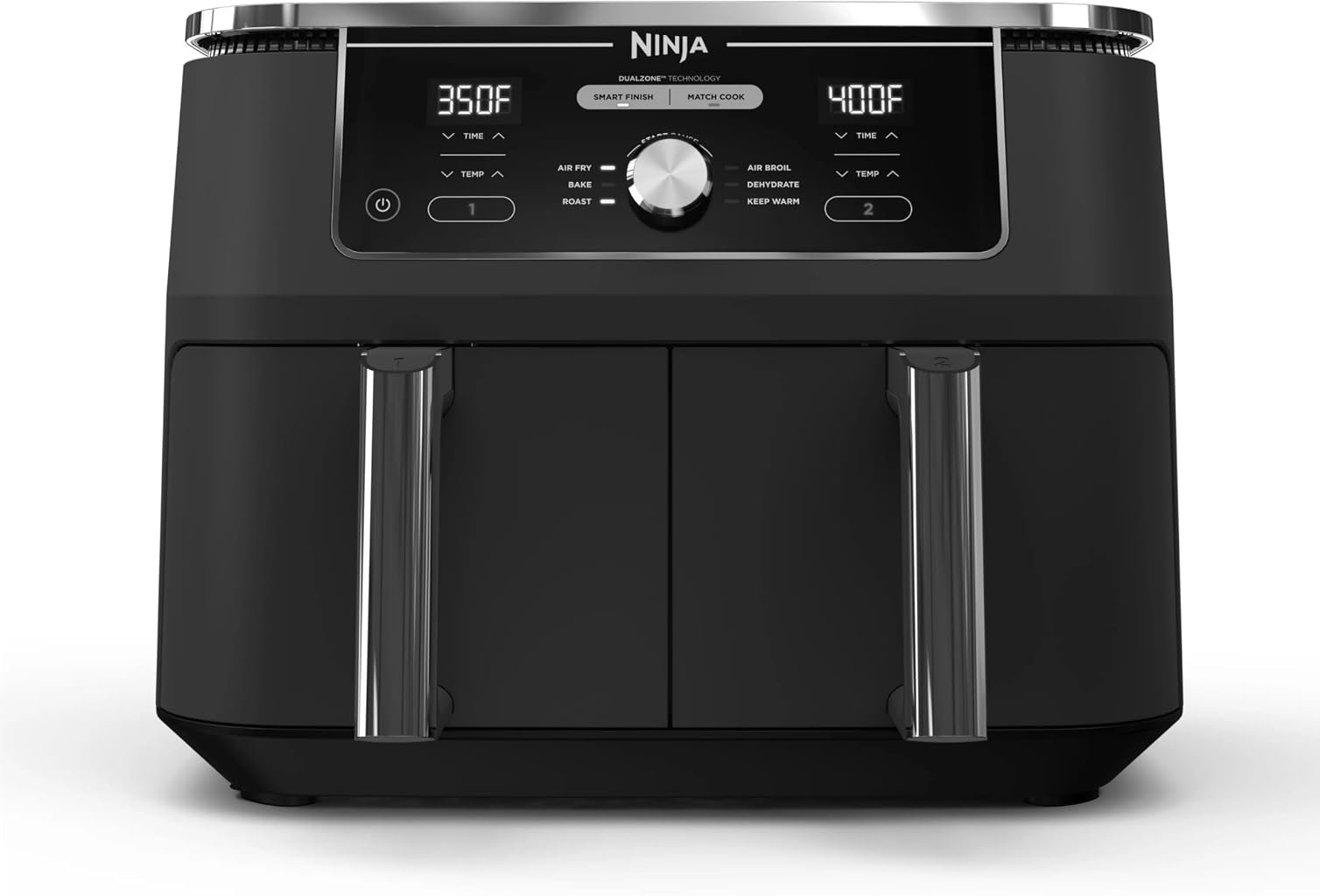
A conventional single-basket air fryer handles one cooking environment. Add a second food requiring another temperature or duration, and the cook faces a choice: compromise on settings, cook sequentially or move one component to another appliance. The DZ401 addresses that problem with two independent 5-quart baskets, each equipped with its own cooking hardware and controls.
The result is a 10-quart appliance whose capacity is permanently divided rather than shared.
According to Ninja’s current DZ401 specifications, the machine uses two independent cooking zones, six programs, Smart Finish, Match Cook and IQ Boost. It is rated at 1,690 watts on a 120-volt supply and measures 19.53 inches long, 16.02 inches wide and 15.87 inches high. Weight is listed at 21.61 pounds.
Those dimensions establish the central bargain immediately. The DZ401 offers substantial simultaneous cooking capacity, but it asks for substantial countertop territory in return.
Our score is 9.01/10. Customer Sentiment stands at 8.94, Buyer Confidence at 9.8 and Value at 8.52. The high Buyer Confidence rating reflects a product whose purpose is unusually transparent: it is designed for households that regularly need two cooking zones. Value sits lower because buyers who rarely exploit that independence are paying for capacity and hardware they may not need.
Ten Quarts Means Two Five-Quart Baskets
Capacity numbers can conceal more than they reveal.
The DZ401 is described as a 10-quart air fryer, but there is no single 10-quart chamber. Instead, Ninja provides two 5-quart baskets. Each zone has its own cooking basket, cyclonic fan and rapid heater.
That distinction matters.
A broad 10-quart chamber can accommodate large foods that need uninterrupted horizontal space. The DZ401 cannot combine its baskets into one cavity. A food too large for one 5-quart drawer remains too large regardless of the appliance’s total capacity.
What the divided design offers instead is independence.
Chicken can cook in one zone while vegetables cook in the other. One basket can reheat leftovers while the second air-fries frozen food. Different temperatures and durations can operate simultaneously.
That arrangement is particularly useful when dinner contains a main dish and a side that would otherwise compete for one basket.
The DZ401 therefore treats capacity as parallel cooking space rather than one large volume.
For many households, that is the more useful interpretation.
Smart Finish Addresses The Timing Problem
Two baskets alone do not guarantee a coordinated meal.
If one food requires 30 minutes and another requires 16, starting both together merely produces one finished dish and one dish still cooking. The first begins cooling while the second catches up.
Ninja’s Smart Finish function addresses this scheduling problem.
The two zones can be programmed differently, and Smart Finish coordinates their operation so the programs end at approximately the same time. Match Cook performs another task: it copies settings between zones when both baskets need the same cooking program. Ninja identifies both functions as part of its DualZone system.
The difference is practical.
Smart Finish is useful when foods differ. Match Cook is useful when they do not.
A family cooking chicken in one basket and potatoes in another can use Smart Finish to coordinate them. A large quantity of wings divided across both baskets can use Match Cook to avoid programming the same settings twice.
Neither feature improves the fundamental heating capability of the appliance. Both improve workflow.
That distinction is important because kitchen convenience is frequently created by eliminating small repetitive decisions rather than inventing new cooking methods.
IQ Boost Manages Power Across The Two Zones
The DZ401 also includes IQ Boost, which Ninja describes as distributing power across the baskets when Smart Finish or Match Cook is not selected. The company specifically frames the feature around cooking a 6-pound whole chicken and a side as quickly as possible.
This feature exposes an engineering reality of dual-zone appliances.
Two cooking chambers do not exist independently from the electrical system supplying the entire machine. The appliance has a finite power budget. Managing how that power reaches each zone can therefore affect heating behavior when both baskets are operating.
The DZ401 is rated at 1,690 watts, 120 volts and 15 amps.
That is substantial countertop-appliance power, but it is still one electrical system serving two cooking zones.
IQ Boost should therefore be understood as power management rather than a mysterious additional heat source. The machine distributes available heating capability according to the operating mode.
For the buyer, the practical benefit is simpler than the engineering: two baskets are not merely bolted onto one chassis. The appliance’s control system is designed around simultaneous cooking.
Six Programs Cover The Expected Jobs
The DZ401 provides six cooking programs: Air Fry, Air Broil, Roast, Bake, Reheat and Dehydrate.
That selection is broad without becoming theatrical.
Air Fry handles the primary convection task. Air Broil provides another route for aggressive surface cooking. Roast accommodates meats and vegetables. Bake extends the appliance toward oven-style foods. Reheat targets leftovers, while Dehydrate moves toward slower moisture removal.
The distinction between these functions should remain grounded.
An air fryer does not transform into six unrelated appliances when another button is pressed. The heating system, fans and baskets remain the same physical hardware. Programs alter variables such as heat, fan operation and duration.
The value lies in giving common cooking tasks sensible starting conditions.
Reheat may be one of the more useful functions in everyday ownership. Microwaves warm food rapidly, but foods that depend on a dry or crisp surface can soften during microwave reheating. Forced convection can restore heat while allowing surface moisture to escape.
Pizza, roasted potatoes, breaded foods and fried leftovers can therefore give an air fryer work even when no meal is being prepared from raw ingredients.
Two Baskets Can Reduce Batch Cooking
Batch cooking is one of the less glamorous limitations of small air fryers.
A compact basket may handle one or two portions efficiently, but feeding several people can mean running the appliance repeatedly. The first batch cools while the second cooks, and the time advantage begins to disappear.
The DZ401 attacks this problem with sheer divided capacity.
Ninja states that the two baskets can handle up to 8 pounds of chicken wings. It also positions the 10-quart format for large family meals and simultaneous main-and-side cooking. Those are manufacturer capacity claims rather than guarantees for every food, but they establish the intended scale of the machine.
The meaningful advantage is not simply fitting more food.
It is fitting more food without forcing all of it to share one program.
A large single basket can reduce batches too, but everything inside generally cooks under the same conditions. The DZ401 combines higher total capacity with independent settings.
That combination explains why dual-zone machines appeal to households using air fryers for full meals rather than isolated snacks.
Airflow Still Limits Practical Capacity
Large baskets invite a predictable mistake: treating stated volume as a target that should always be filled.
Air frying does not work that way.
The USDA’s air-fryer food-safety guidance describes air fryers as countertop convection ovens that cook through rapid circulation of heated air. The agency warns that overcrowding can restrict circulation and contribute to uneven or inadequate cooking.
That warning applies even when a basket has room for more food.
Fries piled deeply do not expose the same surface area as fries spread more openly. Chicken pieces pressed tightly together create different airflow from pieces separated by small gaps. Moisture released during cooking can further alter the environment inside a heavily loaded basket.
The DZ401’s two baskets help because food can be distributed between zones rather than compressed into one chamber.
Still, two overcrowded baskets remain overcrowded baskets.
This is why shoppers comparing the best air fryers should resist treating maximum capacity as a measure of crisping quality. Capacity creates opportunity for better food distribution; it does not remove the need for distribution.
Energy Efficiency Depends On The Entire Meal
Air fryers are often associated with lower electricity consumption than full-size ovens, but the comparison depends heavily on portion size and batch count.
A September 2026 Which? comparison of an air fryer and built-in electric oven measured energy consumption across several foods. Its air fryer used 0.54 kWh for a roast chicken, while the built-in oven used 1.157 kWh. For 320 grams of frozen chips, the figures were 0.287 kWh and 0.863 kWh respectively.
A jacket potato required 0.392 kWh in the tested air fryer and 1.084 kWh in the oven. The cake comparison measured 0.223 kWh against 0.71 kWh. These figures came from the appliances Which? tested and are not measurements of the DZ401.
The underlying lesson is highly relevant to a large dual-basket machine.
Which? found that air-fryer savings were strongest for smaller quantities and diminished when repeated batches became necessary.
A 10-quart dual-zone appliance can potentially avoid some of those repeated cycles.
That gives the DZ401 a structural advantage over a much smaller fryer when several portions need cooking. Yet a conventional oven can accommodate far more food across multiple shelves.
The correct comparison is therefore not simply 1,690 watts against an oven’s rated wattage.
It is the energy required to complete the whole meal.
A 1,690-Watt Appliance Requires Sensible Placement
The DZ401’s 1,690-watt rating deserves practical attention.
Ninja lists the machine at 120 volts and 15 amps, with a 32-inch cord.
This is a high-power heating appliance, not a low-demand countertop accessory.
Its electrical requirements should influence placement. The intended counter position needs suitable outlet access, and owners should follow the manufacturer’s electrical and safety instructions.
The cord length matters because extension-cord improvisation is not an ideal substitute for appropriate kitchen placement.
The appliance’s size reinforces that point.
At 19.53 inches long and 16.02 inches wide, the DZ401 requires enough countertop area to operate without being wedged into an unsuitable space. Its height of 15.87 inches also deserves consideration beneath cabinetry.
The two baskets need room to open forward, adding another spatial requirement that photographs can obscure.
A tape measure remains one of the more useful air-fryer buying tools.
Counter Space Is The Main Physical Cost
Dual-zone capacity has to exist somewhere.
The DZ401 places its two baskets beside each other, producing a body just over 16 inches wide. That is not extreme for a 10-quart appliance, but it is substantial enough to alter how a kitchen counter functions.
The machine also weighs 21.61 pounds.
That weight makes occasional movement realistic while making daily retrieval from a low cupboard less attractive.
Appliance utility is partly behavioral.
A machine permanently available on the counter can become part of everyday cooking. A 21-pound appliance stored behind other equipment introduces enough friction that spontaneous use becomes less likely.
This is why countertop cost should be considered alongside monetary cost.
The DZ401 earns its physical footprint when both baskets are used frequently. If one basket remains empty most of the time, a large portion of the appliance’s width is being paid for without producing much practical benefit.
The Two Baskets Cannot Become One
The permanent divider between the DZ401’s baskets creates its clearest limitation.
There is no mechanism for converting the appliance into one uninterrupted 10-quart chamber.
This matters for wide foods.
A large roast, broad baking dish or other item that exceeds the dimensions of one 5-quart basket cannot borrow unused space from the neighboring zone. Ten total quarts do not help when the food needs six contiguous quarts.
Convertible-zone air fryers solve this problem differently by using a removable separator. The DZ401 chooses fixed independence instead.
That approach has advantages. Each zone has its own basket, cyclonic fan and rapid heater, giving the machine a clearly separated dual-zone architecture.
But buyers should distinguish between total capacity and continuous capacity.
The DZ401 offers plenty of the first and none of the second beyond an individual basket.
Food Safety Requires A Thermometer, Not A Brown Crust
Air fryers can produce remarkably convincing visual signals of doneness.
Chicken skin browns. Breaded food crisps. Exterior fat renders. None of those changes measures the center of the food.
USDA guidance specifies 165°F as the safe minimum internal temperature for poultry and 160°F for ground meat. Fish is listed at 145°F. Whole cuts of beef, pork, veal and lamb require 145°F followed by a three-minute rest.
A food thermometer therefore remains relevant even in an appliance with automated programs.
Smart Finish coordinates timing. It does not measure whether a thick chicken breast has reached 165°F.
The distinction becomes particularly important when the baskets contain different foods. A program finishing simultaneously in both zones says nothing about whether every individual piece heated at the same rate.
Thickness, starting temperature, basket loading and food composition all affect heating.
Automation can coordinate dinner. It cannot replace temperature verification.
Cleaning Two Zones Means Cleaning Two Sets Of Parts
The DZ401 includes two 5-quart baskets and two nonstick crisper plates.
That is exactly what its dual-zone architecture requires, but it also means more food-contact surface than a simple single-basket machine.
Cooking chicken in one basket and seasoned vegetables in the other creates two separate cleanup jobs.
This is not an unusual defect. It is the predictable maintenance cost of independent cooking zones.
The advantage is modularity.
Each basket can be removed individually. A lightly used zone does not necessarily create the same cleaning burden as a heavily greased one.
Regular cleaning matters because air fryers repeatedly expose food residue and fats to high heat. Crumbs can scorch and grease can smoke during later cycles.
Nonstick surfaces also reward careful treatment. Abrasive tools can damage coatings over time, so cleaning methods should follow Ninja’s care guidance.
The larger lesson is straightforward: dual-zone convenience does not end when the timer sounds. It extends the number of components reaching the sink.
IQ Boost Separates The DZ401 From A Basic Twin-Basket Layout
It would be easy to describe the DZ401 merely as two air fryers sharing one shell.
That would miss part of the design.
Ninja specifies separate baskets, fans and heaters, but it also uses IQ Boost to manage power distribution across the two zones under applicable operating conditions.
This is important because simultaneous cooking introduces a resource-allocation problem.
The machine has a finite electrical power rating. Both zones can demand heat, yet their requirements may differ as temperatures rise and thermostatic controls cycle.
The control system therefore matters.
For the owner, none of this needs to become a technical exercise. The practical point is that the DZ401 was conceived as a dual-zone system rather than a single fryer awkwardly split into two compartments.
Its hardware and software both reflect simultaneous cooking.
Where The DZ401 Is Strongest
The DZ401’s advantages are tightly connected:
- Two independent 5-quart baskets provide 10 quarts of total stated capacity.
- Each zone has its own basket, cyclonic fan and rapid heater.
- Smart Finish coordinates foods requiring different settings so they complete together.
- Match Cook copies settings between zones for larger quantities of the same food.
- IQ Boost manages power distribution when applicable.
- Six programs cover Air Fry, Air Broil, Roast, Bake, Reheat and Dehydrate.
- Ninja states capacity for up to 8 pounds of chicken wings.
- The dual-zone format can reduce sequential batch cooking for family meals.
These advantages are meaningful because they address an ordinary kitchen problem rather than an abstract specification contest.
Dinner often contains two foods.
The DZ401 is built around that fact.
The Drawbacks Follow Directly From The Design
The same architecture produces equally recognizable compromises.
Two side-by-side baskets make the appliance wide. At 21.61 pounds, frequent cupboard storage may become tiresome. The baskets cannot combine into one large chamber. Cleaning two zones means handling more removable components.
The 1,690-watt electrical rating also deserves respect in kitchen placement.
Then there is the question of actual use.
A household that routinely cooks one modest portion has little reason to maintain two 5-quart cooking zones on the counter. Capacity unused is not a hidden reserve of value; it is simply unused appliance.
The DZ401 therefore rewards households whose cooking habits genuinely match its architecture.
That is why capacity alone should not determine the purchase.
Interpreting Our 9.01/10 Score
Our overall score for the Ninja Foodi DualZone XL Air Fryer DZ401 is 9.01/10.
The rating reflects the coherence of the product. Two substantial independent baskets, dedicated heating hardware, coordinated finishing and six practical cooking programs combine around a clear objective: preparing more than one component of a meal without sequential cooking.
Customer Sentiment stands at 8.94.
That score sits close to our overall assessment. The small gap reflects the everyday compromises inherent to a large dual-zone machine: width, weight, multiple components to clean and the inability to merge the baskets.
Buyer Confidence reaches 9.8.
That is the strongest figure because the purchasing decision can be made with unusual clarity.
A buyer can measure 19.53 by 16.02 inches of countertop area. The household can decide whether two 5-quart baskets match normal meal preparation. The electrical specification is known. The six cooking programs are defined. The baskets are permanently separate.
There is little need to guess what type of kitchen this machine suits.
Value is 8.52.
That lower score reflects utilization.
For a family using both baskets several nights a week, the ability to prepare a main and side simultaneously can justify considerable counter space. For someone cooking alone, a smaller appliance can deliver the basic advantages of convection cooking with less physical overhead.
The DZ401 provides considerable capability, but capability becomes value only when used.
Who Should Buy The DZ401?
The clearest buyer is a household preparing multi-component meals regularly.
Families can use one basket for a protein and another for a side. Couples who meal-prep can divide different foods between zones. Entertaining becomes easier when larger quantities can be distributed across two baskets.
The appliance is also relevant to households frustrated by repeated batches in smaller fryers.
A 10-quart total capacity does not make the DZ401 an oven replacement for every meal, but it materially increases the amount of food that can be handled simultaneously compared with compact single-basket designs.
The less suitable buyer is someone whose cooking rarely requires two zones.
A one-person household preparing modest portions can reasonably prefer a smaller air fryer. Buyers who frequently cook wide foods may prefer a large undivided basket or convertible-zone design.
Kitchen dimensions may decide the matter before either argument does.
The DZ401 is a substantial appliance. It should earn its counter space through regular use.
Why The DZ401 Still Makes Sense In A Crowded Category
Dual-basket air fryers are no longer unusual.
That makes the DZ401’s underlying choices more interesting than novelty.
Its design is conservative in a productive way. Two baskets remain fully independent. Smart Finish deals with different foods. Match Cook handles identical settings. IQ Boost manages power distribution. Six programs cover recognizable cooking jobs rather than creating an enormous menu of narrowly differentiated presets.
The architecture is easy to understand because it corresponds closely to how dinner is actually assembled.
One food goes here. Another goes there. They need different conditions. They should finish together.
That is not technologically dramatic.
It is useful.
Final Considerations
The Ninja Foodi DualZone XL Air Fryer DZ401 is a 10-quart dual-basket appliance composed of two independent 5-quart zones. Each zone has its own basket, cyclonic fan and rapid heater. The machine provides Air Fry, Air Broil, Roast, Bake, Reheat and Dehydrate programs, alongside Smart Finish, Match Cook and IQ Boost. Ninja rates the US model at 1,690 watts, 120 volts and 15 amps.
Its strongest argument is simultaneous cooking.
Two foods can run under different settings without forcing the cook into consecutive batches. Smart Finish coordinates their completion, while Match Cook simplifies using both baskets for the same food. For households regularly preparing a main dish and side, those functions address a genuine scheduling problem.
The costs are physical.
At 19.53 inches long, 16.02 inches wide and 15.87 inches high, the DZ401 demands meaningful counter space. Its 21.61-pound weight makes frequent storage less attractive. The two baskets remain permanently separate, so the advertised 10-quart capacity cannot become one broad cooking chamber.
Airflow imposes another boundary. More capacity does not justify dense packing. USDA guidance warns that overcrowding can restrict circulation and contribute to uneven or inadequate cooking.
Our 9.01/10 score reflects how effectively the DZ401 balances these compromises against its intended purpose. Customer Sentiment at 8.94 sits close to that assessment. Buyer Confidence reaches 9.8 because the product’s fit can be evaluated with unusual precision before purchase. Value at 8.52 recognizes that two large independent zones are economically useful only when a household routinely needs them.
For buyers comparing the best air fryers, the DZ401 should therefore be judged less by its total quart figure than by the independence of those quarts.
Ten quarts in one chamber solve one problem. Two separate 5-quart chambers solve another.
The DZ401 chooses the second approach without ambiguity.
For households repeatedly juggling different foods, temperatures and finishing times, that choice can simplify dinner in a measurable way. For households cooking one small dish at a time, much of the machine’s physical presence will go unused.
That division explains both the DZ401’s strengths and its limits. It is not trying to be the smallest air fryer or the most flexible single chamber. It is designed to make two simultaneous cooking jobs easier to manage.
On that standard, the 9.01/10 editorial score reflects a mature dual-zone design whose strongest feature is not a particular preset, but the ability to treat two parts of dinner as genuinely independent cooking tasks.