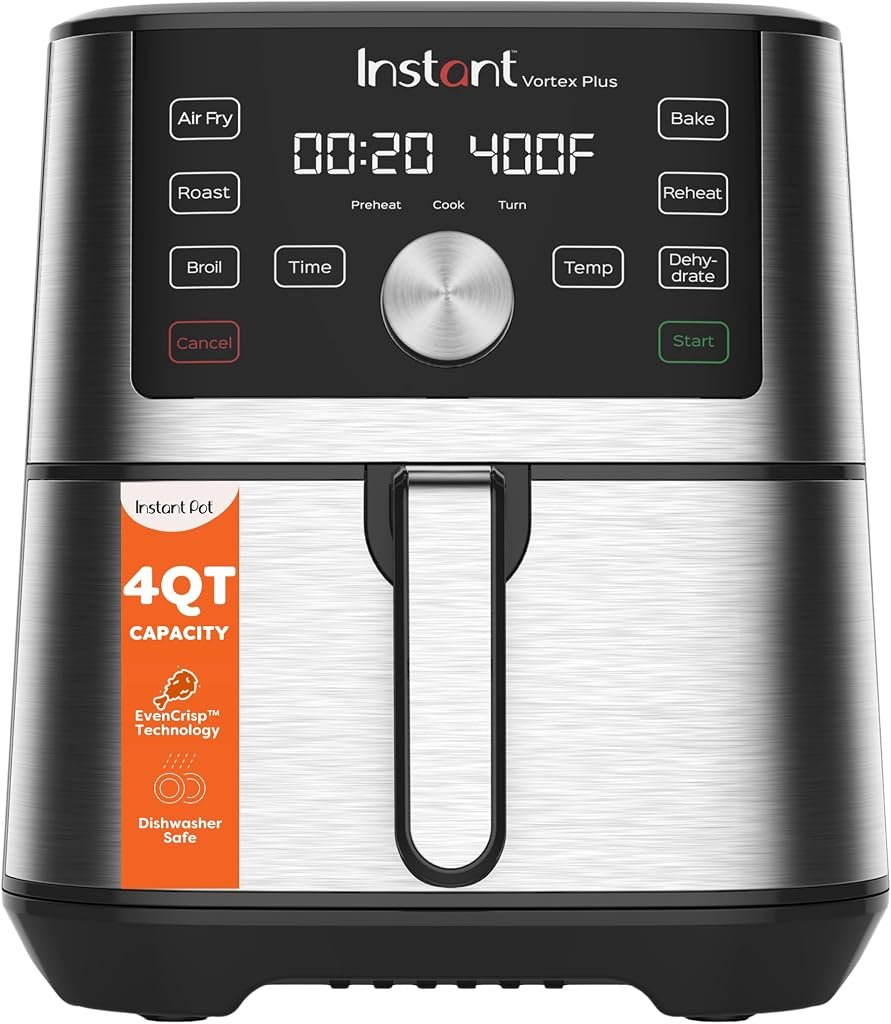
The Instant Pot Vortex Plus Mini Air Fryer belongs to a category that raises an unusually useful question: how much air fryer does a household actually need?
Large air fryers have moved steadily toward greater capacity, dual cooking zones and wider countertops. The Vortex Mini travels in the opposite direction. Its 2-quart cooking chamber, 1,300-watt heating system and four primary functions-Air Fry, Bake, Roast and Reheat-are built around small quantities of food. The design is roughly 9 inches wide, 11.26 inches deep and 11.73 inches high, with a listed weight of 7.28 pounds. Those measurements make the Mini materially different from the family-size machines that dominate much of the category.
The distinction is more meaningful than it sounds. Air fryers are convection appliances, and convection works most effectively when heated air has room to circulate around food. A compact basket used for an appropriately compact meal can therefore make more sense than an oversized chamber used at a fraction of its capacity.
The trade-off is equally obvious. Two quarts is two quarts. The Vortex Mini cannot produce the batch volume of a six-, eight- or ten-quart machine, and no clever preset changes that physical limitation.
Our score is 8.86/10. Customer Sentiment stands at 8.72, Buyer Confidence at 9.8 and Value at 8.4. Those figures describe a focused appliance whose purpose is unusually easy to understand. Buyer Confidence is particularly high because the Mini makes few ambiguous promises: it is a compact air fryer for compact cooking jobs.
Two Quarts Is A Feature And A Limitation
Capacity specifications can mislead because a quart measures volume rather than useful cooking surface.
The Vortex Mini’s 2-quart chamber is small even by single-basket air-fryer standards. That is precisely why it deserves consideration from one-person households, couples with modest portions, students where cooking appliances are permitted, and kitchens where counter space has become more valuable than another oversized appliance.
A contemporary account from The Kitchn found the Vortex Mini suitable for approximately half a bag of fries as well as small batches of foods such as orange chicken and cauliflower gnocchi, while describing the machine as intended primarily for one or two people. That testing should not be interpreted as a universal capacity specification, but it illustrates the scale of cooking for which the Mini was conceived.
A small basket has advantages.
There is less empty chamber to heat. The appliance itself takes up less room. Cleaning a small removable basket can be less cumbersome than wrestling with a large drawer. For one serving of vegetables, leftovers or frozen food, a two-quart chamber may be entirely adequate.
Then dinner gets bigger.
Two substantial portions can quickly expose the Mini’s limits. Foods that need open space for browning are particularly unforgiving because filling the basket to its physical limit can restrict airflow.
This makes the Vortex Mini less of a miniature family fryer than a personal cooking appliance that can occasionally stretch into two-person duties.
Airflow Matters More Than The Quart Number
The USDA’s guidance on air-fryer cooking explains why capacity cannot be considered independently from airflow. Air fryers operate as small convection ovens, circulating heated air rapidly around food. The agency warns against overcrowding because inadequate circulation can produce uneven cooking.
This physical principle is particularly relevant to a 2-quart machine.
The temptation with a small basket is to fill every available space. Doing so can defeat part of the reason for using an air fryer. Fries stacked densely, for example, expose less surface area directly to moving air than fries arranged more openly. Moisture escaping from food can also make the local cooking environment more humid, working against crispness.
The practical lesson is counterintuitive: the Mini can work better when the owner accepts that its usable crisping capacity may be smaller than its maximum physical capacity.
That distinction applies across the best air fryers, but it matters more as basket dimensions shrink.
A buyer should therefore think less about whether two quarts sounds sufficient and more about what normally goes into the oven. One serving of frozen fries is one problem. Dinner for four is another.
Four Functions Are Enough For The Intended Job
The Vortex Mini provides Air Fry, Bake, Roast and Reheat modes. Contemporary documentation and independent coverage identify those four functions consistently.
The absence of a long preset list is not inherently a weakness.
Air fryers do not contain separate mechanical systems for every button. Their cooking programs largely control combinations of heating, fan operation, temperature and time. Four modes can therefore cover a broad range of everyday tasks without turning the control panel into an index of foods.
Air Fry handles the machine’s primary job. Roast broadens its usefulness for vegetables and smaller portions of meat. Bake accommodates appropriately sized baked foods. Reheat targets leftovers.
Reheat deserves particular attention in a compact machine.
A microwave is faster for many foods, but rapid convection can restore surface texture that microwave heating often softens. Pizza, roasted potatoes, breaded food and fried leftovers are obvious candidates.
The Mini’s small capacity becomes less problematic here because leftovers are frequently reheated one portion at a time.
That may ultimately be one of its most rational uses.
A 1,300-Watt Appliance Is Small, Not Weak
The US Vortex Mini documentation specifies 1,300 watts at 120 volts and 60 Hz. The appliance weighs 7.28 pounds and measures approximately 11.26 inches deep, 9.02 inches wide and 11.73 inches high.
Those figures put its compactness into perspective.
A 1,300-watt heating system operating around a 2-quart chamber represents substantial heating power relative to the amount of interior space involved. That relationship-not wattage by itself-is central to the air-fryer proposition.
High wattage does not automatically mean better food, nor does it establish exact energy consumption for a cooking cycle. Electrical power is only one variable. Cooking duration, thermostat cycling, food quantity, starting temperature and selected settings affect total electricity use.
Still, a compact chamber can reach useful cooking conditions without requiring the appliance to heat the much larger volume of a conventional oven.
That becomes economically relevant when the meal itself is small.
Energy Efficiency Favors Small Portions
Claims about air-fryer energy savings often become too broad. An air fryer does not automatically use less electricity for every meal. Portion size and batch count matter.
A September 2026 Which? comparison of an air fryer and built-in electric oven provides useful measured examples. The publication cooked a roast chicken, frozen chips, a jacket potato and a cake in representative appliances while measuring energy consumption.
The tested air fryer consumed 0.54 kWh for the roast chicken, compared with 1.157 kWh for the built-in oven. For 320 grams of frozen chips, the measurements were 0.287 kWh and 0.863 kWh respectively. The jacket potato required 0.392 kWh in the air fryer versus 1.084 kWh in the oven, while the cake used 0.223 kWh compared with 0.71 kWh.
Those measurements were not made using the Vortex Mini, so they cannot legitimately be presented as performance figures for this product.
Their relevance lies elsewhere.
Which? science team leader Steph Kipling said: “The air fryer often used less than half the energy, and the results were just as tasty.” Her next sentence identified the limitation: “However, the savings soon drop off if you have to cook in batches, so an oven may still be the most economical choice when cooking for a crowd.”
That observation almost perfectly describes the economic logic of a 2-quart fryer.
For one portion, the Mini’s small heated chamber is an advantage. If dinner requires three or four consecutive batches, that advantage can erode rapidly.
Capacity is therefore part of energy efficiency, not merely convenience.
Counter Space Is Where The Mini Makes Its Strongest Argument
Kitchen appliances have two prices. One appears on the receipt. The other is paid in counter space.
At approximately 9.02 inches wide, the Vortex Mini asks for considerably less horizontal space than many family-oriented air fryers.
That matters in apartments, small kitchens and households where several appliances compete for the same work surface.
An appliance stored in a cupboard also creates behavioral friction. It has to be retrieved, positioned, plugged in, cleaned and returned to storage. A machine compact enough to remain accessible is more likely to become part of routine cooking.
The Mini’s dimensions do not make placement irrelevant. Air fryers move heated air and require safe operating space. The owner’s manual directs users to place the appliance on a stable, level surface away from combustible materials and external heat sources, while keeping vents unobstructed.
Small does not mean suitable for any available gap.
Still, the footprint is one of the clearest reasons to choose this model over a larger fryer. Anyone with abundant counter space and frequent family-size cooking has less reason to accept a two-quart limit.
Preheating Adds A Small Piece Of Friction
One characteristic noted in independent testing is preheating.
The Kitchn’s testing of the Vortex Mini identified the required preheat stage as a minor drawback compared with air fryers that allow food to be placed into the machine immediately. The publication otherwise found the touchscreen and dial straightforward to operate.
Preheating is not necessarily wasted effort. Bringing the chamber to a predictable starting condition can improve consistency between cooking cycles.
But convenience matters.
One attraction of a miniature air fryer is speed. If the user is reheating a tiny quantity of food, even a short preparatory stage becomes a larger percentage of the total process.
The effect should not be exaggerated. This is a modest inconvenience rather than a structural flaw. It simply prevents the Mini from being quite as instantaneous as its dimensions might imply.
The Controls Favor Simplicity
The Vortex Mini uses a digital control panel and dial rather than relying solely on mechanical knobs. Its cooking programs provide starting points while time and temperature can be adjusted for individual foods.
That balance is appropriate for a compact appliance.
Presets can reduce repetitive input without pretending that every chicken breast or batch of potatoes is identical. Manual adjustment remains necessary because thickness, quantity, moisture and starting temperature vary.
Some coverage of the Mini also identifies a shake-and-turn reminder, which prompts the cook to redistribute food during the cycle.
The reason is mechanical rather than cosmetic.
Food at the top and edges of a basket can encounter different airflow from food buried beneath it. Shaking fries or turning individual pieces changes which surfaces are exposed to rapidly moving air.
No software can make an overcrowded basket behave like an empty one, but a reminder to redistribute food can improve the odds of more even browning.
Food Safety Does Not Shrink With The Appliance
Small portions can cook quickly. They can also create false confidence.
Exterior browning is not a reliable measurement of internal temperature, particularly with meat and poultry. Rapidly circulating hot air can dry and brown the surface while the center follows a slower heating curve.
USDA air-fryer guidance specifies a safe minimum internal temperature of 165°F for poultry and 160°F for ground meat. Fish and whole cuts of beef, pork, veal and lamb are listed at 145°F, with a three-minute rest for whole cuts of those meats.
A thermometer therefore remains useful even beside a tiny fryer.
The Mini’s small basket also makes the USDA warning against overcrowding especially relevant. If raw chicken pieces are compressed tightly together, air circulation and cooking uniformity can suffer.
Capacity should never be stretched at the expense of safe cooking.
Cleaning Benefits From Scale
A smaller appliance creates less surface area to clean, although the basic maintenance requirements remain familiar.
The Vortex Mini uses a removable basket and cooking tray. The manufacturer’s manual instructs owners to allow the appliance to cool before cleaning and provides separate care guidance for removable components and the cooking chamber.
Small baskets are simply easier to handle in many sinks than large family-size drawers.
That matters because cleaning frequency affects the ownership experience. Grease, crumbs and food residue are repeatedly exposed to high temperatures inside an air fryer. Allowing them to accumulate can produce smoke, odors and scorched residue.
The Mini’s compact scale therefore creates a quiet advantage: cleaning is less physically awkward.
The trade-off is frequency. A small appliance used several times a day for individual portions may need attention just as regularly as a larger fryer used once for dinner.
Where The Vortex Mini Works Best
The Mini’s strengths are tightly connected to its size:
- The 2-quart chamber is appropriate for single portions and modest side dishes.
- Its approximately 9-inch width preserves more counter space than many larger basket fryers.
- The 1,300-watt heating system concentrates substantial power around a small cooking chamber.
- Air Fry, Bake, Roast and Reheat cover the core functions expected from a personal air fryer.
- Reheating small quantities can exploit convection without warming a conventional oven.
- The removable basket and cooking tray keep the cleaning process straightforward.
- The low 7.28-pound weight makes moving the appliance less cumbersome than heavier countertop ovens.
These strengths should not be separated from the buyer profile.
The Vortex Mini is not merely a cheaper or smaller version of a large air fryer. It is better understood as an appliance for a different scale of cooking.
Where Two Quarts Becomes Frustrating
The disadvantages arrive quickly when portions grow.
Two quarts leaves limited room for spreading food into open layers. Large chicken portions, multiple servings of vegetables and family quantities of fries can force batch cooking.
That creates a time penalty.
It can also undermine the energy argument. Running a compact fryer once for one serving is a very different proposition from running it four consecutive times to produce dinner.
The Mini also lacks the flexibility of dual-zone models, where two foods can cook independently at different temperatures. There is only one chamber and one cooking environment.
Its four functions are sensible, but shoppers seeking dehydration, dedicated broiling or a broad suite of specialized modes will find larger appliances with wider functional ranges.
The Mini therefore demands an unusually candid assessment of portion size.
Buying too large wastes space. Buying too small wastes time.
Interpreting Our Scores
Our overall score for the Instant Pot Vortex Plus Mini Air Fryer is 8.86/10.
The score reflects a machine with a narrow purpose executed through a sensible hardware configuration. A 2-quart capacity, 1,300-watt heating system and four cooking modes create a coherent personal-air-fryer package rather than a compromised family appliance.
Customer Sentiment is 8.72.
That figure sits close to the overall editorial score, suggesting that the practical appeal and practical restrictions are reasonably aligned. Compact appliances tend to produce predictable satisfaction when buyers understand the capacity before purchase. Two quarts does not hide what it is.
Buyer Confidence reaches 9.8, the highest of the four figures.
That score reflects clarity. The Vortex Mini uses established air-fryer architecture and offers a straightforward set of functions. There is little ambiguity around the buyer fit: small portions, limited counter space, reheating and personal meals.
Value stands at 8.4.
The gap between Buyer Confidence and Value is revealing. Confidence in the design can be extremely high while value remains dependent on household behavior.
For someone cooking one portion repeatedly, a compact air fryer can be more rational than a larger machine. For a family regularly preparing several servings, the Mini’s lower capacity can produce enough batch cooking to make a larger model more economical in time and effort.
Value therefore rises or falls with portion size.
Who Should Buy The Vortex Mini?
The strongest candidate is someone who usually cooks for one.
A couple whose air-fryer use centers on sides, snacks and reheating can also make good use of the Mini, but larger shared meals will expose the capacity limit.
The appliance is particularly logical where counter space is constrained. At roughly nine inches wide, it demands less permanent kitchen territory than many larger models.
It also suits households that already own a conventional oven but want a smaller appliance for jobs where heating the oven feels disproportionate.
The less suitable buyer is equally easy to identify.
Families, enthusiastic batch cooks and anyone routinely preparing multiple components of dinner will probably find two quarts restrictive. People expecting to cook an entire meal in one air-fryer cycle should examine larger single-basket or dual-zone designs.
The Mini rewards accurate self-assessment more than aspirational shopping.
Final Considerations
The Instant Pot Vortex Plus Mini Air Fryer makes its case through restraint.
Its 2-quart basket is not attempting to imitate family-size capacity. Its four primary functions-Air Fry, Bake, Roast and Reheat-focus on everyday convection tasks. The 1,300-watt US specification places meaningful heating power around a compact chamber, while dimensions of approximately 11.26 by 9.02 by 11.73 inches keep the physical footprint controlled.
That architecture gives the Mini a distinct advantage for small meals. A single serving does not need an enormous basket, and a compact heated chamber can make more sense than warming a conventional oven.
The same architecture establishes its ceiling.
Two quarts leaves little tolerance for ambitious portions. Overfilling works against airflow. Repeated batches consume time and can reduce the energy advantage associated with compact convection cooking.
Our 8.86/10 score reflects that balance. Customer Sentiment at 8.72 sits nearby, while Buyer Confidence at 9.8 reflects an appliance whose purpose is unusually transparent. Value at 8.4 is lower because the economic and practical case depends so strongly on meal size.
Among the best air fryers, the Vortex Mini does not need to win a contest for maximum capacity or the longest list of cooking programs. Its more useful question is whether a household routinely needs anything larger.
For one person reheating pizza, roasting vegetables, cooking frozen food or preparing a modest meal, the answer may often be no.
For four people waiting for dinner, it changes quickly.
That tension is not a design accident. It is the entire logic of the Vortex Mini. Its small size is simultaneously its strongest advantage and its firmest restriction, and buyers who understand both sides of that equation are the ones most likely to find the appliance genuinely useful.