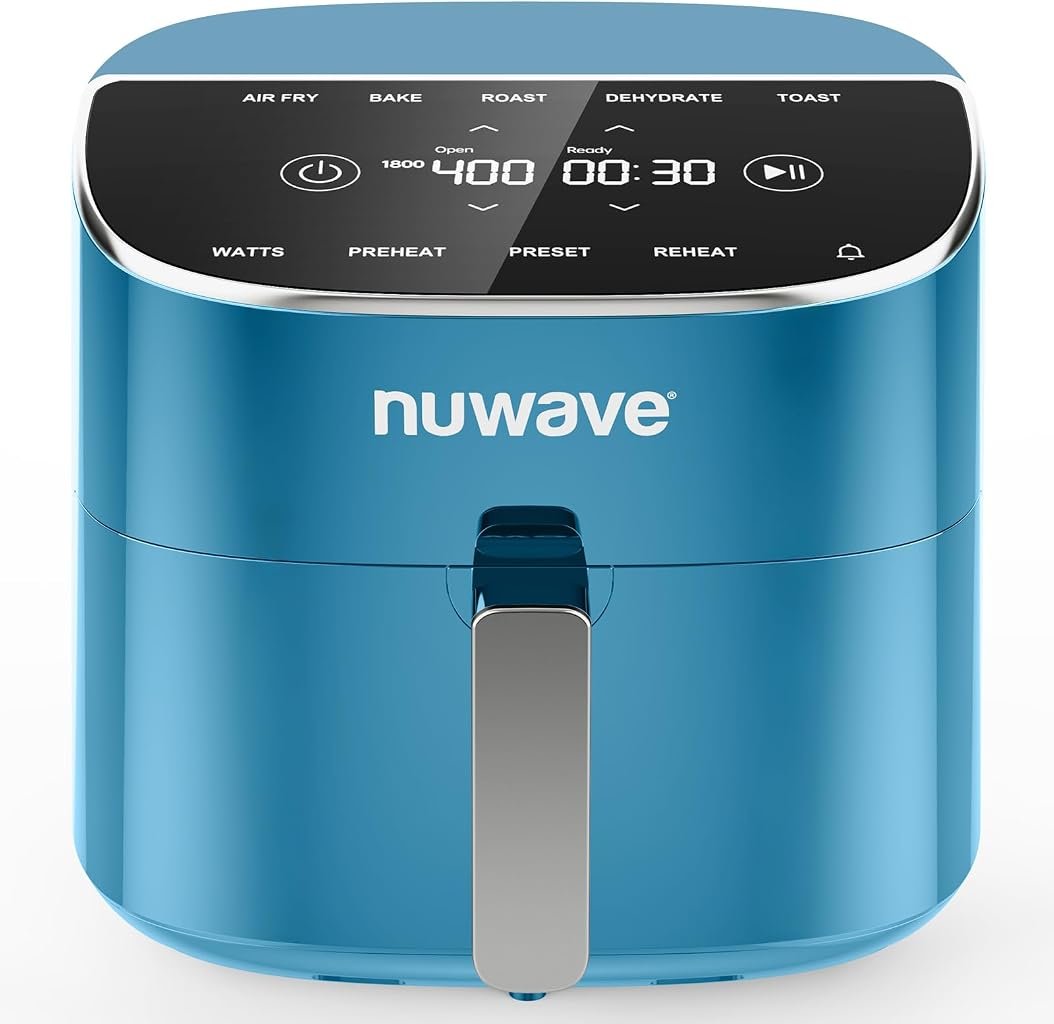
Air fryers have spent years accumulating features, presets, accessories, and increasingly elaborate control panels. The Nuwave Brio Plus 8 QT takes a more focused route. Its principal specifications are an 8-quart single-basket format, 1,800 watts of rated power, digital touch controls, five cooking functions, and temperature adjustment from 50°F to 400°F in 5°F increments.
Those figures describe an appliance aimed less at spectacle than at controllability. The Brio Plus does not divide its cooking chamber into independent zones, nor does it attempt to imitate a full countertop oven. Instead, it concentrates on one substantial basket and gives the cook relatively granular control over temperature.
Nuwave identifies the current Brio Plus 8 QT as model 37501LW. The manufacturer also describes a heating approach called Linear T Technology, an upgraded air-circulation riser, a nine-blade fan, a five-coil heating tube, automatic pause and resume when the basket is removed and returned, and a PFOA-free ceramic nonstick cooking surface.
Our score is 8.55/10. Customer Sentiment stands at 8.28, Buyer Confidence reaches 9.8, and Value is 8.15. At the $109.99 price used for our assessment, those numbers describe a capable single-zone air fryer whose strongest arguments are capacity, temperature control, and a relatively straightforward operating concept.
The Brio Plus does not attempt to solve every countertop-cooking problem. Its appeal is narrower and, in some respects, more rational: one large basket, adjustable heat, forced airflow, and controls that make those fundamentals accessible.
An 8-Quart Basket Means More Than the Capacity Number
The Brio Plus uses one 8-quart basket rather than splitting its capacity between separate cooking zones. Nuwave’s current Brio Plus specifications describe the 8-quart model, 1,800-watt rating, 50°F-to-400°F adjustment range, digital controls, and automatic basket sensing.
That single-basket layout creates a different kind of flexibility from a dual-zone air fryer.
An 8-quart dual-basket machine might divide its headline capacity into two 4-quart compartments. That arrangement is useful when chicken and vegetables require separate temperatures or cooking durations. It is less useful when a large food needs uninterrupted physical space.
The Brio Plus reverses those priorities.
Its basket does not contain a permanent divider, allowing foods to use the available chamber as one cooking area. Large batches that naturally belong together can therefore be arranged without working around a wall between zones.
The compromise is equally direct.
Two foods inside the Brio Plus cannot receive fully independent cooking programs simultaneously. If one item requires 400°F and another needs substantially gentler heat, the cook must manage the difference manually, change timing, or prepare the foods separately.
Capacity alone cannot identify which architecture is preferable.
The question is whether the household benefits more from one larger cooking area or two smaller independent ones.
The 50°F-to-400°F Range Gives the Brio Plus Its Character
One of the more interesting Brio Plus specifications is its temperature range.
Nuwave allows adjustment from 50°F through 400°F in 5°F increments.
The 400°F ceiling is familiar territory for air frying. The 50°F lower limit and five-degree adjustment steps are more revealing because they indicate an appliance designed around user control rather than only high-temperature crisping.
A broad numerical range does not mean every setting will be equally useful for every food. Nor does a five-degree setting change guarantee that food itself experiences precisely the same five-degree difference.
An appliance setting describes the target behavior of the heating system.
Food responds according to mass, moisture, thickness, starting temperature, arrangement, and airflow.
That distinction matters because digital precision can create a misleading impression of laboratory certainty. A display reading 375°F does not mean every point inside a basket remains continuously at exactly 375°F.
What the five-degree increments provide is control resolution.
If a familiar recipe browns too aggressively at one setting, the cook can make a relatively small adjustment rather than being forced into a much larger temperature jump.
That is practical precision rather than theoretical perfection.
Linear T Technology Focuses on Heater Control
Nuwave calls its heating approach Linear T Technology.
The manufacturer says the system maintains heat between 50°F and 400°F in five-degree increments and uses a heater that stays on rather than relying on the larger fluctuations associated with traditional cycling behavior.
The language requires careful reading.
No countertop cooking chamber exists independently of physics. Opening a basket changes the thermal environment. Cold food absorbs energy. Moisture evaporates. Air moves around objects with different shapes and densities.
Linear T Technology should therefore be understood as Nuwave’s heater-control strategy, not as a promise that every location in the cooking chamber remains thermally identical at every instant.
The underlying idea remains useful.
Air frying depends heavily on the relationship between heat and moving air. Better control over the heating system can make small user adjustments more meaningful and can support repeatability when a household prepares the same foods regularly.
The Brio Plus consequently places considerable responsibility in the cook’s hands.
Rather than relying on an enormous library of named food presets, it provides relatively fine numerical control.
For some users, that is the better bargain.
The Five-Coil Heater and Nine-Blade Fan Matter More Than Marketing Labels
Nuwave describes the Brio Plus airflow system as combining a five-coil heating tube with a nine-blade fan.
Those components explain the appliance more clearly than the word “fryer.”
The U.S. Department of Agriculture describes air fryers as “essentially countertop convection ovens” that cook through rapidly circulating hot air. That definition strips away much of the category’s mystique.
An air fryer is not performing conventional deep frying without oil.
It is using heated airflow to transfer energy to food while encouraging surface moisture loss and browning.
The heater generates thermal energy.
The fan moves heated air.
The basket and circulation hardware determine where that air can travel.
Food arrangement determines how much surface area receives useful exposure.
Once those relationships are understood, many air-fryer buying decisions become easier.
A large capacity is useful only when airflow can still reach the food effectively.
The Circulation Riser Has a Straightforward Job
The Brio Plus incorporates what Nuwave describes as an upgraded, more secure circulation riser.
Its purpose is fundamentally geometric.
Food sitting directly against a solid basket floor would receive less airflow underneath. Elevating it creates additional pathways for heated air to move around exposed surfaces.
This is why crisper plates, racks, and perforated inserts are common throughout the air-fryer category.
The hardware does not create crispness by itself.
It creates conditions in which airflow can work more effectively.
A circulation riser cannot compensate completely for an overloaded basket. If food is piled deeply and tightly enough, pieces still shield one another.
This is where the Brio Plus’s 8-quart capacity needs disciplined interpretation.
The basket’s physical volume is not an instruction to fill every available cubic inch.
Five Cooking Functions Keep the Interface Focused
The Brio Plus provides five cooking functions.
That is restrained compared with appliances advertising a long list of narrowly differentiated programs.
Preset count is an unreliable measure of cooking capability because many named functions use the same heater and fan under different temperature and timing instructions.
The Brio Plus instead emphasizes its adjustable temperature system and digital controls.
That approach favors cooks who are comfortable selecting settings rather than asking the appliance to identify every food category through a dedicated button.
There is a legitimate trade-off.
Preset-oriented users may prefer an interface that reduces decision-making. More manual users may prefer a smaller collection of functions accompanied by finer temperature adjustment.
Neither approach automatically produces better food.
The interface simply determines how much control remains visible to the person operating it.
Auto-Pause and Resume Solves a Small Daily Irritation
Integrated sensors pause cooking when the Brio Plus basket is opened and resume the cycle after it is returned.
This feature sounds minor because it is minor.
That is also why it makes sense.
Air-fryer cooking regularly involves basket interaction. Fries may need shaking. Vegetables may need redistribution. Meat may need inspection or turning.
Having the machine respond automatically to the physical removal of the basket reduces unnecessary control-panel interaction.
The cook removes the basket.
The active cycle pauses.
The basket returns.
Cooking resumes.
Features that remove one repetitive step from an activity performed several times a week can matter more than elaborate programs used twice a year.
The 1,800-Watt Rating Should Be Taken Seriously
The Brio Plus carries a 1,800-watt power rating.
Wattage is frequently treated as a shorthand for performance, but that interpretation is too simplistic.
A 1,800-watt appliance is not automatically faster, crispier, or more efficient than every lower-powered alternative. Heater design, chamber volume, insulation, airflow, control behavior, and food loading affect what happens after electricity enters the appliance.
The figure still matters.
An 1,800-watt countertop cooker creates substantial electrical demand and should be operated according to the manufacturer’s electrical guidance. Crowded power strips, unsuitable extension arrangements, or circuits already supporting other high-draw kitchen appliances deserve careful consideration.
The rating also provides useful context for the Brio Plus’s 8-quart format.
This is not a miniature reheating device.
It is a substantial cooking appliance compressed into a countertop footprint.
Ceramic Nonstick Construction Requires Precise Language
Nuwave identifies the Brio Plus cooking material as PFOA-free ceramic nonstick.
The wording matters.
PFOA-free identifies a specific chemical characteristic. It should not automatically be transformed into broader claims about every substance associated with nonstick cookware.
For the user, the immediate practical issue is simpler.
The basket incorporates a ceramic nonstick cooking surface intended to reduce food adhesion and simplify cleanup.
Coated surfaces still need appropriate care.
Abrasive cleaning tools and unsuitable utensils can damage many nonstick materials. Manufacturer cleaning guidance should therefore be treated as part of ordinary ownership rather than an afterthought.
This is especially relevant for an appliance likely to be used repeatedly for browned, seasoned, or fatty foods.
A nonstick surface can reduce cleaning effort.
It does not make cleaning technique irrelevant.
The Digital Interface Prioritizes Readability
Nuwave describes the Brio Plus as using full digital touch controls with large white lettering.
Control-panel visibility is rarely the first specification buyers compare, but it affects every cooking session.
Kitchen appliances are often operated under imperfect conditions: steam in the room, mixed lighting, several dishes underway, hands occupied with ingredients, and attention divided among multiple tasks.
Readable controls reduce unnecessary friction.
The Brio Plus combines that digital interface with a relatively restrained set of cooking functions and granular temperature adjustment.
The result is a machine that places less emphasis on food-specific icons and more emphasis on direct control.
That design will appeal more strongly to some users than others.
Someone who wants one button labeled for every common food may prefer a different interface.
Someone who already knows the desired temperature and time may appreciate the cleaner hierarchy.
Our 8.55/10 Score Reflects a Coherent Single-Basket Design
Our score for the Nuwave Brio Plus is 8.55/10.
That rating reflects the way its major characteristics reinforce one another.
The 8-quart basket supplies uninterrupted cooking space.
The 1,800-watt system supplies substantial electrical power.
The 50°F-to-400°F range broadens control.
Five-degree adjustments provide relatively fine setting changes.
Linear T Technology focuses on heater regulation.
The five-coil heating tube and nine-blade fan support the airflow system.
The circulation riser creates space beneath food for moving air.
Auto-pause and resume reduces friction during basket checks.
The ceramic nonstick surface addresses food release and cleanup.
None of those features makes the Brio Plus universally preferable.
The same single-basket architecture that provides uninterrupted space prevents independent dual-zone cooking. The large capacity may be unnecessary for very small portions. The 1,800-watt electrical load requires sensible setup. The ceramic surface needs appropriate care. Users who favor extensive preset automation may find five cooking functions modest.
The 8.55 score reflects capability with identifiable boundaries.
Customer Sentiment: 8.28
Our Customer Sentiment score is 8.28, slightly below the overall 8.55 rating.
That gap fits the nature of the product.
The Brio Plus is not built around an immediately dramatic feature such as two independent baskets or transparent glass cookware.
Its strengths are quieter.
An 8-quart basket is useful.
Five-degree temperature adjustment is useful.
Automatic basket sensing is useful.
A circulation riser is useful.
A readable digital interface is useful.
The product gains its identity from those features working together rather than from one theatrical centerpiece.
That can create a more selective appeal.
A household regularly preparing one coordinated batch can make good use of the format. A household routinely cooking two foods at different temperatures may find the single chamber restrictive.
Customer Sentiment at 8.28 reflects a capable product whose appeal depends on matching the basket architecture to actual cooking habits.
Buyer Confidence: 9.8
Buyer Confidence is the Brio Plus’s strongest score at 9.8.
The reason is specificity.
Nuwave identifies the current 8-quart model as 37501LW and publishes concrete information about capacity, temperature adjustment, heating behavior, interface design, automatic basket sensing, cooking material, and airflow hardware.
Those specifications allow a buyer to make a relatively disciplined decision.
The relevant questions are practical:
- Is one 8-quart cooking chamber more useful than two smaller independent baskets?
- Does the household regularly cook enough food to benefit from this capacity?
- Are five primary cooking functions sufficient?
- Will 5°F temperature adjustments actually be used?
- Does the household prefer ceramic nonstick cookware?
- Can the intended electrical setup appropriately support a 1,800-watt appliance?
- Is manual temperature control preferable to a large preset library?
- Will the basket be used without chronic overcrowding?
A 9.8 Buyer Confidence score does not imply that the Brio Plus suits every kitchen.
It reflects how clearly its intended role can be evaluated before purchase.
Value: 8.15
Our Value score is 8.15.
That is lower than Our Score, Customer Sentiment, and Buyer Confidence, and the difference deserves attention.
At the $109.99 price used for our assessment, the Brio Plus provides considerable capacity and a useful level of temperature adjustment.
Yet value depends on utilization.
A buyer preparing small portions may rarely exploit an 8-quart basket. Someone who uses one standard temperature for nearly everything may derive little benefit from five-degree adjustments. A household that repeatedly cooks two unrelated foods simultaneously may gain more practical utility from a dual-zone design.
The Brio Plus becomes more economically convincing when its particular strengths match the workload.
Large coordinated batches favor it.
Single-zone roasting favors it.
Users who actively adjust temperatures can exploit its controls.
Households that dislike divided baskets may appreciate the uninterrupted chamber.
The price is therefore only one side of the equation.
Useful capacity is more valuable than unused capacity.
Useful control is more valuable than unused control.
Eight Quarts Does Not Mean Eight Quarts Should Always Be Filled
Large air fryers invite a predictable mistake: treating maximum physical capacity as an ideal cooking load.
Air frying depends on moving air.
Food packed too tightly restricts that movement.
The USDA specifically warns against overcrowding because insufficient circulation can contribute to uneven cooking and undercooking. Large quantities may need to be prepared in batches.
That warning applies regardless of the capacity printed on the appliance.
A loose layer of vegetables interacts with airflow differently from a deep pile of moist food. Wings arranged with exposed surfaces behave differently from wings compressed tightly together.
The Brio Plus’s circulation riser can help air reach underneath food.
It cannot make air pass freely through an impenetrable pile.
This distinction matters when comparing the best air fryers.
Headline capacity describes physical volume.
Effective crisping capacity depends on food geometry.
Food Safety Is a Measurement Problem, Not a Display Setting
The Brio Plus can regulate its cooking environment, but the appliance display does not report the internal temperature of food.
The distinction matters most with meat and poultry.
USDA guidance states that poultry should reach 165°F, ground meat products 160°F, fish 145°F, and whole cuts of beef, pork, veal, and lamb 145°F followed by a three-minute rest. The agency also explains that food thermometers should be positioned in the thickest portion of food and away from bone, fat, or gristle.
That means an air fryer set to 400°F has not proved that a thick chicken breast has reached 165°F internally.
Those temperatures describe different things.
One is the appliance setting.
The other is the food measurement.
The Brio Plus’s five-degree controls can help refine cooking.
A food thermometer verifies safety.
Where the Brio Plus Fits Among the Best Air Fryers
The Brio Plus is best understood as a large single-zone air fryer with unusually granular temperature adjustment rather than as a machine trying to replace every countertop cooking format.
Its strongest buyer profiles include:
- Households that prefer one uninterrupted 8-quart basket.
- Users who regularly prepare larger coordinated batches.
- Cooks who appreciate temperature adjustment in 5°F increments.
- Buyers who can make use of a 50°F-to-400°F operating range.
- Users who prefer direct digital controls over an extensive library of presets.
- Households that value automatic pause and resume during basket checks.
- Buyers who prefer ceramic nonstick cooking surfaces.
- Users who do not require two independent cooking zones.
The weaker fit is equally clear.
A household frequently preparing two foods at different temperatures may benefit more from a dual-basket appliance.
Someone cooking one small portion at a time may find 8 quarts unnecessary.
A user who wants numerous automated food presets may prefer a different interface philosophy.
Capacity and feature count are not universal measures of quality.
Fit is determined by workload.
Cleaning Is Part of the Ownership Equation
Air fryers handle foods that generate grease, crumbs, rendered fat, melted cheese, sauces, and seasoning residue.
No coating removes that reality.
The Brio Plus’s ceramic nonstick surface is intended to simplify food release, but routine cleaning still affects the ownership experience.
The circulation riser deserves particular attention because airflow hardware naturally creates surfaces and gaps where residue can collect.
Regular cleaning also prevents old grease and crumbs from becoming part of later cooking sessions.
The sensible approach is unremarkable but effective: allow components to cool appropriately, follow Nuwave’s cleaning guidance, avoid abrasive treatment that could damage the cooking surface, and clean residue before it accumulates into a larger problem.
An air fryer that is easy to operate but unpleasant to maintain eventually becomes a cabinet resident.
Maintenance therefore belongs in the buying decision.
Single-Basket Simplicity Is Both Strength and Limitation
The Brio Plus is most coherent when viewed as a deliberate rejection of divided cooking space.
One basket means fewer independent controls to manage.
One basket means uninterrupted physical space.
One basket also means one cooking environment.
That last point defines the limitation.
A dual-zone machine can cook fries at one setting and chicken at another while coordinating their finishing times. The Brio Plus cannot create two thermal environments inside the same basket.
Yet dual-zone machines pay for their flexibility by dividing their physical space.
Neither architecture wins automatically.
The household cooking pattern decides which compromise is less disruptive.
This is why air-fryer comparisons based only on total quarts are often misleading.
Two machines can both claim 8 quarts while behaving very differently in actual meal preparation.
Final Considerations
The Nuwave Brio Plus 8 QT is a focused air fryer built around one substantial basket, relatively fine temperature adjustment, and a heating-and-airflow system that gives the user meaningful control over the cooking environment.
Its 8-quart capacity provides uninterrupted space rather than divided zones.
Its 1,800-watt rating identifies it as a substantial countertop appliance.
Its 50°F-to-400°F adjustment range and 5°F increments provide finer control than broad temperature steps.
Linear T Technology represents Nuwave’s approach to heater regulation.
The five-coil heating tube, nine-blade fan, and circulation riser address the mechanics of moving heated air around food.
Automatic pause and resume makes routine basket checks less cumbersome.
The PFOA-free ceramic nonstick cooking surface addresses food release and cleanup.
Our score of 8.55/10 reflects the coherence of that package.
Customer Sentiment at 8.28 is slightly more restrained because the Brio Plus’s advantages are strongest for households that genuinely prefer a large single cooking chamber.
Buyer Confidence at 9.8 is the standout score. The current model’s major characteristics are clearly defined, making it relatively easy to determine whether the appliance matches the intended workload.
Value at 8.15 reflects a more selective judgment. At the $109.99 price used for our assessment, the Brio Plus offers considerable capability, but its value rises or falls according to whether the buyer actually needs 8-quart capacity and granular temperature control.
The appliance also has clear boundaries.
It cannot create independent cooking zones inside one basket.
Its full physical volume should not be confused with ideal crisping capacity.
Its 1,800-watt electrical demand deserves appropriate setup.
Its ceramic cooking surface requires sensible care.
And no digital temperature setting can replace checking the internal temperature of foods for which safety depends on measured doneness.
Those limitations do not obscure the product’s purpose.
They clarify it.
The Nuwave Brio Plus is most persuasive for a household that wants one large air-frying chamber and prefers direct control over divided-basket complexity. It is less persuasive when two foods routinely need separate temperatures at the same time.
That distinction matters more than another preset button ever could.