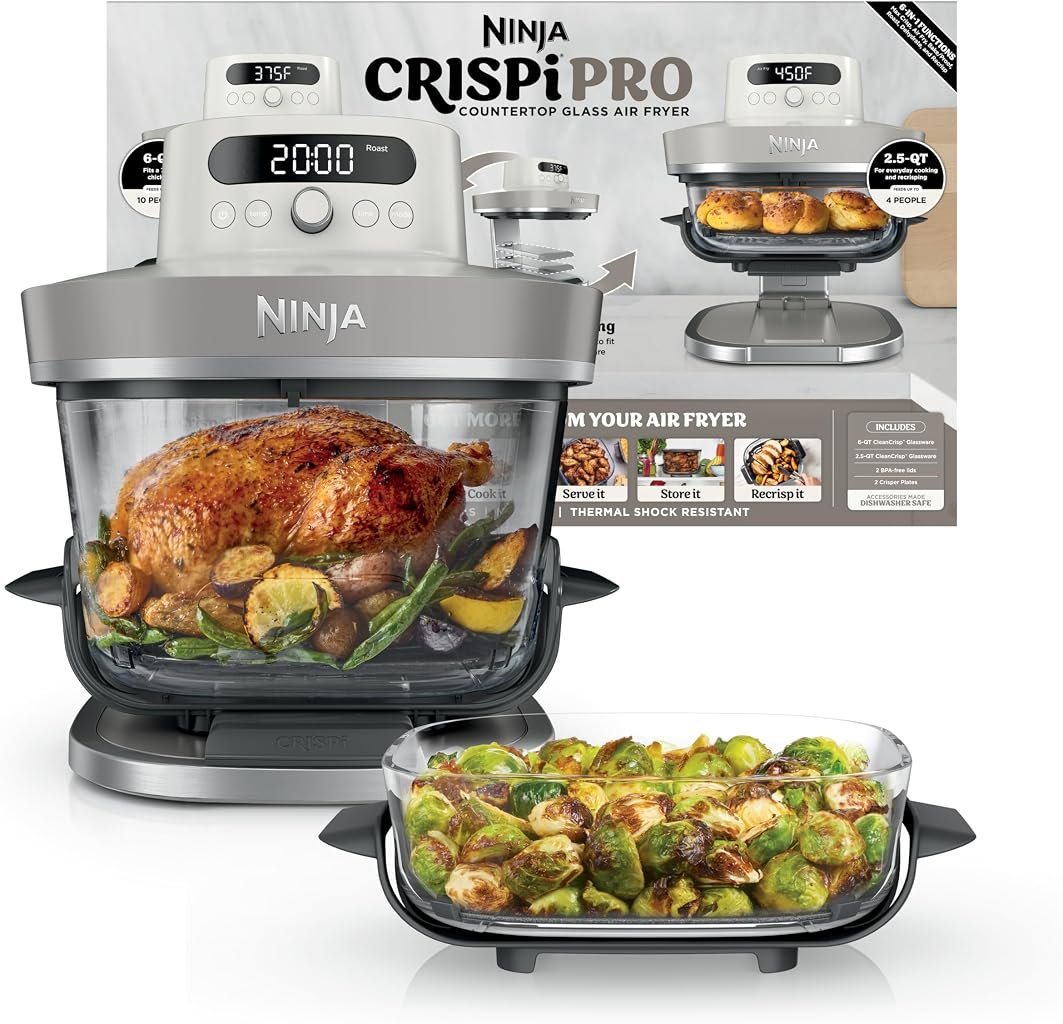
The Ninja Crispi Pro Glass Air Fryer AS101LG approaches countertop air frying from an unusual direction. Instead of hiding food inside an opaque metal drawer, it makes the cooking vessel itself part of the proposition. The system uses interchangeable CleanCrisp glass containers, an adjustable heating unit, crisper plates, storage lids, and a modular base, creating a workflow that can move food from preparation to cooking, serving, and storage with fewer container changes.
That sounds like a cosmetic departure until the details are examined. Ninja supplies a 6-quart glass container for larger meals and a 2.5-quart container for smaller portions. The modular base also accommodates an optional 4-quart CleanCrisp container. The heating system is rated at 1,800 watts, temperatures can reach 450°F, and six functions cover Max Crisp, Air Fry, Bake/Proof, Roast, Recrisp, and Dehydrate.
The AS101LG is the Bone color variant of the Crispi Pro. Ninja lists the appliance at 11.8 inches long, 12.2 inches wide, and 11 inches high, with a weight of 11.4 pounds and a one-year warranty. Those dimensions make the product particularly interesting because its largest included cooking vessel offers 6 quarts of capacity without requiring the broad side-by-side footprint associated with dual-basket machines.
Our score is 8.86/10. Customer Sentiment stands at 8.72, Buyer Confidence reaches 9.8, and Value is 8.4. At the $249.99 price used for our assessment, the Crispi Pro asks buyers to pay meaningfully more than many conventional basket air fryers. The argument for doing so rests less on raw cooking capacity than on glass construction, interchangeable vessel sizes, storage integration, temperature adjustment, and a workflow that treats the cooking container as more than a disposable stage between preparation and the dinner plate.
That distinction defines the entire product.
Glass Is the Design, Not a Decorative Window
Many air fryers offer a viewing window. The Crispi Pro goes considerably further.
Its cooking containers are glass.
Ninja’s official AS101LG specifications identify the included CleanCrisp glassware as 6-quart and 2.5-quart containers, with an optional 4-quart size supported by the adjustable modular base. The manufacturer describes the glass as thermal-shock resistant and designed for cooking and storage without PTFE or PFAS.
That construction changes the relationship between the appliance and the food.
With a conventional drawer-style air fryer, the cooking chamber is largely a piece of appliance hardware. Food is prepared elsewhere, transferred into the basket, cooked, removed for serving, and usually transferred again if leftovers need refrigeration.
The Crispi Pro attempts to compress those stages.
Food can be prepared in the glass container, cooked in it, brought to the table in the same vessel, and stored with the supplied lid afterward.
That does not eliminate dishes. Crisper plates, lids, utensils, and other preparation equipment still exist. Yet reducing unnecessary transfers is a legitimate design objective, particularly for leftovers and meal preparation.
The transparent container also allows the cook to see food without relying entirely on a small window or repeatedly interrupting cooking.
Visibility is not the same as doneness, of course.
Brown food can remain undercooked internally, and pale food can already be safe. Glass helps observation; it does not replace temperature measurement.
The Two Included Container Sizes Are More Important Than They First Appear
The Crispi Pro includes both 6-quart and 2.5-quart CleanCrisp containers.
That decision addresses a common problem with large air fryers: maximum capacity is not always the appropriate capacity.
An appliance large enough for a family dinner can feel absurd when reheating one portion of leftovers. Conversely, a compact fryer that is convenient at lunch can become restrictive when dinner requires a larger batch.
Ninja’s solution is not a telescoping basket or removable divider. It is interchangeable glassware.
The 6-quart container handles the larger workload. Ninja states that it can accommodate a 7.5-pound chicken and describes it as suitable for serving up to 10 people. Those are manufacturer capacity claims rather than guarantees that every 7.5-pound bird or every ten-person meal will have identical spatial requirements.
The 2.5-quart vessel changes the scale for snacks, sides, leftovers, and smaller meals.
An optional 4-quart container creates a middle size.
This modularity is one of the Crispi Pro’s strongest ideas because it recognizes that household cooking volume changes from meal to meal.
Capacity is not a personality trait.
A household does not permanently cook “large” or “small.” Tuesday’s reheated lunch and Saturday’s family dinner may ask entirely different things from the same appliance.
The 1,800-Watt Heating System Supports a Serious Countertop Appliance
The Crispi Pro is rated at 1,800 watts.
That figure places it firmly among substantial countertop cooking appliances. Wattage does not establish food quality by itself; heater geometry, airflow, control logic, vessel shape, food arrangement, and cooking program all affect the result.
Still, electrical power is relevant.
Ninja combines that 1,800-watt system with a maximum temperature of 450°F, giving the appliance access to relatively aggressive high-temperature cooking.
The electrical demand also deserves practical attention. A 1,800-watt appliance is not something to treat casually on an overloaded kitchen circuit or an improvised extension arrangement. The manufacturer’s electrical and placement instructions should govern setup.
The Crispi Pro’s relatively compact physical dimensions can make it look less electrically demanding than a large countertop oven.
Appearances do not change wattage.
Six Functions Avoid Preset Inflation
The AS101LG offers six cooking functions: Max Crisp, Air Fry, Bake/Proof, Roast, Recrisp, and Dehydrate.
The selection is broad enough to alter how the appliance is used without becoming an exercise in button multiplication.
Air Fry covers the familiar hot-air crisping workload. Max Crisp addresses higher-intensity crisping. Roast extends the system toward larger proteins and vegetables. Dehydrate provides a low-moisture cooking application. Recrisp targets cooked foods that need their exterior texture restored.
Bake/Proof is particularly interesting because it combines two kitchen activities associated with very different temperature demands.
That does not mean six functions represent six unrelated heating technologies. The Crispi Pro remains a heated-air cooking system. Programs adjust the operating conditions around that hardware.
Preset counts should therefore never be mistaken for six separate appliances hiding beneath one control panel.
The more meaningful specification is adjustability.
Ninja allows users to select among the six modes and adjust temperature, with cooking temperatures reaching 450°F.
Recrisp Makes More Sense in a Storage-Oriented System
Recrisp can sound like another name for reheating until the glass-container workflow is considered.
Leftovers can be stored in the CleanCrisp container using the included storage lid. When the food is ready to be eaten again, the same cooking vessel can return to the system.
That makes Recrisp conceptually coherent with the hardware.
The feature is not merely asking whether yesterday’s pizza can be warmed. Nearly any competent air fryer can reheat pizza.
The more interesting question is how many containers and transfers stand between refrigerator and table.
This is where the Crispi Pro differs from a conventional drawer.
The container itself can participate in storage.
That does not make every leftover appropriate for high-temperature air frying, nor does it remove normal food-storage rules. It simply makes the path between storing and reheating more direct.
Thermal-Shock Resistance Expands the Workflow
Ninja describes CleanCrisp glassware as thermal-shock resistant and promotes movement from frozen storage into cooking.
That is a significant material claim because rapid temperature changes are a familiar concern with ordinary glass cookware.
The wording should be interpreted specifically rather than universally. The fact that this glassware is designed for thermal shock does not mean every glass container in a kitchen can safely undergo the same treatment.
Only cookware explicitly rated by its manufacturer for the intended temperature transition should be used that way.
For the Crispi Pro, thermal-shock resistance supports the broader prep-cook-store concept.
The vessel is not merely transparent.
It is engineered to participate in multiple stages of food handling.
The Modular Base Is Quietly One of the Smarter Features
The Crispi Pro’s removable modular base allows the heating system to adapt to different CleanCrisp container sizes.
That is an important piece of engineering because interchangeable vessels are only useful if the appliance can accommodate them without requiring separate heating units.
The included 2.5-quart and 6-quart containers represent the small and large ends of the system, while the separately available 4-quart container fills the gap.
This creates a modular capacity strategy rather than a fixed-capacity strategy.
It also introduces additional pieces.
Owners need somewhere to store whichever glass container is not being used. Storage lids, crisper plates, and the modular base add physical components to the system.
Modularity reduces one kind of inconvenience while creating another.
That is not a flaw unique to Ninja. It is the unavoidable price of interchangeable hardware.
Dishwasher-Safe Components Reduce Cleanup Friction
Ninja states that the CleanCrisp glassware, crisper plates, and lids are dishwasher safe.
That matters because glass has a different cleanup proposition from permanently integrated cooking chambers.
The cooking vessel can be removed completely, carried to the sink or dishwasher, and inspected from every angle.
Transparency has an unexpected benefit here: residue is difficult to hide.
Grease films, baked-on sauces, crumbs, and splashes are visible through the glass rather than disappearing against a dark basket interior.
The trade-off is equally obvious.
Glass needs sensible handling. It is heavier and behaves differently from a thin metal basket. A household accustomed to rapidly tossing lightweight air-fryer drawers into the sink may find the glassware more deliberate to handle.
The choice is therefore not between “easy” and “difficult” cleaning.
It is between different cleaning experiences.
Surface-Safe Feet Address a Real Serving Problem
Ninja incorporates fixed heat protection into the glassware and states that the containers can be placed directly on granite, laminate, quartz, butcher block, and marble surfaces.
That feature supports the serving portion of the product’s workflow.
Traditional air-fryer baskets are rarely attractive or practical serving vessels. They contain mechanical interfaces, handles, perforations, and hot surfaces designed around the appliance.
The Crispi Pro’s glassware is closer to conventional serving ware once separated from the heating system.
Fixed heat protection reduces the need to search for a trivet immediately after cooking.
It is a small detail, but small details determine whether a multi-stage concept actually works at dinnertime.
Our 8.86/10 Score Reflects a Distinctive but Specialized System
Our score of 8.86/10 places the Ninja Crispi Pro AS101LG firmly in the upper range of our air-fryer evaluations.
The score reflects how consistently the product’s major features support one central idea.
Glass cooking vessels provide visibility.
Multiple vessel sizes adapt capacity.
Storage lids extend the containers into refrigeration.
Thermal-shock resistance broadens how the glassware can be used.
The modular base accommodates different sizes.
Six cooking functions extend the heating system beyond straightforward air frying.
A 450°F maximum gives the appliance high-temperature capability.
Dishwasher-safe components address cleanup.
The product’s weaknesses are similarly connected to the design.
Glass requires more deliberate handling than lightweight metal baskets. Multiple containers and accessories require storage. There are no independent dual cooking zones. The 6-quart maximum vessel may be less attractive to households seeking very large batch capacity. At the $249.99 price used for our assessment, the system asks buyers to assign real value to glass construction and modularity.
An 8.86 score recognizes an unusually coherent design without pretending those priorities are universal.
Customer Sentiment: 8.72
Our Customer Sentiment score stands at 8.72, slightly below the overall 8.86 rating.
The difference is modest.
The Crispi Pro has an immediately understandable attraction: food is visible, and the cooking vessel can remain useful before and after the heating cycle.
Yet glass cookware changes habits.
The user is no longer handling a conventional air-fryer drawer. There are interchangeable containers, lids, crisper plates, and a modular support system.
For some kitchens, that arrangement reduces clutter because one vessel performs several jobs.
For others, the additional pieces become clutter.
The difference comes down to workflow.
Someone who routinely meal-preps, stores leftovers, reheats food, and serves directly from cookware is more likely to exploit the system than someone who simply wants frozen fries cooked quickly in one permanent basket.
The 8.72 Customer Sentiment score captures that distinction.
Buyer Confidence: 9.8
Buyer Confidence reaches 9.8, the strongest of our four editorial scores.
Ninja provides unusually concrete specifications for the AS101LG.
The model number is explicit. The Bone color is explicit. The manufacturer publishes the 1,800-watt rating, dimensions of 11.8 by 12.2 by 11 inches, weight of 11.4 pounds, one-year warranty, included 6-quart and 2.5-quart glass containers, two crisper plates, two storage lids, removable modular base, six cooking functions, and support for optional 4-quart CleanCrisp glassware.
That makes buyer fit easier to assess before purchase.
The relevant questions are concrete:
- Is a 6-quart maximum cooking vessel large enough for normal meals?
- Will the smaller 2.5-quart container be useful for individual portions and leftovers?
- Does glass cookware fit the household’s handling preferences?
- Is storage available for the container not currently in use?
- Are six cooking functions sufficient?
- Will a 1,800-watt countertop appliance suit the intended electrical setup?
- Does the 11.8-by-12.2-inch footprint fit the planned counter location?
- Is modular capacity more useful than independent dual-zone cooking?
High Buyer Confidence does not mean every answer favors the Crispi Pro.
It means the questions can be answered before money changes hands.
Value: 8.4
Our Value score is 8.4, lower than the overall score, Customer Sentiment, and Buyer Confidence.
At $249.99 in our assessment, the Crispi Pro enters a price range where buyers can reasonably demand more than competent hot-air cooking.
Basic air frying is widely available from less expensive machines.
The Crispi Pro therefore has to justify its cost through architecture.
The value proposition rests on the reusable glass system, two included container sizes, modular compatibility, lids, dishwasher-safe components, six functions, 1,800-watt heating system, 450°F maximum temperature, and the ability to prepare, cook, serve, and store food within the same container family.
A buyer who uses those capabilities can extract meaningful utility from the system.
A buyer who places food in the 6-quart vessel, air-fries it, transfers it to a plate, and never uses the lids or smaller container is paying for a broader workflow that remains mostly dormant.
That explains the 8.4 Value score.
The product has substantial utility, but some of that utility depends on changing how food moves through the kitchen.
Glass Does Not Eliminate Airflow Physics
The transparent cooking chamber makes food easier to observe, but visibility cannot solve overcrowding.
The USDA explains that air fryers depend on rapidly circulating hot air and warns that overfilling can prevent adequate circulation. The agency describes air fryers as “essentially countertop convection ovens.”
That principle applies directly to the Crispi Pro.
A 6-quart container may physically accept a large amount of food, but usable crisping capacity depends on how that food is arranged.
A dense pile of wings presents a different airflow problem from a single layer. Wet vegetables release moisture that must escape. Overlapping pieces shield surfaces from moving air.
The glass container makes those conditions easier to see.
It does not make them disappear.
Among the best air fryers, usable surface area can matter as much as headline volume.
Food Safety Still Depends on Internal Temperature
Transparent glass creates another temptation: judging doneness by appearance.
That is insufficient for foods where internal temperature determines safety.
USDA guidance specifies 145°F for fish, 145°F with a three-minute rest for whole cuts of beef, pork, veal, and lamb, 160°F for ground meat products, and 165°F for poultry. The agency advises using a food thermometer rather than relying on appearance alone.
The Crispi Pro’s visibility can help monitor browning.
It cannot reveal the temperature at the center of a thick chicken breast.
This distinction becomes particularly relevant with a product capable of cooking larger proteins. Ninja says the 6-quart container can accommodate a 7.5-pound chicken. A bird fitting physically inside the vessel does not eliminate the need to verify safe internal temperature.
Glass answers the question, “What does the food look like?”
A thermometer answers a different question.
Where the Crispi Pro Fits Among the Best Air Fryers
The Crispi Pro is most persuasive when buyers value visibility, modular capacity, and container continuity more than dual-zone cooking.
Its strongest buyer profiles include:
- Households that prefer seeing food during cooking.
- Meal-prep users who can exploit cooking and storage in the same glass container.
- Buyers seeking an alternative to a permanently integrated coated metal cooking drawer.
- Kitchens where switching between 2.5-quart and 6-quart vessels is more useful than owning one fixed capacity.
- Users interested in an optional 4-quart middle size.
- Households that regularly reheat leftovers and can make practical use of Recrisp.
- Buyers who value dishwasher-safe glassware and storage lids.
- Cooks who need temperatures reaching 450°F.
- Users who prefer one open cooking vessel rather than two divided zones.
The weaker fit is just as identifiable.
Households frequently cooking two foods at separate temperatures may be better served by a dual-zone machine.
Buyers who want the lightest possible removable basket may prefer metal construction.
Those needing substantially more than 6 quarts in one cooking vessel should examine larger formats.
And shoppers interested only in straightforward air frying may find the $249.99 assessment price difficult to justify when less elaborate machines can perform that basic task.
Counter Space Is Only Half the Storage Question
The Crispi Pro itself measures 11.8 inches long, 12.2 inches wide, and 11 inches high.
Those dimensions are relatively straightforward to measure against a countertop.
The less obvious issue is accessory storage.
When the 6-quart container is attached, the 2.5-quart container needs somewhere to go. Storage lids need a home. Crisper plates must be managed. Buyers adding the optional 4-quart vessel introduce another piece.
This is the paradox of modular appliances.
They can reduce functional redundancy while increasing the number of physical components.
The Crispi Pro may replace separate preparation, cooking, serving, and storage vessels during a particular meal, yet the system itself requires organized cabinet space.
That is not necessarily a poor trade.
It simply needs to be counted.
One-Year Warranty Coverage Is Conventional
Ninja lists a one-year warranty for the AS101LG.
That duration is adequate for basic manufacturer coverage but does not materially distinguish the Crispi Pro from many countertop appliances.
This is one area where the premium positioning of the product is not accompanied by unusually long standard warranty protection.
Long-term ownership will therefore depend partly on ordinary care: handling glassware appropriately, cleaning components according to instructions, avoiding unsuitable utensils or treatment, and respecting electrical and placement requirements.
The 9.8 Buyer Confidence score remains justified by the clarity of the product specification and architecture.
The warranty itself is not the reason for that score.
Strengths and Drawbacks
The Crispi Pro’s strongest characteristics are unusually interconnected.
Its glass containers provide visibility and support preparation, cooking, serving, and storage. The included 2.5-quart and 6-quart sizes allow the appliance to change scale. The modular base supports an optional 4-quart vessel. Six cooking functions cover Max Crisp, Air Fry, Bake/Proof, Roast, Recrisp, and Dehydrate. The heating system is rated at 1,800 watts and reaches up to 450°F. Thermal-shock-resistant glass broadens the storage-to-cooking workflow. Dishwasher-safe glassware, crisper plates, and lids reduce cleanup friction.
The drawbacks follow directly from those choices.
Glass requires deliberate handling. Multiple vessels require storage. The largest included container is 6 quarts rather than the 8- or 10-quart capacities found in some large air fryers. There are no independent dual cooking zones. A one-year warranty is ordinary. And at the $249.99 assessment price, buyers are paying for the glass ecosystem and modular workflow rather than merely the ability to circulate hot air around food.
That final distinction matters most.
The Crispi Pro is not compelling because it can air-fry potatoes.
Far cheaper machines can do that.
Its argument is that the vessel containing those potatoes can become part of a more coherent food-handling system.
Final Considerations
The Ninja Crispi Pro Glass Air Fryer AS101LG is built around a question most air fryers barely ask: what happens to the food container before and after cooking?
Its answer is a modular glass system.
The included 2.5-quart and 6-quart CleanCrisp containers can move through preparation, cooking, serving, and storage, while the modular base adapts the heating system to different vessel sizes. An optional 4-quart container fills the capacity gap. Six cooking functions, 1,800 watts of rated power, temperatures up to 450°F, thermal-shock-resistant glass, storage lids, crisper plates, and dishwasher-safe components build around that central idea.
Our 8.86/10 score reflects how coherently those features work as a product concept.
Customer Sentiment at 8.72 is slightly lower because the glass-and-modular approach asks more of the owner than a conventional drawer fryer. It works best when the containers are used across several stages of meal preparation rather than treated merely as transparent baskets.
Buyer Confidence at 9.8 is the strongest score because the AS101LG’s core specifications and included components are unusually well defined.
Value at 8.4 is more restrained. At the $249.99 price used for our assessment, the Crispi Pro must earn its place through the glassware system, modular capacity, storage integration, and cooking flexibility. Buyers seeking only basic air frying can spend less without surrendering the fundamental hot-air cooking method.
That makes the AS101LG a specialized proposition rather than a universal answer.
Its glass construction does not override airflow physics.
Its 450°F capability does not replace a food thermometer.
Its 6-quart container does not become larger merely because it can accommodate substantial foods.
And its modular system creates storage demands of its own.
Yet the underlying design remains unusually coherent. Instead of treating the basket as a dark drawer that exists only while the appliance is running, Ninja turns the cooking vessel into an object that can remain useful across the meal’s lifecycle.
For households that prepare, cook, serve, save, and reheat food frequently, that is more than a visual novelty.
It changes what the air-fryer container is expected to do.