A countertop microwave priced around $461 has a difficult assignment. It cannot rely on the basic proposition that microwave cooking is fast and convenient; inexpensive machines already accomplish that. At this price, the appliance has to make a credible case through capacity, installation flexibility, controls, automation, connectivity, construction, and day-to-day usability.
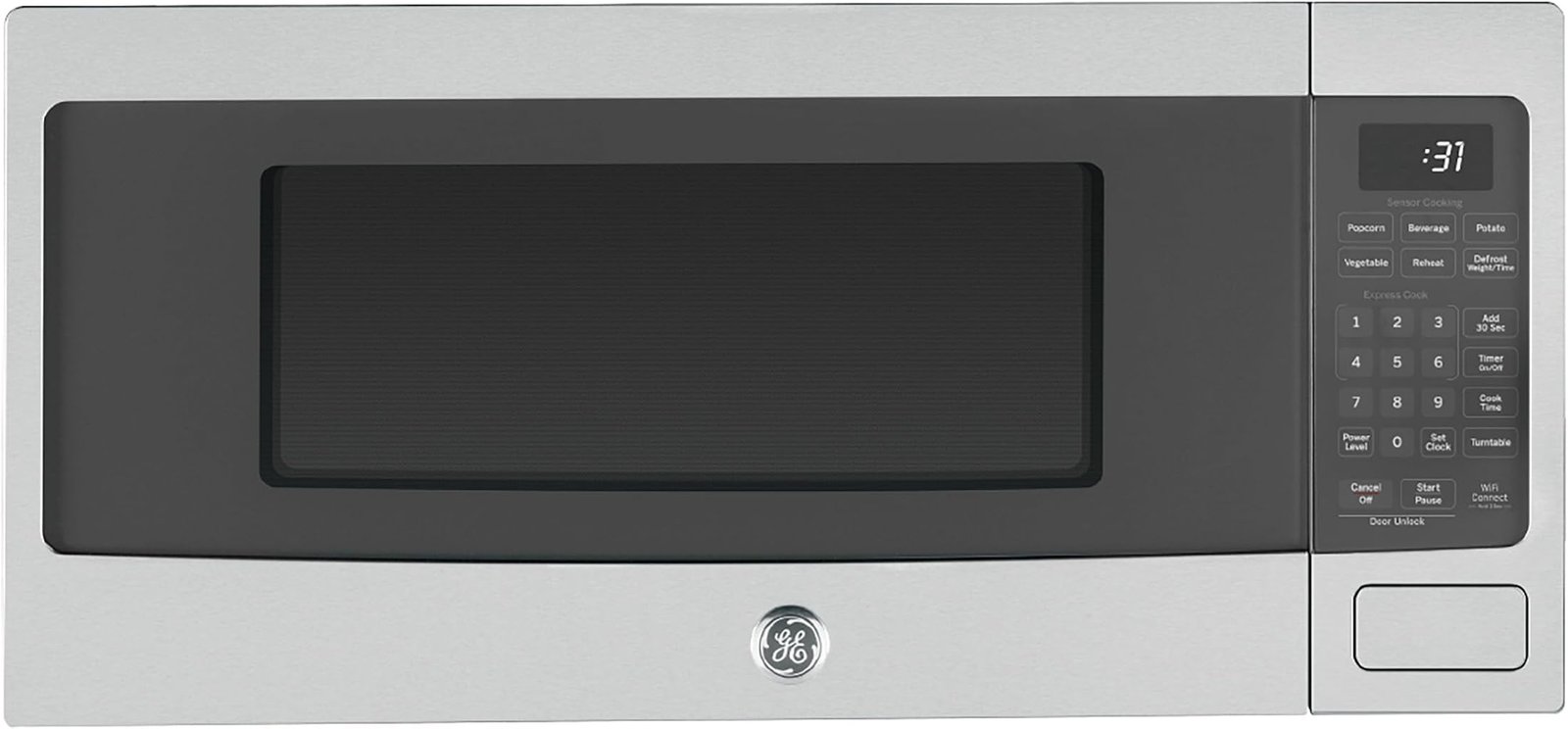
The GE Profile PCHK11S1WSS takes that route. It is a stainless-steel, 1.1-cubic-foot microwave rated at 800 watts, but those headline numbers only describe part of the machine. GE equips it with sensor cooking, 10 power levels, a switchable turntable, express controls, Wi-Fi connectivity, Scan-to-Cook technology, and installation options extending beyond ordinary countertop placement.
Our score is 8.36/10, placing the PCHK11S1WSS firmly in very-good territory. Customer Sentiment stands at 8.28, Buyer Confidence at 8.82, and Value at 8.15. Those numbers tell a fairly coherent story: this is a well-specified microwave with unusually flexible placement and a strong set of convenience functions, but its premium price and relatively modest 800-watt output keep the value proposition from being equally strong for every household.
A 1.1-Cubic-Foot Microwave With An Unusual Installation Story
The PCHK11S1WSS is nominally a countertop appliance, yet treating it solely as one misses one of its more consequential characteristics.
According to the official GE Profile specifications, the microwave supports countertop, built-in, and under-cabinet installation. GE also lists a total capacity of 1.10 cubic feet. That placement flexibility distinguishes it from a conventional portable microwave whose long-term destiny is simply to consume a rectangle of counter space.
The physical dimensions help explain where the appliance fits. GE lists an overall width of 24 inches, height of 11.87 inches, and depth of 12.875 inches. The cavity measures 17.38 inches wide, 9 inches high, and 12.25 inches deep. Net weight is 35 pounds, while the door requires substantially more room when fully opened: overall depth reaches 31.875 inches with the door at 90 degrees.
That last measurement deserves attention during kitchen planning. A shallow appliance can look accommodating on a specification sheet while still demanding considerable clearance during actual use. Anyone positioning the PCHK11S1WSS near an island, wall, shelf edge, or frequently used walkway should account for the open door rather than judging fit solely from its 12.875-inch closed depth.
Its 1.1-cubic-foot cavity is neither tiny nor unusually large. The 10.625-inch glass turntable gives a more practical indication of usable space. Large platters and oversized cookware require measurement before purchase rather than assumptions derived from the cubic-foot figure alone.
For smaller kitchens, the optional mounting possibilities alter the equation. Counter space is expensive kitchen real estate. An appliance that can migrate from the countertop to an under-cabinet or appropriately configured built-in position gives owners more flexibility when layouts change.
800 Watts: Adequate, But Buyers Should Understand The Consequence
The PCHK11S1WSS is rated at 800 watts of microwave output under the IEC-705 test procedure. It offers 10 power levels and conventional microwave cooking rather than making raw wattage the centerpiece of the design.
Eight hundred watts is a meaningful specification because microwave wattage affects cooking speed. The USDA guidance on cooking with microwave ovens states plainly: “The higher the wattage of a microwave oven, the faster it will cook food.” USDA categorizes roughly 800 watts or more as high wattage in its time-to-boil guidance, while 1,000 watts or more falls into its very-high-wattage category.
That places the GE in a perfectly workable range, but it also establishes a limitation that should not be disguised by its premium positioning. Recipes and packaged-food directions written around more powerful microwaves can require timing adjustments.
The USDA specifically advises that if a microwave has lower wattage than the wattage assumed by packaged-food instructions, the food will take longer to reach a safe internal temperature. For foods where temperature determines safety, a food thermometer remains the appropriate verification method.
This is one of the central trade-offs of the PCHK11S1WSS. A household replacing a 1,000- or 1,200-watt microwave should not assume identical heating times merely because the new appliance carries a premium badge and connected features. The GE’s attraction lies elsewhere: installation versatility, automation, sensor functions, control flexibility, and connectivity.
Sensor Cooking Is More Relevant Than Another Row Of Presets
Preset buttons are easy to advertise and easy to overvalue. Sensor cooking is more consequential because it attempts to adjust the cooking process rather than merely attaching a label to a predetermined time.
The PCHK11S1WSS includes sensor controls for popcorn, reheat, beverage, vegetable, and potato functions, alongside weight/time defrost. GE says its sensor cooking controls automatically adjust time and power during cooking.
The distinction matters. A microwave’s everyday workload often consists of leftovers, beverages, vegetables, frozen food, and short reheating tasks rather than elaborate recipes. Automation is useful when it reduces the number of manual decisions needed for those repetitive jobs.
Manual control remains available. There are 10 power levels, Cook Time, Add 30 Seconds, Start/Pause, Express Cook settings covering one through six minutes, and a timer. The appliance therefore does not force the owner into preset-driven cooking.
That balance is preferable to a control panel loaded with narrowly named food buttons. The user can take the fast route when convenience matters or revert to time-and-power settings when a specific recipe requires them.
The turntable can also be switched off. That feature is easily overlooked but can matter with dishes whose shape makes rotation inconvenient. The microwave uses a glass turntable and conventional turntable cooking system.
Connected Features Change The Character Of The Appliance
Wi-Fi in a microwave can sound like connectivity searching for a purpose. In this model, GE ties the feature to its SmartHQ ecosystem and Scan-to-Cook functionality.
GE lists built-in Wi-Fi and Scan-to-Cook Technology among the PCHK11S1WSS’s cooking and connectivity features. Its product information describes connected functions that can supply feedback, alerts, and other SmartHQ functions.
Scan-to-Cook is conceptually straightforward: compatible packaged foods can be identified so that appropriate cooking instructions are communicated to the appliance. This targets one of microwave cooking’s recurring inconveniences-the translation of package instructions into button presses and, when oven wattage differs from the package assumption, adjusted timing.
Whether that matters enough to justify paying more is highly household-dependent. Someone who mainly warms coffee and reheats yesterday’s dinner will extract less benefit from connectivity than a household that regularly prepares compatible frozen or packaged foods.
The more significant point is that none of these connected functions replaces basic microwave controls. An appliance should remain functional when a phone is absent, an account is inconvenient, or network connectivity is unavailable. The PCHK11S1WSS retains conventional touch controls for its central cooking operations.
That separation between core operation and connected convenience is sensible appliance design.
Child Lock And Control Lockout Address Different Everyday Problems
The PCHK11S1WSS includes both a two-step child lock and control lockout. GE describes the two-step child-lock system as a feature intended to help prevent unintended use by younger household members, with the option to deactivate it when unnecessary.
Control lockout addresses accidental activation more generally.
These controls sit within a broader regulatory history surrounding microwave safety. The FDA’s microwave-oven guidance says the agency has regulated microwave-oven manufacture since 1971. Federal standards limit microwave leakage throughout an oven’s lifetime to 5 milliwatts per square centimeter when measured approximately two inches from the oven surface. The standard also requires two independent interlock systems that stop microwave generation when the door is opened or its latch is released.
That history provides useful perspective because consumer discussions of microwave safety sometimes focus on radiation while overlooking the more ordinary hazards of hot containers, overheated liquids, and food temperatures. The FDA reports that most microwave-oven injuries involve heat-related burns rather than radiation.
For routine ownership, door condition matters. The FDA recommends discontinuing use when a microwave door does not close firmly or is bent, warped, or otherwise damaged.
The Controls Favor Speed Without Abandoning Precision
The control scheme follows a familiar microwave vocabulary: electronic touch controls, LED display, clock, kitchen timer, Add 30 Seconds, express cooking, defrost controls, and selectable power.
The display measures 2.45 inches diagonally. Express Cook provides one- through six-minute shortcuts, while Instant On controls reduce the steps needed for common short cycles.
These are mundane features until they are poorly implemented or absent. A microwave is frequently operated in intervals measured in seconds, often while the user is handling other food. The difference between an appliance requiring several commands and one allowing a quick 30-second extension accumulates over years of daily use.
The PCHK11S1WSS’s control architecture therefore makes more sense than one centered on novelty. Sensor cooking and connectivity sit above a conventional operating layer rather than replacing it.
Price Is The Hardest Part Of The Argument
At the $461 reference price, this microwave enters territory where expectations rise sharply.
Our Value score of 8.15 is positive but lower than the 8.36 overall score and 8.82 Buyer Confidence rating. That gap captures the product’s central tension. There is considerable capability here, but not every buyer needs to pay for it.
A household seeking nothing more than manual reheating can find the PCHK11S1WSS overqualified for the assignment. Its financial logic improves when installation flexibility, sensor programs, connected controls, Scan-to-Cook, the stainless-steel Profile design, and a relatively shallow body solve identifiable needs.
This distinction belongs in any serious microwave buying guide. Price comparisons based solely on capacity and wattage can make premium models look irrational, while comparisons based solely on feature counts can make ordinary models look inadequate. Neither approach captures actual ownership.
The better question is which features remove recurring friction.
For a kitchen where counter space is scarce, mounting flexibility has tangible utility. For someone who frequently reheats varied foods, sensors can reduce manual adjustment. For households using compatible packaged meals, Scan-to-Cook has a plausible role. For a user who wants maximum heating speed per dollar, however, the 800-watt specification deserves more weight than the connectivity package.
Where The PCHK11S1WSS Is Strongest
Several characteristics account for our 8.36/10 assessment:
- Its 1.1-cubic-foot capacity occupies a practical middle ground without requiring the footprint associated with some larger countertop ovens.
- Countertop, built-in, and under-cabinet possibilities create unusual placement flexibility.
- Sensor controls address common foods and reheating tasks rather than functioning merely as decorative presets.
- Ten power levels preserve manual control.
- The turntable can be disabled when rotation is undesirable.
- Express Cook and Add 30 Seconds simplify repetitive short heating cycles.
- Built-in Wi-Fi and Scan-to-Cook extend functionality for households that will actually use connected cooking.
- Child-lock and control-lockout functions provide additional safeguards against unintended activation.
None of these individual features transforms microwave cooking. Their combined effect is more relevant: the PCHK11S1WSS is designed to adapt to different kitchen configurations and different levels of user involvement.
Where It Gives Ground
The 800-watt output is the most obvious compromise. It is not inherently inadequate-the USDA’s own guidance places approximately 800 watts in its high-wattage range-but it is below the output of many 1,000-watt-plus machines. Buyers moving from a more powerful microwave should expect some cooking times to change.
The second issue is economic. At $461, the PCHK11S1WSS makes little sense as a purchase driven only by cavity size and heating power. Its value rests on the whole package. Buyers who will never use Wi-Fi, Scan-to-Cook, alternative installation arrangements, or sensor cooking are effectively paying for capabilities with little personal utility.
The 10.625-inch turntable also sets a practical boundary. Cubic-foot capacity can sound spacious in isolation, but dish compatibility ultimately comes down to cavity geometry and usable rotating diameter.
Finally, connected appliances introduce a category of functionality that simple microwaves avoid altogether: setup, software, network pairing, and platform interaction. These functions can be convenient, but simplicity has value too. Buyers should decide whether connectivity solves an actual kitchen problem rather than treating Wi-Fi as an automatic upgrade.
Who Is Most Likely To Appreciate It?
The PCHK11S1WSS makes its strongest case in kitchens where space planning and installation matter nearly as much as heating food.
Apartment owners, renovators, and households trying to reclaim worktop space can make use of its mounting options. Buyers already using GE Profile appliances may also find the stainless-steel design and ecosystem integration more relevant than someone purchasing an isolated microwave for a utility room.
It also suits users who prefer automation without surrendering conventional controls. Sensor reheating, express cooking, weight/time defrost, adjustable power, and Scan-to-Cook offer several levels of interaction depending on the task.
By contrast, a buyer primarily concerned with maximum wattage for the lowest possible price has a different set of priorities. So does someone who wants the smallest, simplest appliance possible. The GE’s higher score reflects capability and flexibility, not universal suitability.
Understanding Our Ratings
Our Customer Sentiment score of 8.28 suggests a generally favorable ownership proposition while leaving room for the practical compromises inherent in an 800-watt premium microwave. The 8.82 Buyer Confidence score is the strongest of the four figures, reflecting a product whose core specifications, installation possibilities, controls, and manufacturer support structure form a coherent package.
Value, at 8.15, is more conditional. The price becomes easier to defend as more of the appliance’s distinctive capabilities are used. If it spends its life on a counter performing only 30-second reheats, much of what distinguishes it is wasted.
Our overall 8.36/10 score sits between those considerations. The PCHK11S1WSS is not judged merely as an 800-watt box that heats food. It is judged as a compact, flexible-installation microwave with sensor automation and connected functions-and the rating reflects both that broader capability and the premium attached to it.
Final Considerations
The GE Profile PCHK11S1WSS is a more interesting appliance than its basic 1.1-cubic-foot, 800-watt description suggests. Its strongest argument is architectural as much as culinary: a relatively shallow 24-inch-wide body can operate on a countertop while also supporting built-in and under-cabinet configurations. Add sensor cooking, 10 power levels, a switchable turntable, express functions, Wi-Fi, and Scan-to-Cook, and the machine begins to justify its position above basic countertop microwaves.
Its limitations are equally concrete. Eight hundred watts means buyers should pay attention to cooking instructions written for higher-output machines. A 10.625-inch turntable imposes a real limit on dish size. And at roughly $461, the economics are strongest only when the appliance’s broader feature set addresses genuine needs.
That produces a fairly precise editorial judgment. Our 8.36/10 score reflects a very good microwave whose strengths lie in versatility rather than brute heating power. Customer Sentiment of 8.28 and Value of 8.15 acknowledge the trade-offs, while Buyer Confidence of 8.82 reflects the coherence of the overall package.
For the right kitchen, the PCHK11S1WSS can do something inexpensive countertop microwaves often cannot: fit into the layout rather than forcing the layout to accommodate the appliance. That distinction is less dramatic than another hundred watts on a specification sheet, but over years of daily kitchen use, it can be considerably more consequential.