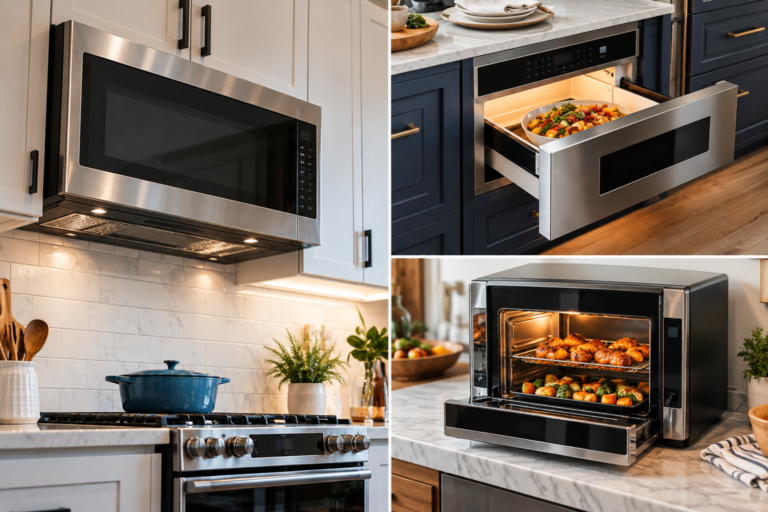
Choosing a microwave looks easy until the appliance has to live somewhere.
At the most basic level, countertop, over-the-range, and built-in microwaves perform the same central task: they use microwave energy to heat food. The meaningful differences emerge outside the cooking cavity. Placement determines how much counter space disappears, whether cabinetry must be modified, how ventilation is handled, how easily the appliance can be replaced, and how much installation can add to the real cost of ownership.
That makes microwave type less a question of cooking technology than kitchen architecture.
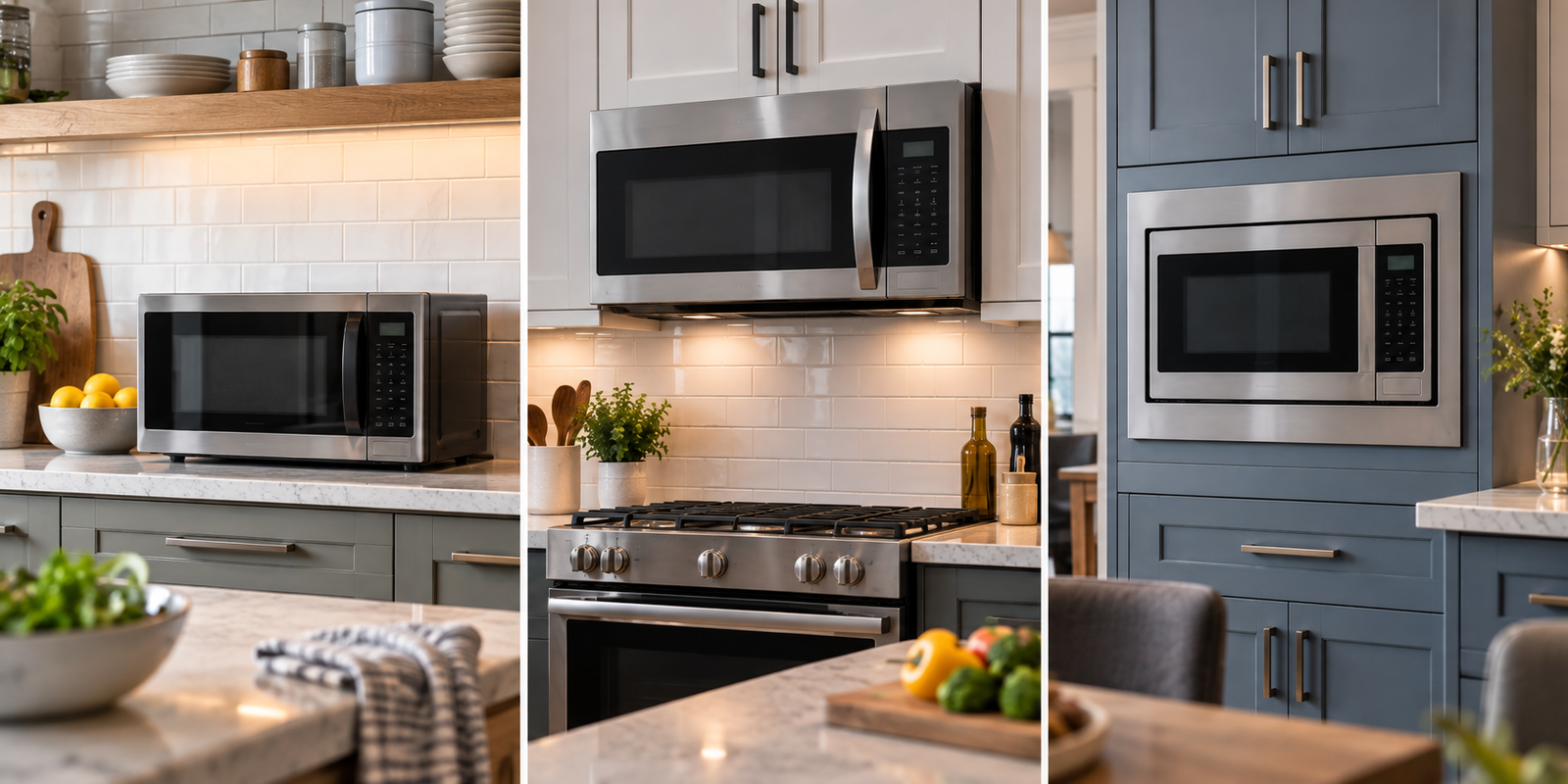
A countertop microwave asks for horizontal work surface. An over-the-range model uses the space above a range while often combining microwave and ventilation functions. A built-in microwave moves the appliance into cabinetry, creating a more integrated appearance while making dimensions, clearances, trim, ventilation, and replacement planning more consequential.
No one format is inherently superior. The correct choice depends on what the kitchen can physically support and what the household is trying to preserve: money, counter area, ventilation capability, visual integration, installation simplicity, or some combination of those priorities.
A useful microwave buying guide should therefore begin with the room rather than the appliance.
Countertop Microwaves Make Simplicity Their Main Advantage
The countertop microwave is the least architecturally demanding of the three formats.
It normally requires a suitable surface, adequate clearances according to the manufacturer’s instructions, and an appropriate electrical connection. There is no cabinet cutout to engineer and no wall mounting process comparable with an over-the-range installation.
That simplicity has economic consequences.
A countertop appliance can generally be replaced without paying someone to remove it from cabinetry or detach it from a mounting system. If the microwave fails, the household can unplug it, remove it, and select another model that fits the available surface and electrical requirements.
This freedom is easy to underestimate.
Built-in kitchen appliances create dependencies between the product and the room. Countertop microwaves largely avoid that relationship. A future replacement does not need to reproduce a cabinet opening with great precision. Remodeling the kitchen does not necessarily require relocating the appliance permanently. Renters can usually take the microwave with them.
The compromise is equally obvious: counter space.
A microwave can consume a meaningful portion of a small kitchen’s usable preparation area. The inconvenience becomes more pronounced when the same surface already supports a coffee maker, toaster, mixer, food processor, drying rack, storage containers, or other equipment.
Countertop models therefore make the strongest case where physical surface area is abundant or installation simplicity carries greater value than reclaiming work space.
Counter Space Is More Valuable Than Its Square Inches Suggest
Kitchen counters perform several jobs simultaneously.
They are preparation surfaces, temporary storage areas, serving stations, landing zones for groceries, locations for small appliances, and places where hot cookware moves between cooking and serving.
A microwave placed on that surface does not merely consume its own footprint. It can fragment the remaining work area.
Imagine a counter with several feet of nominal width. A microwave placed in the middle can divide one useful preparation zone into two smaller zones. The total square footage has not changed dramatically, but the practical usefulness of the surface can decline.
This is one reason over-the-range and built-in microwaves exist.
They transfer the appliance into vertical space or cabinetry, trading installation complexity for recovered work surface.
The exchange can be worthwhile in compact kitchens. In a large kitchen with extensive counters, the same exchange may accomplish little.
The decision should therefore begin with an observation of how the kitchen actually functions. If meal preparation regularly becomes a negotiation over a few remaining inches of counter, moving the microwave can have a larger effect than its dimensions initially suggest.
Over-the-Range Microwaves Combine Two Kitchen Functions
An over-the-range microwave uses the area above the cooking surface.
This configuration has an obvious spatial advantage: the microwave leaves the countertop while using an area already associated with cooking. Many over-the-range models also incorporate ventilation, allowing one appliance to perform microwave and range-ventilation functions within the same general footprint.
That consolidation is attractive, but it changes the installation equation.
The appliance must fit the available width, height, and depth. The upper cabinet must support the approved installation arrangement. Electrical access has to be appropriate. Required clearances must be maintained. Ventilation configuration needs attention.
A household replacing an existing over-the-range microwave may already have much of that infrastructure. Even so, compatibility should never be assumed merely because the old and new appliances share the same nominal width.
Mounting plates can differ. Cabinet holes can differ. Depth and height can differ. Vent locations and duct arrangements can differ.
A tape measure and the installation manual are more dependable than visual similarity.
Ventilation Is the Over-the-Range Category’s Defining Complication
The ventilation component deserves particular scrutiny.
Cooking produces heat, moisture, airborne particles, grease, smoke, and odors. An over-the-range microwave with a fan attempts to address some of those by combining ventilation with microwave placement.
The effectiveness of that arrangement cannot be inferred merely from the existence of a fan.
Airflow capacity, duct configuration, fan speeds, filter design, noise, capture area, installation height, and whether the appliance exhausts outdoors or recirculates air can all affect the practical result.
A buyer should therefore investigate ventilation specifications separately from microwave specifications.
A high microwave wattage says nothing about ventilation performance. A large cavity says nothing about airflow. Stainless steel says nothing about grease capture.
These are separate systems sharing one enclosure.
Where exterior ducting already exists, an over-the-range model designed for compatible venting can integrate neatly into the kitchen. Where no exterior duct is available, some models support recirculating arrangements, but the exact appliance documentation should establish whether and how that configuration works.
The broader lesson is straightforward: an over-the-range microwave should not be selected as though it were merely a countertop microwave with mounting hardware.
Built-In Microwaves Put Integration Ahead of Portability
Built-in microwaves take the architectural relationship further.
Instead of sitting on the counter or hanging above the range, the appliance is installed into cabinetry or another approved built-in location. Depending on the model, installation may involve a dedicated opening, manufacturer-approved clearances, ventilation provisions, and sometimes a model-specific trim kit.
The visual result can be cleaner because the microwave becomes part of the cabinet layout.
That integration has a cost.
A countertop microwave can be replaced with considerable dimensional flexibility. A built-in opening is less forgiving. The replacement appliance has to work with the available space, approved installation requirements, ventilation needs, and any trim arrangement.
This makes future planning unusually relevant.
A built-in microwave that fits beautifully today can create a more difficult replacement project years later if a future model has different dimensions or installation requirements.
That does not make built-in installation a poor choice. It means the household is trading portability for integration.
Buyers should make that trade deliberately.
A Countertop Microwave Is Usually the Easiest to Replace
Serviceability is rarely exciting during the purchase process. It becomes far more interesting when an appliance stops working.
Countertop microwaves have an obvious advantage here.
If service is impractical or uneconomical, replacement can be relatively straightforward. The appliance is accessible and generally does not need to be removed from a wall or cabinet installation.
An over-the-range microwave creates more work. Removal may require supporting a relatively heavy appliance while disengaging it from mounting hardware and the upper cabinet.
A built-in microwave can add another layer because surrounding trim or cabinetry may need to be addressed before the appliance can be removed.
This difference should influence purchasing decisions in homes where easy maintenance is a priority.
The cheapest appliance to purchase is not necessarily the least expensive appliance to own if installation and removal repeatedly add labor costs.
Built-In Does Not Mean a Countertop Microwave Placed Inside a Cabinet
This distinction deserves emphasis.
A countertop microwave should not automatically be enclosed inside cabinetry merely because its dimensions appear to fit.
Microwave ovens produce heat, and manufacturers specify placement and clearance requirements for their products. A model intended for countertop use may rely on ventilation around parts of its enclosure that would be obstructed by an improvised cabinet installation.
Built-in installation should therefore follow the manufacturer’s approved configuration for the exact appliance.
If a manufacturer permits a particular countertop-style microwave to be installed with a specified trim kit or built-in arrangement, those instructions govern the installation. Without such approval, fitting the box physically into a cabinet opening is not enough.
Physical fit and approved installation are different questions.
This is one of the most consequential distinctions shoppers can make when comparing microwave types.
Capacity Is Useful, but Interior Geometry Is Better
Microwave capacity is commonly advertised in cubic feet.
The number is useful for broad comparison. It is less useful for predicting whether a particular casserole dish, dinner plate, bowl, or covered container will fit.
Two microwaves with similar stated capacities can have different internal proportions.
One cavity may be wider and shallower. Another may be narrower and deeper. Turntable diameter can further restrict practical cookware dimensions. Handles and lids can create clearance problems that the nominal capacity figure cannot reveal.
Before buying any microwave type, the household should measure the cookware it uses most frequently.
That includes:
- The widest dinner plates.
- Frequently used casserole dishes.
- Tall covered containers.
- Large bowls.
- Meal-preparation containers.
- Any vessel routinely used for microwave cooking rather than simple reheating.
These measurements should then be compared with published interior dimensions and turntable specifications where available.
A household does not cook in cubic feet. It cooks in dishes.
Placement Can Affect Accessibility
Installation height deserves attention as well.
Countertop microwaves usually place the cavity somewhere near counter level. That can make the interior relatively easy to see and can reduce the distance hot food must travel before reaching a work surface.
Over-the-range microwaves sit higher.
For many adults, that placement is familiar and workable. For shorter users, children, or people with limited reach, removing a hot bowl or liquid-filled container from an elevated cavity can be less convenient.
Built-in microwaves offer more flexibility because cabinet design can place them at different heights, but the chosen position needs to be considered carefully.
This is not merely a question of comfort.
Hot liquids and heavy containers deserve controlled handling. An appliance positioned too high for a user can make that process unnecessarily awkward.
Households should evaluate microwave height using the people who will actually operate it rather than an idealized kitchen rendering.
Safety Standards Apply Across the Categories
Countertop, over-the-range, and built-in microwaves differ in installation, but the underlying microwave technology operates within the same federal safety framework in the United States.
The U.S. Food and Drug Administration says it has regulated microwave oven manufacturing since 1971. Manufacturers must certify products and meet federal safety-performance standards, and the agency states that ovens meeting those standards and used according to manufacturer instructions are safe based on current knowledge.
Microwaves use non-ionizing electromagnetic radiation rather than the ionizing radiation associated with X-rays. The FDA explains that microwave energy is absorbed by food and causes water molecules to vibrate, producing heat.
Federal requirements are quantitative. The standard limits leakage over the oven’s lifetime to 5 milliwatts per square centimeter at approximately two inches from the appliance surface. It also requires two independent interlock systems to stop microwave production when the door opens or its latch is released.
Those rules apply regardless of whether the microwave sits on a counter or becomes part of cabinetry.
The more immediate household concern is condition. Damaged hinges, latches, seals, or doors warrant attention, and the FDA advises against using an oven if its door does not close firmly or is bent, warped, or otherwise damaged.
Food Safety Does Not Change With Installation Style
A built-in microwave does not cook food more safely merely because it costs more to install. An over-the-range model does not eliminate cold spots because it includes a ventilation fan. A countertop microwave is not inherently less capable of safe reheating because it is portable.
Food safety depends on temperature and technique.
The USDA advises reheating previously cooked foods or leftovers to at least 165°F, or 73.8°C. It recommends using a food thermometer, covering and rotating food during microwave reheating, allowing standing time, and checking the internal temperature in several locations.
That guidance exposes one of the limitations of shopping by wattage alone.
A powerful microwave can still produce temperature differences within a dish. Food shape, density, moisture, initial temperature, placement, and portion size all affect heating.
Microwave type does not change those fundamentals.
Countertop vs Over-the-Range vs Built-In: The Practical Trade-Offs
The three formats can be reduced to a series of exchanges.
A countertop microwave offers placement simplicity, portability, easier replacement, and minimal installation demands. In return, it consumes counter space and can add visual clutter to a heavily used work area.
An over-the-range microwave recovers counter space and can combine microwave and ventilation functions. In return, it requires mounting, careful dimensional checks, attention to clearances, and closer examination of ventilation performance.
A built-in microwave can provide the most integrated cabinet appearance and can free both counter space and the area above the range for a separate hood. In return, installation becomes more dependent on cabinetry, approved clearances, ventilation, trim arrangements, and future replacement dimensions.
The choice is therefore not a hierarchy. It is a resource-allocation decision.
The household decides which inconvenience is cheapest to tolerate.
When a Countertop Microwave Makes the Most Sense
Countertop is the logical starting point when installation simplicity matters more than preserving every inch of work surface.
It is particularly suitable for renters, temporary kitchens, secondary kitchens, dormitory-style settings where permitted, offices, households expecting to move, and kitchens with generous counter area.
It can also make financial sense for buyers who prefer easy replacement.
There is little reason to create an elaborate installation merely to avoid placing an appliance on an underused section of counter.
The strongest argument against countertop placement appears when the counter itself is scarce.
In that setting, the inexpensive installation can create a daily spatial cost.
When an Over-the-Range Microwave Makes the Most Sense
Over-the-range installation is strongest when the kitchen already supports that configuration and the household wants to recover counter space while placing microwave functionality near the cooking area.
Replacement projects are especially natural candidates, assuming the new appliance is compatible with the existing cabinet, electrical, clearance, and ventilation arrangements.
The format also makes sense when combining ventilation and microwave functions is a deliberate spatial strategy.
It becomes less attractive when ventilation performance is a major priority and the available microwave models do not meet the household’s airflow, capture, noise, or ducting needs.
A household doing substantial stovetop cooking should evaluate the ventilation system as carefully as the microwave cavity.
When a Built-In Microwave Makes the Most Sense
Built-in installation suits kitchens where cabinetry integration is a priority and the renovation or construction plan already accommodates the appliance.
It can also be useful when the household wants a dedicated range hood rather than combining ventilation and microwave functions above the cooking surface.
Placement flexibility is another advantage. Depending on the approved installation, a built-in microwave can sometimes be positioned at a height chosen around the kitchen layout rather than automatically sitting above the range.
The trade-off is commitment.
Cabinet dimensions become part of the appliance decision. Future replacement deserves thought before the opening is created.
A built-in microwave makes the most sense when the household values integration enough to accept that dependency.
A Better Way to Choose
The buying process becomes much easier when the sequence is reversed.
Instead of beginning with models, begin with constraints.
First, measure the kitchen. Record the available countertop area, potential cabinet openings, space above the range, and relevant dimensions.
Second, decide whether the microwave needs to provide ventilation. If so, investigate the ventilation specifications independently rather than treating the fan as a secondary feature.
Third, measure frequently used cookware.
Fourth, consider accessibility. The person who most often removes hot food from the microwave should be able to reach the cavity comfortably.
Fifth, calculate installed cost. Include mounting, cabinetry, trim components, electrical work, ventilation modifications, and removal of an old appliance where relevant.
Sixth, think about replacement. Ask how difficult it would be to remove the appliance and find another model that fits five or ten years later.
Only after those questions are answered should finish, presets, control-panel design, and secondary conveniences settle the decision.
Final Considerations
Countertop, over-the-range, and built-in microwaves solve different spatial problems.
Countertop models ask the least from the building and the most from the work surface. They are portable, comparatively easy to replace, and usually the least complicated to install.
Over-the-range models reclaim counter space and can combine two appliances’ functions by incorporating ventilation. Their success depends heavily on dimensions, mounting, clearances, accessibility, and the quality and configuration of the ventilation system.
Built-in microwaves integrate more deliberately with cabinetry and can preserve both counter space and the area above the range. That visual and spatial integration comes with greater dependence on cabinet dimensions, approved installation requirements, and future replacement compatibility.
Capacity, wattage, sensors, presets, finishes, and control panels still matter. They simply come after the kitchen has decided which format is practical.
The most disciplined choice starts with measurements, cookware, ventilation requirements, accessibility, installation cost, and replacement planning. Those factors remain relevant long after the appeal of a new control panel has faded.
For a kitchen with generous work surface and no desire for installation work, countertop placement is difficult to fault. Where counter space is scarce and an integrated ventilation arrangement is appropriate, over-the-range installation can use vertical space efficiently. Where cabinetry integration and a separate ventilation strategy are priorities, a properly specified built-in model can make more architectural sense.
The microwave itself may perform a simple task. Choosing where it lives is the complicated part.