
An over-the-range microwave has an unusually demanding job description. It must heat and reheat food, fit into a predetermined section of cabinetry, coexist with a cooktop, and perform a second duty as part of the kitchen’s ventilation system. A countertop microwave can be replaced with something slightly larger or smaller without much consequence. An over-the-range model is architectural hardware as much as an appliance.
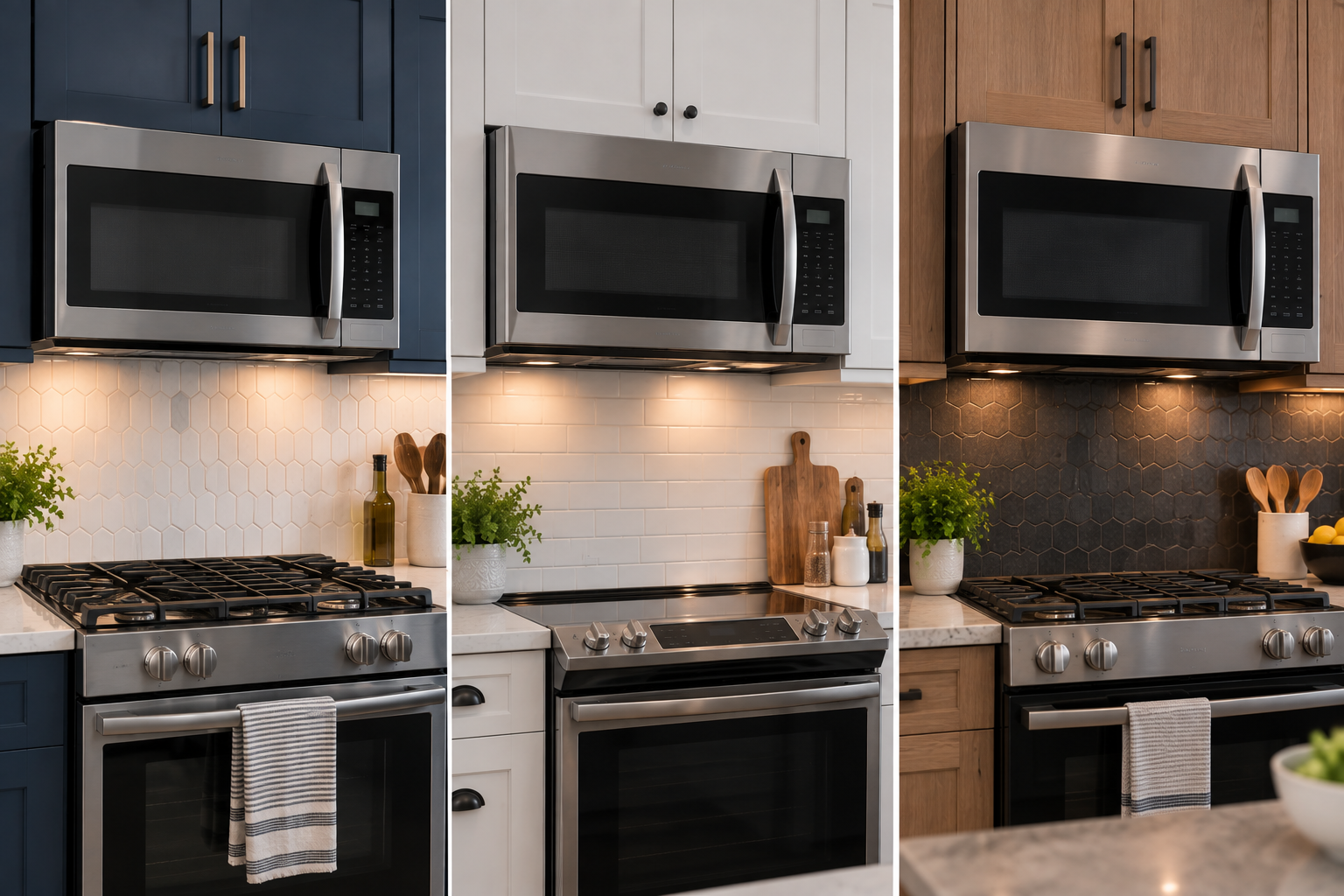
That distinction frames the comparison among three stainless-steel models: the 24-inch Stellar Coll 1.3-cu.-ft. over-the-range microwave, the Kenmore 1.7-cu.-ft. over-the-range microwave, and the 30-inch Stellar Coll 1.9-cu.-ft. over-the-range microwave.
The price spread is relatively narrow but meaningful. The 24-inch Stellar Coll 1.3-cu.-ft. model is priced at $308.99, the Kenmore 1.7-cu.-ft. model at $399.99, and the 30-inch Stellar Coll 1.9-cu.-ft. model at $356.99.
Capacity moves in the opposite direction from price. The least expensive model is also the smallest. Yet the largest of the three is not the most expensive. That creates a comparison in which installation geometry, rather than a simple progression from cheap to expensive, deserves much of the attention.
Our assessment also separates these models more narrowly than their capacities might suggest. Both Stellar Coll configurations earn an Our Score of 8.49/10, with Customer Sentiment at 8.28, Buyer Confidence at 9.48, and Value at 8.15. The Kenmore receives an Our Score of 8.13/10, Customer Sentiment of 8.06, Buyer Confidence of 8.43, and Value of 8.03.
Those numbers establish the editorial baseline. They do not, however, make the buying decision automatically. A microwave that physically suits a kitchen is more useful than a higher-scoring unit that does not.
The Comparison at a Glance
| Model | Width | Capacity | Price | Our Score | Customer Sentiment | Buyer Confidence | Value |
|---|---|---|---|---|---|---|---|
| Stellar Coll 1.3 | 24 in. | 1.3 cu. ft. | $308.99 | 8.49/10 | 8.28 | 9.48 | 8.15 |
| Kenmore 1.7 | – | 1.7 cu. ft. | $399.99 | 8.13/10 | 8.06 | 8.43 | 8.03 |
| Stellar Coll 1.9 | 30 in. | 1.9 cu. ft. | $356.99 | 8.49/10 | 8.28 | 9.48 | 8.15 |
The first surprise appears immediately: paying more does not buy greater stated capacity in this group.
At $399.99, the Kenmore costs $43 more than the 1.9-cu.-ft. Stellar Coll despite giving up 0.2 cubic foot of stated interior volume. Compared with the smaller Stellar Coll, the Kenmore adds 0.4 cubic foot but costs $91 more.
The two Stellar Coll configurations are separated by $48. For that additional expenditure, stated capacity rises from 1.3 to 1.9 cubic feet, an increase of roughly 46%. Their widths also establish substantially different installation profiles: 24 inches for the smaller model and 30 inches for the larger one.
That last detail cannot be treated as an afterthought.
Stellar Coll 1.3: The Compact-Space Proposition
The Stellar Coll 1.3 has the clearest identity of the three. Its 24-inch width and 1.3-cu.-ft. capacity make it the compact option, while its $308.99 price is also the lowest in this comparison.
The attraction is not simply saving $48 against its larger Stellar Coll counterpart or $91 against the Kenmore. The more consequential distinction is dimensional. Kitchens designed around a 24-inch appliance opening present a fundamentally different purchasing problem from kitchens configured for a 30-inch unit.
That makes the smaller Stellar Coll particularly relevant to apartments, compact kitchens, renovations involving narrower cabinetry, and replacement situations in which altering cabinets would turn an appliance purchase into a construction project.
Its 1.3-cu.-ft. cavity naturally involves a capacity trade-off. The difference between 1.3 and 1.9 cubic feet is 0.6 cubic foot, meaning the larger Stellar Coll advertises about 46% more interior volume. Cubic-foot measurements alone do not establish usable dish dimensions, however. Cavity geometry matters. A buyer regularly reheating wide casserole dishes should therefore check the interior dimensions and turntable dimensions applicable to the exact unit before assuming that nominal volume answers the question.
The model is also explicitly configured as an over-the-range microwave with a vent fan. That combination addresses the central purpose of this appliance category: moving the microwave away from the counter while combining cooking and ventilation functions in the space above a range.
Our 8.49/10 score is accompanied by a 9.48 Buyer Confidence assessment, the strongest confidence figure represented here and shared with the larger Stellar Coll. Value stands at 8.15.
Its buyer profile is consequently specific rather than universal. The Stellar Coll 1.3 better suits a household prioritizing a 24-inch format, moderate microwave capacity, and the lowest acquisition price among these three choices. A household routinely using oversized cookware has a stronger reason to examine the larger alternatives.
Kenmore 1.7: The Middle Capacity, Highest Price Option
The Kenmore occupies the middle position by capacity but the upper position by price. It provides 1.7 cubic feet of stated capacity and costs $399.99.
That combination demands a different value calculation.
Against the Stellar Coll 1.3, the Kenmore supplies approximately 31% more stated cavity volume: 1.7 cubic feet rather than 1.3. Its $91 price premium is approximately 29% relative to the Stellar Coll 1.3’s $308.99 price. Capacity and price therefore rise at broadly similar percentages in that particular comparison, although capacity figures should never be mistaken for measurements of every usable internal dimension.
The more difficult comparison for the Kenmore is the Stellar Coll 1.9. The Kenmore costs approximately 12% more while offering approximately 11% less stated capacity.
Price and capacity, of course, are not the entirety of an appliance. Brand preference, controls, installation requirements, service considerations, specific cooking functions, ventilation specifications, warranty coverage, and physical dimensions can all alter a buyer’s decision. Those attributes should be verified for the exact model before purchase rather than inferred from category conventions.
On the editorial measures considered here, the Kenmore receives an Our Score of 8.13/10. Customer Sentiment is 8.06, Buyer Confidence is 8.43, and Value is 8.03. All four figures remain relatively close to the Stellar Coll scores, but each is lower.
That does not make the Kenmore irrelevant. It makes buyer fit more selective. A household specifically seeking a 1.7-cu.-ft. Kenmore over-the-range unit may reasonably see brand familiarity or compatibility considerations as more consequential than maximizing cubic feet per dollar. For a buyer making the decision primarily from capacity and price, however, the Stellar Coll 1.9 presents a materially different economic proposition.
Stellar Coll 1.9: More Capacity Without the Highest Price
The 30-inch Stellar Coll 1.9 is the capacity leader of the group at 1.9 cubic feet, yet its $356.99 price sits between the $308.99 Stellar Coll 1.3 and the $399.99 Kenmore.
This creates the clearest capacity-for-price relationship in the comparison.
Relative to the 1.3-cu.-ft. Stellar Coll, the 1.9-cu.-ft. version costs about 15.5% more while offering roughly 46% more stated capacity. That does not mean every usable internal measurement increases by 46%; cubic volume cannot reveal the exact shape of the cooking cavity. It does show that the nominal capacity increase is substantial relative to the price increase.
The comparison with Kenmore is still more direct. The Stellar Coll supplies 1.9 rather than 1.7 cubic feet while costing $43 less at the prices examined here.
Its 30-inch width is equally consequential. A 30-inch appliance and a 24-inch appliance should not be treated as interchangeable merely because both sit over a range. Cabinet openings, mounting arrangements, ventilation configuration, electrical requirements, clearances, and installation instructions govern whether an appliance belongs in a particular space.
For a kitchen already suited to the 30-inch Stellar Coll, its combination of 1.9-cu.-ft. stated capacity, $356.99 price, vent-fan configuration, and 8.49/10 Our Score makes it the capacity-oriented member of this trio. Buyer Confidence is 9.48, Customer Sentiment 8.28, and Value 8.15.
Its natural audience is the household that has room for the larger chassis and regularly benefits from more microwave cavity space.
Capacity Is More Than a Number on a Specification Sheet
Microwave capacity is frequently reduced to a single cubic-foot figure, but daily usability is more physical than mathematical.
A larger cavity can offer more freedom for dishes, bowls, containers, and family-sized portions. Yet total volume cannot establish whether a particular rectangular casserole dish clears the side walls, whether a tall vessel fits comfortably, or whether a wide plate can rotate unobstructed.
That distinction becomes especially relevant here because 1.3, 1.7, and 1.9 cubic feet sound like orderly steps along a single scale. Real kitchens are less orderly.
The 1.3-cu.-ft. Stellar Coll can be entirely adequate for reheating individual plates, mugs, bowls, vegetables, and ordinary leftovers while occupying a narrower installation footprint. The 1.9-cu.-ft. model offers substantially greater nominal capacity for households dealing with larger portions or cookware. The Kenmore sits between them at 1.7 cubic feet.
A useful microwave buying guide therefore starts with objects rather than abstract volume. Buyers can measure the dinner plates, bowls, covered containers, and casserole dishes they use most often, then compare those dimensions with the manufacturer’s current interior and turntable specifications.
That small exercise can prevent a surprisingly expensive mismatch.
Installation Geometry Can Overrule Every Other Metric
Over-the-range microwaves punish casual measurement.
The 24-inch and 30-inch Stellar Coll models illustrate why. A six-inch difference in appliance width is not a minor styling distinction. It can determine whether the appliance belongs in the available cabinet opening at all.
Before ordering any over-the-range microwave, the buyer should establish several facts:
- The width, height, and depth of the existing opening.
- The configuration and condition of the upper cabinet.
- The location and type of electrical connection.
- The ventilation path and whether the installation recirculates air or exhausts it outside.
- The required mounting hardware and wall conditions.
- Manufacturer-specified clearances around the range and cabinetry.
- The actual interior dimensions needed for frequently used cookware.
The governing source should be the installation documentation for the exact model being purchased. Nominal appliance width is only the beginning of the measurement process.
This is also where paying for professional installation can have a rational economic basis. A microwave is a relatively modest appliance purchase; cabinet modification, electrical changes, damaged finishes, or correcting an unsuitable installation can be considerably less modest.
Ventilation Deserves Equal Billing
The phrase “over-the-range microwave” can cause buyers to focus heavily on the microwave half of the appliance and treat the ventilation function as secondary. In routine cooking, the opposite may sometimes be true.
The microwave may run for several minutes at a time. The ventilation system sits above boiling water, frying pans, sauces, and other cooktop activity day after day.
Both Stellar Coll models are identified as microwave-and-vent-fan configurations. For any of the three appliances, a serious pre-purchase check should extend beyond the presence of ventilation and establish the exact ventilation specifications, available exhaust configuration, filter arrangement, installation requirements, and maintenance procedure for the specific model.
No airflow performance figure should be inferred merely because a vent fan exists. A stated feature establishes presence, not measured effectiveness.
The kitchen itself matters as well. Recirculating ventilation and externally ducted ventilation are different arrangements. Existing ductwork can constrain installation choices regardless of microwave capacity or purchase price.
In other words, the most impressive cavity is of little comfort if installing the appliance creates a ventilation problem above the cooktop.
What the Price Differences Actually Buy
Price comparisons become more revealing when converted into incremental decisions.
Moving from the $308.99 Stellar Coll 1.3 to the $356.99 Stellar Coll 1.9 costs another $48. Nominal capacity rises by 0.6 cubic foot.
Moving from the Stellar Coll 1.3 to the $399.99 Kenmore costs another $91. Nominal capacity rises by 0.4 cubic foot.
Moving from the Stellar Coll 1.9 to the Kenmore reverses the usual relationship: spending another $43 results in 0.2 cubic foot less stated capacity.
Those figures do not establish total ownership cost. Installation, accessories, maintenance, service, longevity, energy use, and eventual repairs can outweigh relatively small differences in purchase price. Nor do they establish cooking performance, because no controlled performance testing is being claimed here.
They do reveal what the sticker price alone can establish. Among these three models, the most expensive option is not the largest, and the largest is only $48 more expensive than the smallest.
That makes dimensions and buyer requirements more informative than a simple assumption that price tracks appliance size.
Microwave Performance Also Depends on User Technique
Even a carefully selected microwave cannot repeal the physics of microwave cooking.
The U.S. Department of Agriculture explains that microwave cooking can produce uneven heating and “cold spots” where harmful bacteria may survive. Its microwave cooking guidance recommends stirring, rotating or turning food where possible, observing standing time, and checking temperatures with a food thermometer. The agency states that leftovers should reach 165°F and identifies safe minimum temperatures of 160°F for ground meats, 165°F for poultry, and 145°F for fish.
This matters in a product comparison because cavity size alone cannot guarantee even reheating. Neither can the purchase price.
Technique remains part of performance. Covered dishes can retain moisture, stirring redistributes hot and cold areas, and standing time permits heat to continue moving through food after microwave energy stops.
The USDA also explains that wattage affects cooking speed. Higher-wattage ovens generally cook food faster, which is why cooking instructions and manufacturer guidance should be interpreted with the appliance’s actual specifications in mind.
For these three products, no unsupported wattage comparison should be inserted into the decision. Buyers for whom heating speed is a priority should verify the exact cooking-power specification of the current model configuration before ordering.
How the Editorial Scores Change the Decision
Scores are most useful when they sharpen a decision rather than substitute for one.
The two Stellar Coll models share an Our Score of 8.49/10, compared with 8.13/10 for Kenmore. Their Customer Sentiment score is 8.28 versus Kenmore’s 8.06. Buyer Confidence shows the widest separation: 9.48 for each Stellar Coll and 8.43 for Kenmore. Value is closer, at 8.15 for Stellar Coll and 8.03 for Kenmore.
The implication is not that every household should choose the same machine. The figures indicate stronger editorial positioning for the two Stellar Coll configurations while leaving installation fit as the first practical filter.
For a narrow opening, the 24-inch Stellar Coll 1.3 has the clearest case. It combines the smallest stated capacity with the lowest price and the compact width explicitly identified for the model.
For a kitchen compatible with the 30-inch Stellar Coll 1.9, the value calculation changes. An additional $48 over the smaller Stellar Coll buys 0.6 cubic foot of extra stated capacity. Compared with the Kenmore, it combines greater stated capacity with a $43 lower purchase price.
The Kenmore’s strongest fit is therefore not the shopper seeking maximum nominal capacity for minimum purchase cost. It better suits a buyer who specifically prefers the Kenmore configuration and finds its exact dimensions, controls, installation requirements, service arrangements, or other verified model-specific characteristics better aligned with the kitchen.
Three Different Buyers, Three Different Decisions
The comparison becomes clearer when translated into household profiles rather than abstract rankings.
The compact-kitchen buyer has the strongest reason to examine the Stellar Coll 1.3. Its 24-inch width is its defining characteristic, and the $308.99 price is the lowest here. The 1.3-cu.-ft. capacity is the trade-off accepted for the smaller format.
The capacity-oriented buyer with a compatible 30-inch opening has a strong factual case for examining the Stellar Coll 1.9. It carries the largest stated capacity at 1.9 cubic feet, costs $356.99, and shares the stronger 8.49/10 editorial score and 9.48 Buyer Confidence rating of the smaller Stellar Coll.
The buyer specifically seeking the Kenmore configuration receives 1.7 cubic feet of capacity at $399.99. Its Our Score of 8.13/10, Customer Sentiment of 8.06, Buyer Confidence of 8.43, and Value of 8.03 remain solid editorial assessments, although its price-to-capacity relationship is less aggressive than the Stellar Coll 1.9’s.
These are different purchasing cases rather than contestants on a podium.
A Pre-Purchase Checklist That Prevents Expensive Mistakes
The final decision should be made in the kitchen, with a tape measure and the current manufacturer documentation close at hand.
Before ordering, the buyer should verify the opening width and all required clearances, check the existing ventilation arrangement, establish electrical compatibility, confirm mounting requirements, compare usable interior dimensions with common cookware, inspect the exact warranty terms, and confirm cooking-power and ventilation specifications from current documentation.
Price should be checked again at the point of purchase as well. Appliance pricing can change, and a $43 or $48 difference is small enough to disappear or widen during promotions or inventory changes.
The same discipline applies to capacity. A household should not pay for cavity volume it will rarely use, but neither should it choose a compact model only to discover that its most frequently used dishes do not fit comfortably.
That is where a technically modest appliance becomes an architectural decision.
Final Considerations
The three microwaves resolve three somewhat different problems.
The Stellar Coll 1.3 is the compact option: 24 inches wide, 1.3 cubic feet, $308.99, and an Our Score of 8.49/10. Its strongest case is spatial efficiency and lower initial cost. It better suits kitchens where a 24-inch format is desirable and moderate capacity is sufficient.
The Kenmore offers 1.7 cubic feet at $399.99 and receives an Our Score of 8.13/10. It occupies the middle of the capacity range but the upper end of the price range. Its fit is strongest where the buyer specifically favors its exact Kenmore configuration after verifying dimensions, functions, ventilation requirements, warranty terms, and installation compatibility.
The Stellar Coll 1.9 combines the largest stated capacity, 1.9 cubic feet, with a $356.99 price and an Our Score of 8.49/10. It costs $48 more than the compact Stellar Coll but $43 less than the Kenmore. For kitchens compatible with its 30-inch width, those numbers make it particularly relevant to households prioritizing interior capacity without moving to the highest purchase price in this comparison.
The larger lesson is less dramatic but more useful. Over-the-range microwave shopping is not primarily a contest of cubic feet or scores. The appliance has to fit the cabinetry, accommodate the cookware, work with the ventilation arrangement, satisfy the household’s cooking habits, and justify its price within those constraints.
A 1.9-cu.-ft. cavity is an advantage only when the kitchen can accommodate the appliance around it. A 24-inch chassis is an advantage only when compact dimensions solve an actual spatial problem. And a familiar brand name is meaningful only when the complete appliance configuration suits the installation and household.
That is the decision framework that survives beyond the specification sheet: measure first, verify the installation requirements, compare the cookware that will actually go inside, examine ventilation as carefully as microwave capacity, and then judge price.
For these three models, the numbers establish distinct roles. Stellar Coll 1.3 addresses constrained space and lower initial expenditure. Kenmore 1.7 addresses buyers whose preferences or installation requirements align specifically with that model. Stellar Coll 1.9 addresses buyers with room for a 30-inch unit who place greater weight on stated cavity capacity and the price relationship among these three choices.
The right selection is therefore not a universal trophy holder. It is the appliance whose dimensions, capacity, installation demands, ventilation arrangement, and cost most closely match the kitchen in which it will spend its working life.