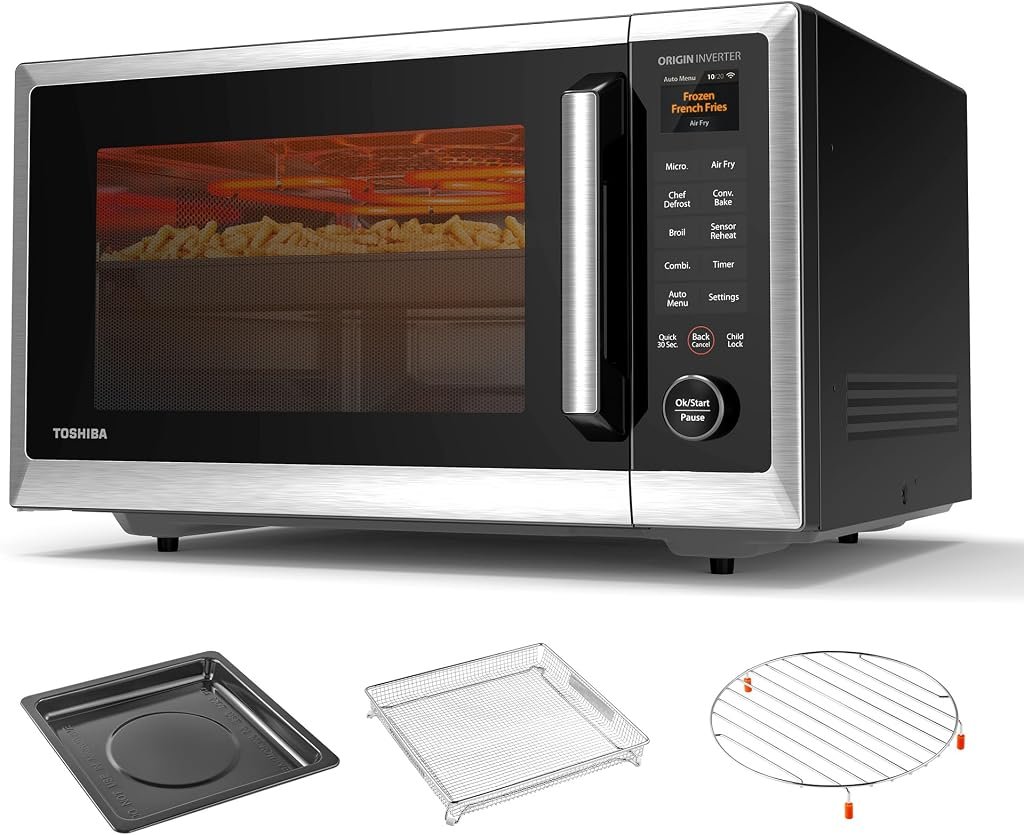
The Toshiba OptiChef PRO MAX Air Fryer Combo Microwave Oven is an ambitious countertop appliance built around a simple proposition: one cavity should be able to microwave, reheat, defrost, convection-cook and air fry without requiring a procession of separate machines across the kitchen counter.
The model behind the OptiChef PRO MAX configuration is ML2-STC13SAIT(SS). Toshiba specifies a 1.3-cubic-foot cavity, 1,100 watts of microwave output, convection heating, a 13.58-inch turntable and 25 automatic programs. The appliance also incorporates Origin Inverter technology, ChefFry Plus air frying, humidity-sensor reheating and a color-screen interface.
Our score is 8.12/10. Customer Sentiment stands at 7.84, Buyer Confidence at 9.13 and Value at 7.91. Those figures describe a sophisticated appliance with a fairly specific audience. Buyer Confidence leads because Toshiba documents the major functions and physical specifications clearly. Value sits lower because multifunctionality carries a price: at a reference price of $479.99, this is not an economical route to basic microwave heating.
The OptiChef PRO MAX makes more sense when its air-fry, convection, sensor and inverter systems replace appliances or cooking routines that would otherwise require separate equipment.
A Microwave Built Around Consolidation
A conventional countertop microwave has a narrow job description. It heats quickly, reheats leftovers, defrosts food and handles short cooking tasks with little preparation.
The OptiChef PRO MAX has a considerably broader assignment.
Toshiba’s official specification identifies convection as its heating technology and ChefFry Plus as the air-fry system. The same appliance also provides microwave cooking, sensor reheating and 25 preset automatic menus.
That makes the product better understood as a compact cooking station than as a microwave with a few bonus buttons.
The distinction matters because multifunction appliances are often evaluated unfairly in both directions. Compared only with an inexpensive microwave, their prices look excessive. Compared with the combined footprint and cost of a microwave, air fryer and compact convection oven, their economics can look rather different.
Neither comparison works universally.
A household that already owns and regularly uses a dedicated basket air fryer may find little benefit in duplicating that function. A kitchen with restricted counter space, however, can gain something tangible from replacing several machines with one.
Consolidation is therefore the central argument for the OptiChef PRO MAX.
The 1.3-Cubic-Foot Cavity Is Substantial but Not Huge
Toshiba rates the cooking cavity at 1.3 cubic feet and specifies a 13.58-inch turntable. The exterior dimensions on the manufacturer’s U.S. page are 19.4 inches deep, 21.8 inches wide and 12.8 inches high.
Those dimensions place the machine firmly in full-size countertop territory.
The 13.58-inch rotating platform gives buyers a more useful reference than cubic feet alone. Dinner plates and microwave-safe containers can be measured directly against that diameter before purchase.
Capacity becomes more complicated when air frying enters the discussion.
A large bowl may fit comfortably during microwave operation, but air frying benefits from exposing food to moving hot air. Fries piled deeply into a vessel may fit physically while producing a less favorable arrangement for crisping than the same quantity distributed across a wider cooking surface.
The usable capacity therefore changes according to cooking mode.
Microwave capacity is largely about whether a container fits and rotates correctly. Convection capacity involves oven-safe cookware and clearance. Air-fry capacity depends heavily on how much food can be exposed to circulating heat without excessive crowding.
A microwave buying guide dealing with combination appliances should distinguish among those three ideas rather than treating cubic feet as a universal measurement of cooking capacity.
The 1,100-Watt Microwave System Is Only Part of the Story
Toshiba specifies 1,100 watts of microwave output.
That figure establishes the conventional microwave side of the appliance, but the more consequential technology is the power-delivery system behind it.
The OptiChef PRO MAX uses Toshiba’s Origin Inverter system.
Traditional microwave power control can cycle the magnetron between full output and periods of inactivity to approximate lower average power. Inverter designs can regulate microwave energy more continuously.
The practical purpose is greater control during jobs that do not benefit from repeated bursts of maximum output.
Defrosting illustrates the problem well. The objective is not merely to add heat quickly. It is to thaw food while limiting the familiar combination of warm edges and a frozen center.
Toshiba specifically pairs the inverter system with its Advanced ChefDefrost function and states that the system can achieve 40% faster defrosting with different power levels for more even results. That performance statement is the manufacturer’s claim rather than an independent test result.
The engineering principle is more important than the headline percentage.
For daily ownership, controlled lower-power cooking can be as useful as maximum wattage.
ChefFry Plus Gives the Appliance Its Second Identity
ChefFry Plus is Toshiba’s air-fry system.
The manufacturer describes it as using top convection technology, while product documentation identifies a top fan and heating element as the hardware behind the function.
That architecture matters because air frying is fundamentally a hot-air cooking process.
The microwave system is excellent at rapid internal heating, particularly for moisture-rich foods. Air frying has a different objective: moving heated air around exposed food surfaces to encourage moisture loss, browning and crisping.
The OptiChef PRO MAX puts both approaches inside the same cavity.
That arrangement can make reheating more interesting than it sounds. A microwave can make leftover pizza hot rapidly, but microwave heating alone is not naturally suited to restoring a dry crust. A convection or air-fry system addresses the exterior differently.
Frozen breaded foods, potato products and roasted vegetables are other logical candidates for ChefFry Plus.
Yet the existence of an air-fry mode should not be confused with proof that the Toshiba duplicates every characteristic of a dedicated basket air fryer.
A combination microwave has competing design requirements. Its cavity needs room for dinner plates and bowls, a rotating platform for microwave operation and sufficient volume for convection cooking. A dedicated air fryer can shape nearly its entire cooking chamber around concentrated airflow.
The Toshiba wins the architectural argument through versatility, not through specialization.
Convection Makes It More Than an Air Fryer Microwave
Air frying attracts attention, but conventional convection may prove equally useful.
Toshiba identifies convection as the heating technology of the ML2-STC13SAIT(SS).
Convection broadens the appliance beyond reheating and crisping. It creates the possibility of baking and roasting in a relatively compact cavity.
That gives the OptiChef PRO MAX a secondary-oven function.
For smaller portions, heating a countertop convection cavity can be more proportionate than using a large conventional oven. During larger meals, the additional cavity can also separate dishes that need different cooking conditions.
This does not turn 1.3 cubic feet into the equivalent of a full-size range oven.
Cookware dimensions remain restrictive, and large roasting vessels are not the purpose of the machine. Its usefulness lies in modest quantities and foods that fit the cavity naturally.
The distinction is important because multifunction products invite inflated expectations. Five cooking modes do not create five full-size appliances. They create one compact appliance capable of performing several types of cooking within the physical limits of one cavity.
The Humidity Sensor Addresses Everyday Reheating
One of the more practical features is also one of the least theatrical.
Toshiba equips the OptiChef PRO MAX with an intuitive humidity sensor and a one-touch Sensor Reheat function. The manufacturer describes the system as monitoring conditions during heating so the appliance can manage reheating without requiring the user to specify every variable manually.
This matters because reheating is deceptively difficult.
A refrigerated bowl of soup, a plate of rice and vegetables and a dense portion of pasta can have similar mass while requiring very different heating patterns. Moisture content, density, geometry and starting temperature all affect the result.
Fixed-time cooking ignores most of those differences.
Sensor operation gives the appliance another input beyond the clock.
It does not remove the need for correct cookware, food arrangement or basic judgment, but it can reduce the repetitive cycle of setting a time, checking the food and adding another 30 seconds.
For an appliance likely to spend much of its working life reheating ordinary meals, that is a more consequential feature than several obscure preset recipes.
Twenty-Five Presets Create Convenience and Interface Pressure
The OptiChef PRO MAX provides 25 preset automatic menus.
That is enough automation to create a design problem: how does a manufacturer expose all those options without turning the front panel into a wall of tiny labels?
Toshiba’s answer is a color-screen interface.
The official product page describes color-screen menus that replace conventional numerical codes, along with an LED-backlit keyboard intended to improve visibility.
The approach is sensible for a multifunction appliance.
A basic microwave can survive with a numerical keypad and several dedicated buttons because the number of possible actions is limited. Once convection, air frying, sensor programs and dozens of automatic menus enter the equation, a static control panel becomes crowded quickly.
A screen can present information contextually.
The trade-off is dependence on software-driven navigation. Some users prefer dedicated controls because their locations become familiar through repetition. A display-based system can require more visual attention.
The quality of the interface therefore matters more here than it would on a basic microwave.
Alexa Compatibility Is Secondary to the Physical Controls
Toshiba also identifies the model as compatible with Alexa.
Voice control sounds futuristic in a kitchen appliance, but its practical value should be kept in proportion.
Cooking still requires physical interaction. Food has to be placed inside the cavity. Cookware must be appropriate for the selected mode. Air-fry and convection accessories have to be arranged correctly. Hot food has to be removed manually.
Voice operation cannot eliminate those steps.
Its more credible role is supplemental control when a person’s hands are occupied with food preparation.
That can be convenient, but it should not determine the purchasing decision.
The quality of microwave heating, air-fry architecture, cavity size, controls and cleaning arrangements affects every use. Voice compatibility does not.
The Two-Step Door System Is a Deliberate Safety Choice
The OptiChef PRO MAX uses a two-step door-opening arrangement. Toshiba instructs the user to pull upward and hold the release trigger before pulling the handle to open the door.
That differs from the familiar one-action handle found on many microwaves.
The additional action can initially feel less immediate, but its purpose is straightforward: making accidental opening more difficult.
This design is part of a broader shift toward additional child-safety mechanisms on cooking appliances.
There is a usability trade-off.
Microwaves are frequently opened and closed several times during a single food-preparation sequence. Any additional action therefore becomes part of the daily interaction rather than a rarely encountered safety mechanism.
Households should understand the door arrangement before purchase rather than discovering it after the appliance reaches the counter.
Counter Space Remains a Real Cost
Combination appliances are frequently described as space savers, but that description requires precision.
The OptiChef PRO MAX is not physically small.
At 21.8 inches wide and 12.8 inches high, with Toshiba listing a depth of 19.4 inches, it requires a substantial countertop footprint.
The spatial advantage appears only when the machine replaces other equipment.
If it allows a separate microwave and air fryer to disappear, consolidation can free meaningful counter area. If both appliances remain because the household prefers the dedicated air fryer for some jobs, the Toshiba becomes another large machine competing for worktop space.
This is why countertop planning should occur before purchase.
Width alone is insufficient. Depth determines how much preparation surface remains in front of the appliance. Door clearance matters. Ventilation requirements matter. Nearby cabinets can affect comfortable access.
A multifunction machine that cannot remain conveniently accessible is unlikely to deliver the convenience its feature list promises.
Buyer Confidence at 9.13 Reflects Strong Product Definition
Our Buyer Confidence rating is 9.13.
That score sits substantially above the overall 8.12/10 because the OptiChef PRO MAX is reasonably well defined before purchase.
Toshiba identifies its model number, 1.3-cubic-foot capacity, 1,100-watt microwave output, 13.58-inch turntable, exterior dimensions, 120-volt electrical specification, convection heating, 25 programs, sensor system, inverter technology, air-fry function and control architecture.
This allows buyers to answer several important questions before committing money or counter space.
Will the appliance physically fit? Will existing dinner plates fit the turntable? Does the household actually need convection? Will ChefFry Plus replace an air fryer, or merely duplicate one? Is the color-screen interface desirable?
Buyer Confidence stops short of a higher figure because multifunction cooking still creates performance questions that specification sheets cannot resolve fully. Air-fry results, for example, depend on food load, arrangement, recipe and airflow.
Still, the machine’s intended capabilities are unusually easy to identify.
Value at 7.91 Is More Conditional
Our Value score is 7.91.
The OptiChef PRO MAX carries a reference price of $479.99. At that level, it competes poorly with basic microwaves if microwave heating is the only requirement.
The economic case improves when the comparison expands.
This appliance combines an 1,100-watt inverter microwave, convection system, ChefFry Plus air frying, humidity sensing, 25 presets, a color interface and connected control within one 1.3-cubic-foot countertop machine.
If those functions replace a separate air fryer and compact convection oven, the price becomes easier to rationalize.
If they remain unused, the buyer has paid heavily for dormant hardware.
That is why Value trails Buyer Confidence.
There is little ambiguity about what the machine attempts to do. The uncertainty lies in how much of that capability a particular household will actually use.
Customer Sentiment at 7.84 Reflects the Cost of Complexity
Customer Sentiment stands at 7.84.
That rating reflects the inherent trade-off of an appliance designed to perform several distinct jobs.
A basic microwave is almost frictionless. Put food inside, select time and power, and start.
The OptiChef PRO MAX asks more of its owner if its broader abilities are going to justify the purchase. Different cooking modes call for different accessories, food arrangements and control choices. Convection and air frying introduce heat and cleaning considerations absent from straightforward microwave reheating.
The color interface reduces some of that burden, but it cannot eliminate the learning curve created by multifunctionality.
This is not inherently negative.
A camera with more controls asks more of its user because it can do more. Kitchen appliances follow similar logic. Complexity becomes a problem only when the additional functions fail to provide corresponding utility.
The Toshiba therefore suits households prepared to use its broader cooking range.
Who Should Buy the Toshiba OptiChef PRO MAX?
The strongest buyer is looking to consolidate countertop cooking equipment rather than merely replace an old microwave.
The model is particularly well matched to households that:
- regularly use microwave reheating but also want air-fry capability;
- would use a compact convection cavity for smaller baking or roasting jobs;
- can accommodate a countertop appliance measuring 21.8 inches wide;
- have cookware compatible with the 13.58-inch turntable and 1.3-cubic-foot cavity;
- value sensor reheating and inverter-controlled microwave power;
- prefer a graphical interface over a conventional panel dominated by numerical codes;
- can remove another appliance from the counter because ChefFry Plus or convection replaces it.
The weaker buyer profile is straightforward.
Someone seeking only fast microwave reheating can spend considerably less and operate a simpler machine. A household already committed to a large dedicated air fryer may gain limited value from duplicating the function. Buyers who dislike screen-driven controls may also prefer a more conventional interface.
The OptiChef PRO MAX earns its place by replacing functions, not by accumulating them.
How It Fits Into a Microwave Buying Guide
A microwave buying guide evaluating the OptiChef PRO MAX should begin with cooking habits rather than the number of presets.
First comes microwave use. The 1,100-watt output, inverter system, humidity sensing and 13.58-inch turntable define the machine’s everyday reheating identity.
Second comes air frying. The buyer should ask whether ChefFry Plus will genuinely replace a countertop air fryer. If the existing air fryer remains in regular service, part of the Toshiba’s economic and spatial argument disappears.
Third comes convection. A secondary heated cavity can be useful for smaller portions, baking and roasting, but only if those jobs fit naturally into a 1.3-cubic-foot appliance.
Fourth comes physical space. A 21.8-inch-wide countertop machine is not a minor object. The counter needs enough width, depth and surrounding clearance for comfortable daily use.
Finally comes interface preference. Twenty-five automatic programs, a color screen, backlit controls and Alexa compatibility create a very different ownership experience from a conventional microwave with a timer and numerical keypad.
The correct choice depends less on whether those features sound sophisticated and more on whether they remove friction from the household’s actual cooking routine.
Final Considerations
The Toshiba OptiChef PRO MAX Air Fryer Combo Microwave Oven earns our 8.12/10 score by combining several genuinely different cooking systems rather than relying on cosmetic feature proliferation.
Its 1.3-cubic-foot cavity, 1,100-watt microwave output, Origin Inverter technology, ChefFry Plus air frying, convection heat, humidity sensing, 25 automatic menus, 13.58-inch turntable and color-screen controls give it substantially broader cooking scope than a basic countertop microwave.
Buyer Confidence at 9.13 is the strongest component of our assessment. Toshiba publishes enough information about dimensions, capacity, microwave power and major cooking systems for a prospective owner to make a disciplined pre-purchase decision.
Value at 7.91 requires more restraint. At a reference price of $479.99, this machine needs to replace more than an inexpensive microwave to justify itself. The financial and spatial argument becomes much stronger when ChefFry Plus removes the need for a separate air fryer and convection provides useful secondary-oven capacity.
Customer Sentiment at 7.84 reflects the other side of that versatility. More cooking systems create more decisions. The owner needs to learn when microwave energy, sensor reheating, convection or air frying is appropriate and how food should be arranged for each.
The OptiChef PRO MAX is therefore most coherent as a consolidation appliance. Its appeal does not rest on having 25 programs or a color display in isolation. It rests on whether one 1.3-cubic-foot cavity can meaningfully take over work previously divided among several countertop machines.
For households that regularly microwave, air fry and use compact convection cooking, that proposition is credible. For households seeking little beyond rapid reheating and defrosting, the OptiChef PRO MAX carries hardware, complexity and cost that basic microwave ownership does not require.