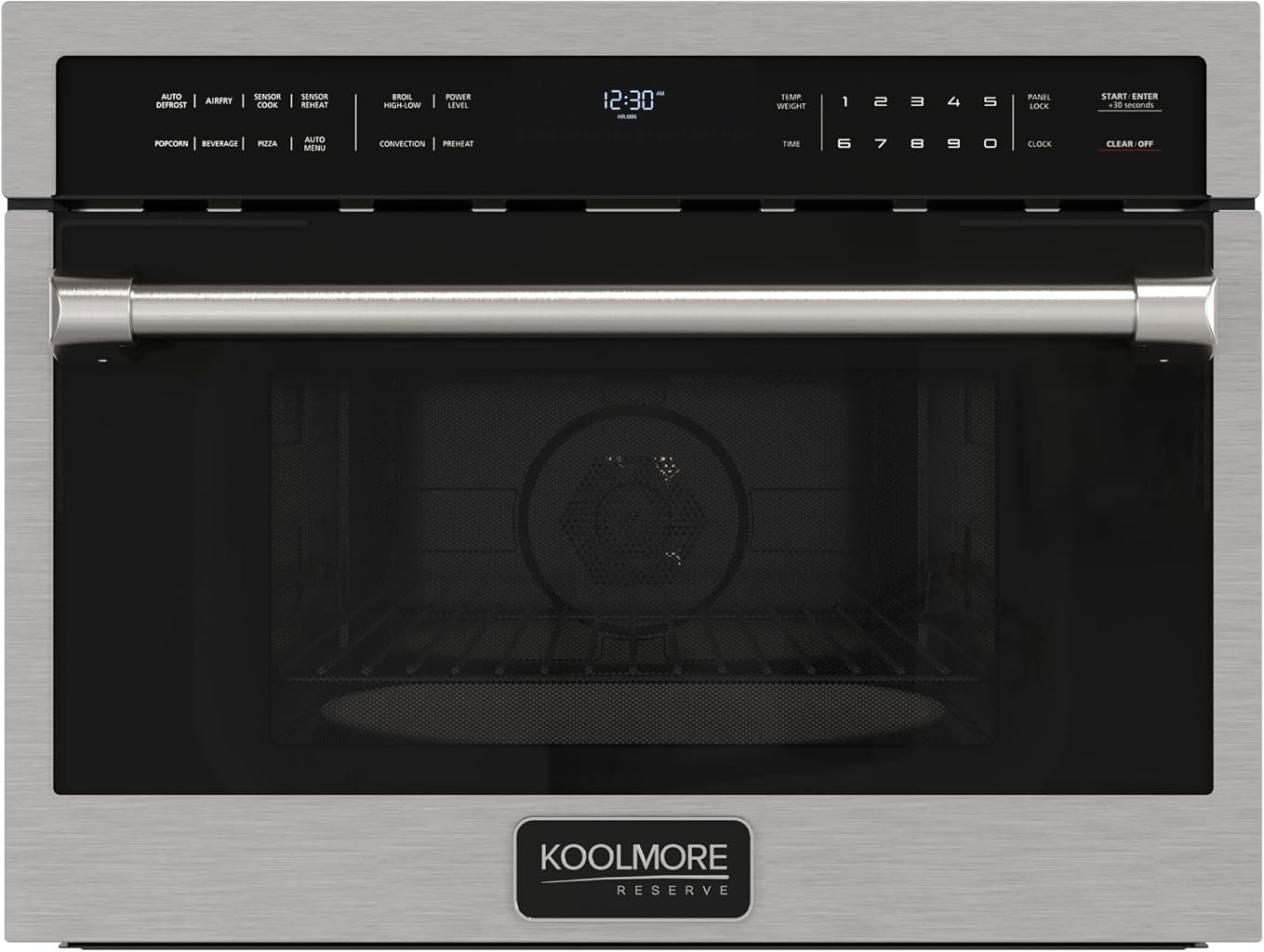
The KoolMore Reserve Built-In Microwave Convection Oven, model KM-CWO24-AFSS, takes a familiar kitchen idea—the combination microwave—and pushes it toward the architecture and functionality of a compact wall oven. The 24-inch built-in appliance combines microwave cooking, convection heat and air frying in a 1.6-cubic-foot stainless-steel format, with sensor controls, a downward-opening soft-close door and a temperature range extending as high as 450°F. KoolMore currently lists the model at $1,240.
That combination gives the appliance a fairly specific purpose. It is not simply a microwave intended to disappear into cabinetry. Nor is it a full-size oven compressed into a smaller opening. It is a secondary cooking cavity intended to handle fast microwave work alongside baking, roasting, broiling, crisping and air frying.
Our score is 8.14/10. Customer Sentiment stands at 7.84, Buyer Confidence at 9.27 and Value at 7.91. The separation between those figures is meaningful. Buyer Confidence is particularly high because KoolMore publishes unusually detailed physical, electrical and functional specifications. Value is more restrained because the appliance commands a substantial price and makes economic sense only when its broader cooking capabilities receive regular use.
The question surrounding the KM-CWO24-AFSS is therefore less about whether it offers enough functions. It offers plenty. The harder question is whether those functions solve enough real kitchen problems to justify the cabinet space, installation planning and cost.
Three Cooking Systems Define the Product
The central idea is 3-in-1 cooking.
The official KoolMore product specifications identify microwave, convection oven and air-fryer operation within the same appliance. The available cooking functions include baking, broiling, roasting, crisping and reheating, while the control system adds sensor cooking, sensor reheating, automatic defrost, beverage, popcorn and pizza programs.
These functions should not be treated as interchangeable.
Microwave energy is suited to rapid heating and defrosting. Convection cooking relies on heated air and is therefore capable of the surface drying and browning that conventional microwave cooking cannot readily produce. Air frying uses the convection system more aggressively to promote crisp surfaces.
Putting all three into one cabinet creates the Reserve model’s central advantage: consolidation.
A household that would otherwise maintain a microwave, countertop air fryer and compact convection oven can potentially replace all three with one built-in appliance. That does not mean every specialized appliance becomes redundant. A dedicated basket air fryer, for example, has a chamber geometry optimized specifically around concentrated airflow.
The KoolMore has a broader assignment. Its value comes from versatility rather than specialization.
The 24-Inch Format Changes the Installation Equation
The Reserve model is notably more compact than KoolMore’s 30-inch built-in convection microwave designs.
The appliance itself measures 23.43 inches long, 22.36 inches wide and 17.87 inches high. Depth including the handle reaches 24.21 inches, while the body excluding the handle measures 22.36 inches deep. Total weight is 81.79 pounds.
Those dimensions matter because a built-in appliance has to satisfy two different kinds of fit.
First comes structural fit: can the cabinet physically accommodate the appliance and its required installation arrangement?
Then comes functional fit: can the door open, can cookware be removed comfortably, can ventilation operate as intended and can the electrical connection be reached without interfering with the appliance body?
The second question is frequently underestimated.
A microwave sitting on a countertop can usually be repositioned. An 81.79-pound built-in appliance surrounded by finished cabinetry is a different proposition. Small measurement errors can become carpentry projects.
Anyone using a microwave buying guide for this category should therefore treat cabinet measurement as part of product selection rather than as a task postponed until installation day.
The Door-Open Dimension Deserves Its Own Measurement
The KoolMore Reserve uses a vertically downward-swinging door with bottom hinges. When opened to 90 degrees, total depth reaches 35.4 inches.
That specification can matter more in daily ownership than closed depth.
Consider a wall of appliances facing an island. The oven may fit perfectly into its cabinet, yet its open door can project far enough into the aisle to restrict movement. That becomes particularly relevant when the user is handling cookware heated to several hundred degrees.
The downward-opening door also affects installation height.
Traditional countertop microwaves generally have side-hinged doors, allowing a person to stand relatively close to the cavity. The KoolMore’s open door sits between the user and the interior. An installation positioned too high can make reaching over that door uncomfortable, particularly when removing heavy or hot dishes.
The design itself is coherent. It gives the appliance the visual and functional character of a compact wall oven. But placement should be determined by ergonomics as well as alignment with adjacent cabinetry.
Kitchen symmetry looks excellent in photographs. Reach distance matters every day.
Capacity Requires More Than a Cubic-Foot Number
KoolMore describes the KM-CWO24-AFSS as a 1.6-cubic-foot appliance. The detailed specification gives interior dimensions of 16.54 inches by 16.54 inches by 9.84 inches. The distance from the turntable to the top is listed at 9.64 inches, and the rotating platform measures 14.17 inches in diameter.
Those measurements tell buyers more than the headline capacity.
For microwave use, a 14.17-inch turntable provides a direct way to evaluate compatibility with dinner plates and common containers. A household can measure the cookware already in the kitchen rather than trying to visualize cubic feet.
For convection work, the 9.84-inch interior height deserves equal attention.
This is not a substitute for the physical volume of a full-size wall oven. Tall cookware and large roasting vessels can encounter limits quickly. The cavity is better interpreted as a compact secondary oven capable of handling smaller baking and roasting jobs.
That distinction is central to the product’s identity.
Its appeal lies in obtaining several cooking methods from a relatively small built-in cavity, not in replicating the capacity of a conventional range oven.
Convection Performance Is Defined by More Than Temperature
KoolMore describes a temperature range extending from 175°F to 450°F in its feature summary, while the detailed specification table lists a convection temperature range of 250°F to 450°F.
The discrepancy between those published ranges is worth recognizing when planning recipes at the lower end of the temperature scale. The 450°F upper figure, however, is consistent across the product information and places the appliance within a useful range for common baking, roasting and high-temperature cooking.
KoolMore also specifies a convection fan operating at 1,400 RPM.
Fan speed alone does not establish cooking performance. Airflow depends on fan geometry, ducting, cavity design and food placement as well as rotational speed. The number nevertheless confirms that convection is supported by an active circulation system rather than merely an additional heating element.
The appliance includes a baking rack, which further distinguishes convection use from ordinary turntable-based microwave operation.
This is where the Reserve model begins to justify its cabinet space. A secondary heated cavity can be useful when the primary oven is occupied, when two foods require different temperatures or when heating a full-size oven for a modest portion would be unnecessary.
Air Frying Extends the Consolidation Argument
Air fry is one of the KM-CWO24-AFSS’s named cooking functions.
The mechanism is conceptually compatible with the convection architecture already inside the appliance: heated air circulates around food to encourage moisture loss and surface browning.
The practical question is not whether air frying exists on the control panel. It is what the feature can replace in the kitchen.
A household with a large dedicated air fryer that is used daily may prefer the speed, basket geometry and direct access of that specialized appliance. A household that uses air frying occasionally may find a built-in combination more appealing because it removes another machine from the worktop.
That difference has real spatial consequences.
Countertop appliances tend to accumulate because each one solves a slightly different problem. Microwave ovens heat quickly. Air fryers crisp efficiently. Toaster ovens handle small dry-heat jobs. Eventually, a large percentage of the kitchen’s working surface can become appliance storage.
The KoolMore Reserve attacks that problem through consolidation rather than miniaturization.
Its footprint does not disappear. It moves into cabinetry.
Sensor Cooking Adds Automation Where It Matters
The KM-CWO24-AFSS uses two sensor control pads identified for temperature and humidity. KoolMore includes both Sensor Cooking and Sensor Reheat among its principal functions.
That is a meaningful distinction from fixed presets.
A fixed program generally assumes a particular cooking pattern. Sensor-based operation attempts to respond to conditions during the heating process, reducing the amount of manual timing required for common tasks.
This approach is particularly appropriate for reheating.
Leftovers vary dramatically in moisture content, density, portion size and starting temperature. A plate of refrigerated pasta does not behave like a bowl of soup merely because both are being reheated.
Sensors cannot eliminate those physical differences, but they give the control system another source of information beyond a clock.
The Reserve model also includes 10 one-touch settings. KoolMore names popcorn, pizza, broil, defrost and soften/melt among the accessible programs.
The combination of sensors and presets gives the appliance two personalities: a fast microwave for routine use and a more deliberate convection appliance when the cooking task demands it.
The Control System Avoids Excessive Complexity
Multifunction appliances can create an interface problem.
Every added cooking method requires controls, yet a microwave is frequently used for tasks that should take seconds to initiate. A control panel that requires navigating several layers merely to heat a drink undermines the convenience that made microwave ovens popular.
KoolMore uses a digital front control arrangement with 10 one-touch settings. The specification identifies Express Cooking, Auto Defrost, Sensor Cooking, Sensor Reheat, Convection, Beverage, Popcorn, Broil, Air Fry and Pizza as the principal functions.
That list is broad without becoming absurdly fragmented.
There will still be a learning period for anyone moving from a basic microwave. Convection temperature selection, preheating and air-fry operation necessarily require more decisions than pressing a single reheating button.
The difference is functional rather than decorative. Each mode corresponds to a distinct cooking process.
That makes the complexity easier to defend.
The Soft-Close Door Is More Than a Styling Detail
KoolMore equips the Reserve model with a soft-close vertical swing door constructed with stainless steel and tempered glass.
Soft-close mechanisms are easy to dismiss as cosmetic additions until the mass and location of the door are considered.
A downward-opening oven-style door moves differently from the lightweight side door of a small countertop microwave. Controlled closing can reduce abrupt movement and make the appliance feel more appropriate within built-in cabinetry.
The tempered glass and stainless-steel construction also align the microwave visually with wall ovens and other integrated cooking appliances.
That aesthetic coherence is part of what the buyer is purchasing.
Built-in appliances do not exist solely as machines. They become permanent visual elements of a kitchen elevation. A countertop microwave can be moved or replaced with little architectural effect; a built-in model is part of the room.
That makes appearance relevant, though appearance alone cannot justify the price.
Ventilation Is Engineered for Cabinet Installation
The exhaust vent is positioned at the front of the unit, and KoolMore specifies multi-speed ventilation with a 2,600-RPM exhaust system. A cooling fan operates during and after cooking to manage internal temperature.
Those details are particularly relevant because this appliance performs sustained high-temperature cooking.
A microwave reheating cycle may last only a few minutes. Convection baking or roasting can expose the cabinet installation to heat for substantially longer periods.
Front exhaust gives that heat a defined escape route.
The practical implication is straightforward: the ventilation openings are part of the appliance, not unused visual gaps that should be covered by improvised trim.
Installation planning should preserve the intended airflow.
This is another reason built-in combination ovens demand more preparation than countertop microwaves. Cabinet dimensions, electrical supply, door clearance and ventilation all interact.
Electrical Requirements Need Attention Before Installation
The KM-CWO24-AFSS operates at 120 volts, 60 Hz and 15 amps, with total wattage listed at 1,750 watts. KoolMore specifies single-phase electrical operation and plug-in installation.
The plug is a NEMA 5-20P, and the power cord measures 59.06 inches.
That plug specification deserves attention.
A NEMA 5-20P uses a blade arrangement different from the common 5-15P plug found on many smaller household appliances. The receptacle and circuit therefore need to be checked before the microwave is installed.
This is not a detail to discover after cabinetry has been completed.
The long power cord gives installers some flexibility in receptacle positioning, but electrical hardware still consumes physical space. An outlet placed directly behind a deep appliance can interfere with fit depending on cabinet geometry.
The model is also identified as UL listed for safety in KoolMore’s detailed specifications, while its feature description references CSA certification and a three-year parts-and-labor warranty.
The warranty period is particularly relevant for a permanently installed appliance because replacement is more disruptive than swapping a countertop microwave.
Energy Consumption Adds a Rarely Published Data Point
KoolMore lists annual energy consumption at 320 kWh.
That figure is useful primarily as a standardized reference rather than a prediction of any particular household’s electricity use.
Actual consumption will vary substantially with cooking habits. A household using convection functions daily will impose a different workload from one relying mostly on brief microwave cycles.
The figure is nevertheless useful because appliance operating cost is often ignored when multifunction cooking equipment is evaluated.
At 320 kWh annually, every $0.10 per kWh of electricity price corresponds mathematically to about $32 in annual electricity expenditure if actual use matched the stated consumption figure. At $0.20 per kWh, the same amount of energy would cost about $64.
Those examples are arithmetic rather than predictions.
Local electricity rates and actual usage determine the real bill.
Manual Cleaning Is a Practical Limitation
The stainless-steel cavity offers durability and a surface familiar from conventional ovens, but multifunction cooking introduces a maintenance issue that microwave-only appliances encounter less severely.
Air frying, broiling and roasting can produce grease and baked-on residue.
A microwave used largely for covered reheating may need little more than routine wiping. A combination cavity exposed to high-temperature cooking can require more persistent cleaning.
The KM-CWO24-AFSS does not turn cleaning into an automated process.
That is a trade-off buyers should include in their expectations, particularly if air frying and roasting will be frequent activities.
The top-mounted LED lighting helps here. KoolMore specifies a 125-lumen interior light, giving the user visibility into the stainless-steel cavity during cooking and cleaning.
Small details of this kind matter more over years of ownership than they do on a showroom specification card.
Buyer Confidence Is the Standout Score
Our Buyer Confidence rating is 9.27, significantly above the overall 8.14/10 score.
The reason is documentation.
KoolMore identifies the appliance’s exterior and interior dimensions, weight, door-open depth, turntable diameter, electrical requirements, plug type, cord length, energy consumption, control arrangement, heating methods, ventilation system, construction materials, safety lock and warranty.
That degree of specificity lowers uncertainty before purchase.
Built-in appliances punish uncertainty. A vague countertop microwave specification might cause inconvenience. A vague built-in specification can lead to cabinet modification, electrical work or an appliance that cannot be installed where intended.
The Reserve model gives buyers enough dimensional and electrical information to conduct meaningful pre-purchase planning.
That explains why Buyer Confidence leads the scoring.
It does not indicate universal suitability. It indicates that suitability can be assessed with relatively high precision.
Value at 7.91 Reflects the Cost of Consolidation
Our Value score is 7.91.
At KoolMore’s current $1,240 listed price, the KM-CWO24-AFSS costs far more than a conventional countertop microwave. The comparison becomes more reasonable only when its other functions are included.
The buyer is acquiring a built-in microwave, convection oven and air fryer in one cavity, together with sensor cooking, broiling, automatic defrosting and oven-style construction.
If that arrangement replaces two or three separate appliances, value improves.
If convection and air frying are rarely used, the economics deteriorate quickly.
Installation can add another layer of expense. Cabinet preparation and electrical work are project costs even when they do not appear on the appliance receipt.
That is why Value trails Buyer Confidence.
The machine’s purpose is clear. Whether that purpose is worth the price depends on how much duplication it removes from a particular kitchen.
Customer Sentiment Reflects a Narrower Buyer Fit
Customer Sentiment stands at 7.84.
That figure reflects a broader ownership reality: combination appliances demand more engagement than simple microwaves.
The KM-CWO24-AFSS has multiple heating methods, sensor functions, high-temperature cooking modes, a drop-down door and installation requirements that resemble a compact oven more than a freestanding microwave.
Those attributes create flexibility, but they also require the owner to understand which cooking method suits a particular job.
The buyer seeking one-button simplicity may find much of the appliance unnecessary.
The buyer who routinely reheats, bakes, roasts and air-fries has a stronger reason to learn the interface and exploit the additional modes.
That difference in buyer fit keeps Customer Sentiment below Buyer Confidence.
Who Should Buy the KoolMore Reserve?
The strongest candidate is a household planning a built-in kitchen and seeking to consolidate several secondary cooking appliances.
The Reserve model is particularly well aligned with buyers who:
- want microwave, convection and air-fry cooking in one cabinet;
- need a secondary oven for smaller dishes;
- value keeping countertop space free;
- can accommodate the appliance’s 35.4-inch open-door depth;
- can provide the specified 120-volt, 15-amp electrical arrangement and NEMA 5-20P connection;
- regularly use sensor reheating and automated cooking programs;
- accept the cleaning demands associated with high-temperature cooking;
- value a three-year parts-and-labor warranty on a built-in appliance.
The weaker buyer profile is equally easy to identify.
Someone who mainly heats coffee, leftovers and frozen meals can obtain adequate microwave functionality from a much simpler appliance. A household already satisfied with a dedicated air fryer and full-size oven may also gain relatively little from duplicating those functions.
The Reserve works best when consolidation solves an actual problem.
How It Fits Into a Microwave Buying Guide
A microwave buying guide addressing the KM-CWO24-AFSS should begin with installation rather than wattage.
First, the buyer needs to determine whether the cabinetry, electrical connection and surrounding clearance can support the appliance. The 81.79-pound weight and 35.4-inch door-open depth deserve physical verification in the room.
Second comes cookware.
The 14.17-inch turntable and roughly 9.8-inch cavity height should be compared with the dishes, baking vessels and plates already used by the household.
Third comes cooking behavior.
Will convection baking receive regular use? Will air frying replace a countertop machine? Does a second oven solve scheduling conflicts during meal preparation? Will sensor reheating simplify daily routines?
Only after those questions does the feature count become useful.
The Reserve model is not compelling because it has many buttons. It becomes compelling when several of those buttons correspond to appliances the kitchen no longer needs.
Final Considerations
The KoolMore Reserve Built-In Microwave Convection Oven earns our 8.14/10 score by combining three distinct cooking systems inside a relatively compact 24-inch built-in format.
Its 1.6-cubic-foot cavity, 14.17-inch turntable, convection system, air-fry capability, broiler, sensor controls and 450°F upper cooking temperature give it substantially more range than a conventional microwave. The soft-close downward-opening door, front ventilation and stainless-steel construction reinforce its compact-oven identity.
Buyer Confidence at 9.27 is the strongest rating because KoolMore documents the appliance in considerable detail. Exterior dimensions, interior dimensions, electrical load, plug configuration, energy consumption, door clearance, ventilation and cooking functions can all be examined before cabinetry is committed.
Value at 7.91 is more conditional. A $1,240 appliance needs to do more than reheat food to justify itself, and the Reserve can do considerably more. The financial case is strongest when convection and air frying eliminate separate equipment or when a secondary oven provides recurring utility.
Customer Sentiment at 7.84 reflects the narrower audience created by that sophistication. A combination oven rewards households that actually use its combination of functions. For basic microwave work, its capabilities and cost are excessive.
The Reserve model therefore succeeds most clearly as a space-management appliance. It takes several forms of cooking that often spread across multiple countertop machines and places them inside one built-in stainless-steel cavity.
That is a practical achievement, but only when the kitchen needs consolidation in the first place. For the right installation and cooking pattern, the KM-CWO24-AFSS offers a carefully defined middle ground between a microwave and a full-size oven. For households that need only one of those things, simpler equipment remains the more rational choice.