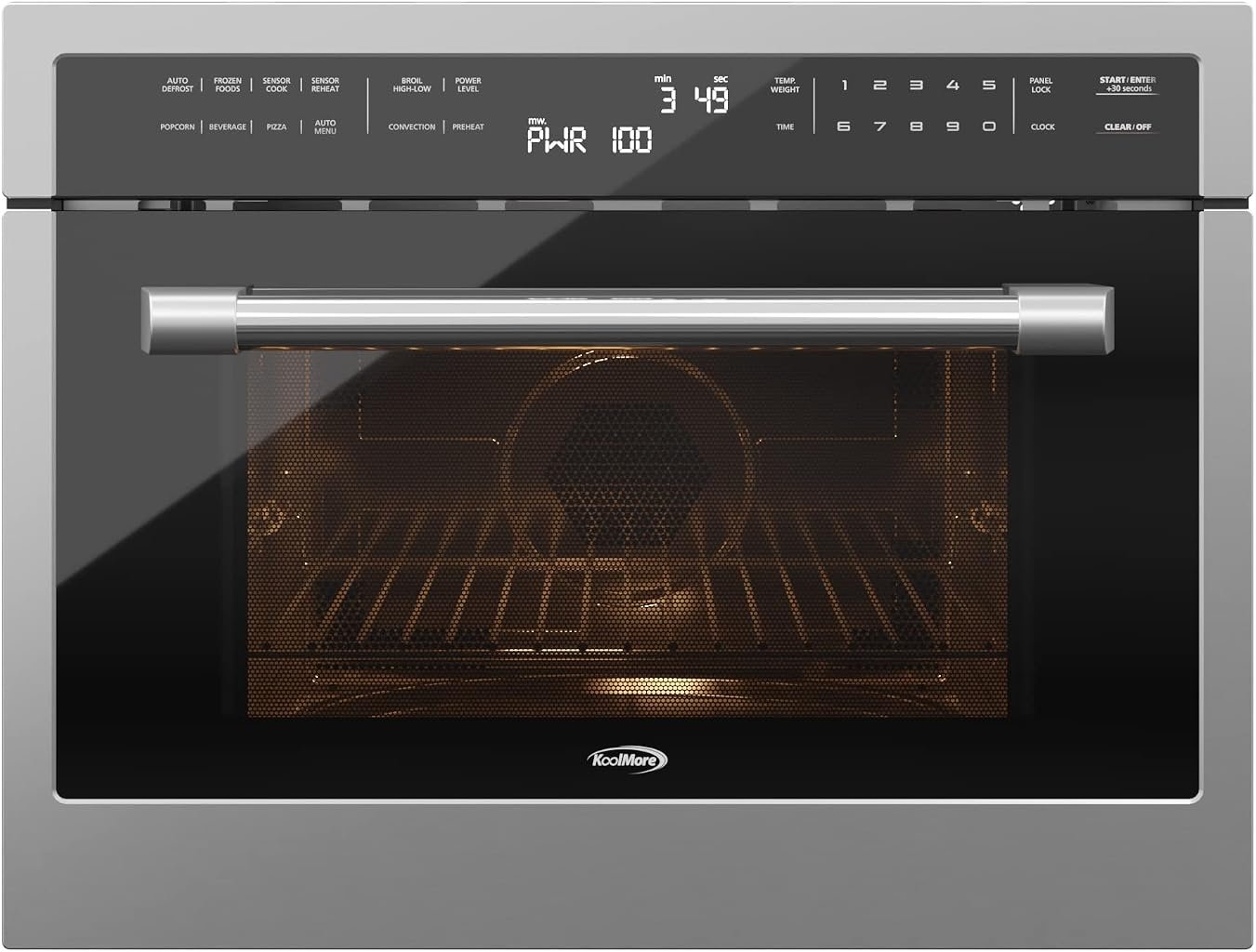
The KoolMore Built-In Oven Microwave Combination is best understood not as a conventional microwave with a few additional presets, but as a compact cooking station built around several heating methods. The stainless-steel KM-CWO30-SS combines 1,000-watt microwave cooking with convection heat, air frying, baking, roasting, broiling and sensor reheating inside a 30-inch built-in format. KoolMore currently lists the model at $1,475, which places it firmly in the territory of planned kitchen appliances rather than casual countertop purchases.
Our score is 8.14/10. Customer Sentiment stands at 7.84, Buyer Confidence at 9.27 and Value at 7.91. The pattern is revealing. Confidence is substantially higher than the overall score because the product is unusually well documented: cabinet dimensions, electrical connection, cooking modes, interior measurements, door clearance and ventilation arrangement are all published. Value is lower because the buyer is paying for consolidation and built-in integration, not merely microwave wattage.
The KM-CWO30-SS therefore poses a more interesting question than whether it can reheat dinner. It can. The real issue is whether a household will use enough of its microwave, convection, air-fry and broiling capability to justify devoting a large cabinet opening-and a substantial budget-to a single multifunction appliance.
This Is Closer to a Compact Oven Than a Basic Microwave
The fundamental specification is its combination of heating systems.
KoolMore identifies the KM-CWO30-SS as a 30-inch built-in microwave with convection oven and air-fryer capability. Its specifications list 1,000 watts of microwave power, while the appliance has a total rated wattage of 1,750 watts. The temperature range extends from 100°F to 450°F.
That temperature range changes the nature of the appliance.
Microwave-only machines are exceptionally useful for rapid heating and defrosting but cannot reproduce conventional dry-heat cooking. Browning and crisping require another mechanism. The convection side of the KoolMore supplies heated-air cooking, allowing the appliance to bake and roast as well as microwave.
Broiling extends that repertoire further, while the air-fry setting uses the convection architecture for high-airflow cooking intended to brown and crisp food.
The attraction is not that any of these techniques is new. It is that they are concentrated in one cavity.
A kitchen that might otherwise contain a microwave, countertop air fryer and secondary compact oven can potentially consolidate those functions. Whether that represents good value depends heavily on how the household actually cooks.
The Dimensions Establish the First Buying Test
Built-in appliances are unforgiving of casual measurement.
The KM-CWO30-SS measures 29.84 inches across its front dimension, 25.43 inches in overall width/depth orientation as documented by KoolMore, and 19.13 inches high. Depth excluding the handles is 22.4 inches, while depth including the handles reaches 24.72 inches. The appliance weighs 88.95 pounds.
More important are the cutout specifications.
KoolMore calls for a cabinet opening 28.5 inches wide, 24.19 inches from front to back and 19.19 inches high.
Those numbers should be checked against the actual cabinet rather than inferred from a nominal “30-inch” designation.
A 30-inch appliance label does not mean the cabinet opening should simply measure 30 inches across. The visible front overlaps the smaller cutout, producing the integrated appearance associated with a built-in appliance.
For an existing kitchen, measurements should be taken at several points. Cabinet openings can be slightly out of square. Width at the top may differ from width at the bottom, and the usable rear depth can be reduced by electrical hardware or cabinet construction.
This is where a microwave buying guide becomes more architectural than culinary. An excellent feature set has little value when the cabinet cannot accept the appliance.
The Door Requires More Space Than the Closed Appliance Suggests
Closed dimensions tell only part of the installation story.
The KoolMore uses a vertical downward-swinging door hinged at the bottom. With that door opened 90 degrees, KoolMore specifies a depth of 35.43 inches.
That figure deserves a tape measure before purchase.
An appliance that fits comfortably into a wall cabinet can become inconvenient if its open door projects into an island aisle or narrow walkway. This is particularly relevant because convection cooking encourages the use of cookware that may be hotter and heavier than the plate or bowl typically removed from a microwave.
The drop-down arrangement also changes ergonomics.
A side-opening microwave allows the user to approach the cavity directly. A downward-opening door creates a horizontal barrier between the user and the food. If the appliance is installed too high, shorter users may have to reach across the door while lifting hot cookware.
That does not make the door configuration inherently problematic. Wall ovens have used comparable arrangements for decades. It means installation height should be chosen around the people using the appliance rather than around visual symmetry alone.
A beautifully aligned appliance bank is not particularly successful if routine cooking requires uncomfortable reaching.
The Cavity Is More Revealing Than the Headline Capacity
KoolMore describes the appliance as having 1.6 cubic feet of gross capacity. Its specification table also lists 0.8 cubic feet of net capacity.
That difference is precisely why capacity labels deserve skepticism.
The interior measurements are more informative: 16.54 inches by 16.54 inches with 9.84 inches of interior height. A 14.17-inch turntable sits inside the stainless-steel cavity.
For microwave use, the turntable diameter gives buyers a useful reference point. A household can measure commonly used dinner plates or containers and determine whether they sit comfortably within that diameter.
Convection cooking raises different questions.
The 9.84-inch cavity height reminds the buyer that this remains a compact oven format. It does not offer the vertical freedom of a conventional full-size wall oven. Large roasts, tall baking vessels and multiple racks of food are outside the natural scope of the design.
That limitation is not surprising. The appliance earns its space by combining functions rather than by maximizing any single dimension.
Ten Microwave Power Levels Preserve Everyday Flexibility
A combination appliance still needs to perform ordinary microwave work well enough to justify replacing a dedicated microwave.
KoolMore gives the KM-CWO30-SS 10 microwave power levels, express cooking, time and weight defrosting, auto defrost and sensor reheating. It also provides 17 one-touch settings.
The 10 power levels matter because full microwave power is not appropriate for every task.
Gentler settings can be useful when reheating foods prone to uneven temperature development, softening ingredients or warming dishes whose edges heat faster than their centers. Defrosting also benefits from controlled energy delivery rather than uninterrupted maximum power.
The presence of sensor reheating is another meaningful addition.
Sensor systems are intended to reduce dependence on fixed cooking times by responding to conditions generated as food heats. They do not eliminate the effects of container shape, food density, starting temperature or portion size, but they can reduce the repetitive cycle of setting a time, checking the food and adding another interval.
For an appliance this expensive, sophisticated basic microwave controls are expected rather than exceptional. KoolMore meets that expectation.
Convection Is What Changes the Ownership Proposition
Convection cooking is where the KM-CWO30-SS moves away from ordinary microwave comparisons.
Its temperature range runs from 100°F to 450°F, and KoolMore identifies bake-and-roast, preheat and broil among the machine’s functions.
A 450°F upper limit allows cooking at temperatures associated with many conventional roasting and baking tasks. Preheating further reinforces the oven-like nature of the appliance.
This does not make a 1.6-cubic-foot combination cavity equivalent to a full-size oven.
Capacity remains dramatically different. So does the geometry of the cooking chamber. A conventional oven can accommodate cookware and quantities that simply will not fit into a cavity measuring less than 10 inches high internally.
The more productive comparison is with a secondary oven.
For a household that already has a conventional range or wall oven, the KoolMore can create another heated cavity for smaller portions, side dishes or situations where operating the main oven would be unnecessary.
That can be particularly useful during meals requiring different temperatures simultaneously.
Air Frying Strengthens the Consolidation Argument
Air frying is explicitly included among the KM-CWO30-SS’s cooking functions.
The feature fits naturally within a convection combination appliance because air frying fundamentally relies on moving heated air around food. A dedicated basket-style air fryer is optimized around a small chamber and concentrated airflow; the KoolMore has to balance air frying against its responsibilities as a microwave, convection oven and broiler.
Expectations should therefore be calibrated around multifunctionality.
The benefit is not necessarily that a combination cavity reproduces every characteristic of a specialized countertop air fryer. The benefit is that a household may be able to remove another appliance from the counter.
That matters in compact kitchens.
Counter space is finite, and a separate microwave, toaster oven and air fryer can consume a surprising amount of it. Moving several overlapping cooking functions into cabinetry changes the kitchen physically as much as functionally.
For buyers who value an uncluttered working surface, that consolidation has real utility.
For buyers who already own specialized appliances they enjoy using, the argument becomes less persuasive.
Front Exhaust Is an Important Built-In Detail
KoolMore specifies the exhaust vent at the front of the appliance.
That specification should not be overlooked.
A countertop microwave operates with substantial open space around its enclosure. A built-in appliance sits inside cabinetry, where unmanaged heat would have fewer routes to escape.
Front ventilation is therefore part of the installation architecture.
It also means decorative modifications around the appliance should not obstruct the intended airflow path. A carpenter’s instinct to eliminate every visible opening can work against the cooling strategy engineered into the appliance.
The KM-CWO30-SS also includes a cooling fan, according to KoolMore’s documentation.
This becomes particularly relevant during sustained convection cooking. Heating a meal for three minutes by microwave is one operating pattern; maintaining elevated temperatures for baking or roasting is another.
The ventilation system has to accommodate both.
Electrical Requirements Need to Be Checked Before Cabinet Work
The KoolMore operates on 120 volts at 60 Hz and 15 amps, with total wattage listed at 1,750 watts. Electrical installation is plug-in rather than hardwired.
The less ordinary detail is the connection.
KoolMore specifies a NEMA 5-20P plug and a 39.4-inch power cord.
A NEMA 5-20P plug has a different blade configuration from the familiar parallel-blade 5-15P plug used by many household appliances. That distinction needs to be resolved before installation rather than after an 89-pound appliance is positioned in finished cabinetry.
The outlet location matters as well.
A receptacle or plug projecting behind the appliance can consume cabinet depth. With only a defined amount of cutout depth available, electrical placement is part of dimensional planning.
The 120-volt architecture is nevertheless less demanding than that of many full-size electric wall ovens, which commonly require higher-voltage connections. The KoolMore’s plug-in design can simplify some installations, provided the required receptacle and circuit are correctly arranged.
Materials Are Appropriate, but Maintenance Remains Manual
The appliance uses galvanized steel and 430 stainless steel externally, with a stainless-steel interior and tempered glass. KoolMore lists a 24-gauge stainless-steel specification and an LED interior light positioned at the top of the cavity.
Cleaning is manual.
That point becomes more significant in a multifunction oven than in a reheating-only microwave.
Microwave splatters are one kind of maintenance problem. Broiling, roasting and air frying can introduce grease and baked-on residue. A cavity regularly used for dry-heat cooking will generally demand more cleaning attention than one used mainly for reheating soup.
There is no self-cleaning cycle listed.
The stainless-steel interior at least provides a familiar surface, but buyers planning heavy convection and air-fry use should assume that routine wiping and periodic deeper cleaning will be part of ownership.
Buyer Confidence Is the Strongest Part of the Assessment
Our Buyer Confidence score is 9.27, considerably above the 8.14/10 overall rating.
That difference reflects documentation rather than spectacle.
KoolMore publishes the cabinet cutout, exterior dimensions, open-door depth, interior dimensions, turntable diameter, electrical characteristics, plug type, ventilation location, temperature range, cooking functions and construction materials.
That level of specificity matters enormously for a built-in appliance.
An ordinary countertop microwave can be returned to the counter if a measurement is slightly wrong. A built-in model can involve cabinetry, electrical work and installation labor. Ambiguous dimensions become expensive quickly.
The product is also UL certified for safety, according to KoolMore.
Buyer Confidence does not mean the appliance will suit every household. It means prospective owners can establish its requirements with relatively little guesswork.
For built-in appliances, predictability is an underrated asset.
Why Value Stops at 7.91
Our Value rating is 7.91.
KoolMore currently lists the stainless-steel KM-CWO30-SS at $1,475. That price cannot be defended by microwave output alone. Plenty of appliances deliver 1,000 watts of microwave cooking for far less.
The economic case rests on consolidation.
This one cabinet opening contains microwave cooking, convection baking and roasting, broiling and air frying. It also provides sensor reheating, automated defrosting, 10 power levels and 17 one-touch settings.
If those capabilities replace multiple appliances, the calculation becomes more favorable.
If the household primarily reheats leftovers and occasionally defrosts frozen food, much of the investment remains unused.
Installation costs also belong in the value equation. Cabinet preparation, electrical changes and professional installation can raise the real project price beyond the appliance itself.
That is why the KM-CWO30-SS should not be compared solely with countertop microwaves. It competes partly with combinations of appliances and partly with secondary built-in ovens.
Customer Sentiment Suggests a More Measured Buyer Fit
Customer Sentiment is 7.84, below both Buyer Confidence and our overall 8.14 rating.
That difference fits the nature of multifunction appliances.
More cooking modes create more possibilities, but they also create more controls and a larger learning curve. A household accustomed to pressing a single microwave button may not immediately use convection temperatures, preheating, broiling and air frying with equal confidence.
The physical design adds another adjustment.
The downward-swinging door behaves more like an oven door than a conventional microwave door. The top-mounted digital controls differ from the side-mounted keypads found on many freestanding microwaves. Built-in installation makes replacement more involved.
None of these characteristics is inherently negative. They simply make buyer-product alignment more consequential.
A combination appliance earns its price when the household uses the combination.
Who Should Buy the KoolMore Combination?
The strongest buyer is renovating or designing a kitchen and wants several cooking functions without surrendering counter space to multiple appliances.
The product is particularly coherent for households that:
- regularly use both microwave and dry-heat cooking;
- want a secondary oven for smaller dishes or simultaneous meal preparation;
- would otherwise keep a countertop air fryer or compact convection oven;
- have cabinetry capable of accommodating the specified 28.5-by-24.19-by-19.19-inch cutout;
- can provide the required electrical connection;
- have enough working clearance for a 35.43-inch open-door depth;
- are comfortable cleaning a multifunction stainless-steel cavity manually.
The fit becomes weaker for someone seeking inexpensive microwave reheating.
It is also less persuasive where a full-size oven, microwave and preferred dedicated air fryer already exist and counter space is plentiful. In that kitchen, consolidation solves little.
How It Fits Into a Microwave Buying Guide
A conventional microwave buying guide often starts with wattage and capacity. For the KoolMore Built-In Oven Microwave Combination, those measurements are only the beginning.
The more revealing questions concern the kitchen itself.
Can the cabinet accommodate the exact cutout? Does the electrical installation support the specified plug? Can the door open fully without interfering with an island? Is the mounting height comfortable for removing hot cookware? Does the household need a second convection cavity? Will air frying actually replace another appliance?
Interior geometry should also be checked against real cookware. The 14.17-inch turntable and 9.84-inch cavity height are more actionable measurements than the gross 1.6-cubic-foot label.
Then comes usage.
A household that regularly bakes, reheats, roasts and air-fries has a much stronger case for the KoolMore than one that simply wants a hidden microwave.
This product is ultimately a kitchen-planning decision disguised as an appliance purchase.
Final Considerations
The KoolMore Built-In Oven Microwave Combination earns our 8.14/10 rating because its multifunction design is coherent rather than arbitrary. Microwave heating, convection, baking, roasting, broiling and air frying all address distinct cooking jobs, while sensor reheating, defrost modes and 10 microwave power levels preserve everyday microwave utility.
Its physical specifications reinforce that serious built-in identity. The KM-CWO30-SS requires a 28.5-inch-wide, 24.19-inch-deep and 19.19-inch-high cutout. It weighs 88.95 pounds, uses a downward-opening door and reaches 35.43 inches deep with that door opened 90 degrees. Its electrical system runs at 120 volts and 15 amps through a NEMA 5-20P plug.
Buyer Confidence at 9.27 is the standout rating because these requirements are documented in unusual detail.
Value at 7.91 is more conditional. At a current manufacturer price of $1,475, this is not a rational purchase merely because a household needs a microwave. Its economics improve when convection cooking, air frying and built-in consolidation replace equipment that would otherwise consume additional money and space.
Customer Sentiment at 7.84 reinforces the need for that match. Multifunction appliances ask more of their owners than simple microwaves. Their benefits emerge through repeated use of the broader feature set.
The KM-CWO30-SS therefore makes its strongest case as a compact secondary cooking station built permanently into a planned kitchen. It can microwave dinner quickly, but that is almost the least interesting thing about it.
Its real proposition is consolidation: several familiar cooking methods, one stainless-steel cavity and no separate countertop footprint. When a kitchen genuinely needs that combination, the design has a coherent purpose. When it does not, a simpler microwave leaves considerably more money-and complexity-out of the cabinet.