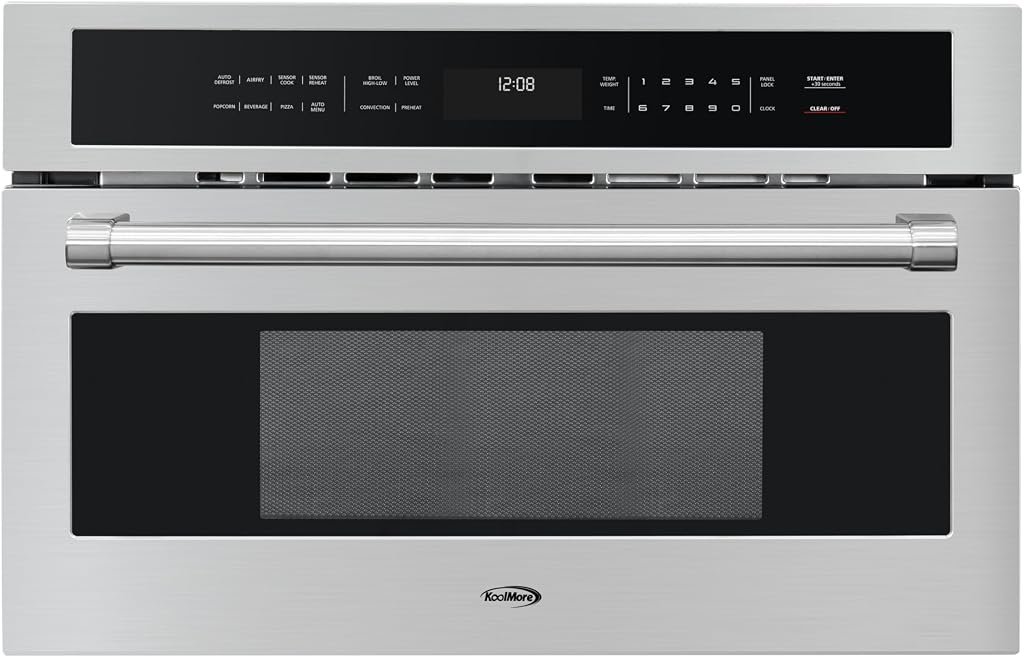
The KoolMore KM-CWO30-SS sits in a category that asks a microwave to behave like something much larger. It is a 30-inch built-in appliance combining microwave cooking with convection heat, broiling, baking, roasting and air frying, wrapped in stainless steel and configured around a drop-down door rather than the familiar side-hinged microwave design.
That breadth gives the KM-CWO30-SS an unusual proposition. It is not simply a microwave intended to disappear into cabinetry. It is closer to a compact secondary oven that happens to possess microwave speed.
Our score is 8.14/10. Customer Sentiment stands at 7.84, Buyer Confidence at 9.27 and Value at 7.91. Those numbers tell a fairly coherent story: this is a feature-dense built-in appliance with well-documented specifications and a persuasive case for kitchens where space consolidation matters, but its price and installation requirements make the buying decision more consequential than purchasing an ordinary countertop microwave.
The distinction is central to this review. The KM-CWO30-SS should be judged less by the standards of a basic reheating appliance and more by how successfully its multiple cooking systems justify the cabinet space and expenditure devoted to it.
A Microwave That Is Really a Combination Oven
The manufacturer describes the KM-CWO30-SS as a 30-inch built-in convection microwave with an integrated air-fryer function. Its cooking specifications explain why the appliance extends beyond ordinary microwave duty. KoolMore lists 1,000 watts of microwave output, while documentation for the model specifies 1,700 watts of convection power.
That distinction matters.
Microwave energy heats food through a fundamentally different process from the heated-air circulation used during convection cooking. Combining the two systems gives the appliance access to tasks that conventional microwave-only machines handle poorly. Browning, roasting and baking need dry heat. Microwave energy, meanwhile, can dramatically accelerate reheating, defrosting and many basic cooking jobs.
The KM-CWO30-SS therefore includes air fry, bake and roast, preheat and broil functions alongside express cooking, sensor reheating and defrost programs. KoolMore specifies 10 microwave power levels and 17 one-touch settings. Its convection temperature range extends from 100°F to 450°F.
That 450°F ceiling matters more than a long list of presets. It puts the convection side of the appliance into a temperature range associated with conventional baking and roasting rather than low-temperature warming alone.
This is the central attraction of the design: one cabinet opening can perform jobs that might otherwise be divided among a microwave, countertop air fryer and compact convection oven.
Dimensions Demand Serious Planning
Built-in appliances cannot be evaluated independently of the cabinetry around them.
KoolMore lists the KM-CWO30-SS at 29.84 inches across its exterior front dimension, 25.43 inches deep and 19.13 inches high, with a weight of 88.95 pounds. The specified cabinet cutout is 28.5 inches wide, 24.19 inches deep and 19.19 inches high.
Those measurements immediately separate this machine from a microwave that can simply be placed on a counter and plugged in.
The cutout needs to be verified before purchase, especially in an existing kitchen. A nominally 30-inch cabinet does not automatically guarantee compatibility. Cabinet construction, face frames, interior depth and electrical placement can all affect usable space.
Door geometry deserves equal attention. KoolMore specifies a vertical downward-swinging door, with the hinges at the bottom. The appliance reaches 35.43 inches in depth when its door is opened to 90 degrees.
That measurement should be taken literally during planning.
An island, opposing cabinet run or narrow passage can transform an elegant built-in installation into an awkward working area if the open door projects into circulation space. Because hot cookware may be moved across that door, working clearance is not merely an aesthetic concern.
The unit’s nearly 89-pound weight also makes installation a different proposition from carrying a compact microwave onto a countertop. Cabinet structure and installation procedure matter.
The Electrical Requirements Deserve Attention
Another specification can easily escape notice: the plug.
KoolMore lists the appliance at 120 volts, 15 amps and 1,750 watts, but specifies a NEMA 5-20P plug. The cord measures 39.4 inches.
A NEMA 5-20P is not the ordinary two-parallel-blade configuration associated with many household appliances. Buyers working with existing cabinetry should verify receptacle compatibility and circuit requirements before installation rather than assuming that the nearest conventional outlet will necessarily accommodate the machine.
This is exactly the kind of detail that separates a useful microwave buying guide from a superficial one. Width, capacity and cooking power attract attention because they are easy to compare. Receptacle type, cutout depth and door-open dimensions are far more likely to determine whether the appliance actually belongs in a particular kitchen.
KoolMore identifies the unit as UL certified and lists plug-in rather than hardwired electrical installation.
Buyer Confidence reaches 9.27 in our assessment partly because the installation and electrical specifications are unusually concrete. There is relatively little ambiguity about what cabinet opening and electrical arrangement the appliance expects.
That does not make installation trivial. It makes installation predictable.
Front Ventilation Is a Meaningful Design Choice
The KM-CWO30-SS exhausts from the front of the unit.
That specification is especially relevant for built-in microwave installations because an appliance enclosed by cabinetry cannot rely on the open space surrounding a countertop machine.
Front exhaust allows the ventilation system to work with the built-in architecture rather than expecting a large open cavity around the microwave. It also means buyers should resist the temptation to alter the finished installation with decorative pieces that could interfere with intended airflow.
The broader lesson is simple: cabinet fit is not determined exclusively by whether the metal enclosure slides into the hole. Air movement, electrical access and door movement are part of the fit.
That is particularly true of a combination oven capable of sustained convection operation. Microwave reheating may last several minutes; baking or roasting can keep the appliance operating for considerably longer. The ventilation arrangement therefore deserves the same planning attention as the cutout itself.
Capacity Numbers Need Closer Reading
KoolMore advertises a 1.6-cubic-foot gross capacity, but its technical specifications also identify a 0.8-cubic-foot net capacity. The interior measures 16.54 by 16.54 by 9.84 inches and contains a 14.17-inch turntable.
That distinction between gross and net volume is useful because headline capacity alone can create an exaggerated impression of usable cooking space.
For everyday microwave work, the 14.17-inch turntable is arguably a more intuitive measurement. It gives buyers a physical reference for assessing dinner plates and cookware. Anyone intending to use the machine extensively for baking or roasting should pay even closer attention to the interior dimensions rather than relying on the 1.6-cubic-foot headline.
The cavity is stainless steel, with an LED light positioned at its top.
The interior height of 9.84 inches also reveals the compromise inherent in this format. This is not a replacement for the cavity volume of a full-size wall oven. It is a compact combination cooking chamber engineered to perform several kinds of cooking within limited vertical space.
That distinction defines who will appreciate the appliance.
Air Frying Adds Utility, but Physics Still Applies
Air frying has become a common addition to combination ovens because the underlying process fits naturally with convection hardware. Rather than creating an entirely separate cooking technology, the function uses rapidly circulated heated air to encourage surface browning and crisping.
The KM-CWO30-SS explicitly includes an air-fry cooking mode.
Its advantage is consolidation. A household already planning to devote cabinet space to a combination microwave may be able to avoid keeping a separate basket-style air fryer on the counter.
There is still an unavoidable trade-off.
A dedicated air fryer can use a compact cooking chamber and basket geometry optimized around concentrated airflow. A 30-inch combination appliance has a broader mandate. Its cavity must accommodate microwave operation, turntable use, convection cooking and other functions.
The correct expectation is therefore versatility, not an assumption that every specialized mode will duplicate a dedicated appliance in every circumstance.
That principle applies across the machine. Combination appliances earn their place by reducing duplication. Buyers seeking maximum specialization in each cooking method may still prefer separate equipment.
Sensor Cooking Makes the Microwave Side More Credible
The microwave portion is not treated as an afterthought.
KoolMore specifies sensor reheating, time and weight defrost, auto defrost, express cooking, an auto menu and 10 microwave power levels.
Sensor cooking is especially relevant because microwave performance is not solely a matter of wattage. Fixed-time programs require the user to estimate how long a particular quantity of food needs. Sensor systems attempt to automate part of that decision.
The 1,000-watt microwave output is substantial enough to place the appliance within familiar contemporary microwave cooking territory without requiring unusual recipe assumptions. More important, adjustable power levels allow gentler heating when full output would be inappropriate.
That matters for tasks such as softening, reheating dense foods or working with dishes that heat unevenly.
A microwave with convection hardware can become unnecessarily complicated if its basic microwave controls are buried beneath secondary functions. The top-mounted digital control panel and one-touch settings are intended to keep routine operations accessible, though the number of modes inevitably means a learning period will accompany the appliance.
The Drop-Down Door Changes How the Appliance Feels
The vertical downward-swinging door is one of the KM-CWO30-SS’s defining physical characteristics.
Traditional countertop microwaves usually use a side-hinged door. A drop-down arrangement visually and ergonomically moves the appliance closer to wall-oven design.
That has practical consequences.
A lowered door can create a temporary landing-like barrier between the user and the cooking cavity. Depending on installation height, reaching deep into the cavity may require extending over the open door. Placement therefore matters more than it might with a side-opening microwave.
Installed too high, the appliance can make removal of hot cookware uncomfortable. Installed too low, controls and cavity visibility may become inconvenient.
The 35.43-inch door-open depth reinforces the need to plan the surrounding workspace.
For a carefully designed wall installation, the format makes architectural sense. For a retrofit into whatever opening happens to be available, it deserves more scrutiny.
Materials and Cleaning Are Straightforward Rather Than Elaborate
KoolMore specifies galvanized and 430 stainless steel for the exterior construction and stainless steel for the interior. The door uses tempered glass. Cleaning is manual.
There is no self-cleaning system to transform maintenance into a largely automated process.
That is hardly surprising in a microwave-convection combination cavity, but it matters because air frying, roasting and broiling can create grease and food deposits that ordinary microwave reheating does not.
Owners planning to use convection functions frequently should therefore regard interior wiping as routine maintenance rather than an occasional response to spills.
Stainless-steel interiors have a practical advantage here: the surface is familiar, visible and accessible. The absence of a specialized cleaning cycle also keeps the appliance’s maintenance architecture relatively straightforward.
Where the KM-CWO30-SS Makes Its Strongest Case
Our 8.14/10 score reflects an appliance whose appeal comes from integration rather than any single specification.
Its strongest argument is kitchen consolidation.
A buyer can obtain microwave heating, convection baking and roasting, broiling and air frying within one built-in cavity. The 100°F-to-450°F temperature range, 1,000-watt microwave output, 1,700-watt convection specification, 10 microwave power levels and sensor functions create a genuinely broad cooking platform.
The stainless-steel built-in format also removes a substantial appliance from the countertop.
That can matter greatly in kitchens where working surface is scarce. Counter space recovered from a microwave and possibly a separate air fryer has functional value that does not appear in a specification sheet.
The design is therefore particularly coherent for a kitchen being planned or renovated around built-in appliances.
Where the Trade-Offs Become More Visible
Value is 7.91 rather than tracking Buyer Confidence at 9.27, and that gap deserves explanation.
At the stated $1,049 reference price, this is a meaningful appliance purchase. A basic countertop microwave costs far less, and shoppers who need only reheating, popcorn and defrosting will struggle to justify paying for convection, broiling, air frying and built-in architecture they rarely use.
Installation also narrows the audience.
The required 28.5-by-24.19-by-19.19-inch cutout, NEMA 5-20P plug, nearly 89-pound appliance weight and drop-down-door clearance all demand planning.
This is not an appliance that should be bought first and measured for later.
The 7.84 Customer Sentiment score also sits below our overall rating. That reinforces a familiar pattern with sophisticated combination appliances: breadth is attractive, but more functions mean more controls, more operating modes and more opportunities for the user’s expectations to differ from what a particular cooking method delivers.
The KM-CWO30-SS makes the most sense when its functions will actually be used.
Who Should Buy It
The strongest buyer profile is a household designing a kitchen around a 30-inch built-in appliance and looking to consolidate several cooking methods.
It is especially well matched to kitchens where a secondary oven would be useful but dedicating space to another full-size wall oven would be excessive. The convection and broil modes broaden its usefulness beyond reheating, while air frying can reduce the need for another countertop appliance.
It also makes sense for buyers who care about keeping countertops visually and physically open.
The fit is less persuasive for someone whose cooking pattern revolves almost entirely around basic microwave tasks. Paying for a built-in combination oven to warm coffee and leftovers is an inefficient allocation of money and cabinet space.
Likewise, anyone replacing an existing built-in microwave should measure first. Nominal 30-inch sizing does not establish cutout compatibility.
How It Fits Into a Microwave Buying Guide
A conventional microwave buying guide tends to emphasize capacity, wattage, presets and price. The KM-CWO30-SS demonstrates why built-in combination models require another layer of analysis.
The relevant questions become more architectural:
- Does the 28.5-inch-wide, 24.19-inch-deep and 19.19-inch-high cutout match the cabinetry?
- Can the electrical installation accommodate the specified NEMA 5-20P connection?
- Is there sufficient room for the 35.43-inch depth with the door fully open?
- Is the installation height comfortable for lifting hot cookware over a drop-down door?
- Will microwave, convection, broil and air-fry functions all receive enough use to justify one multifunction appliance?
- Does a 14.17-inch turntable and 9.84-inch interior height suit the cookware the household actually uses?
Those questions reveal more about ownership suitability than the stainless-steel exterior.
Final Considerations
The KoolMore KM-CWO30-SS earns its 8.14/10 score by treating the built-in microwave as a genuine multipurpose cooking appliance. Its 1,000-watt microwave output is paired with convection capability, a 100°F-to-450°F operating range, air frying, broiling, baking and roasting functions, sensor reheating, multiple defrost modes and 10 microwave power levels.
Buyer Confidence at 9.27 is the strongest component of our assessment. The manufacturer publishes unusually specific physical and electrical details: cabinet cutout dimensions, open-door depth, plug type, cord length, turntable diameter, interior dimensions and ventilation location are all identifiable before cabinetry is altered.
Value at 7.91 is more conditional. This appliance makes financial and spatial sense when its multifunction design replaces several cooking devices or provides useful secondary-oven capacity. It is harder to justify when the household needs little more than a microwave.
Customer Sentiment at 7.84 provides another reason to keep expectations disciplined. Combination appliances trade simplicity for range. That exchange works when the owner values the range enough to learn and regularly use it.
The KM-CWO30-SS is consequently not a universal microwave recommendation. It is a focused built-in solution for kitchens where microwave speed, dry-heat cooking and countertop conservation need to coexist in one cabinet opening.
Its greatest strength is not air frying, stainless steel or the number of cooking presets considered separately. It is the way those capabilities are assembled into one 30-inch installation.
For the right kitchen, that integration is the reason to buy it. For a household seeking only fast reheating, it is also the reason to look elsewhere.