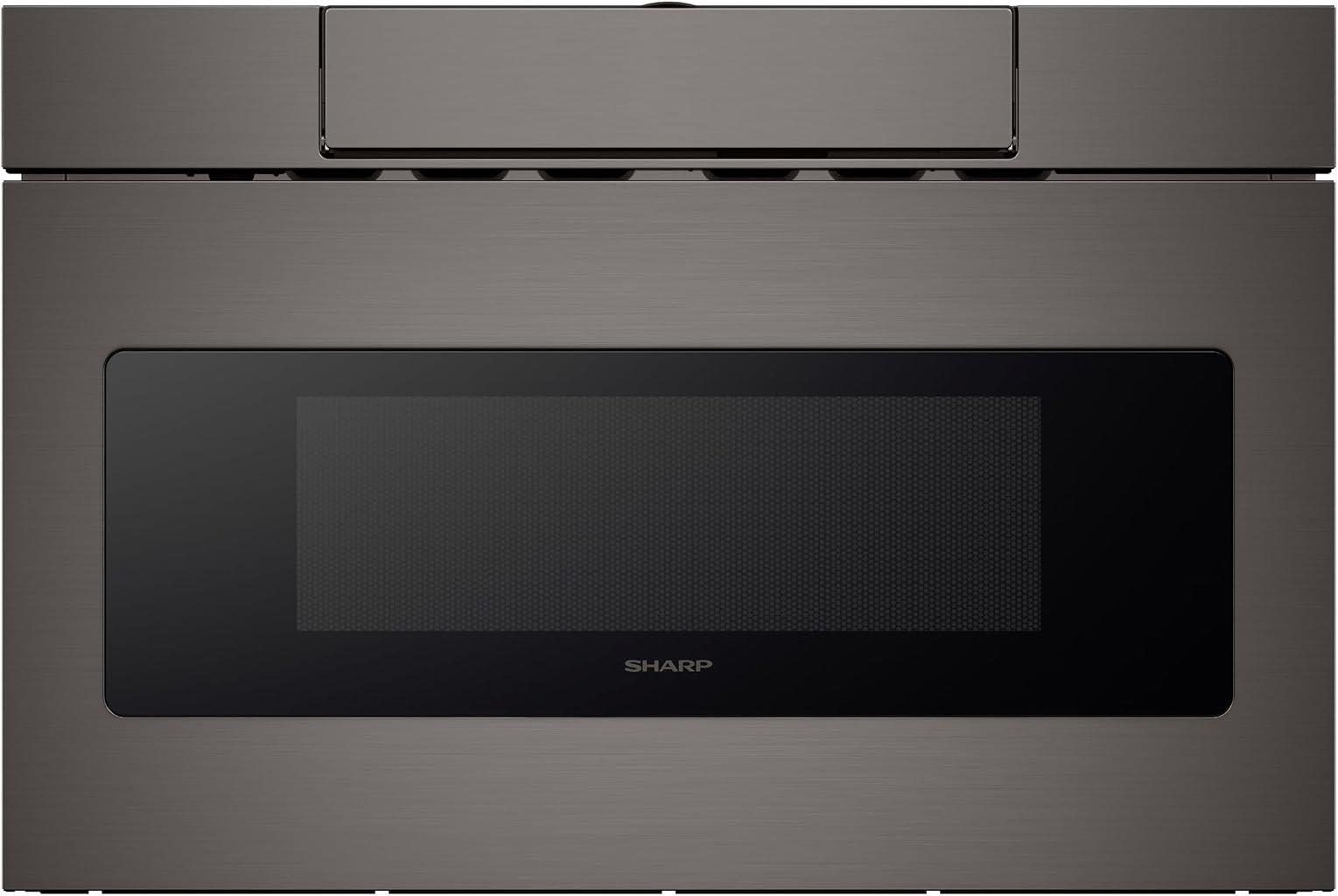
The Sharp SMD2470AH Microwave Drawer Oven is built around a proposition that has little to do with maximizing microwave power per dollar. At $1,597 in this review, it costs far more than a conventional countertop microwave while producing 950 watts of microwave output. Its justification lies elsewhere: permanent integration, below-counter access, an automatic drawer, concealed controls and a black stainless-steel finish intended to coordinate with a specific kitchen aesthetic.
That distinction is central to evaluating the appliance fairly.
Sharp identifies the SMD2470AH as a 24-inch microwave drawer with a 1.2 cu. ft. cavity. The company says its cooking space can accommodate a 4-quart casserole dish or a 20-ounce beverage. The control panel remains concealed when not needed and opens to a 45-degree angle, while the automatic drawer system opens electronically and permits hands-free closing. These features make the appliance substantially different to use and install than a microwave sitting on a worktop.
Our score is 7.99/10. Customer Sentiment is 7.62, Buyer Confidence is 9.25, and Value stands at 7.79.
Those numbers expose the SMD2470AH’s central tension. Confidence is high because its function, dimensions and installation concept are clearly defined. Value and Customer Sentiment are lower because the $1,597 expenditure demands more than adequate microwave heating. The buyer must place meaningful value on the drawer format, black stainless finish and architectural integration.
The SMD2470AH can make sense in the right kitchen. The kitchen, however, has to do much of the work in making that case.
Our Score: 7.99/10
A 7.99/10 overall rating reflects a capable but specialized built-in appliance.
According to Sharp’s current SMD2470AH product listing, the model combines a 24-inch format, 1.2 cu. ft. cavity and 950-watt output with black stainless steel, an automatic drawer and a concealed control panel that opens to a 45-degree angle. Sharp also states that the drawer can be installed beneath an island, peninsula or standard cabinetry and adjacent to a wall oven.
This is a coherent package. Every major design decision points toward integration.
The difficulty is economic. A $1,597 microwave must justify an expenditure that has only a loose relationship with cooking power. The premium pays primarily for physical format, interface, finish and the ability to remove the microwave from conventional countertop or over-the-range positions.
That can be worthwhile. It is not automatically worthwhile.
Our rating therefore recognizes the SMD2470AH as a purpose-built kitchen appliance rather than treating its price as evidence of superior microwave physics.
Black Stainless Steel Is Central to the Buying Decision
The SMD2470AH’s black stainless-steel finish is not a minor variation hidden at the end of a specification list. It is one of the clearest reasons this particular model exists.
Built-in appliances become visual components of cabinetry. Their finishes interact with refrigerators, ovens, dishwashers, handles and surrounding materials. A microwave installed permanently beneath a counter cannot be visually dismissed as easily as a portable appliance.
For a kitchen already using black stainless appliances, the SMD2470AH can provide visual continuity that an ordinary stainless drawer cannot.
For a kitchen without that requirement, the financial case becomes narrower.
Finish does not increase microwave output. It does not enlarge the 1.2 cu. ft. cavity. It does not make food absorb microwave energy differently. The buyer is paying partly for architectural coordination.
There is nothing inherently frivolous about that. Kitchens are both working spaces and designed environments. The mistake would be pretending that aesthetic value is cooking performance.
The SMD2470AH is easier to understand once those two ideas are kept separate.
The Drawer Format Fundamentally Changes Access
Most microwaves require the user to reach horizontally into a cavity. Over-the-range models add vertical lifting. A drawer changes the movement.
Food is lowered into the SMD2470AH from above.
That geometry can make large plates, bowls and casserole dishes easier to see while they are being placed inside. It also removes the side-hinged door found on conventional microwaves.
Below-counter placement introduces its own compromises. Controls and food sit lower. A tall user may need to look downward more sharply. Installation height becomes a permanent ergonomic decision rather than something that can be corrected by moving an appliance later.
Sharp addresses part of this problem through the concealed control panel. When needed, the panel opens to a 45-degree angle rather than remaining flat and horizontal.
That angle matters.
Controls positioned on the top edge of a below-counter appliance would be less convenient if the display remained parallel with the floor. Tilting it toward the user improves the viewing relationship without leaving the interface permanently exposed.
The design is a sensible response to the physical limitations created by the drawer itself.
The Automatic Drawer Is a Functional Feature
The automatic drawer is another defining element.
Sharp describes the system as opening smoothly and enabling hands-free closing. That changes the interaction compared with manually pulling a heavy appliance drawer through its full travel.
The potential advantage becomes clearer when cookware enters the equation. A person holding a dish may benefit from reducing the amount of manual drawer manipulation required during loading.
Automation also creates mechanical complexity.
An electronic opening system contains moving parts and controls that a stationary countertop microwave does not require. No responsible assessment should assign an unsupported lifespan to those components.
The relevant judgment is narrower: while functioning as intended, the automatic mechanism addresses a real interaction problem inherent in drawer-style appliances.
That contributes positively to the 7.99 overall score.
It does not erase the need to think about future service access.
The 1.2-Cubic-Foot Capacity Needs Real-World Interpretation
Sharp specifies a 1.2 cu. ft. cavity and says the SMD2470AH has enough cooking space for a 4-quart casserole dish or a 20-ounce beverage.
Those cookware references are more useful than cubic footage alone.
Capacity figures describe theoretical interior volume. Kitchens operate with physical objects whose handles, lids, rims and shapes determine whether they fit comfortably.
A wide casserole can be more challenging than a taller container with similar volume. A dinner plate may technically fit while leaving little room for comfortable handling.
The drawer configuration also changes loading. Cookware must be lowered into the cavity rather than slid horizontally through a front opening.
Prospective owners should measure the dishes they use most frequently before cabinetry is completed.
That is particularly relevant for a built-in appliance. Discovering that a favorite casserole dish fits poorly after a $1,597 microwave has been integrated into custom cabinetry is a remarkably expensive way to learn the difference between nominal capacity and usable geometry.
A serious microwave buying guide should therefore place cookware measurements near the beginning of the purchasing process.
The 950-Watt Output Should Not Be Overinterpreted
Sharp’s current retail listing identifies the SMD2470AH as a 950-watt microwave.
That figure provides a useful baseline, but microwave wattage is not a complete predictor of cooking behavior.
Food composition matters. So do thickness, moisture, quantity, shape, starting temperature and arrangement.
The USDA Food Safety and Inspection Service explains that microwave ovens operate at about 2,450 MHz and that the energy is readily absorbed by water, fats and sugars. The agency also warns that microwave cooking can create cold spots where harmful bacteria may survive.
That scientific reality places the SMD2470AH’s premium in perspective.
The buyer is not spending $1,597 to escape the basic limitations of microwave heating. Thick foods can still heat unevenly. Stirring, rotating and standing time can still matter.
The appliance’s premium features address the kitchen around the food more than the physics inside the food.
Sensor Programs Reduce Manual Timing
The SMD2470AH’s operating documentation includes sensor-based cooking and reheating functions.
Sensor programs attempt to reduce the amount of manual timing required for suitable foods. That can be useful because microwave cooking times vary substantially with quantity, moisture and starting temperature.
The benefit should be described accurately.
A sensor cannot guarantee uniform temperature throughout every food. Nor can it determine that every part of a dense casserole has reached a food-safe temperature.
Its practical contribution is convenience.
Microwaves are frequently used for repetitive tasks: reheating leftovers, preparing vegetables, warming beverages or handling side dishes. Reducing manual calculation during those tasks can make the appliance easier to live with.
That fits the broader SMD2470AH design philosophy. The appliance is less about inventing new microwave functions than reducing friction around familiar ones.
Buyer Confidence: 9.25
Buyer Confidence receives our highest rating for the SMD2470AH at 9.25.
The reason is clarity.
Sharp publishes detailed installation and operating documentation for the SMD2470 family. The company’s installation manual covers the SMD2470AH alongside related SMD2470 and SMD3070 models and states that installation and service must be performed by a qualified installer. It also requires proper grounding and a correctly installed anti-tip block.
These requirements make the appliance more demanding than a countertop microwave, but they also make the project easier to define before money is committed.
A buyer can inspect the planned cabinet location, compare it with Sharp’s required dimensions, verify the electrical provision and determine whether the drawer will have adequate clearance.
That is what a high Buyer Confidence rating represents.
It does not imply universal suitability. Rather, the product gives the buyer enough concrete information to determine suitability with relatively little ambiguity.
Customer Sentiment: 7.62
Customer Sentiment is 7.62, noticeably below the 9.25 Buyer Confidence score.
That gap deserves attention.
A microwave drawer can be easy to understand before purchase while being highly dependent on installation quality during ownership.
A few inches of height can change how comfortable the controls feel. Poor placement can force users to bend unnecessarily. A drawer installed far from useful counter space can make handling hot cookware awkward.
The black stainless finish introduces another ownership consideration: because appearance is part of the reason for choosing this model, the appliance must integrate successfully with the surrounding kitchen for the purchase to deliver its intended benefit.
The 7.62 rating reflects a product whose appeal is more conditional than its specifications initially suggest.
Its design makes sense. Its daily success depends heavily on where and why it was installed.
Value: 7.79
Value receives a 7.79 rating.
At $1,597, this is the most difficult part of the SMD2470AH’s case.
Microwave heating can be obtained for dramatically less money. The SMD2470AH cannot reasonably defend its price by pointing to 950 watts and 1.2 cu. ft. alone.
Its value comes from integration.
The buyer is paying to move the microwave into cabinetry, recover conventional countertop placement, gain drawer access, use the automatic opening system, obtain the angled concealed controls and coordinate with black stainless appliances.
Those benefits can have genuine worth in a renovation.
They can also be almost irrelevant in another kitchen.
A household with ample counter space, no objection to a conventional microwave and no black stainless design requirement has little reason to absorb the premium.
That contextual value explains why the score remains respectable without rising to the level of Buyer Confidence.
The SMD2470AH is easy to understand. It is harder to justify economically unless the kitchen can use what makes it different.
Installation Cannot Be Treated as an Afterthought
The SMD2470AH is part of the cabinetry in a way a countertop microwave never is.
Sharp’s installation documentation requires specific clearances, grounding and an anti-tip block. The manufacturer also warns against installing the drawer in combustible cabinetry that does not comply with its stated clearances.
The manual further warns against using the drawer as storage and against stepping, leaning or sitting on it.
Those requirements should affect the purchasing process.
Before ordering, the project should establish:
- Finished cabinet opening dimensions.
- Electrical supply and receptacle location.
- Required anti-tip provisions.
- Structural support.
- Full drawer-opening clearance.
- Clearance from adjacent cabinet handles and doors.
- A convenient nearby landing surface.
- Comfortable operating height.
- Access for eventual service or removal.
The last item is easily ignored.
Built-in appliances eventually become replacement projects. The cabinetry remains after the microwave is removed, making the dimensions of that opening a long-term property of the kitchen.
Recording those measurements after installation is prudent.
Landing Space Matters More Than It Appears
A microwave drawer may free countertop space, but it still needs a nearby surface for hot food.
The National Kitchen & Bath Association recommends at least 15 inches of microwave landing area above, below or adjacent to the handle side. Its accessibility recommendation places landing area in front of or immediately adjacent to the handle side.
That guidance is especially relevant to drawer microwaves.
An island can provide an effective arrangement because the countertop sits directly above the appliance. A hot casserole can travel a short vertical distance from drawer to worktop.
A remote cabinet without convenient counter space creates a less elegant workflow. The user may need to carry a hot, heavy dish across an aisle immediately after removing it.
This is a kitchen-planning issue rather than a microwave feature, yet it can influence ownership satisfaction more than another preset program.
Appliances do not operate in isolation. Their surroundings determine how effectively their design translates into daily use.
Food Safety Still Requires Human Verification
Automation should not be confused with food-safety verification.
The USDA warns that microwave ovens can heat unevenly and leave cold spots where harmful bacteria survive. The agency advises users to stir, rotate or turn food where possible and to check temperature in multiple places.
Sharp’s SMD2470 operating manual likewise provides detailed safety and operating instructions, including requirements concerning suitable containers, drawer clearance and proper installation.
The practical lesson is straightforward.
Sensor settings can reduce timing decisions. They cannot inspect the center of a dense serving of food. A food thermometer remains the appropriate verification tool when safe internal temperature matters.
Standing time also deserves respect. Food can continue heating after microwave energy stops because thermal energy moves through the food.
The SMD2470AH may automate part of the cooking process. Judgment remains part of the process as well.
The Concealed Controls Have a Genuine Design Purpose
Concealed controls can sound like an aesthetic flourish, but their value on the SMD2470AH is partly ergonomic.
The panel disappears when not needed, preserving a relatively restrained appliance front. When opened, it tilts to 45 degrees.
That design serves two objectives at once.
Visually, the control surface does not dominate the cabinet run. Functionally, the tilted position improves the relationship between the user’s eyes and a below-counter interface.
This is a more convincing use of concealment than hiding controls purely for visual minimalism.
The feature also illustrates why the SMD2470AH should be judged as a built-in design object as well as a cooking appliance. Its interface has been shaped around the expected installation position.
That coherence helps support the overall rating despite the weaker Value score.
Black Stainless Buyers Have the Clearest Case
The SMD2470AH’s strongest buyer profile is unusually specific.
It suits a household already committed to a black stainless kitchen, planning a 24-inch microwave drawer location and willing to pay for integrated placement.
When those conditions overlap, the model’s features reinforce one another.
The black stainless finish coordinates visually. The drawer removes the microwave from the countertop. The concealed panel limits visual clutter. The automatic mechanism supports the drawer interaction. The 1.2 cu. ft. cavity handles common cookware formats described by Sharp.
Remove those conditions and the case weakens.
A buyer indifferent to finish coordination loses one of the SMD2470AH’s defining reasons for existing. Someone who does not need drawer placement loses another. A household focused primarily on microwave power can purchase heating capacity far more cheaply elsewhere.
The product is therefore specialized rather than broadly economical.
An Island Can Be an Especially Logical Location
Kitchen islands often provide the spatial conditions a microwave drawer needs.
They offer base cabinetry, broad countertop landing space and an opportunity to keep the microwave away from primary wall elevations.
An island installation can also place the appliance near food-preparation areas without consuming the preparation surface itself.
Traffic still requires attention.
A drawer that opens directly into a narrow walkway can become an obstruction. Nearby cabinet doors or handles can interfere with movement if clearances are poorly planned.
The ideal installation therefore considers the drawer both closed and fully extended.
A floor plan showing only the appliance face is insufficient. The moving appliance needs its own operating zone.
That small distinction can separate an elegant installation from a daily irritation.
The Finish Should Be Evaluated in the Actual Kitchen
Black stainless is highly dependent on its surroundings.
Lighting, cabinet color, countertop material and neighboring appliances can all affect how the finish reads visually. A sample viewed under showroom lighting may not resemble the same surface beneath warm residential lighting.
For that reason, finish selection should be made with the kitchen palette in mind.
This does not require elaborate design theory. The buyer can compare the intended appliance finish with existing refrigerator, range or dishwasher surfaces and assess whether differences in tone are acceptable.
The issue matters more with a $1,597 built-in appliance because replacing it for aesthetic reasons would be disproportionately expensive.
The black stainless finish should therefore be treated as a design commitment rather than an incidental color choice.
Future Service Access Should Be Planned Now
Built-in appliances eventually need attention.
That reality makes serviceability part of good installation design.
The SMD2470AH should be installed so that a qualified technician can access and remove it without unnecessary destruction of surrounding cabinetry. Installation documentation should be retained rather than discarded after the project.
Owners can also record:
- Finished opening dimensions.
- Receptacle position.
- Relevant circuit information.
- Model and serial information.
- Installation date.
- Photographs of the opening before final installation.
These records cost almost nothing to create.
Years later, they can simplify conversations with service technicians or cabinetmakers and make replacement planning less speculative.
The expensive mistake is assuming that a built-in appliance will remain untouched simply because it looks permanent.
A Microwave Buying Guide Should Ask Why Before Asking How Much
A useful microwave buying guide for the SMD2470AH should begin with one question: why does the kitchen need a drawer?
If the answer is merely that drawer microwaves look cleaner, $1,597 deserves careful scrutiny.
If the answer includes recovering work surface, avoiding over-the-range placement, integrating the microwave into an island and coordinating with black stainless appliances, the expenditure has a more substantial context.
After that comes fit.
The cabinet opening, electrical provision, drawer clearance, landing area and user height should all be evaluated before ordering.
Only then should cooking features dominate the discussion.
The SMD2470AH’s 950 watts, sensor programs and 1.2 cu. ft. capacity matter. They simply do not explain most of the price.
Architecture does.
Final Considerations
The Sharp SMD2470AH Microwave Drawer Oven earns our 7.99/10 score by delivering a coherent combination of drawer access, 950-watt microwave output, 1.2 cu. ft. capacity, concealed 45-degree controls, automatic operation and black stainless-steel integration.
Its individual ratings reveal the trade-offs more clearly. Buyer Confidence reaches 9.25, Customer Sentiment stands at 7.62, and Value is 7.79.
Buyer Confidence is highest because the appliance has a sharply defined purpose. It is a 24-inch built-in microwave drawer intended for kitchens where below-counter placement and black stainless coordination matter. Sharp provides installation and operating documentation that allows the project to be planned with precision.
Value is lower because $1,597 is difficult to defend through microwave performance alone. The appliance’s 950-watt output does not transform the physics of microwave heating. Uneven temperatures remain possible, food-safety technique remains necessary, and conventional microwaves can perform basic heating tasks for much less money.
Customer Sentiment sits between those considerations. The SMD2470AH can integrate elegantly into the right kitchen, but permanent installation magnifies planning errors. Poor height, inadequate landing space or an inconvenient traffic position can undermine an otherwise coherent design.
The strongest buyer is therefore easy to identify: someone planning a microwave drawer from the beginning, with an appropriate 24-inch cabinet location, nearby work surface and a genuine preference for black stainless steel.
That buyer should still measure cookware, verify cabinet and electrical requirements, examine drawer clearance and preserve future service access before installation.
The weaker buyer is equally identifiable. Someone who simply needs 950 watts of microwave heating has far cheaper options. Someone indifferent to black stainless loses much of this model’s distinctive rationale. Someone uncertain about drawer placement should resolve the kitchen plan before committing to the appliance.
The SMD2470AH is not primarily an argument for spending more money on microwave technology. It is an argument for spending more money on where the microwave lives and how it interacts with the kitchen.
That distinction defines the entire review.
At $1,597, the appliance asks the room around it to justify a significant portion of the expenditure. When the cabinetry, workflow, landing area and finish coordination all support the drawer concept, the SMD2470AH can become a logical part of a deliberately planned kitchen. When those conditions are absent, its premium becomes much harder to defend.
The 7.99/10 overall score reflects precisely that balance: high confidence in a clearly engineered built-in format, respectable value when its architectural advantages are genuinely needed, and a narrower buyer profile created by a price that demands more than the ability to heat food.