A microwave drawer asks buyers to reconsider one of the kitchen’s most familiar appliances. Instead of sitting on a counter or hanging above a range, the microwave becomes part of the cabinetry, opening horizontally like a drawer and receiving cookware from above. That architectural shift sounds simple. Financially, it is anything but.
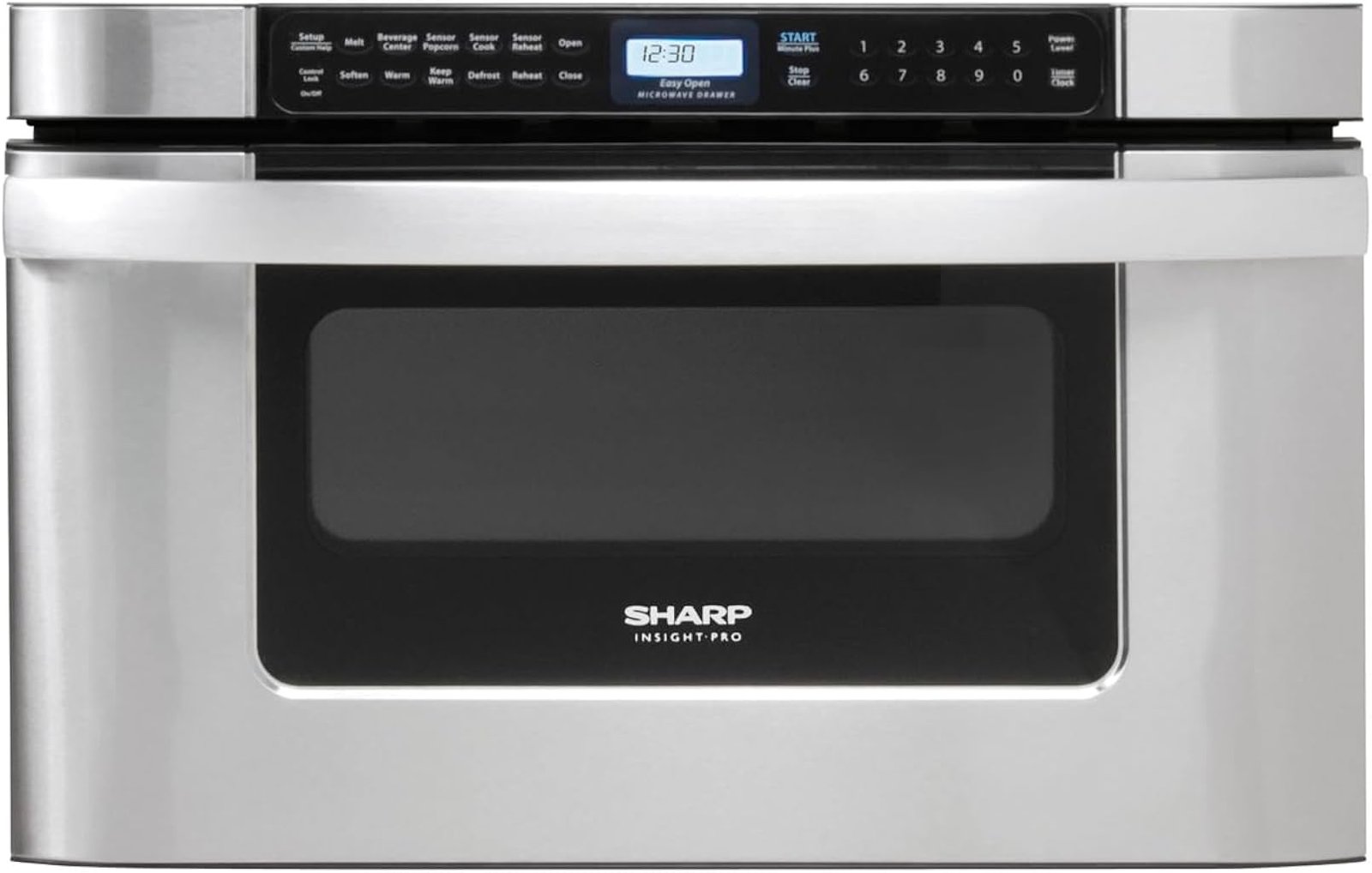
The Sharp KB6524PSY Microwave Drawer Oven costs $1,297 in this review. Sharp identifies it as a 24-inch stainless-steel model with a 1.2 cu. ft. cavity and 950 watts of microwave output. Its defining features include an Auto-Touch control panel, Easy Open operation, a low-profile design and enough interior room, according to Sharp, for a 4-quart casserole dish or 20-ounce cup.
Our score is 8.38/10. Customer Sentiment is 8.06, Buyer Confidence reaches 9.7, and Value stands at 8.03. That rating pattern says more about the KB6524PSY than any isolated specification. The product’s purpose is unusually clear, which drives confidence upward. Its value case is more conditional because nearly $1,300 buys microwave heating that can be obtained much more cheaply in another format.
The KB6524PSY therefore needs to be judged as part appliance and part kitchen infrastructure. Its central question is not whether it can reheat dinner. It is whether placing the microwave inside a base cabinet improves the kitchen enough to justify the cost and installation.
Our Score: 8.38/10
An 8.38/10 score places the KB6524PSY in favorable territory while preserving room for skepticism about price.
The appliance has a focused design. Sharp’s current KB6524PSY product page identifies a 24-inch format, 1.2 cu. ft. cavity and 950-watt output. It also lists an Auto-Touch control panel, low-profile construction and stainless-steel finish.
Those specifications make the basic proposition easy to understand. This is not a countertop microwave with decorative trim pretending to be integrated. The drawer mechanism fundamentally changes access to the cavity.
Sharp provides two methods for opening or closing it: the Easy Open handle can be pushed or pulled, or the Auto-Touch control can operate the drawer electronically.
That flexibility is more consequential than it initially appears. Built-in appliances are encountered thousands of times over their service lives. Small physical interactions accumulate. How a drawer opens, where the controls sit and where a hot dish is placed afterward can affect daily satisfaction more consistently than rarely used presets.
The KB6524PSY earns much of its score through that interaction model rather than raw microwave power.
A Microwave Drawer Solves a Spatial Problem
The conventional countertop microwave carries a hidden cost: work surface.
A microwave can remain in one position for years while consuming an area that could otherwise hold a cutting board, mixing bowl or hot pan. Over-the-range models recover that surface but place the cavity higher, sometimes requiring users to lift hot or heavy cookware near shoulder or face level.
A drawer creates another option.
Placed below the countertop, the KB6524PSY moves microwave access into base cabinetry. The user approaches food from above rather than reaching into a side-hinged cavity.
This geometry can be especially logical in an island or peninsula where wall space is limited and countertop continuity matters.
It also creates new questions. Below-counter placement requires bending or looking downward. The exact installation height affects comfort. A drawer projecting into a traffic aisle needs enough clearance to open without creating an obstruction.
There is no universally superior microwave position. The relevant issue is whether drawer placement improves the specific kitchen.
That distinction keeps the review grounded. Architecture can solve one problem while creating another.
The 1.2-Cubic-Foot Capacity Is More Practical Than It Sounds
A 1.2 cu. ft. cavity can appear modest beside larger countertop microwaves, but cubic footage alone does not explain usable space.
Sharp states that the KB6524PSY fits a 4-quart casserole dish and is tall enough for a 20-ounce cup. Those references are more useful than an abstract volume measurement because they translate capacity into recognizable kitchen objects.
Still, buyers should measure their own cookware.
Casserole dishes vary in handle design. Dinner plates vary in diameter. Bowls can flare outward. A container may technically fit inside a cavity while remaining awkward to lower into it.
The drawer format adds another geometric consideration: food is loaded downward. The user needs enough clearance to lower and remove cookware comfortably without striking surrounding surfaces or struggling with handles.
That is why capacity should be evaluated with actual dishes before cabinetry is finalized.
A household that frequently uses one oversized plate or particular casserole can measure it in less than a minute. That small exercise can prevent a much larger problem after installation.
A useful microwave buying guide should therefore treat cookware dimensions as seriously as nominal cavity volume.
The 950-Watt Rating Needs Proper Perspective
Sharp currently classifies the KB6524PSY as a 950-watt microwave.
Wattage provides a useful reference point, but it cannot predict every cooking result.
Microwave heating depends on food composition, moisture, thickness, density, quantity and arrangement. Two foods receiving the same microwave output can heat very differently.
The USDA Food Safety and Inspection Service explains that microwaves operate at approximately 2,450 MHz and that microwave energy is readily absorbed by water, fats and sugars. The agency also explains that microwaves penetrate food only about 1 to 1½ inches, with heat reaching deeper portions through conduction.
That physics is relevant to any premium microwave.
A high purchase price does not cause microwave energy to penetrate more deeply into a thick casserole. Nor does a built-in installation eliminate cold spots.
The KB6524PSY’s value must therefore be separated from unrealistic assumptions about what expensive microwave hardware can do.
Its premium concerns placement, drawer operation and integration. The heating process remains subject to familiar microwave limitations.
Sensor Cooking Addresses Everyday Guesswork
Sharp identifies sensor cooking among the KB6524PSY’s current product features.
Sensor cooking is useful because microwave timing is inherently variable.
A refrigerated bowl of leftovers and an identical-looking bowl closer to room temperature do not require precisely the same heating cycle. Moisture content, food mass and container geometry add further variation.
Sensor programs attempt to reduce the need for manual timing under compatible conditions.
The sensible interpretation is convenience rather than perfection.
No sensor can erase every difference in food composition or geometry. A thick casserole may still require stirring, standing or additional heating. A large quantity can behave differently from a smaller serving.
Yet reducing manual guesswork has genuine everyday value. Microwave use often occurs precisely when speed matters: reheating lunch, warming leftovers, preparing vegetables or handling a side dish while other food is cooking.
The more frequently those tasks occur, the more meaningful small reductions in interaction can become.
Buyer Confidence: 9.7
Buyer Confidence is the strongest component of our assessment at 9.7.
That rating reflects a product whose identity is unusually easy to define.
A buyer is not purchasing the KB6524PSY because it provides mysterious cooking capabilities unavailable elsewhere. The rationale is architectural. The buyer wants a 24-inch built-in microwave drawer, stainless-steel appearance and a specific access pattern.
Those requirements sharply narrow the decision.
Sharp’s current documentation also makes the product’s basic dimensions, capacity, output and operating arrangement readily identifiable. That reduces ambiguity before installation.
High Buyer Confidence does not mean the product suits every household. It means fit can be determined with reasonable precision.
A kitchen either has an appropriate cabinet location or it does not. The user either values below-counter microwave access or prefers another position. The $1,297 expenditure either fits the renovation budget or places too much money into microwave integration.
Those are answerable questions.
That clarity is the foundation of the 9.7 rating.
Customer Sentiment: 8.06
Customer Sentiment receives an 8.06 score, notably below Buyer Confidence.
The gap matters because ownership introduces variables that a specification sheet cannot settle.
A built-in microwave becomes part of the physical routine of a kitchen. Installation height affects every use. Drawer movement becomes familiar. Control placement matters repeatedly. The distance to a landing surface becomes apparent whenever a hot dish leaves the cavity.
A countertop appliance can be repositioned if the original location proves irritating. A built-in drawer is less forgiving.
The KB6524PSY’s Easy Open and Auto-Touch arrangements give users two ways to interact with the drawer, which is a sensible design choice. But even a well-designed drawer can feel inconvenient when installed in the wrong location.
The 8.06 Customer Sentiment score captures that ownership reality. The appliance’s concept is strong, while satisfaction remains dependent on planning, expectations and daily cooking habits.
Value: 8.03
Value receives an 8.03 rating, the lowest of our four measures.
At $1,297, the reason is straightforward.
The buyer is not paying primarily for microwave wattage. Conventional microwaves with comparable or higher output exist at much lower prices. Sharp’s own current microwave range demonstrates how significantly prices vary across installation formats.
The financial case rests on what the drawer format replaces or improves.
If moving the microwave below the counter frees a heavily used preparation surface, that recovered space has practical value. If the appliance permits a kitchen design without an over-the-range microwave, that can affect cabinetry and ventilation choices. If top access is preferable for the household, the physical interaction itself can justify part of the premium.
Those benefits are contextual rather than universal.
A household with abundant counter space and no objection to a conventional microwave may see little economic reason to spend $1,297. A kitchen renovation already configured around a drawer has a different equation.
Installation cost must also enter the calculation. Cabinet modification and electrical work can push the project expenditure beyond the appliance price.
That is why an 8.03 Value score is appropriate despite the higher 8.38 overall rating. The product is coherent. The economics require a kitchen that can exploit its design.
Auto-Touch and Easy Open Provide Two Interaction Paths
Sharp says the KB6524PSY can be opened or closed in two ways: through the Easy Open handle or through the Auto-Touch control panel.
Redundancy can be useful in an appliance that moves physically.
A user carrying cookware may prefer electronic operation in one situation and direct handle operation in another. The availability of both methods avoids making one interface mandatory.
That flexibility also distinguishes the KB6524PSY from designs that emphasize a concealed or more heavily automated control arrangement.
There is an appealing simplicity here. The drawer is integrated, but the interaction remains recognizable.
Mechanical complexity still deserves consideration. Any moving built-in appliance contains components that may eventually require service. No lifespan claim should be attached to the drawer mechanism without long-term evidence.
The more immediate question is whether the dual operating methods improve everyday usability. For many installations, they plausibly can.
Microwave Safety Does Not Change With Price
The KB6524PSY’s built-in appearance can make it feel more like permanent kitchen equipment than a small appliance, but food-safety requirements remain the same.
The USDA warns that microwave ovens can heat unevenly and create cold spots where harmful bacteria may survive. It recommends stirring, rotating or turning foods when possible and checking temperature in multiple locations.
For leftovers, USDA guidance specifies reheating to 165°F as measured with a food thermometer. The agency recommends covering and rotating food during microwave reheating and allowing standing time before checking internal temperature.
This matters because automation can create false confidence if interpreted too broadly.
Sensor cooking can reduce timing guesswork. It cannot inspect every cold region in a dense dish. The proper response is ordinary kitchen discipline: arrange food evenly, cover appropriate dishes, stir when possible, respect standing time and use a thermometer when internal temperature determines safety.
A $1,297 appliance does not repeal those rules.
Landing Space Is Part of the Design
A drawer microwave can recover counter space, but removing every nearby work surface would defeat part of the purpose.
Hot food needs somewhere to go.
The National Kitchen & Bath Association recommends at least 15 inches of landing area above, below or adjacent to the handle side of a microwave. Its accessibility recommendation calls for landing area in front of or immediately adjacent to the handle side.
For the KB6524PSY, that guidance has an obvious application.
An island installation can place the drawer immediately beneath a broad worktop. A dish can move upward from the cavity to the counter in a short, controlled motion.
A poorly chosen location can produce the opposite result. If the drawer sits at the end of a cabinet run with no convenient surface nearby, a hot casserole may have to be carried across an aisle.
The difference cannot be fixed through sensor settings or additional microwave power.
This is why installation planning belongs inside the product review rather than outside it.
Installation Height Can Make or Break the Experience
Microwave drawers are often discussed as though below-counter placement were automatically ergonomic.
It is not.
A tall user may find a very low installation less comfortable. Someone with limited bending mobility may have different requirements. A child-accessible location can create household considerations that do not exist with an elevated microwave.
The correct height depends on the people using the kitchen.
Before cabinetry is finalized, regular users should physically simulate the interaction. Stand in front of the proposed location. Imagine lowering a full casserole into the drawer. Consider whether the controls can be read comfortably and whether a dish can be transferred immediately to the worktop.
This kind of rehearsal sounds almost absurdly simple compared with architectural drawings. It can reveal problems those drawings hide.
Ergonomics is experienced at human scale, not on a floor plan.
The Stainless-Steel Design Is Part of the Purchase
The KB6524PSY uses a stainless-steel finish and low-profile front design.
Aesthetic integration should not be confused with cooking performance, but neither should it be dismissed as irrelevant.
Built-in appliances become part of the visual architecture of a kitchen. A countertop microwave can be moved, hidden or replaced independently. A drawer is integrated into a cabinet run and therefore interacts with surrounding ovens, dishwashers, refrigerators and hardware.
The KB6524PSY’s restrained stainless treatment makes sense in kitchens already using stainless appliances.
That does not increase heating power or capacity. It can, however, affect whether the appliance looks intentional after installation.
For a product purchased partly because it disappears from the countertop, visual integration is legitimately part of the value calculation.
Who Should Consider the KB6524PSY?
The KB6524PSY makes the strongest case for homeowners planning or modifying cabinetry specifically around a microwave drawer.
Kitchen islands are a natural setting because they provide base-cabinet volume beneath a large landing surface. Peninsulas can offer similar advantages.
The model also makes sense for households that strongly prefer to keep microwaves off the countertop and do not want an over-the-range installation.
Its $1,297 price demands that those benefits be meaningful.
The weaker buyer is someone seeking only efficient reheating. A basic countertop microwave solves that problem with far less capital and almost no installation commitment.
Renters are similarly poor candidates because the product’s value is tied to permanent integration.
The distinction is simple: the KB6524PSY should solve a kitchen-design problem. If it solves only a microwave-heating problem, much of the expenditure is difficult to defend.
Future Serviceability Deserves Attention
Built-in appliances create obligations long after installation day.
Eventually, a microwave may require repair or replacement. The cabinet opening remains even if the original appliance does not.
That makes documentation worth preserving.
Owners should retain installation instructions, record the finished cabinet opening and keep electrical details accessible. Photographs taken before surrounding trim or cabinetry is completed can also document receptacle and structural locations.
Future replacements may not use identical dimensions.
This possibility does not argue against built-in appliances. It argues for avoiding unnecessarily specialized cabinetry and preserving service access.
A well-planned installation anticipates removal as carefully as insertion.
That mindset can prevent a future appliance replacement from becoming a cabinet renovation.
A Microwave Buying Guide Should Begin With Placement
A microwave buying guide for drawer appliances should reverse the sequence commonly used for countertop models.
Start with the kitchen.
Identify the intended cabinet. Measure it. Determine the finished opening. Verify electrical requirements. Confirm drawer clearance. Locate the nearest landing surface. Consider traffic through the area. Evaluate control visibility and loading height for the people who will actually use the appliance.
Then consider capacity and cooking functions.
For the KB6524PSY, the questions should include whether a 4-quart casserole and 20-ounce cup represent the household’s real cookware needs, whether 1.2 cu. ft. is sufficient, and whether sensor cooking aligns with typical use.
Finally comes price.
At $1,297, the appliance needs a reason to be built into the kitchen. The drawer should free meaningful counter space, improve placement or support a deliberate architectural plan.
When those conditions are present, the cost has context. Without them, it is simply an expensive route to 950 watts of microwave output.
Final Considerations
The Sharp KB6524PSY Microwave Drawer Oven earns our 8.38/10 score because it executes a specific idea with considerable clarity: move microwave cooking into a 24-inch base-cabinet format while retaining familiar controls, stainless-steel integration and enough cavity space for everyday cookware.
Its ratings expose both the strength and limitation of that proposition. Buyer Confidence reaches 9.7, Customer Sentiment is 8.06, and Value stands at 8.03.
The 9.7 Buyer Confidence score reflects how straightforward the purchasing logic can become once the buyer has committed to the drawer format. Sharp identifies the appliance as a 24-inch, 1.2 cu. ft., 950-watt model and provides both Easy Open handle operation and Auto-Touch control. The cavity is described as accommodating a 4-quart casserole dish and a 20-ounce cup.
The lower Value score reflects the price. At $1,297, the KB6524PSY cannot justify itself through microwave power alone. Its financial rationale comes from reclaiming work surface, changing microwave placement and integrating the appliance into cabinetry.
Customer Sentiment at 8.06 sits between those two perspectives. The design is coherent, but ownership depends heavily on installation. A drawer placed at an awkward height or far from landing space can undermine an otherwise sensible appliance.
That makes planning unusually consequential.
Prospective owners should measure cookware, verify cabinet dimensions, confirm electrical requirements, evaluate drawer clearance and stand physically in front of the proposed location before construction is finished. They should also preserve future service access and record the finished opening.
Food handling deserves equal attention. The KB6524PSY’s sensor capability can reduce timing guesswork, but microwave heating remains subject to uneven temperature distribution. USDA guidance on stirring, rotating, standing time and temperature verification remains relevant regardless of appliance price.
The KB6524PSY is therefore best understood not as an unusually powerful microwave but as a different answer to the question of where a microwave belongs.
For a household with abundant counter space, comfortable conventional microwave placement and no desire to modify cabinetry, that answer may be unnecessarily expensive.
For a kitchen where counter space is heavily contested, an island provides an appropriate cabinet location, or microwave placement is being reconsidered during renovation, the equation changes. The drawer can become part of the room’s architecture rather than another object sitting on the work surface.
That distinction explains the 8.38/10 overall score. The KB6524PSY is a focused built-in appliance with high Buyer Confidence and respectable editorial scores across the board. Its limitation is not ambiguity about what it does. Its limitation is that the $1,297 price only makes sense when the kitchen can extract genuine value from where and how it does it.