A microwave usually earns its place in a kitchen through speed. A microwave drawer has a more complicated assignment. It must heat food effectively while justifying permanent cabinetry, an unconventional access position and a price that can exceed the cost of several conventional countertop models combined.
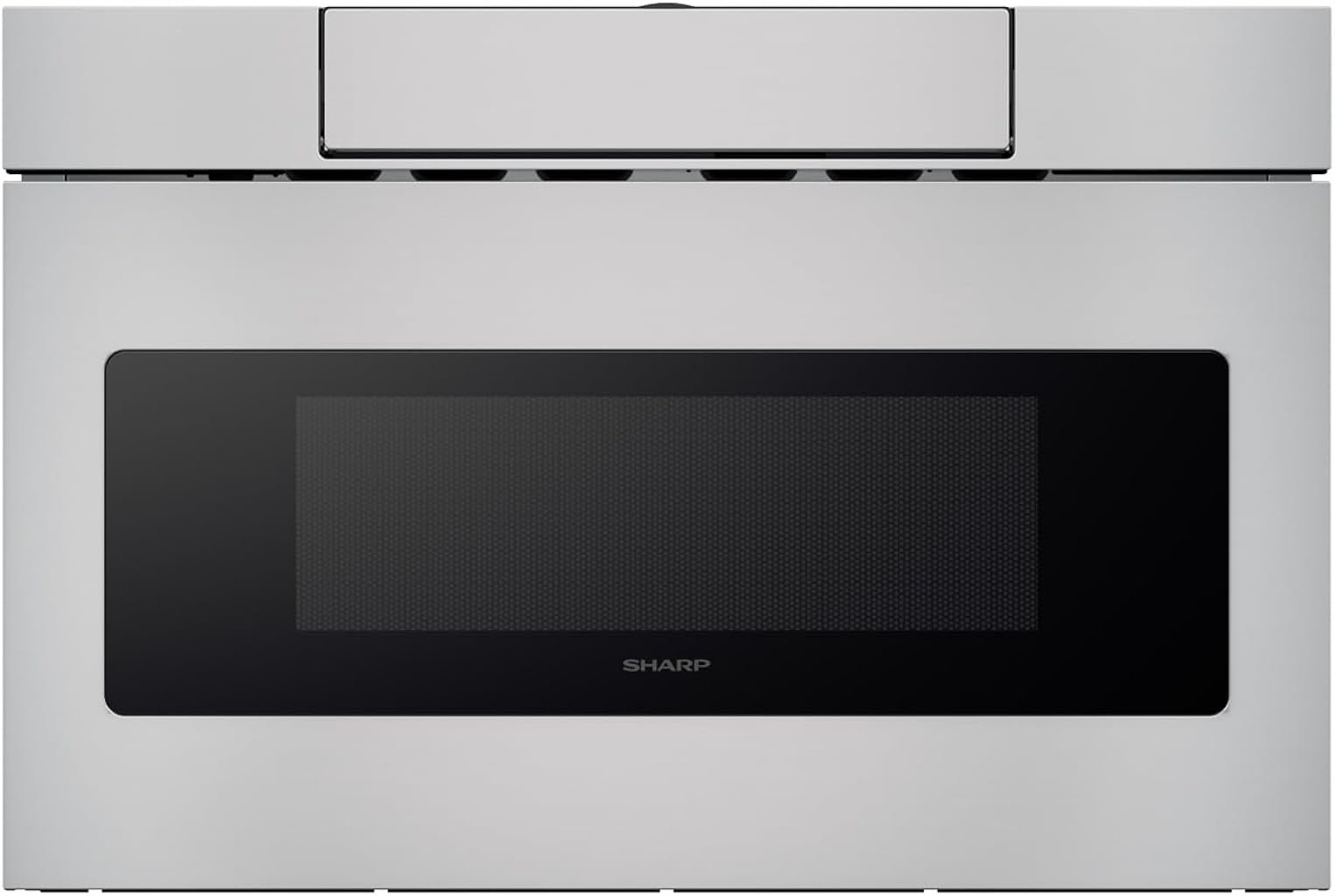
The Sharp SMD2470ASY enters that equation at $1,497. It is a 24-inch stainless-steel Microwave Drawer Oven with a 1.2 cu. ft. cavity and 950 watts of microwave output. Sharp equips it with an Easy Touch automatic drawer, a concealed control panel that tilts to a 45-degree viewing angle, sensor cooking and reheating functions, automatic defrost settings and a keep-warm mode.
Our score is 8.55/10. Customer Sentiment stands at 8.28, Buyer Confidence reaches 9.8, and Value is 8.15. The relationship among those numbers captures the SMD2470ASY unusually well. Confidence is exceptionally high because the appliance has a clearly defined purpose, detailed installation requirements and a mature feature set. Value is more restrained because $1,497 remains a large expenditure for an appliance whose fundamental heating technology is still microwave energy.
That does not make the drawer format irrational. It means the purchase has to solve more than a reheating problem.
Our Score: 8.55/10
An 8.55/10 overall score reflects a microwave drawer with a coherent design philosophy.
The SMD2470ASY is not trying to compete with inexpensive countertop microwaves on dollars per watt. That comparison would be brutal and largely pointless. Its appeal lies elsewhere: built-in placement, above-drawer access to food, an automatic opening mechanism and controls engineered around below-counter installation.
According to Sharp’s current specification sheet, the appliance provides 950 watts of output, 1.2 cu. ft. of stated capacity, 12 sensor cook, reheat and popcorn settings, two automatic reheat settings, six automatic defrost settings and a keep-warm function lasting up to 30 minutes.
The same documentation lists a three-prong grounding plug, 120-volt/60-Hz electrical supply, 1.67 kW power rating and 14.5-amp draw. Those are not glamorous specifications, but they matter enormously once cabinetry and electrical infrastructure enter the transaction.
This is where the SMD2470ASY begins to justify its high Buyer Confidence rating. The purchasing proposition is specific. It asks the buyer to decide whether a permanent drawer microwave solves a kitchen-planning problem better than a portable appliance.
The Drawer Format Changes the Kitchen
A conventional countertop microwave takes up horizontal work space. An over-the-range microwave moves the appliance upward but requires users to lift hot dishes to and from an elevated cavity.
The SMD2470ASY changes that geometry.
Food is lowered into the drawer from above. Controls are positioned at the center-top and presented on a touchpad panel that opens to a 45-degree angle. Sharp also uses an automatic drawer mechanism rather than requiring the user to pull and push the drawer through its full travel manually.
These are not merely cosmetic decisions.
A below-counter appliance presents a basic visibility problem: horizontal controls can be difficult to read from a standing position. Angling the panel upward directly addresses that issue. Likewise, an automatic drawer can reduce the physical awkwardness of manipulating the appliance while handling cookware.
The result is an appliance designed around its installation position rather than a conventional microwave repackaged into a rectangular cabinet opening.
That design coherence contributes substantially to the 8.55 overall score.
The 1.2-Cubic-Foot Capacity Needs Context
Sharp specifies 1.2 cu. ft. of internal capacity and states that the cavity can accommodate a 9-by-13-inch dish. The company also explicitly cautions that internal capacity is calculated using maximum width, depth and height and that actual food-holding capacity is lower.
That caveat deserves attention.
Microwave capacity is frequently reduced to one cubic-foot figure, but cookware does not behave like liquid poured into a box. A casserole dish needs usable width and depth. A tall mug requires vertical clearance. Handles and lids complicate matters further.
The practical approach is to measure the dishes already used in the kitchen.
A household that regularly reheats food in a particular casserole dish should confirm compatibility before the cabinet opening is finalized. The same applies to oversized dinner plates and tall containers.
This exercise becomes more consequential with built-in equipment. A countertop microwave that proves inconvenient can be replaced with limited disruption. A drawer microwave leaves behind cabinetry constructed around a specific physical envelope.
A microwave buying guide for this category therefore needs to treat cookware compatibility as an installation issue, not an afterthought.
The 950-Watt Output Is Adequate, but Wattage Is Not the Whole Story
The SMD2470ASY uses 950 watts of microwave output. That figure establishes its heating class, but it should not be treated as a complete description of cooking behavior.
Microwave performance depends on food quantity, moisture content, density, shape, container material and starting temperature. Even powerful microwave ovens can create uneven temperatures.
The USDA Food Safety and Inspection Service explains that microwave cooking can heat food less evenly than conventional cooking and recommends stirring, rotating or turning food where possible to reduce cold spots. The agency also recommends checking temperatures in multiple locations when safety depends on reaching a specific internal temperature.
That distinction matters because a premium microwave can create an understandable expectation of premium heating uniformity.
Price does not alter microwave physics.
The SMD2470ASY’s 950-watt output provides useful heating power, but sensor functions, food arrangement, standing time and appropriate user technique remain relevant.
Sensor Cooking Is More Useful Than Another Row of Presets
The SMD2470ASY includes 12 sensor cook, reheat and popcorn settings.
Sensor cooking deserves more attention than many preset features because it attempts to respond to conditions during cooking rather than merely running a predetermined timer.
The underlying problem is familiar. Two bowls of leftovers may look similar while differing considerably in mass, moisture and starting temperature. A fixed two-minute setting treats them identically.
Sensor-based programs provide another layer of control.
They should not be interpreted as automatic guarantees of perfect doneness or uniform temperature. The more defensible benefit is convenience: the user does not need to calculate every cooking time and power level manually for supported foods.
That distinction fits the broader philosophy of the SMD2470ASY. Its strongest features tend to reduce friction rather than radically change microwave cooking.
The automatic drawer reduces handling effort. The angled control panel improves viewing geometry. Sensor programs reduce manual timing. Keep Warm provides a way to hold suitable food after heating.
Individually, none transforms microwave technology. Together, they make routine interaction more deliberate.
Buyer Confidence: 9.8
Buyer Confidence is the strongest rating in our assessment at 9.8.
That score reflects how clearly the SMD2470ASY defines its requirements and purpose.
Sharp specifies a cutout measuring 22 1/8 inches wide, 15 9/16 inches high and 23 1/2 inches deep. The appliance itself measures approximately 23 7/8 inches wide, 15 7/8 inches high and 23 1/64 inches deep in the current specification sheet, with a listed product weight of 74 pounds.
The documentation also specifies a 24-inch minimum cabinet and states that the floor supporting the installation should support 100 pounds.
Those figures give a cabinetmaker, installer and homeowner concrete dimensions to work with.
Sharp’s installation manual also calls for installation and service by a qualified installer and specifies safety clearances and anti-tip provisions.
This level of documentation does not make installation trivial. It makes installation knowable.
That distinction supports the 9.8 rating. Buyers who measure correctly, confirm the electrical arrangement and plan the cabinet opening can determine with considerable confidence whether the SMD2470ASY belongs in the kitchen.
Customer Sentiment: 8.28
Customer Sentiment receives an 8.28 rating, lower than Buyer Confidence but still a strong component of the overall score.
The gap is revealing.
A built-in microwave can be straightforward to evaluate before purchase while creating more nuanced reactions during ownership. The appliance becomes part of the cabinetry. Its height is fixed. Its controls are encountered repeatedly. The automatic drawer becomes a daily mechanical interaction rather than an occasional novelty.
The SMD2470ASY’s design addresses several of these issues intelligently, but permanent installation raises expectations.
A $1,497 microwave drawer is not judged merely on whether leftovers become hot. Owners can reasonably expect the interface, drawer movement, sensor programs and physical integration to justify the additional expenditure.
The 8.28 Customer Sentiment rating reflects that more demanding standard.
It also illustrates why kitchen planning matters so much. An appliance installed at an uncomfortable height can become irritating regardless of its electronic features. A drawer positioned far from a useful work surface can create an unnecessary journey with hot cookware.
Good appliance design cannot fully rescue poor placement.
Value: 8.15
Value is the lowest of the four editorial measures at 8.15.
That is not surprising at $1,497.
Microwave heating can be purchased for dramatically less. Anyone evaluating the SMD2470ASY solely as a mechanism for reheating soup or making popcorn will struggle to construct a compelling economic argument.
The value comes from architecture and usability.
Moving the microwave below the counter can recover work space. The drawer format can remove the need for overhead lifting. The concealed controls create a restrained front profile. Automatic operation changes the physical interaction with the appliance.
Those benefits are real, but their financial significance varies by kitchen.
In a renovation where cabinetry is already being designed around a drawer microwave, the installation can be integrated from the beginning. In an existing kitchen requiring extensive cabinet reconstruction and electrical alterations, the true acquisition cost can climb well above the $1,497 appliance price.
That difference explains why Value sits below Buyer Confidence by 1.65 points.
The SMD2470ASY has a clearly defined reason to exist. Whether that reason is worth the expenditure depends on how much the household values the drawer format.
Installation Is Part of the Appliance
Built-in equipment cannot be evaluated responsibly while treating installation as somebody else’s problem.
Sharp’s installation documentation calls for a dedicated physical opening, appropriate clearances, grounding and an anti-tip block. The appliance is not intended simply to be pushed into any nominally 24-inch cabinet.
The distinction between appliance dimensions and cutout dimensions is especially important.
A cabinet opening is not supposed to match the external dimensions exactly. Clearances, overlaps and support requirements create a different set of measurements.
Before ordering, a buyer should establish:
- Exact finished cutout width, height and depth.
- Cabinet-floor load capacity.
- Required anti-tip provisions.
- Electrical supply and receptacle position.
- Clearance for the drawer’s full opening movement.
- Nearby landing space for hot dishes.
- Comfortable operating height for regular users.
- Access for future servicing and eventual removal.
- Whether flush-mount installation requires additional accessories.
These checks are less exciting than comparing sensor programs, but they are more likely to determine whether the finished kitchen works properly.
Landing Space Deserves Serious Attention
A microwave drawer can reclaim countertop space, but it should not be isolated from countertop space.
The distinction sounds contradictory until someone removes a steaming casserole.
The National Kitchen & Bath Association recommends at least 15 inches of landing area above, below or adjacent to the handle side of a microwave oven. Its accessibility guidance calls for landing area immediately in front of or adjacent to the handle side.
That recommendation provides a useful way to evaluate potential SMD2470ASY locations.
An island installation can work well when the countertop directly above the drawer provides immediate landing space. A remote cabinet position may be less successful if hot dishes have to cross a traffic aisle before reaching a work surface.
The issue is not merely convenience.
Large microwave-safe dishes can become hot, heavy and awkward. Reducing the distance between appliance and landing area makes food handling more controlled.
This is one of the quieter advantages of planning the drawer as part of the kitchen workflow rather than selecting an empty cabinet after the rest of the room has been designed.
The Automatic Drawer Is More Than Visual Theater
The Easy Touch automatic drawer is one of the defining features of the SMD2470ASY.
Sharp describes it as smoothly opening and enabling hands-free closing. A 2024 Sharp product booklet also identifies the SMD2470ASY as ADA compliant and lists a 15-inch automatic drawer opening.
An automatic mechanism adds mechanical complexity, so its value should be judged by repeated use rather than novelty.
The most obvious advantage occurs when hands are already managing cookware. Reducing the need to pull or push a large drawer through its full travel can make loading more convenient.
There is also an architectural benefit. A microwave drawer is a large moving component integrated into cabinetry. Controlled movement is more consistent with that installation style than the abrupt operation of a simple manual drawer.
Long-term mechanical durability should not be inferred merely from the presence of automation. No unsupported lifespan claim is warranted.
Its immediate usability benefit, however, is easy to identify.
Keep Warm Has a Narrow but Practical Purpose
Sharp specifies a keep-warm function lasting up to 30 minutes.
This is not a substitute for understanding safe food-holding temperatures, and it should not be interpreted as permission to leave perishable food indefinitely.
Its practical use is much narrower: coordinating meal timing.
Kitchens rarely operate with perfect synchronization. One dish may finish while another needs several more minutes. A temporary warming function can reduce the need to restart heating just before serving.
The feature is particularly logical in an appliance designed for reheating and side dishes.
It also demonstrates an important point about premium appliance design. The most useful additions are often not dramatic cooking technologies. They are small functions that address predictable moments of inconvenience.
Food Safety Still Requires Human Judgment
Sensor controls and automatic programs can simplify cooking, but they cannot determine food safety in every situation.
The USDA’s guidance for leftovers specifies reheating to 165°F, measured with a food thermometer. For microwave reheating, the agency recommends covering and rotating food, checking temperature in several places and allowing standing time.
That advice matters with the SMD2470ASY precisely because its automation is convenient.
Convenience can encourage users to treat a sensor cycle as a final answer. Food geometry is less cooperative. A thick casserole can contain cooler regions even when another section is steaming.
The appropriate response is not distrust of the microwave. It is proper technique.
Arrange food evenly when possible. Stir or rotate appropriate dishes. Respect standing time. Use microwave-safe cookware. Verify internal temperature when safety depends on it.
A premium control panel cannot replace a thermometer.
Who Is the SMD2470ASY For?
The SMD2470ASY makes its strongest case in a kitchen where the drawer format solves an identifiable spatial or ergonomic problem.
A renovation is an obvious setting. Cabinet dimensions, electrical supply and work surfaces can be planned around the appliance before construction is finished.
Kitchen islands are another logical location. A drawer microwave can sit below the worktop while leaving the surface available for preparation.
It can also appeal to households that want to remove the microwave from the visual field above a range or countertop.
The weaker buyer profile is equally apparent.
Renters receive little advantage from an appliance requiring permanent integration. Households with abundant counter space and no objection to a conventional microwave may find the additional expenditure difficult to justify. Anyone expecting fundamentally different microwave cooking performance simply because the appliance costs $1,497 is focusing on the wrong part of the design.
The SMD2470ASY’s premium is primarily about placement and interaction.
Future Replacement Should Be Considered Before Installation
Built-in appliances have an afterlife that countertop models largely avoid.
Eventually, every appliance requires service or replacement. When that happens, the cabinet opening remains.
This creates a long-range planning question: how specialized is the installation?
Keeping the original installation manual, cutout measurements and electrical information can make future replacement considerably easier. A homeowner should also avoid unnecessary cabinetry decisions that make removal difficult.
The SMD2470ASY’s documented 24-inch format helps because it belongs to an established appliance category, but future compatibility should never be assumed.
Model lines change. Dimensions change. Trim treatments change.
Recording the finished opening is a small administrative task that can save considerable frustration years later.
A Better Microwave Buying Guide Starts With the Kitchen
A useful microwave buying guide should not begin with wattage.
For a drawer model, it should begin with location.
Is there a suitable 24-inch cabinet? Can the required cutout be created? Is the electrical supply appropriate? Will the drawer open without interfering with nearby handles, doors or traffic? Is there enough landing space? Can every regular user comfortably see the controls and load food?
Only after those questions have satisfactory answers should 950 watts, sensor programs and automatic defrost functions dominate the discussion.
This ordering matters because the SMD2470ASY’s greatest strengths are architectural.
A conventional microwave is an appliance placed in a kitchen. A microwave drawer becomes part of the kitchen.
That difference explains both its appeal and its cost.
Final Considerations
The Sharp SMD2470ASY Microwave Drawer Oven earns our 8.55/10 score through a focused combination of built-in integration, 950-watt microwave output, 1.2 cu. ft. capacity, sensor cooking, an automatic drawer and a concealed 45-degree control panel.
Its rating profile tells the deeper story. Buyer Confidence reaches 9.8, Customer Sentiment stands at 8.28, and Value is 8.15.
The exceptionally high Buyer Confidence rating reflects how clearly the appliance defines its purpose and installation requirements. Sharp provides specific cutout measurements, electrical requirements, support requirements and installation documentation. The buyer can determine with considerable precision whether the product fits the planned kitchen.
The lower Value rating reflects the unavoidable economic reality of a $1,497 microwave. Basic microwave heating costs far less. The SMD2470ASY therefore needs to earn its price through placement, recovered counter space, drawer ergonomics and interface design.
Its 950-watt output should not be mistaken for the reason to spend nearly $1,500. Nor should sensor programs be treated as a substitute for proper microwave technique. The more compelling features are those that address the physical relationship between appliance and kitchen: the automatic drawer, angled controls and integrated installation.
The buyer who benefits most is not simply someone who needs a microwave. It is someone who has already decided that a drawer microwave belongs in the kitchen plan.
For that buyer, the remaining work is practical. Measure the opening. Verify the electrical provision. Plan the anti-tip installation. Check the landing area. Confirm that regular users can comfortably interact with the drawer. Preserve access for future service.
Those details determine whether a built-in appliance feels thoughtfully integrated or permanently inconvenient.
The SMD2470ASY’s 8.55/10 rating reflects that balance. It is a well-defined solution to a specific kitchen-design problem, supported by unusually high Buyer Confidence. Its $1,497 price prevents the value argument from becoming automatic, but the drawer format offers benefits that conventional microwave comparisons fail to capture.
The decisive question is therefore not whether the SMD2470ASY can heat food. A far cheaper microwave can do that. The relevant question is whether the kitchen benefits enough from where this microwave lives, how it opens and how the user interacts with it to justify making it part of the cabinetry. For households where the answer is affirmative, the SMD2470ASY presents a coherent case for permanent integration.