Kitchen appliances become more difficult to judge when one machine attempts to replace several. A basic microwave has an uncomplicated assignment: heat food quickly. Add convection cooking, air frying, sensor programs and built-in installation, and the purchasing decision shifts from simple reheating toward kitchen planning.
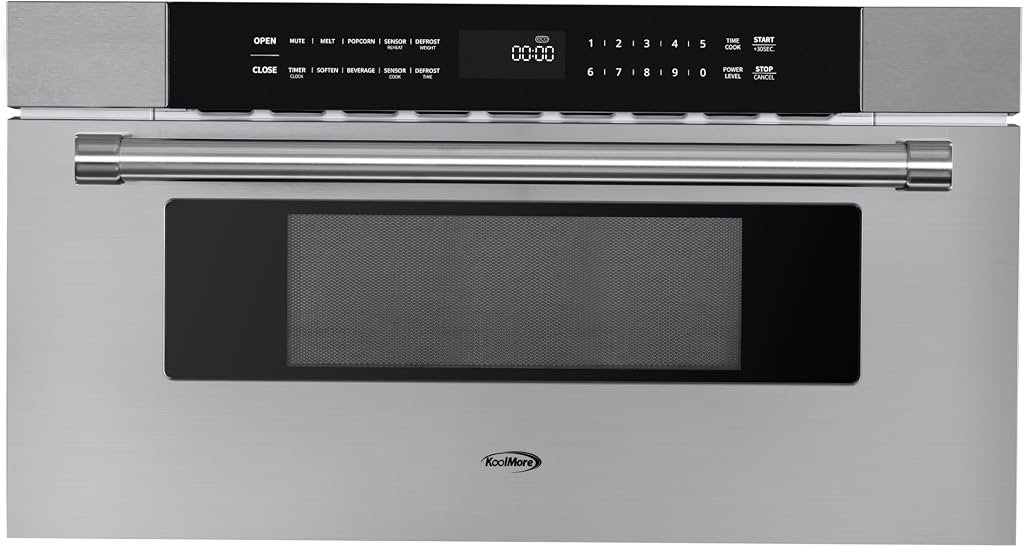
The KoolMore KM-MD30-SS Microwave Drawer sits in that more ambitious category. At $1,145, it is a substantial appliance purchase built around a multifunction proposition: microwave cooking, convection heating and air frying in one integrated unit, accompanied by sensor cooking, a soft-close door and a 1.6 cu. ft. capacity.
Our score is 8.14/10. Customer Sentiment stands at 7.84, Buyer Confidence reaches 9.27, and Value is 7.91. Those figures describe a product with a particularly strong purchasing case when its functions match the kitchen, but a less automatic value argument. A household seeking nothing more than rapid reheating has little reason to pay for several cooking technologies. A household trying to consolidate appliances has a different calculation.
The difference is fundamental. The KM-MD30-SS is not best understood as an expensive substitute for a countertop microwave. It makes more sense as a built-in cooking station whose usefulness depends on how often its broader capabilities are put to work.
Our Score: 8.14/10
An 8.14/10 overall score reflects a favorable assessment without ignoring the compromises attached to multifunction built-in appliances.
The central advantage is consolidation. Microwave energy handles rapid heating and reheating. Convection heat expands the appliance into baking and roasting territory. Air frying introduces another method for producing browned or crisp surfaces.
KoolMore’s current Reserve 24-inch built-in model using this same three-way concept is described by the manufacturer as a microwave, convection oven and air fryer capable of baking, broiling, roasting, crisping and reheating. That related Reserve model also uses sensor cooking and a soft-close door, illustrating how the company approaches multifunction built-in cooking.
Those functions are not merely different buttons for the same heating process. Microwave energy and convection heat operate differently, which affects texture, speed and the types of dishes each method handles well.
That distinction is the foundation of the KM-MD30-SS’s appeal. The appliance earns its space most convincingly when the owner needs more than microwave heating.
Why Three Cooking Methods Matter
Microwave ovens are extraordinarily efficient at one particular task: moving energy into food rapidly. They are less naturally suited to producing dry, browned exterior surfaces.
Convection cooking addresses a different requirement. Heated air circulates around food, allowing surface temperatures and cooking behavior more closely associated with conventional oven preparation. Air frying applies the same broad principle of heated air circulation with an emphasis on surface crisping.
The practical advantage is not that one technology is universally superior. It is that different foods benefit from different methods.
Soup needs no crisp crust. Leftover pizza often does. A beverage needs rapid heating; roasted vegetables require another approach. A casserole may benefit from microwave speed at one stage and dry heat at another.
That flexibility gives a 3-in-1 appliance a legitimate culinary purpose.
Yet multifunctionality can become expensive decoration when cooking habits do not match the feature set. Someone who reheats coffee and leftovers but never bakes, crisps or air-fries food is unlikely to extract the same return from the KM-MD30-SS as a household that regularly uses several cooking modes.
The first question is therefore behavioral rather than technical: how does the household actually cook?
The 1.6-Cubic-Foot Capacity Is More Meaningful Than a Headline Number
A 1.6 cu. ft. cavity places the KM-MD30-SS beyond the very small microwave category, but capacity figures require context.
Cubic footage measures volume. It does not describe the precise geometry of that volume.
A wide casserole dish can fail to fit inside a cavity that has sufficient theoretical volume. Tall cookware can encounter the same problem. For that reason, anyone considering an integrated appliance should compare interior measurements with the cookware already used at home.
KoolMore’s current 1.6 cu. ft. built-in convection models illustrate why detailed dimensions matter. The company’s related KM-CWO24-BSS, for example, lists a 14.17-inch turntable and a 16.54-by-16.54-inch interior footprint. Those dimensions are specific to that related model and should not be transferred to the KM-MD30-SS, but they demonstrate the type of measurement buyers should seek before committing cabinetry to an appliance.
The distinction matters more with a built-in appliance than with a countertop microwave. A poorly chosen countertop machine can be replaced with modest disruption. An integrated appliance can leave behind cabinetry tailored to its dimensions.
Capacity should therefore be tested conceptually against real plates, bowls and cookware before installation.
Buyer Confidence: 9.27
Buyer Confidence is the standout rating at 9.27.
That number reflects a product with a clearly identifiable use case. The KM-MD30-SS is not attempting to disguise what kind of buyer it requires. It makes the strongest sense for a household deliberately seeking built-in placement and several cooking methods in one appliance.
The high confidence rating does not mean every kitchen should accommodate one.
Built-in equipment imposes more preparation than portable equipment. Cabinet dimensions must match. Electrical requirements must be confirmed. Ventilation and clearances have to be respected. The position needs to remain comfortable during repeated daily use.
These requirements actually help explain the strong Buyer Confidence score. Once those questions have been answered, the purchasing decision becomes less ambiguous. A buyer either has an appropriate location and use for the appliance or does not.
The product’s functional identity is similarly clear. Microwave cooking, convection, air frying and sensor cooking serve distinct purposes rather than merely expanding the control panel.
That clarity supports confidence even when the price remains substantial.
Customer Sentiment: 7.84
Customer Sentiment is lower at 7.84.
The gap between 7.84 and the 9.27 Buyer Confidence score is informative because it separates the strength of the purchasing proposition from the realities of ownership.
A multifunction built-in appliance creates more expectations than a basic microwave. It needs to fit correctly, operate intuitively across several modes and justify the permanent cabinet space assigned to it.
Its everyday usefulness also depends heavily on habit.
Owners who regularly use convection and air frying can extract functionality that a microwave-only household cannot. Conversely, unused cooking modes represent money and complexity without corresponding practical benefit.
The 7.84 Customer Sentiment score remains favorable, but it keeps the overall assessment grounded. The KM-MD30-SS is a specialized answer to a particular kitchen problem rather than a universally rational replacement for a basic microwave.
That distinction should remain central throughout the purchasing process.
Value: 7.91
Value stands at 7.91, slightly below the overall 8.14 score and substantially below Buyer Confidence.
At $1,145, price is impossible to separate from the evaluation.
Basic microwave functionality can be purchased for far less. The KM-MD30-SS therefore cannot justify itself through reheating alone. Its economic argument depends on integration and consolidation.
A household that would otherwise purchase a separate microwave and air fryer, while also wanting convection capability, can assign genuine value to combining functions. The equation becomes even more favorable where countertop space is scarce.
The opposite scenario is equally straightforward. If the air-fry and convection functions are rarely used, the owner has effectively paid a premium for dormant capability.
Value also needs to include installation. Cabinet alterations, electrical work and professional fitting can raise the actual project cost beyond the $1,145 appliance price.
That explains why Value does not reach the level of Buyer Confidence. The KM-MD30-SS has a coherent purpose, but purpose and affordability are different questions.
Sensor Cooking Addresses a Real Microwave Problem
Sensor cooking is one of the more functionally interesting features because microwave heating is affected by variables that fixed cooking times cannot always accommodate neatly.
Food mass, starting temperature, water content, container material and geometry all influence heating behavior. A fixed two-minute program treats those variables as if they were constant.
Sensor systems attempt to respond to conditions during cooking rather than relying entirely on a predetermined duration.
KoolMore’s related Reserve 3-in-1 model uses temperature and humidity sensor controls and provides dedicated sensor cooking and sensor reheating functions.
The presence of sensor cooking on the KM-MD30-SS should not be converted into unsupported claims about exact temperature accuracy or perfect doneness. Sensors reduce one source of guesswork; they do not repeal the uneven-heating characteristics of microwave cooking.
For common reheating tasks, however, sensor control is more than a decorative specification. It attempts to address one of the oldest inconveniences of microwave use: estimating how long an unfamiliar quantity of food actually needs.
Microwave Power and Food Safety Are Different Questions
Fast heating should never be confused with uniform heating.
Microwave energy can create uneven temperature distribution, especially in dense foods or containers with irregular shapes. Heat must continue moving through portions of food after microwave energy has been absorbed nearer the surface.
The practical consequences are significant when reheating meat, poultry, casseroles and other foods where internal temperature matters.
The USDA advises that reheated leftovers reach 165°F throughout and recommends checking several locations with a food thermometer. It also advises covering food and rotating or stirring it during microwave reheating.
For frozen leftovers thawed in a microwave, USDA guidance says heating should continue until the food reaches 165°F, measured with a food thermometer.
These recommendations apply regardless of price or control sophistication.
Sensor cooking can automate part of the process, but a food thermometer remains the more meaningful instrument when safety depends on reaching a specific internal temperature.
Air Frying Changes the Value Equation
Air fryers became popular largely because they offer a countertop method of circulating hot air around food to encourage browning and crispness without conventional deep frying.
The KM-MD30-SS folds that capability into an appliance that already performs microwave and convection duties.
That integration can have a surprisingly practical consequence: fewer appliances competing for countertop space.
A standalone air fryer is not enormous in isolation. Neither is a toaster oven or countertop microwave. Put several together, however, and a kitchen work surface can begin resembling appliance storage rather than preparation space.
A built-in 3-in-1 appliance attempts to reverse that accumulation.
Its success depends on whether the consolidated machine can replace appliances the household would otherwise own. If a separate air fryer remains on the counter because it is preferred for everyday use, part of the KM-MD30-SS’s spatial argument disappears.
This is why purchasing decisions should be grounded in existing habits rather than imagined future behavior.
An appliance does not save space merely because it can replace another appliance. It saves space when the household actually removes the other appliance.
The Soft-Close Door Is a Small Feature With Daily Consequences
Soft-close doors rarely dominate appliance comparisons, but repeated physical interactions deserve more attention than specification sheets usually give them.
A door can be opened several times during one meal. Over years of ownership, that creates thousands of interactions.
A soft-close mechanism changes the final part of that motion, reducing the abrupt slam associated with conventional hinges or drawers. The benefit is experiential rather than culinary.
No durability assumption should be attached to the feature without long-term mechanical evidence. Additional mechanisms can themselves require service eventually.
Yet daily usability is built from precisely these small interactions. Controls, door movement, display visibility and access height may influence satisfaction more often than specialized cooking programs.
The soft-close feature therefore belongs in the evaluation, but not because it changes cooking performance. It changes ownership experience.
Built-In Ergonomics Demand Careful Planning
Integrated cooking equipment creates an ergonomic question that portable appliances often avoid.
Once cabinetry is finished, moving the appliance is difficult.
Installation height therefore deserves serious attention. A position that appears visually balanced on a kitchen drawing may feel uncomfortable when someone repeatedly handles hot cookware.
The National Kitchen & Bath Association recommends at least a 15-inch landing area above, below or adjacent to the handle side of a microwave. That recommendation addresses an easily overlooked part of microwave use: the dish has to go somewhere immediately after leaving the oven.
Traffic matters too. NKBA safety guidance advises thinking about how people move through the kitchen and locating microwaves to avoid awkward reaching when retrieving food.
These recommendations become more consequential with a permanent built-in appliance.
A kitchen can be visually orderly and functionally awkward at the same time. The test is not how the installation photographs but how someone behaves while carrying a hot, heavy container.
What Buyers Should Measure Before Ordering
The installation process deserves the same scrutiny as the cooking functions.
Before ordering, buyers should establish:
- The exact manufacturer-required cabinet cutout dimensions for the model being purchased.
- Available cabinet depth, width and height.
- Required front, rear and side clearances.
- Electrical voltage, amperage, receptacle and plug requirements.
- Ventilation provisions.
- Door or drawer clearance when fully open.
- Nearby landing space for hot cookware.
- The height at which regular users will load and unload food.
- Access for future servicing or replacement.
Nominal product width is not a substitute for installation dimensions.
KoolMore’s current built-in models demonstrate how much these numbers can differ. Its related 1.6 cu. ft. KM-CWO24-BSS lists appliance dimensions separately from a 22.06-inch-wide, 21.63-inch-deep and 18.13-inch-high cabinet cutout. Those measurements belong to that specific related model, but the distinction illustrates why buyers need documentation for the exact appliance being installed.
Cabinetry should never be cut using assumptions derived from a marketing description.
A Microwave Buying Guide Should Start With Use, Not Features
A useful microwave buying guide for this category starts with a simple inventory of household behavior.
How often is the microwave used? Is a separate air fryer already used regularly? Does the household bake or roast small quantities often enough to benefit from convection capability? Is countertop space scarce? Is a kitchen renovation already underway?
Those questions expose whether a multifunction built-in appliance solves an existing problem or merely introduces additional capability.
Next comes physical compatibility.
The buyer should measure the intended location, inspect electrical requirements, check access height and identify a landing area. Only after those issues are settled should secondary interface details dominate the comparison.
This sequence prevents a common appliance-buying mistake: choosing features first and discovering installation realities later.
The KM-MD30-SS is particularly sensitive to this discipline because its value comes from combining capabilities. Every unused function weakens the economic argument. Every function that genuinely replaces another appliance strengthens it.
Energy Standards Add Another Layer to Ownership
Microwave ovens are also regulated for energy efficiency in the United States.
The U.S. Department of Energy states that amended microwave energy-conservation standards established by its 2023 final rule require compliance for covered microwave ovens manufactured and distributed in commerce on and after June 22, 2026.
That regulatory fact should not be mistaken for a product-specific electricity estimate. It establishes the framework under which covered appliances are regulated, not the KM-MD30-SS’s measured annual consumption.
Operating cost for a multifunction appliance is also more complicated than microwave wattage alone suggests. Microwave heating, convection operation and air frying use different heating mechanisms and can run for different durations.
The more useful comparison is therefore task-specific. Heating soup for three minutes is a different energy event from convection-baking food for half an hour.
Anyone concerned about lifetime electricity cost should rely on model-specific technical documentation and actual cooking patterns rather than extrapolating from one headline wattage figure.
The Case for Appliance Consolidation
The strongest strategic argument for the KM-MD30-SS is consolidation.
Modern kitchens accumulate machines. Microwave. Air fryer. Toaster oven. Blender. Coffee maker. Mixer. Each may solve a legitimate problem, but each also consumes physical space.
Built-in multifunction appliances attack that problem by combining several jobs behind one façade.
The benefits can extend beyond aesthetics. Counter space is working space. Clearing appliances can create additional room for chopping, mixing, plating and handling hot cookware.
Consolidation can also simplify electrical demand at countertop receptacles by reducing the number of portable high-wattage cooking appliances competing for convenient locations.
But consolidation only works when replacement is genuine.
If a household installs a 3-in-1 appliance and keeps the existing microwave and air fryer in active service, the spatial return is minimal. The purchase has added capacity rather than consolidated it.
That may still be desirable, but it is a different value proposition.
Who Should Consider the KM-MD30-SS?
The strongest buyer profile is a homeowner already planning an integrated kitchen and intending to use multiple cooking modes.
A remodel provides particularly favorable circumstances because cabinetry and electrical work can be coordinated before surfaces are finished. Installation becomes part of the project rather than an intervention into completed cabinetry.
The product can also make sense in kitchens where countertop space carries a premium. If the built-in unit genuinely replaces a microwave and standalone air fryer, the recovered work surface can be meaningful.
Households cooking smaller portions may also appreciate having convection capability without using a larger conventional oven for every task.
The weaker buyer profile is almost the reverse.
Someone needing only microwave reheating can achieve that objective for far less money. Renters receive little benefit from permanent integration. Households already satisfied with dedicated countertop appliances may find that consolidation sounds better in theory than in daily practice.
The $1,145 price makes those distinctions difficult to ignore.
Serviceability and Future Replacement Matter
Built-in appliances create a long-tail ownership question that receives surprisingly little attention: what happens when the appliance eventually needs replacement?
Countertop equipment makes that problem easy. Remove one appliance and put another in its place.
Built-in equipment is constrained by cabinetry.
Future models may use different cutout dimensions. Electrical requirements can change. Trim arrangements may differ. An exact replacement might no longer exist when the original unit reaches the end of its service life.
Buyers can reduce that risk by keeping installation documents, recording the finished cabinet opening and avoiding unnecessary cabinet alterations that make the opening unusually model-specific.
Service access matters for the same reason. An integrated appliance that is difficult to remove can make routine repair more labor-intensive.
The purchase decision should therefore extend beyond day-one appearance. Built-in appliances become part of the kitchen’s physical infrastructure.
Final Considerations
The KoolMore KM-MD30-SS Microwave Drawer earns our 8.14/10 score because it presents a coherent multifunction proposition: microwave speed, convection capability, air frying, sensor cooking and integrated installation in one appliance.
The ratings reveal where that proposition is strongest. Buyer Confidence reaches 9.27, considerably above Customer Sentiment at 7.84 and Value at 7.91. That distribution describes a product whose purpose is easier to defend than its economics for every household.
At $1,145, it is not a rational purchase merely because someone needs a microwave. The price requires a broader justification.
That justification becomes credible when the appliance replaces several pieces of equipment, recovers useful countertop space or fits naturally into a kitchen renovation already designed around built-in cooking. It becomes weaker when convection and air frying remain unused or when installation requires disproportionate cabinetry and electrical work.
The 1.6 cu. ft. capacity adds practical flexibility, while sensor cooking addresses some of the guesswork inherent in microwave preparation. The soft-close mechanism improves a repeated physical interaction. Air frying and convection expand the types of food the appliance can reasonably tackle.
None of those features eliminates the need for careful planning.
The buyer should measure the installation area, verify current specifications for the exact model, confirm electrical requirements, check door or drawer clearance, evaluate user height and preserve nearby landing space. Cooking habits deserve the same scrutiny: an existing air fryer that will never be retired weakens the consolidation argument immediately.
That is ultimately where the KM-MD30-SS separates itself from a conventional microwave. Its value is not located in one specification. It emerges from whether several functions, one cabinet opening and a $1,145 expenditure align with the way a household actually cooks.
For the right kitchen, that alignment can make the appliance a logical piece of infrastructure rather than another gadget. For a household interested almost exclusively in reheating, the same machine carries capability that may spend much of its life unused. The difference between those two situations explains both the strong 9.27 Buyer Confidence rating and the more restrained 7.91 Value score—and it is the distinction that should guide the purchase.