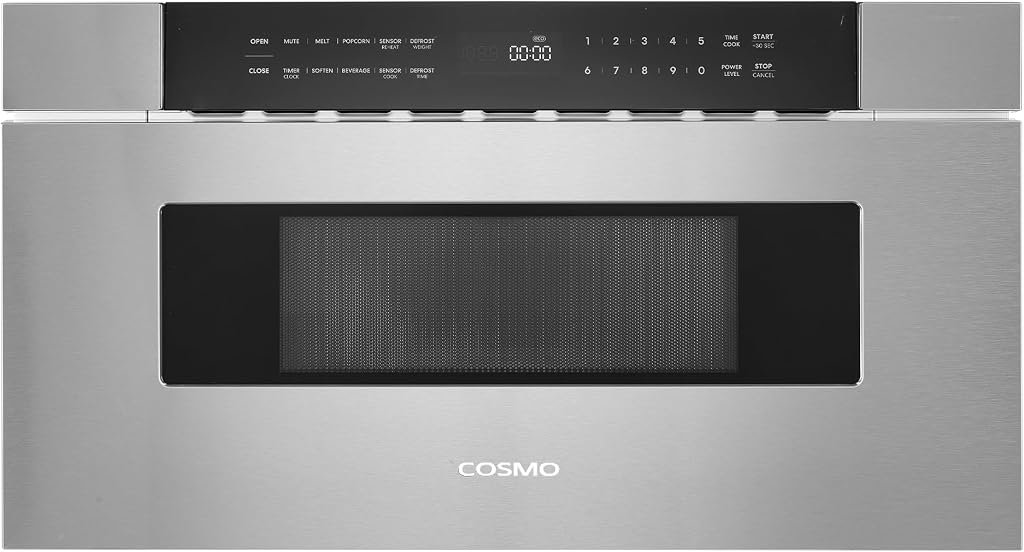
Built-in microwave drawers solve a problem that conventional microwaves often create: where to put a bulky appliance without surrendering useful counter space or placing a hot-food handling point at an awkward height. The Haven Coll 1.2 cu. ft. Built-In Microwave Drawer enters that category at $1,249.99, positioning itself as a substantial kitchen purchase rather than an inexpensive countertop appliance.
Our score is 8.58/10. Customer Sentiment stands at 8.72, Buyer Confidence at 8.43, and Value at 8.4. Those numbers describe a product with a persuasive overall proposition but also a meaningful price hurdle. The slightly lower Value rating is particularly revealing. A microwave drawer can improve kitchen layout and preserve countertop area, yet its economics are fundamentally different from those of a conventional microwave that can simply be placed on a counter and plugged in.
That distinction should guide the entire purchasing decision. This is less a question of whether a microwave can reheat leftovers and more a question of whether a built-in drawer is the right piece of kitchen architecture.
A Microwave That Is Also a Cabinetry Decision
A conventional countertop microwave is essentially furniture-independent. Give it adequate space, ventilation and electrical service, and it can usually be relocated without remodeling anything.
A built-in microwave drawer belongs to a different category of commitment.
Its location becomes part of the cabinetry plan. The appliance sits below the counter rather than consuming work-surface space or hanging above a range. That arrangement changes how users load food, observe containers and retrieve hot dishes. It can also change the visual hierarchy of the kitchen because the microwave no longer dominates a countertop or upper wall.
That is one reason the $1,249.99 price should not be interpreted in isolation. A purchaser is paying for an appliance format as much as for microwave heating itself.
The National Kitchen & Bath Association has previously identified insufficient counter space as a major consumer complaint and specifically cited under-counter microwave installation as one method of recovering that space. Its guidance also describes a microwave drawer as ergonomic for users of different sizes and mobility levels.
That does not mean lower placement is automatically better for everyone. Ergonomics are personal, and repeated bending can be inconvenient for some users. The point is that the drawer configuration changes the physical interaction with the appliance enough that buyers should evaluate placement before evaluating cosmetic details.
What the 1.2-Cubic-Foot Capacity Means
The Haven Coll is identified here as a 1.2 cu. ft. built-in microwave drawer. Capacity figures deserve careful interpretation because cubic footage is an internal-volume measurement, not a guarantee that every oversized dish will fit.
Two microwave cavities with similar published capacities can differ in useful width, depth and vertical clearance. A buyer who regularly reheats food in a particular casserole, mixing bowl or tall container should therefore treat 1.2 cubic feet as an initial screening figure rather than the final fit test.
This distinction becomes more consequential with a built-in product. A countertop microwave that proves inconvenient can be replaced with relatively little disruption. A drawer integrated into cabinetry creates greater switching friction.
Before ordering, buyers should verify:
- Overall appliance dimensions and required cabinet cutout dimensions.
- Interior cavity dimensions rather than relying solely on cubic-foot capacity.
- Electrical requirements and outlet location.
- Required clearances and ventilation instructions.
- Maximum container height with the drawer closed.
- Whether existing cabinetry requires structural modification.
- Installation requirements and whether professional fitting is recommended.
- Warranty coverage, parts availability and service arrangements for the buyer’s location.
These are not peripheral details. They determine whether a built-in appliance is compatible with the kitchen in which it will spend its working life.
The Ergonomic Case for a Microwave Drawer
The physical logic of the drawer is easy to understand. Instead of opening a hinged door and reaching into a cavity positioned at chest, shoulder or head level, the user accesses the food from above.
That can be particularly appealing on an island or peninsula, where an upper-cabinet microwave would be structurally awkward. It can also keep the appliance away from the primary visual field.
Kitchen-planning guidance adds useful context. The National Kitchen & Bath Association recommends choosing microwave placement according to the user’s height and abilities. Its published guideline says the ideal bottom of a microwave is 3 inches below the principal user’s shoulder and no more than 54 inches above the floor. For a microwave below a countertop, the guideline specifies that the oven bottom should be at least 15 inches above the finished floor.
Those measurements illustrate why installation should be treated as an ergonomic exercise rather than a simple cabinet-cutting job.
A household with tall adults may perceive a low drawer differently from a household that includes a wheelchair user, shorter adults or children. A person with limited ability to bend may prefer a higher installation. Conversely, moving a heavy bowl downward rather than lifting it toward an elevated microwave can alter the handling equation.
The drawer arrangement also changes visibility. Users can look down into containers rather than reaching forward into a horizontal cavity. For dishes containing hot liquids, that difference deserves consideration during kitchen planning.
None of this establishes that a drawer is universally safer or more comfortable. It establishes something more useful: installation height is part of appliance performance because poor placement can make an otherwise capable appliance irritating every day.
Counter Space Has Economic Value Too
Microwave comparisons often reduce value to cooking power, capacity and purchase price. That approach understates the reason built-in drawers exist.
Countertop area is finite.
A microwave sitting on a work surface consumes space continuously even though its active cooking time may amount to only a small portion of the day. Moving the microwave into cabinetry returns that surface to food preparation, small appliances or simply empty workspace.
The National Kitchen & Bath Association’s discussion of kitchen organization explicitly recommends under-counter microwave placement as one way of maximizing counter space.
That matters most in kitchens where work surface is scarce. In a large kitchen with several uninterrupted countertop runs, reclaiming a few square feet may have modest practical impact. In a compact kitchen, the same area can materially change preparation space.
This is where the Haven Coll’s Value score of 8.4 needs context. At $1,249.99, the appliance cannot compete with ordinary countertop microwaves on acquisition cost alone. Its value proposition depends on assigning economic and functional value to integration, space recovery and the drawer configuration.
A buyer who merely needs a machine for reheating coffee and leftovers is paying for architectural advantages that may go largely unused. A buyer already redesigning cabinetry faces a different calculation because the microwave can be planned into the room from the beginning.
Our Score: 8.58/10
An 8.58/10 overall rating places the Haven Coll in a strong editorial position without erasing the compromises inherent in the format.
The strongest part of the proposition is not novelty. Microwave drawers have existed long enough to be an established kitchen format. An NKBA kitchen-design trends report published in 2020, using survey data from 94 respondents in the transitional-kitchen segment, reported microwave drawers at 60% among the listed “other cooking” selections. That figure should not be read as household market share; it reflects the particular design-professional survey and style category. It nevertheless demonstrates that microwave drawers were already familiar elements in professional kitchen planning rather than an experimental appliance concept.
The Haven Coll’s score therefore reflects a mature use case: removing the microwave from the counter and integrating it into lower cabinetry.
Its weaker point is economic. At more than twelve hundred dollars before any installation-related expense, the appliance needs a household that values the format. That explains why the 8.4 Value score trails the 8.58 overall score and 8.72 Customer Sentiment score.
The difference is small but meaningful. Satisfaction with the concept and willingness to pay for it are not identical measurements.
Customer Sentiment: 8.72
Customer Sentiment is the highest of our four headline measures at 8.72.
For editorial purposes, that score indicates that the ownership proposition resonates strongly once buyers have chosen this appliance class. A drawer microwave is rarely an accidental purchase. Price, installation format and cabinet integration create several decision points before the appliance reaches the kitchen.
The score should not be converted into assumptions about specific heating characteristics that have not been independently measured. It does, however, support a broader interpretation: the product concept appears to align well with the expectations of its intended buyer.
That intended buyer is likely to care about integration at least as much as raw appliance cost.
A renter, student or homeowner seeking the lowest-cost microwave solution sits outside that profile. So does a household unwilling to alter cabinetry. A homeowner remodeling a kitchen, replacing an existing compatible drawer or trying to remove a microwave from a crowded counter is much closer to the center of the product’s appeal.
Buyer Confidence: 8.43
Buyer Confidence is 8.43, lower than Customer Sentiment and the overall 8.58 score.
That gap is worth examining because built-in appliances impose risks that portable appliances largely avoid.
Compatibility is one. Installation is another. Serviceability is a third.
If a countertop microwave fails, replacement may involve carrying the old unit away and putting another one in its place. If a built-in microwave drawer fails years after installation, the replacement has to coexist with a cabinet opening designed around the previous appliance.
The practical question therefore extends beyond “Will this microwave work in this kitchen today?” It includes “How difficult will replacement be later?”
This is why exact cutout measurements belong near the beginning of any microwave buying guide dealing with built-in appliances. Buyers should retain installation documentation and record the finished opening dimensions. That information can become surprisingly useful when the appliance eventually needs repair or replacement.
An 8.43 Buyer Confidence score is still strong. It simply sits in the appropriate relationship to a product that asks for more planning than a portable microwave.
Value: 8.4
The Haven Coll’s 8.4 Value rating requires the most disciplined interpretation.
At $1,249.99, the purchase price is substantial for an appliance whose central cooking mechanism performs a task available from far less expensive microwave formats. The justification lies elsewhere: cabinet integration, recovered countertop space and drawer access.
Those benefits can be economically rational in the right project.
Consider a kitchen renovation where cabinetry, stonework, electrical work and appliance placement are already being coordinated. Installing a microwave drawer during that process can be less disruptive than attempting to retrofit one after the kitchen is finished. Conversely, buying the appliance solely to replace a functioning countertop microwave can create additional costs beyond the purchase price.
Value therefore depends heavily on project timing.
The 8.4 rating recognizes that the Haven Coll can make sense as part of an integrated kitchen plan while refusing to treat premium placement as free. Buyers should calculate the entire installed cost, not merely the checkout price.
Energy Consumption Deserves a More Careful Reading
Microwave energy discussions often focus on the short periods during which food is actually heating, but standby consumption has historically mattered because the appliance remains connected around the clock.
The U.S. Department of Energy once illustrated the imbalance neatly: a typical microwave was estimated to heat food for roughly 70 hours per year while remaining connected for the other 8,690 hours to support electronic controls and displays. That figure comes from a 2013 DOE discussion of microwave efficiency standards and describes the usage assumptions relevant to that period, rather than a measurement of the Haven Coll itself.
DOE defines standby power as electricity consumed when equipment is plugged into mains power while operating in its lowest-power state. Its measurement guidance references IEC 62301 procedures for assessing appliance standby consumption.
Current U.S. regulation also provides context. DOE states that manufacturers have been subject to microwave energy-conservation standards since 2016, with amended standards requiring compliance for covered products manufactured and distributed in commerce on and after June 22, 2026.
No product-specific energy-consumption figure should be inferred from those regulations. They explain the regulatory environment, not the Haven Coll’s measured electricity use.
For buyers comparing operating costs, a model-specific standby-power figure from technical documentation is more useful than assumptions derived from wattage labels or historical industry averages.
Where the Haven Coll Makes the Most Sense
The strongest case for this microwave is a planned kitchen in which counter space, sight lines and appliance placement have already been considered.
An island installation is an obvious example. A drawer allows the microwave to live below the worktop without requiring an upper cabinet or sacrificing the visual openness that often motivates an island in the first place.
It also makes sense where a conventional over-the-range microwave is undesirable because ventilation is being handled separately. Separating microwave placement from the cooking surface gives the kitchen designer more freedom to locate each appliance according to its actual function.
There is a subtler benefit as well: microwaves are frequently used by more than one person while other cooking is taking place. Moving one away from the range can potentially reduce congestion around the main cooking zone, provided the drawer itself is not positioned in a major traffic path.
The NKBA’s safety guidance recommends considering traffic flow and placing microwaves conveniently so users can retrieve food without awkward reaching.
Placement, once again, determines whether the design advantage survives contact with everyday life.
Where It Makes Less Sense
The Haven Coll becomes harder to justify when the household has abundant counter space, minimal microwave usage or no desire to modify cabinetry.
Price is the obvious obstacle, but permanence is equally relevant.
A freestanding microwave offers flexibility. It can move to another counter, accompany a household to another property or be replaced with a differently sized appliance. A built-in drawer trades some of that flexibility for integration.
That trade becomes more consequential in rental properties, short-term renovations and kitchens likely to be reconfigured soon.
Physical preference matters too. Anyone who dislikes bending toward lower cabinetry should experience a drawer microwave at a showroom or appliance retailer before committing. Published ergonomic guidelines can establish reasonable placement boundaries, but they cannot reproduce an individual’s height, reach, mobility or habits.
A microwave drawer should feel natural during repeated use, not merely look orderly when closed.
The Case for Careful Installation
A premium built-in appliance can be undermined by mediocre installation.
Cabinet openings need to correspond to manufacturer requirements. Electrical connections need to satisfy the applicable instructions and local requirements. Surrounding cabinetry needs to accommodate the appliance correctly rather than forcing the unit into a nominally similar opening.
This is one area where measuring twice is not a cliché but a cost-control measure.
The buyer should compare the manufacturer’s installation diagram against the actual cabinet opening before ordering. Width alone is insufficient. Height, depth, electrical access and required clearances all matter.
For replacement installations, existing trim can also create false confidence. Two appliance fronts may appear similar while their chassis or cutout requirements differ.
The National Kitchen & Bath Association’s current planning framework treats equipment location, clearances, accessible design, energy conservation and human comfort as connected parts of kitchen planning rather than isolated decisions.
That approach is particularly appropriate for microwave drawers because the appliance literally becomes part of the cabinet layout.
A More Useful Microwave Buying Guide
For shoppers comparing microwave formats, the first question should not be “Which microwave has the most features?” It should be “Where should the microwave live?”
If the answer is the countertop, a drawer is unnecessary. If the answer is above the range, ventilation and mounting become central. If the goal is to preserve both counter area and upper-wall space, a built-in drawer becomes far more relevant.
Capacity follows placement. Installation requirements follow capacity. Only then should controls, cooking modes and secondary conveniences dominate the comparison.
For the Haven Coll specifically, the 1.2 cu. ft. capacity, $1,249.99 price and built-in drawer configuration establish the purchasing framework. The appliance is not competing solely for the title of microwave. It is competing for permanent cabinet space.
That cabinet space has a cost, but so does the counter area that the drawer frees.
Final Considerations
The Haven Coll 1.2 cu. ft. Built-In Microwave Drawer earns our 8.58/10 score because its proposition is coherent: integrate microwave functionality into lower cabinetry, preserve countertop space and provide drawer-style access in kitchens where those characteristics have practical value.
Customer Sentiment at 8.72 is the strongest component of the rating profile. Buyer Confidence at 8.43 remains favorable while acknowledging the additional planning inherent in a built-in appliance. Value at 8.4 reflects the clearest compromise. At $1,249.99, this is a considered kitchen investment rather than a low-cost route to microwave cooking.
Its best buyer is therefore not simply someone who needs a microwave. It is someone whose kitchen benefits materially from a microwave drawer.
That difference should control the purchasing decision.
A buyer already planning cabinetry, trying to recover counter space or seeking an under-counter appliance layout has a credible reason to place the Haven Coll on the shortlist. A buyer primarily concerned with inexpensive reheating has little reason to absorb the added cost and installation commitment.
The most sensible pre-purchase exercise is physical rather than theoretical: measure the cabinet, measure frequently used dishes, examine the intended installation height, verify electrical and clearance requirements, and calculate the installed cost. Those checks reveal more about long-term suitability than a long inventory of secondary features.
The Haven Coll’s appeal ultimately rests on spatial efficiency. Microwave technology is only half of what the purchaser is buying. The other half is a decision about how the kitchen should work when the appliance is not running-which, as historical DOE usage estimates illustrate, is nearly all of the time.