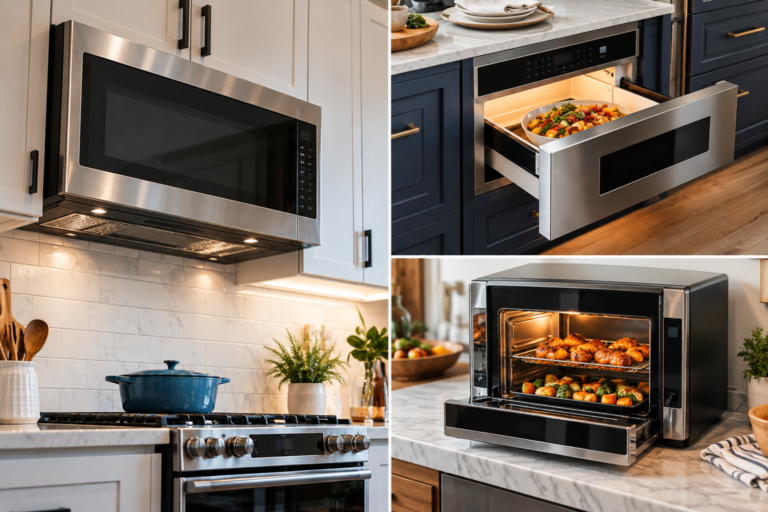
The microwave drawer solves a peculiar kitchen-design problem. A conventional microwave is useful enough to earn permanent space, yet bulky enough that many homeowners would prefer not to see it. Put it on the counter and it consumes work surface. Hang it above the range and it becomes part appliance, part ventilation system, with compromises attached to both jobs. Build a conventional unit into a lower cabinet and its side-hinged door can make access awkward.
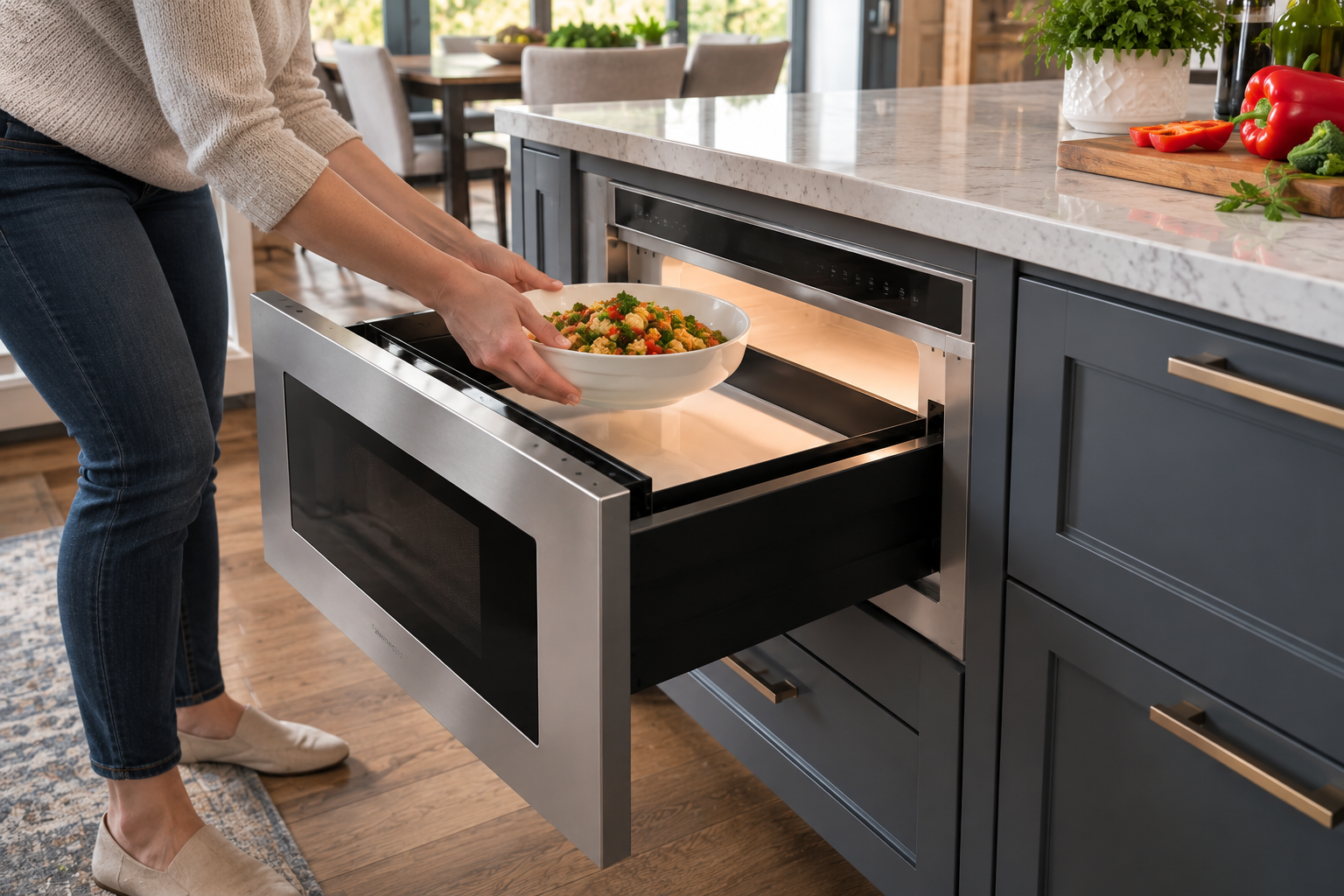
A microwave drawer changes the geometry rather than the cooking principle. Instead of opening a door toward the user, the cooking cavity slides horizontally out of a base cabinet. Food is lowered into the cavity from above, the drawer closes, and microwave energy does the same basic work it performs in a conventional machine.
That seemingly modest mechanical change affects cabinet planning, accessibility, cleaning, cost and everyday handling. It also explains why microwave drawers can make considerable sense in some kitchens while being an expensive answer to a problem other kitchens do not have.
For buyers working through a microwave buying guide, the central question is therefore not whether drawer microwaves look cleaner. They generally do. The harder question is whether their spatial and ergonomic advantages justify their price, installation requirements and limitations.
How a Microwave Drawer Actually Differs
The cooking technology itself is familiar. The U.S. Food and Drug Administration explains that microwave ovens use a magnetron to produce microwaves, which interact with food and generate heat. The agency describes microwaves as non-ionizing radiation and states that ovens meeting its standard and operated according to manufacturer instructions are considered safe.
The difference is primarily architectural.
A countertop microwave is an appliance placed in the kitchen. A drawer microwave is closer to being part of the kitchen. It is normally installed below the countertop in an island, peninsula or base cabinet. Some configurations can also place one beneath a wall oven.
That distinction has practical consequences. A built-in appliance must fit not merely the visible opening but the cabinet cavity behind it, with adequate structural support, electrical access and clearances.
Consider a current 24-inch Sharp installation. Its installation documentation specifies a 24-inch minimum cabinet, a 23½-inch minimum cabinet depth and a floor capable of supporting 100 pounds. The same documentation specifies a 22⅛-inch opening width and shows a 15-inch automatic drawer opening.
Those measurements illustrate why buying the appliance before verifying cabinetry can become an expensive ordering error.
Pro: It Frees Counter and Upper-Cabinet Space
The most obvious advantage is also one of the strongest.
A microwave drawer removes a sizable appliance from the countertop without consuming an upper cabinet at eye level. In a compact kitchen, reclaiming that counter area can materially improve the preparation zone. In a larger kitchen, the benefit is often visual: long runs of backsplash and cabinetry remain uninterrupted.
This matters particularly on an island. A conventional microwave installed at the end of an island can look conspicuously like a countertop appliance placed inside a hole. A drawer is purpose-built for lower cabinetry.
Consumer Reports senior market analyst Mark Allwood summarized the appeal succinctly: “People buy them because they offer a sleeker, cleaner look for the kitchen.”
That aesthetic benefit should not be dismissed as vanity. Kitchen design is partly an exercise in managing sightlines and work zones. An appliance that can sit near the food-preparation area without occupying the preparation surface has a legitimate functional advantage.
Pro: Loading From Above Can Be Easier
The drawer format changes how hot food is handled.
With an over-the-range microwave, a user may have to lift a hot bowl toward shoulder or eye level and then lower it again after heating. Spilled liquid at that height is especially undesirable.
With a microwave drawer, the food remains below the counter. The user looks downward into the cavity and lifts the container vertically when removing it.
That arrangement can be particularly useful with heavy bowls and casserole dishes. Current 24-inch Sharp drawer models, for example, have a 1.2-cubic-foot cavity and are specified to accommodate a four-quart casserole dish or a 20-ounce beverage.
There is another subtle benefit: food can often be inspected or stirred while remaining inside the open drawer. With a conventional microwave installed unusually low in a base cabinet, the user may have to crouch and pull the dish outward to inspect it.
Still, “more ergonomic” should not be treated as a universal verdict. A low appliance can be easier for one person and harder for another. Someone with difficulty bending, reaching downward or lifting upward from below waist level may prefer a microwave positioned higher.
The sensible test is remarkably low-tech: before ordering, stand in front of a base cabinet at the intended location and simulate removing a full, hot bowl with both hands.
Pro: Islands Become More Functional
Kitchen islands frequently create the strongest case for microwave drawers.
An island can contain preparation space, storage, seating, electrical outlets and appliances without filling the primary wall with equipment. Placing the microwave near the food-preparation zone can also reduce unnecessary movement across the kitchen.
Manufacturers explicitly design drawers around this use. Sharp specifies installation below islands, peninsulas and standard cabinetry for current models.
The location can also separate microwave traffic from the primary cooking zone. In a household where one person is reheating lunch while another is working at the range, that separation may reduce collisions.
But location matters more than the appliance category. Installing a drawer directly in the standing path of an island seat, dishwasher or major walkway can create a different problem: an open horizontal drawer projecting into traffic.
A floor plan should therefore be evaluated with the drawer shown open, not merely closed.
Pro: Motorized Operation Can Reduce Door Handling
Many drawer models use powered opening and closing rather than requiring the user to pull a heavy hinged door.
For example, Sharp’s SMD2470 series uses an automatic drawer system, while the control panel tilts to a 45-degree angle when exposed.
This arrangement addresses two potential weaknesses of under-counter appliances: reaching down to operate controls and manually pulling open a heavy mechanism.
Some models also add touchless opening or other automated controls. Such features can be convenient when hands are occupied or dirty, though they should be regarded as convenience features rather than reasons by themselves to select a microwave.
Mechanical sophistication also has another side: a powered drawer introduces moving components absent from a basic hinged-door countertop machine.
Con: Microwave Drawers Cost Considerably More
Price is the most difficult disadvantage to ignore.
Current manufacturer pricing illustrates the scale of the difference. Sharp lists its 24-inch, 1.2-cubic-foot, 950-watt SMD2470ASY drawer at an MSRP of $1,899.99, with a current direct price of $1,499.99. The 30-inch SMD3070ASY carries a $1,999.99 MSRP and a current direct price of $1,599.99.
On the same manufacturer’s catalog, a 1.1-cubic-foot, 1,000-watt countertop model is listed at $139.99.
Those products are not direct equivalents in construction or installation, but the comparison exposes the central economics: the drawer format carries a substantial premium.
And appliance price is only the beginning.
A remodel may require cabinet modification, electrical work, finish carpentry or a new cabinet altogether. A purpose-built pedestal accessory can add further expense; Sharp currently lists one compatible 24-inch under-counter pedestal at an $999.99 MSRP and an $799.99 direct price.
For a new kitchen already receiving custom cabinetry, those costs can be incorporated into the design. Retrofitting an existing kitchen is less forgiving.
Con: 30 Inches of Exterior Width Does Not Necessarily Mean More Cooking Space
Width deserves unusually close attention.
Consumers may reasonably assume that moving from a 24-inch to a 30-inch microwave drawer produces a substantially larger cooking cavity. That assumption can fail.
Sharp’s current 24-inch SMD2470ASY and 30-inch SMD3070ASY are both rated at 1.2 cubic feet and 950 watts.
In that case, six additional inches of nominal appliance width do not buy additional stated cavity volume or microwave output.
The 30-inch version can still make architectural sense. It may align with a 30-inch wall oven, cooktop or cabinet module and therefore create more coherent proportions. But that is a design benefit, not extra cooking capacity.
Buyers should compare internal capacity, usable dish dimensions and power rather than treating exterior width as a proxy for performance.
Con: The Low Position Is Not Universally Accessible
Under-counter placement changes who can comfortably use the appliance.
Children may find a drawer microwave easier to reach than an over-the-range unit. For households with young children, that makes control-lock functionality especially relevant. Current Sharp drawer models include a control-lock setting intended to prevent accidental operation.
Adults with limited mobility present a more nuanced case. A wheelchair user may find an appropriately positioned drawer easier to approach than an over-the-range microwave, while someone who has difficulty bending or lifting from a low position may prefer counter height.
There is no meaningful universal claim that a drawer is inherently more accessible. Accessibility depends on installation height, reach range, control design, the user’s mobility and the surrounding cabinetry.
This is one purchase where showroom testing can reveal more than another hour of specification-sheet reading.
Con: Cleaning Is Different, Not Eliminated
Drawer construction can make the bottom of the cavity easy to see and wipe because it is exposed when the drawer opens. That is useful after splashes and crumbs.
The ceiling is another matter.
A user cannot simply stand in front of an open side-hinged microwave and look directly at every interior surface. Cleaning the upper interior of a low drawer may require bending and reaching into the cavity.
Food spills also deserve consideration because the appliance moves. A nearly full bowl of soup or sauce can theoretically slosh as the drawer begins moving. Motorized mechanisms generally move more smoothly than a manually yanked kitchen drawer, but liquid should still be given adequate headroom.
The format changes the cleaning problem; it does not abolish it.
Con: Installation Errors Can Be Expensive
A countertop microwave can be replaced in minutes. A built-in drawer is tied to cabinet dimensions and electrical placement.
The manufacturer’s installation drawings should therefore be treated as construction documents rather than optional reading.
For the 24-inch Sharp example, the installation guide specifies not only opening dimensions and minimum depth but an anti-tip block and defined electrical-outlet placement. It also instructs installers to allow sufficient power-cord length so that the cord is not under tension.
That level of specificity explains why a nominal “24-inch microwave drawer” should not automatically be assumed to fit every 24-inch opening.
Before purchase, record:
- Exact cabinet opening width, height and depth
- Countertop overhang
- Adjacent drawer and door clearances
- Electrical outlet position and circuit requirements
- Appliance depth, including plug and cord clearance
- Required ventilation or airflow provisions
- Full open-drawer projection into the aisle
- Cabinet support requirements
- Compatibility with a wall oven or cooktop above, if applicable
The last point is particularly significant. Compatibility should be confirmed from the installation instructions for both appliances, not inferred because the dimensions appear to work on paper.
What About Microwave Radiation?
Drawer orientation does not alter the basic regulatory framework governing microwave ovens.
The FDA has regulated microwave-oven manufacturing since 1971. Federal requirements limit microwave leakage throughout an oven’s lifetime to 5 milliwatts per square centimeter measured approximately two inches from the oven surface. The FDA says this limit is “far below the level known to harm people.”
The standard also requires two independent interlock systems that stop microwave production when the latch is released or the door opens, plus a monitoring system addressing interlock failure.
The agency further reports that most microwave-related injuries involve heat: hot containers, overheated food or exploding liquids. Radiation injuries have been very rare and have generally involved unusual circumstances or improper servicing.
For owners of any microwave style, physical condition matters. A unit with damaged hinges, latches, seals or a door that does not close properly should not continue in normal use pending manufacturer guidance.
In other words, the drawer configuration should be evaluated primarily on kitchen design, usability and cost-not fear of microwave radiation.
Wattage and Capacity Still Matter
A handsome built-in appliance remains a cooking appliance.
Two numbers deserve attention: output wattage and usable cavity size.
Many current Sharp drawer models are rated at 950 watts and 1.2 cubic feet. A conventional countertop microwave may offer more output or more capacity for substantially less money.
Higher wattage does not automatically guarantee better food quality, but microwave recipes and packaged-food instructions are sensitive to output. Moving from a higher-powered conventional microwave to a lower-powered drawer can alter heating times.
Capacity is equally easy to misunderstand. Cubic-foot figures describe volume, but the dishes a household actually uses have shapes. A tall mug, wide casserole, large mixing bowl and oversized dinner plate make different demands on the cavity.
The better shopping method is physical rather than theoretical: measure the widest, tallest and most frequently microwaved containers in the kitchen and compare them with the manufacturer’s usable cavity specifications.
Sensor Cooking and Extra Features
Current drawer microwaves can offer sensor cooking, automatic opening, angled controls, control locks, touchless operation and, in some models, additional convection capability.
Sensor cooking can be genuinely useful because microwave heating is highly dependent on food quantity, moisture and composition. But feature lists should not obscure the everyday questions.
Does the drawer open quickly enough? Can the display be read without crouching? Is there a dedicated 30-second function? Can cooking time be adjusted easily? Can the controls be locked? Does the drawer remain open while food is stirred? How loud is the opening mechanism? What happens during a power failure?
Those interactions occur hundreds or thousands of times over the appliance’s service life. A rarely used preset matters less than a control panel that irritates its owner every morning.
Repair and Replacement Deserve Advance Planning
Built-in appliances create a form of dimensional commitment.
If a countertop microwave fails, almost any similarly sized replacement can occupy the vacated counter space. If a drawer fails years after installation, its successor has to work with an existing cabinet opening-or the cabinetry has to change.
That makes long-term planning more relevant than it is with inexpensive countertop machines.
Before buying, examine the warranty, service availability, installation method and dimensional drawings. Save the installation manual with the kitchen records. If cabinetry is being custom-built, retain the cabinet opening measurements independently of the appliance model number.
The objective is not to predict which microwave will be available ten years later. It is to avoid creating cabinetry so tightly dependent on one appliance that replacement becomes a small remodeling project.
Who Gets the Most From a Microwave Drawer?
The strongest use cases share a pattern. The household values counter space, wants the microwave out of the main sightline and already has-or is planning-appropriate lower cabinetry.
A drawer is particularly coherent when an island sits beside the principal preparation area and the microwave can be positioned on the working side without obstructing seating or traffic.
The economics become harder to defend when the primary objective is simply heating food cheaply. A conventional countertop unit can perform the core task for a fraction of the purchase price, and an appropriately designed shelf can remove it from the counter without committing to a drawer mechanism.
Likewise, a household that frequently uses the microwave for very large vessels should verify fit rather than assume the built-in format is spacious.
The decision is less about whether microwave drawers are “better” and more about which problem the kitchen is asking the microwave to solve.
A Practical Pre-Purchase Test
Before ordering, buyers can perform a simple audit of the kitchen and their habits.
Measure the proposed cabinet and aisle with the drawer both closed and fully projected. Put a heavy casserole dish on a low shelf at approximately the intended appliance height and practice lifting it straight upward. Check whether another person can pass behind the user while the imaginary drawer is open.
Then inventory the dishes that actually enter the microwave.
Finally, calculate the installed cost-not merely the appliance price. Cabinet work, electrical changes, trim, delivery and installation can alter the comparison substantially.
This exercise frequently exposes whether the drawer is solving a real workflow problem or merely moving an appliance to a fashionable location.
Final Considerations
A microwave drawer is fundamentally a space-management appliance. Its strongest advantages arise from what disappears: countertop clutter, an upper-cabinet microwave and the outward swing of a conventional door. Its top-loading geometry can make large hot dishes easier to inspect and lift, and installation in an island can place reheating close to food preparation without dominating the kitchen visually.
The trade-offs are equally concrete. Purchase prices are substantially higher than those of ordinary countertop microwaves. Installation demands precise cabinet dimensions. A wider exterior does not necessarily buy a larger cavity. Low placement works well for some bodies and poorly for others. Cleaning the cavity ceiling can require bending, and replacement years later is more complicated because the appliance is integrated into cabinetry.
The strongest buying decision therefore begins with measurements rather than finishes.
Verify the cutout. Measure the cookware. Check wattage and capacity. Read the electrical and installation requirements. Test the intended height with a heavy dish. Examine the open-drawer path through the kitchen. Compare the complete installed cost against a conventional microwave placed elsewhere.
When those details align, a microwave drawer can resolve several persistent kitchen-design conflicts with one appliance. When they do not, its clean appearance can become an expensive substitute for more careful space planning.