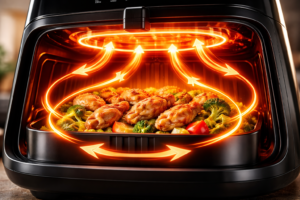
Air fryers entered domestic kitchens as a response to changing expectations around convenience, energy use, and food texture. Their early appeal rested on a simple idea: circulating hot air at high speed could replicate some effects of deep frying while using little or no oil. As adoption increased, so did scrutiny. Users reported uneven browning, extended preheating cycles, and surface dryness in certain foods. These recurring observations prompted manufacturers to experiment with alternative heat-transfer strategies, leading to the emergence of the infrared heating air fryer.
Infrared air fryer technology does not replace convection; it supplements it. By adding radiant heat to forced air circulation, an air fryer with infrared heating alters how energy reaches food surfaces, how quickly cooking begins, and how moisture behaves during cooking. The benefits attributed to this approach are often framed in promotional terms. This analysis examines those benefits through the lens of physics, food science, and measured performance rather than branding language.
Infrared Heating as a Cooking Method
Infrared radiation occupies a region of the electromagnetic spectrum between visible light and microwaves. The U.S. National Aeronautics and Space Administration defines infrared radiation as “electromagnetic radiation with longer wavelengths than visible light, extending from the nominal red edge of the visible spectrum at about 0.7 micrometers to 1 millimeter.” When absorbed by matter, this radiation converts directly into heat.
In food systems, infrared heating differs from convection by eliminating air as the primary intermediary. A technical overview published by ScienceDirect describes infrared heating as a process that “transfers heat by electromagnetic waves directly to the product surface without the need for a heating medium.” This direct transfer underpins most of the claimed infrared air fryer benefits.
Faster Onset of Cooking
One of the most measurable benefits of infrared heating in air fryers is reduced delay between activation and effective cooking. Traditional air fryers must raise the temperature of the internal air and chamber walls before food receives consistent heat. Although faster than full-size ovens, this process remains sequential.
Infrared emitters behave differently. Once energized, they radiate heat almost immediately. Research on infrared food processing consistently identifies instant heating through direct heat transfer as a defining characteristic. In an infrared hot air fryer, food begins absorbing radiant energy as soon as emitters activate, rather than waiting for air temperature stabilization.
In daily use, this shortens the interval between appliance start and surface browning. While total cook time for thick foods may remain similar, the initial thermal response is faster.
Improved Surface Browning
Surface browning remains one of the most frequently cited motivations for adopting an infrared cooking air fryer. Browning reactions, primarily the Maillard reaction, depend on surface temperature and moisture conditions. In convection systems, evaporative cooling can limit surface temperature even when air temperature is high.
Infrared radiation raises surface temperature directly. The Institute of Culinary Education explains that infrared cooking “heats the exterior of food quickly, which can improve browning while limiting overcooking of the interior.” This effect has long been used in industrial food processing to enhance color development on baked goods, roasted vegetables, and proteins.
Within an infrared convection air fryer, radiant heat reduces reliance on airflow uniformity. Foods receive surface energy even when air circulation is partially obstructed, decreasing the need for frequent shaking or repositioning.
Greater Uniformity of Surface Heat
Traditional air fryers depend on turbulent airflow to distribute heat. When baskets are crowded or food pieces overlap, airflow patterns become uneven, producing localized hot and cool zones.
Infrared radiation travels in straight lines and delivers energy to exposed surfaces independent of air movement. This property improves surface heat consistency when food is arranged within the emitter’s field. Scientific literature on infrared food heating highlights uniform heating as one of its operational strengths when systems are properly designed.
Reduced Preheating Dependency
Preheating serves to stabilize cooking conditions. Infrared heating reduces dependency on this step. Since radiant energy heats food directly, cooking can begin before air temperature reaches its set point.
This behavior aligns with findings in food engineering, where infrared systems are used to shorten processing cycles. In domestic contexts, it translates into practical time savings, particularly for foods where surface reactions drive quality outcomes.
Energy Transfer Efficiency
Energy efficiency represents another benefit associated with infrared air fryer technology. Conventional air fryers already demonstrate efficiency gains over ovens. An analysis by GreenMatch reports that air fryers use less electricity than a conventional oven for similar cooking tasks.
Infrared heating modifies how energy is allocated. Radiant heat targets food surfaces directly, reducing energy spent heating unused air volume. A review in the journal Foods notes that infrared heating can reduce energy consumption by shortening heating periods and improving heat transfer efficiency in food applications.
In household use, this can lower energy demand per cooking cycle, although total savings depend on appliance insulation, emitter control, and cooking patterns.
Moisture Retention and Texture Balance
Moisture management shapes perceived food quality. Continuous exposure to hot air accelerates evaporation, which can dry surfaces prematurely. Infrared heating concentrates energy at the surface while potentially reducing exposure time.
Food science research supports this mechanism. Findings published in Foods report that infrared heating allows better control of surface moisture loss compared to conventional hot air drying. In practical terms, this can produce crisp exteriors while limiting internal moisture loss.
Shorter Processing Time in Some Applications
In industrial food processing, infrared heating is used to shorten drying and roasting stages. The same principle applies on a smaller scale in an infrared heating air fryer.
Shorter processing time does not always mean shorter total cook time. Internal doneness still depends on conduction and convection. Yet surface reactions reach target states sooner, which can allow earlier removal in foods where interior cooking is less critical.
Reduced Reliance on Mechanical Intervention
Traditional air fryers often require manual shaking or turning to achieve even results. Infrared radiation reduces dependence on such intervention by providing surface energy that does not rely entirely on air movement.
This does not eliminate the need for repositioning in all cases. Dense loading still blocks radiant paths. Still, moderate loads benefit from more consistent surface exposure.
Stability of Cooking Outcomes
Cooking stability refers to repeatability across cycles. Infrared systems, when paired with proper control electronics, offer stable radiant output. Once calibrated, emitters deliver predictable energy profiles.
Modern infrared convection air fryer models use temperature sensors and microcontrollers to balance radiant and convective heat. When design quality is high, results remain consistent across batches.
Limitations That Frame the Benefits
Understanding benefits requires acknowledging limits. Infrared radiation penetrates only a short distance into food. Infrared energy is absorbed at the surface and converted to heat, which then conducts inward. This physical constraint means infrared heating cannot replace convection or conduction for internal cooking.
Benefits appear most clearly at the surface level. Interior cooking behavior remains similar to that of traditional air fryers once surface conditions equalize.
Alignment With Existing Cooking Habits
The benefits of infrared air fryer technology align well with existing cooking habits. Users seeking crisp textures, reduced wait times, and consistent browning gain the most. Those focused on large batch cooking or thick cuts see smaller differences.
This alignment explains why infrared heating air fryer reviews vary widely. Benefits depend on how closely usage patterns match the strengths of radiant heating.
Perspective From Food Engineering History
Infrared heating is not a recent innovation. Its use in food processing dates back decades, particularly in drying, roasting, and surface pasteurization. The transfer of this method into domestic appliances reflects miniaturization and improved control electronics rather than a novel scientific principle.
Evaluating the Best Claims
Claims around the best infrared heating air fryer often focus on speed, texture, and efficiency. Physics and food science support many of these claims in constrained contexts. At the same time, no single design outperforms others across all tasks.
Final Considerations
The benefits of infrared heating in air fryers stem from how radiant energy alters surface heat transfer. Faster onset of cooking, improved browning consistency, moderated moisture loss, and reduced dependence on airflow uniformity all follow from well-documented physical principles.
Infrared air fryer technology does not redefine air frying. It refines it by addressing specific limitations of convection-only systems. Internal cooking dynamics remain governed by conduction and air movement, while surface outcomes benefit most from radiant input.
An infrared heating air fryer offers tangible advantages when expectations align with physics rather than marketing. Its benefits are real, measurable, and bounded, shaped by how infrared energy behaves when confined to a compact cooking chamber alongside forced hot air circulation.